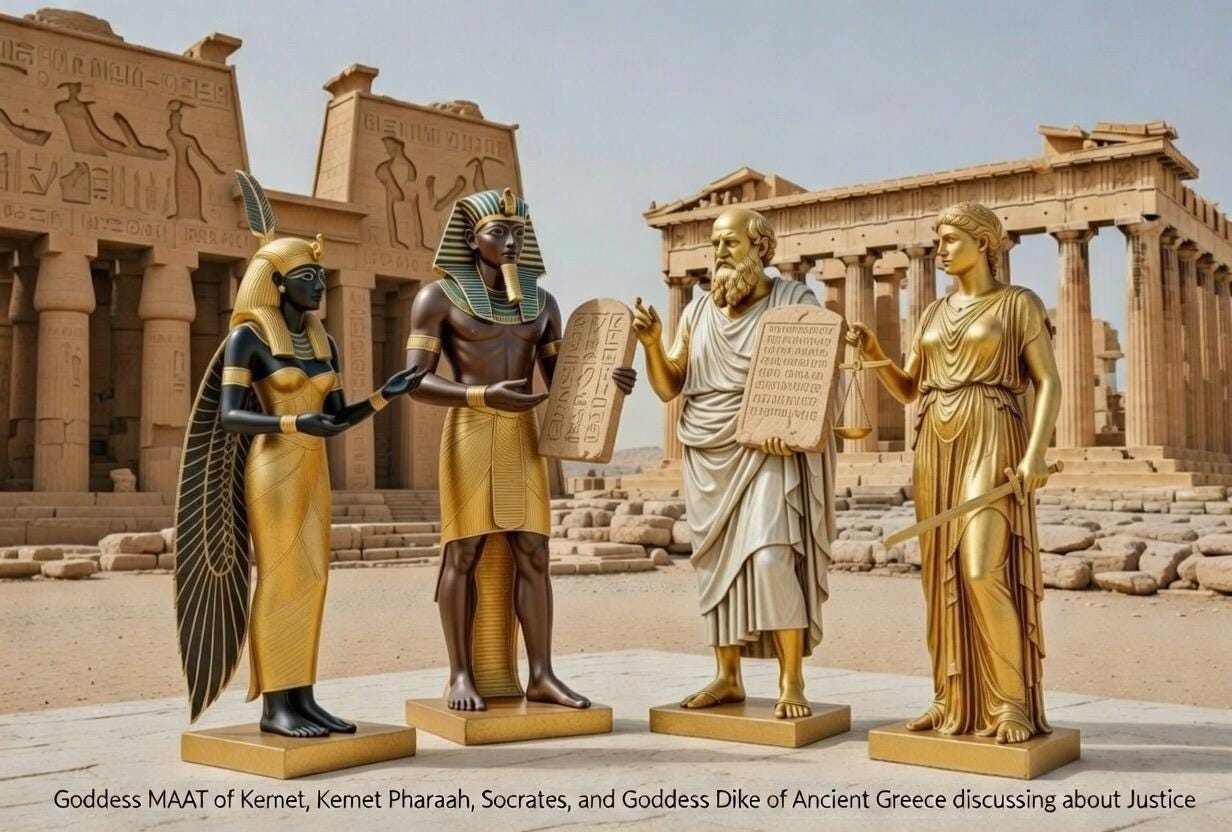
Kemet and Ancient Greece Contributions in the Foundation of Mathematics, Science and Engineering
Kemet Meeting Ancient Greece
Kemet and Ancient Greece Contributions in the Foundation of Mathematics, Science and Engineering

Kemet Meeting Ancient Greece
Abstract
This work examines the contributions of Kemet (Ancient Egypt) and ancient Greece to the foundations of mathematics, science, and engineering. It highlights Greek achievements in deductive reasoning, axiomatic geometry (e.g., Euclid, Archimedes), empirical biology (Aristotle), and mechanical devices (e.g., Antikythera mechanism), while arguing these built on earlier empirical-inductive knowledge from Kemet, particularly empirical geometry for surveying after Nile floods. Ancient Greek sources (Herodotus, Diodorus Siculus, Proclus) explicitly credit Egypt with originating geometry and related principles through systematic observation and experience. The text critiques modern views that dismiss Egyptian methods as non-scientific “practical” knowledge, asserting empirical induction produces abstraction and theory equivalent to deduction. It extends parallels to other civilizations’ inductive approaches and integrates both strands as essential to modern scientific methodology (empirical data and deductive rigor).
The study also places Egyptian contributions within a broader global context by comparing empirical scientific traditions in Mesopotamia, India, China, and the Maya civilization. Ultimately, the paper argues that modern science is built upon a synthesis of two complementary traditions: empirical induction and deductive reasoning. Recognizing the contributions of both Kemet and Ancient Greece provides a more balanced and historically accurate understanding of the development of scientific knowledge.
Keywords: Kemet (Ancient Egypt), ancient Greece, mathematics, geometry, empirical-inductive methods, deductive reasoning, Herodotus, Diodorus Siculus, Proclus, Nile floods, Rhind Papyrus, scientific methodology, Afrocentric historiography critique, Maat, Aristotle, Leonardo da Vinci, Maya astronomy, Babylonian mathematics, Ancient Civilizations and Science, Mathematical Papyrus, Knowledge Transmission in Antiquity.
Introduction
The ancient world witnessed profound developments in mathematics, science, and engineering, with ancient Greece often celebrated for shifting toward abstract, deductive reasoning and systematic proof (e.g., Thales’ deductive geometry, Euclid’s Elements, Archimedes’ exhaustion methods approximating π and volumes). These advancements, spanning the 6th century BCE to the Hellenistic period, built foundational elements of Western science. However, Greek sources themselves acknowledge significant debt to earlier traditions, particularly from Kemet (Ancient Egypt), where practical geometry and measurement arose from empirical responses to environmental challenges like annual Nile inundations requiring land re-surveying.
Testimonies from Herodotus, Diodorus Siculus, and Proclus (citing Eudemus) describe Egyptian knowledge as grounded in repeated observation, iterative refinement, and principle derivation — methods portrayed as legitimate scientific discovery. This work argues that Kemet’s empirical-inductive approach provided the observational base for Greek deductive extensions, forming a complementary continuum essential to science. It critiques modern tendencies to diminish Egyptian contributions as “merely practical” and explores parallels in other civilizations, emphasizing both inductive and deductive methods as interdependent in knowledge production.
The foundations of mathematics, science, and engineering emerged from the intellectual developments of several ancient civilizations. Among the most influential were Kemet (Ancient Egypt) and Ancient Greece, whose contributions shaped the trajectory of scientific thought. Egyptian mathematical knowledge developed primarily through empirical observation and practical problem-solving related to land surveying, construction, and administration. Surviving sources such as the Rhind Mathematical Papyrus and the Moscow Mathematical Papyrus demonstrate that Egyptian scholars employed systematic procedures to calculate areas, volumes, and proportions, often in response to environmental challenges such as the annual flooding of the Nile.
Ancient Greek authors themselves acknowledged these Egyptian contributions. Herodotus reported that geometry originated in Egypt from the need to measure land after Nile inundations erased property boundaries. Later writers, including Proclus and Diodorus Siculus, echoed similar accounts, stating that Egyptians had discovered fundamental principles of geometry through practical experience and observation. According to these testimonies, Greek thinkers later adopted this knowledge and transformed it through deductive reasoning and theoretical abstraction.
Greek mathematicians such as Thales, Pythagoras, Euclid, and Archimedes advanced mathematical thought by emphasizing logical proof, axiomatic systems, and universal principles. While the Greeks are often credited with formalizing mathematics and science, their work built upon earlier empirical traditions. The interaction between Egyptian empirical methods and Greek deductive reasoning contributed significantly to the development of systematic scientific inquiry.
This study explores the complementary roles of Kemet and Ancient Greece in the formation of scientific knowledge, highlighting how empirical observation and theoretical abstraction together formed the foundations of modern scientific methodology.
Methodology
The analysis draws primarily from ancient textual sources and surviving artifacts. Greek testimonies serve as key evidence: Herodotus’ **Histories (Book II) links geometry’s origin to Egyptian land measurement post-Nile floods; Diodorus Siculus’ Library of History (Book I) credits Egyptians with discovering geometry’s principles through experiential observation and “scientific” dispute resolution; Proclus’ *Commentary on Euclid’*s Elements (citing Eudemus) describes Egyptians possessing theorems from utility and long experience, with Greeks (e.g., Thales) later adding theoretical demonstrations.
Egyptian evidence includes mathematical papyri (Rhind ~1550 BCE: areas, volumes, false-position algebra, π approximation; Moscow ~1850 BCE: truncated pyramid volume) and medical texts (Edwin Smith Papyrus: systematic case-based diagnosis/prognosis/treatment). Archaeological validation comes from monumental precision (Giza pyramids’ alignments, leveling) and devices (Antikythera mechanism as applied Hellenistic science).
This study employs a historical and textual analysis approach to examine the origins of mathematical and scientific knowledge in Kemet and Ancient Greece. The methodology relies on three primary forms of evidence.
Analysis of Ancient Greek Literary Testimonies: Primary historical sources written by Greek authors — including Herodotus, Proclus, and Diodorus Siculus — are examined to identify references to Egyptian scientific knowledge. These texts provide descriptions of Egyptian geometry, astronomy, and methods of knowledge acquisition, as well as testimonies acknowledging the influence of Egyptian learning on Greek scholars.
Examination of Archaeological and Documentary Evidence: Surviving Egyptian mathematical documents such as the Rhind Mathematical Papyrus and the Moscow Mathematical Papyrus are analyzed as evidence of early mathematical practice. These documents contain problems related to measurement, geometry, and engineering, demonstrating the empirical techniques used in Egyptian mathematics.
Comparative Historical Analysis: The study compares Egyptian and Greek scientific approaches with those of other ancient civilizations — including Mesopotamia, India, China, and the Maya — to highlight broader patterns of empirical knowledge development and mathematical innovation. This comparative approach helps contextualize the evolution of scientific reasoning across different cultural traditions.
Through these methods, the research reconstructs the historical relationship between empirical observation and deductive reasoning in the development of early science.
The approach critiques modern historiography for imposing binaries (practical vs. theoretical, empirical as inferior) inconsistent with primary sources, which affirm Egyptian empirical rigor as principled. Parallels are drawn from other civilizations’ inductive systems (Babylonian quadratics, Indian Sulba Sutras, Chinese Nine Chapters, Maya vigesimal zero/astronomy). Philosophical integration references Aristotle’s inductive-deductive biology, Leonardo da Vinci’s empirical dissections, and modern hypothetico-deductive models (induction generates hypotheses; deduction tests them). Credibility of Greek accounts is supported by their balanced criticism of Egyptian customs alongside praise for knowledge.
This study aimes at providing the testimonies of Ancient Greeks as the factual evidence about what was the lost Kemet science. It doesn’t interprete this evidence. It provides an analysis on the evidence for what it is: strong first hand rigourous observation and epystemological analysis of the lost Kemet science.
0. 0. Historical Context
0. 1. The Kemet Origin of Geometry and Early Scientific Practices
Ancient Greek authors frequently attributed the origins of geometry and certain scientific practices to Kemet, known today as Ancient Egypt. Several classical testimonies describe Egyptian knowledge systems rooted in empirical observation, measurement, and institutional learning associated with temple priesthoods.
One of the earliest testimonies comes from Herodotus in Histories (Book II), written in the 5th century BCE. Herodotus reports that geometry emerged in Egypt from the practical necessity of measuring agricultural land after the annual inundation of the Nile River. According to his account, floodwaters erased property boundaries, requiring systematic methods of land measurement. Herodotus explicitly states that the practice later passed from Egypt to Greece. Although modern historians recognize that his narrative combines observation and priestly explanations, it remains one of the earliest written references connecting Egyptian land surveying to the development of geometric reasoning.
A similar claim appears in the first century BCE work Bibliotheca Historica by Diodorus Siculus. Diodorus states that the Egyptians “discovered geometry” due to the environmental and administrative demands created by the Nile floods. He further attributes to Egypt developments in arithmetic, astronomy, and calendrical science. Later philosophical writers reinforced this tradition. In his commentary on Euclid, the Neoplatonist philosopher Proclus wrote that geometry originated in Egypt and was later systematized in Greece into theoretical form.
Archaeological discoveries have strengthened the plausibility of these accounts. Egyptian mathematical papyri demonstrate that structured mathematical knowledge existed in Egypt centuries before the flourishing of Greek mathematics. Among the most significant sources are the Rhind Mathematical Papyrus (c. 1650 BCE) and the Moscow Mathematical Papyrus (c. 1850 BCE). These documents contain dozens of mathematical problems involving area calculations, fractions, geometric volumes, and algorithmic procedures for solving quantitative problems. The Rhind Papyrus, for example, includes methods for determining the area of circles and fields, while the Moscow Papyrus contains problems involving the volume of truncated pyramids.
Historians of mathematics such as Otto Neugebauer and Richard Gillings have emphasized that these texts demonstrate systematic reasoning rather than ad hoc calculation. Egyptian mathematical problems often follow a structured format consisting of problem statement, method, and verification. This procedural logic suggests a form of mathematical generalization based on empirical observation and repeated practice.
Beyond mathematics, Egyptian civilization developed sophisticated knowledge in astronomy, medicine, engineering, and architecture. Monumental structures such as pyramids and temples required precise measurement systems and astronomical orientation. Egyptian medical papyri, including the Edwin Smith Papyrus, demonstrate diagnostic reasoning and surgical knowledge based on observation of symptoms.
Taken together, classical Greek testimonies and archaeological evidence suggest that Egypt possessed highly developed empirical knowledge traditions long before the emergence of formalized Greek mathematics. While Greek mathematicians later developed deductive geometry, the historical record indicates that earlier civilizations such as Egypt provided important foundations in measurement, calculation, and observational science.
0. 2. The Origin of the “Practical vs. Theoretical” Comparison Between Kemetian and Greek Science
The common distinction between “practical Egyptian science” and “theoretical Greek science” did not originate in antiquity but emerged largely during nineteenth-century European scholarship on the history of mathematics. Early historians attempted to construct a developmental narrative explaining the emergence of modern scientific rationality, and within this framework Greek mathematics was often interpreted as the decisive intellectual breakthrough.
One of the most influential figures in shaping this narrative was the German historian of mathematics Moritz Cantor. In his monumental multi-volume work Vorlesungen über Geschichte der Mathematik (Lectures on the History of Mathematics), Cantor argued that Egyptian and Mesopotamian mathematics consisted mainly of practical techniques used in administration, engineering, and commerce. By contrast, he viewed Greek mathematics as introducing deductive reasoning and systematic proof, particularly in the works of Euclid and later mathematicians.
Another influential scholar was the British classicist Thomas Heath, whose translations of Greek mathematical texts in the late nineteenth and early twentieth centuries reinforced this perspective. Heath’s studies of Euclid and Archimedes emphasized the formal structure of Greek geometry, which was built upon definitions, axioms, and logical proofs. Because such structures resemble modern mathematical practice, Greek mathematics was often interpreted as the origin of “true” scientific reasoning.
Several historical circumstances contributed to this interpretive framework. First, when nineteenth-century historians began writing histories of mathematics, few Egyptian mathematical texts were known or fully translated. The discovery and publication of the Rhind Mathematical Papyrus and other papyri occurred gradually during the late nineteenth century. As a result, scholars initially relied heavily on surviving Greek mathematical literature, which naturally emphasized deductive methods.
Second, European intellectual culture of the period strongly admired classical Greek philosophy and logic. Greek thinkers such as Aristotle were regarded as foundational figures in the development of Western rational thought. This admiration encouraged narratives portraying Greece as the birthplace of systematic science.
Finally, the stylistic differences between Egyptian and Greek mathematical texts seemed to support such interpretations. Egyptian papyri generally present problems and procedural solutions without formal axioms or proofs. Greek mathematical works, by contrast, often emphasize deductive demonstrations. Early historians interpreted these stylistic differences as evidence of a qualitative intellectual transformation.
However, many modern scholars argue that this distinction oversimplifies the historical situation. Egyptian mathematics employed algorithmic reasoning, general methods, and verification procedures that indicate systematic thinking. The characterization of Egyptian science as merely “practical” may therefore reflect historiographical bias rather than an accurate description of intellectual sophistication.
Today historians increasingly view ancient mathematics as consisting of different traditions of reasoning rather than a simple hierarchy between practical and theoretical knowledge.
0. 3. Why Modern Historians Believe Egyptian Influence on Greece Was Greater Than Previously Recognized
In recent decades historians of science have increasingly reconsidered the extent to which early Greek intellectual traditions were influenced by older civilizations, particularly Egypt and Mesopotamia. This reassessment has emerged from several developments in archaeology, philology, and the comparative study of ancient scientific texts.
One factor has been the growing recognition of extensive cultural contact between Greece and Egypt during the early first millennium BCE. Greek merchants, soldiers, and settlers were present in Egypt, especially in the trading city of Naucratis, which was established in the seventh century BCE. This city functioned as a hub of commercial and cultural exchange between Greek and Egyptian societies. Such interactions created opportunities for the transmission of knowledge in fields such as astronomy, engineering, and mathematics.
Ancient literary sources also preserve traditions that Greek intellectual figures traveled to Egypt to study with Egyptian priests. Writers including Herodotus, Diodorus Siculus, and the philosopher Iamblichus report that several early Greek thinkers spent time in Egypt. These traditions involve figures such as Thales of Miletus, Pythagoras, and Eudoxus of Cnidus. While historians debate the historical details of these accounts, they demonstrate that Greeks themselves believed Egyptian learning played a role in the development of Greek intellectual traditions.
Archaeological discoveries have also reshaped scholarly understanding. Mathematical papyri such as the Rhind Mathematical Papyrus and the Moscow Mathematical Papyrus reveal a sophisticated mathematical culture centuries before the rise of classical Greek mathematics. Similarly, Babylonian cuneiform tablets show advanced numerical and algebraic techniques. Historians now recognize that Greek mathematicians were not working in an intellectual vacuum but within a broader ancient Near Eastern environment rich in mathematical traditions.
Scholars such as Otto Neugebauer, Reviel Netz, and Jens Høyrup have argued that Greek mathematics should be understood within this wider network of knowledge exchange. Greek mathematicians made distinctive contributions — particularly the development of formal proof — but these contributions may have built upon earlier empirical and computational traditions encountered through intercultural contact.
Consequently, many modern historians emphasize a multicivilizational model of the origins of science. In this view, Egyptian, Mesopotamian, and Greek traditions each contributed different elements to the development of mathematical and scientific knowledge. Egyptian traditions emphasized measurement, engineering, and observational practice; Mesopotamian traditions developed sophisticated numerical methods; and Greek mathematicians introduced systematic deductive structures.
This broader perspective does not diminish Greek achievements but situates them within a larger historical continuum of knowledge transmission across the ancient Mediterranean world.
1.0. Science, math & Engineering in Ancient Greece
The ancient Greeks made profound contributions to mathematics, science, engineering, and technology from roughly the 6th century BCE through the Hellenistic period (ending around the 1st century BCE). Their work shifted from practical, empirical knowledge inherited from Egyptian and Babylonian traditions to abstract, deductive reasoning and systematic inquiry. This intellectual revolution emphasized proof, logic, and the pursuit of universal principles, laying foundational elements for Western science and technology.
1. 1. Mathematics
Greek mathematics emphasized geometry as a model of deductive reasoning, prioritizing rigorous proofs over computation. Thales of Miletus (c. 624–546 BCE) introduced deductive geometry, proving theorems like the angles in a semicircle being right angles. Pythagoras (c. 570–495 BCE) and his school linked numbers to philosophy, discovering the Pythagorean theorem (a² + b² = c² for right triangles) and exploring number theory, harmonics, and irrational numbers (e.g., √2). Euclid (c. 300 BCE) compiled The Elements, a 13-book axiomatic treatise systematizing plane and solid geometry, number theory, and proportions. It served as the standard geometry text for over 2,000 years. Archimedes (c. 287–212 BCE) advanced geometry with methods approximating π (between 3 1/7 and 3 10/71), calculating areas/volumes via exhaustion (prefiguring integral calculus), and studying conic sections and spheres.
Historical evidence includes surviving manuscripts (Byzantine copies and Arabic translations) of Euclid’s Elements and Archimedes’ works (e.g., recovered via the Archimedes Palimpsest, a 10th-century parchment overwritten but revealed by modern imaging). No original autographs survive, but consistency across copies and references by later authors (e.g., Pappus, Proclus) confirm authenticity.
1. 2. Science
Greek science transitioned toward natural explanations, observation, and theory. Pre-Socratics like Thales proposed water as the fundamental substance, while Aristotle (384–322 BCE) developed biology (classifying animals), physics (motion, elements: earth, water, air, fire), and empirical methods. Hellenistic astronomers like Hipparchus advanced trigonometry and star catalogs. The Antikythera mechanism exemplifies applied science: a geared astronomical computer (c. 150–100 BCE) predicting solar/lunar positions, eclipses, and planetary motions using Babylonian cycles and epicyclic gearing.
Archaeological evidence for the Antikythera mechanism is robust: discovered in 1901 in a shipwreck off Antikythera island (dated ~70–60 BCE), it comprises 82 bronze fragments with over 30 gears. X-ray tomography (2005) and reconstructions reveal inscriptions and functions. Scholarly analyses confirm its sophistication, unmatched until medieval clocks.
1. 3. Engineering and Technology
Greeks excelled in mechanics and practical devices. Archimedes invented the screw pump (for irrigation/ship bilge drainage), compound pulleys, and war machines (e.g., claw for Syracuse defense). Heron of Alexandria (c. 10–70 CE) described steam-powered aeolipile (reaction turbine prototype), vending machines, automatic doors, and pneumatics/hydraulics in Pneumatica and Automata. Other inventions include water mills, odometers, and surveying tools (dioptra).
Evidence includes textual descriptions (Heron’s treatises preserved in Byzantine/Arabic manuscripts) and physical artifacts like the Antikythera mechanism (direct proof of advanced gearing). Reconstructions validate functionality, though no originals of most devices survive due to perishable materials.
These achievements reflect a culture valuing inquiry, supported by institutions like Plato’s Academy and Alexandria’s Museum and Library. While influenced by earlier civilizations, Greeks formalized proof and abstraction.
2. 0. Testimonies from Ancient Greeks Declaring Kemet as the Origin of their Scientific Development
The ancient Greek sources provide direct testimonies acknowledging that their knowledge, particularly in mathematics (especially geometry) and related practical sciences originated from or were learned in Kemet.
2. 1. Greek Knowledge with Equivalents in Kemet Based on Greek Admissions and Surviving Egyptian Records
Ancient Greeks themselves stated that practical geometry had an equivalent and origin in Egypt. This aligns with surviving Egyptian physical and archaeological evidence, such as the Rhind Mathematical Papyrus (c. 1550 BCE, from the Second Intermediate Period, now in the British Museum) and the Moscow Mathematical Papyrus (c. 1850 BCE, Middle Kingdom), which contain problems on land measurement, area/volume calculations for fields, pyramids, and granaries — practical geometry applied to surveying after Nile floods, pyramid construction, and engineering.
Herodotus (Histories, Book II, c. 440 BCE) explicitly states that the Egyptians invented geometry for land measurement due to annual Nile inundations requiring re-surveying of fields to adjust taxes. He writes: “from this he [Sesostris] made his revenue… and if the river should take away anything… the king used to send men to examine and to find out by measurement how much less the piece of land had become… and I think that thus the art of geometry was found out and afterwards came into Hellas also.” (Histories II.109). This directly links Greek geometry to Egyptian practical surveying.
Egyptian records support this: tomb inscriptions, boundary stelae, and papyri show precise land surveys using ropes (harpedonaptai, “rope-stretchers”) for right angles and areas, predating Greek texts by centuries.
2. 2. Ancient Greek Testimonies Admitting Learning from Kemet
Several Greek authors explicitly credit Egypt as the source of specific knowledge, particularly geometry, astronomy, and related teachings, often stating that prominent Greeks studied there.
Herodotus (Histories II.109) credits Egyptians with originating geometry (as above) and notes that Greeks learned it from them. He also credits Egyptians (alongside Babylonians) with early astronomical divisions like the sundial, gnomon, and 12-hour day (II.109).
Diodorus Siculus (Library of History, Book I, 1st century BCE) reports Egyptian claims (from their priests’ records) that they discovered writing, star observation, geometry’s basic principles, and most arts. He lists Greeks who visited and learned there: Pythagoras learned geometrical propositions, number theory, and transmigration of souls from Egyptians; Democritus spent five years learning astrology; Eudoxus studied astrology; Oenopides learned the sun’s oblique orbit. Diodorus notes: “all the things for which they were admired among the Greeks were transferred from Egypt” (I.69–98, esp. sections on Pythagoras and others).
Proclus (Commentary on Euclid’s Elements, 5th century CE, citing earlier sources like Eudemus) states that geometry originated in Egypt for practical needs, and Thales, having visited Egypt, brought it to Greece and was the first to introduce deductive proofs.
Iamblichus (Life of Pythagoras, 3rd–4th century CE, drawing on earlier traditions) reports Pythagoras applied himself greatly to geometry among the Egyptians.
These Greek texts (Herodotus, Diodorus, Proclus, Iamblichus) preserve direct admissions that geometry (practical measurement and propositions) and aspects of astronomy/numbers were learned in Egypt. No surviving Greek source claims deductive axiomatic geometry (as in Euclid) originated there; Greeks state they advanced it theoretically.
Egyptian physical evidence includes:
- Rhind Papyrus: problems on slopes (seked), areas of circles/rectangles, pyramid volumes.
- Moscow Papyrus: truncated pyramid volume calculation.
- Archaeological sites: pyramid alignments and precise measurements (e.g., Giza pyramids show knowledge of π approximation and proportions).
No ancient Greek text claims origins in Kemet for abstract deductive proof systems, conic sections, or mechanical devices like those of Archimedes/Heron — these are presented as Greek developments.
Primary ancient sources referenced:
- Herodotus, Histories Book II (Loeb Classical Library edition).
- Diodorus Siculus, Library of History Book I (Loeb Classical Library).
- Proclus, A Commentary on the First Book of Euclid’s Elements (trans. Glenn R. Morrow).
- Iamblichus, Life of Pythagoras (various editions preserving earlier traditions). visited Egypt
3. 0. Ancient Greek Description of Kemet Science
3. 1. Scientific Knowledge in Kemet
Ancient Greek testimonies, as preserved in their texts, describe Egyptian (Kemet) knowledge of geometry as originating from and applied to practical purposes, such as land measurement due to Nile floods.
Herodotus (Histories, Book II.109, c. 440 BCE): “For this reason Egypt was cut up; and they said that this king distributed the land to all the Egyptians, giving an equal square portion to each man, and from this he made his revenue, having appointed them to pay a certain rent every year: and if the river should take away anything from any man’s portion, he would come to the king and declare that which had happened, and the king used to send men to examine and to find out by measurement how much less the piece of land had become, in order that for the future the man might pay less, in proportion to the rent appointed: and I think that thus the art of geometry was found out and afterwards came into Hellas also.”
Proclus (Commentary on Euclid’s Elements, Prologue I, 5th century CE, citing earlier sources like Eudemus): “According to most accounts, geometry was first discovered among the Egyptians, taking its origin from the measurement of areas. For they found it necessary by reason of the rising of the Nile, which wiped out everybody’s proper boundaries. Nor is there anything surprising in that the discovery both of this science and of the other sciences proceeded from utility, since everything that is in the process of becoming advances from the imperfect to the perfect.” 10 Proclus further states: “The theorems which are now called theoretical were formerly demonstrated for the sake of practical works… For the Egyptians had long since discovered the theorems about lines, and used them in measuring land… But Thales was the first to demonstrate them theoretically.”
Diodorus Siculus (Library of History, Book I.81, 1st century BCE): “Geometry and arithmetic are given special attention. For the river, by changing the face of the country each year in manifold ways, gives rise to many and varied disputes between neighbours over their boundary lines, and these disputes cannot be easily tested out with any exactness unless a geometer works out the truth scientifically by the application of his experience.” 20 Diodorus also notes: “Now it is maintained by the Egyptians that it was they who first discovered writing and the observation of the stars, who also discovered the basic principles of geometry and most of the arts.”
3. 2. Ancient Greek Description of Methods of Acquiring Knowledge in Kemet
Ancient Greek sources describe Egyptian (Kemet) knowledge, particularly in geometry, astronomy, and related fields, as arising from practical needs and direct observation of natural phenomena, such as the annual Nile floods requiring repeated land measurements.
Herodotus (Histories, Book II.109) states that geometry originated in Egypt due to the necessity of measuring land after the Nile’s inundations erased boundaries for taxation purposes. He writes that this practical requirement led to the invention of geometry, which was later transmitted to Greece. This portrays Egyptian knowledge as derived from empirical response to recurring environmental events (observation of flood patterns and boundary changes), not mere ignorance.
Proclus (Commentary on the First Book of Euclid’s Elements, Prologue, citing earlier traditions including Eudemus) explains that geometry was discovered among the Egyptians from the measurement of areas necessitated by the Nile’s rising, which obliterated land boundaries each year. He notes that the Egyptians long possessed theorems about lines and used them in land measurement based on observed utility, while Greeks like Thales later demonstrated them more theoretically.
Diodorus Siculus (Library of History, Book I.81) reports that Egyptians gave special attention to geometry and arithmetic because the river’s annual changes created disputes over boundaries, which could only be resolved scientifically through measurement and experience. He adds that Egyptians discovered the basic principles of geometry and most arts through such observations.
These Greek accounts present Egyptian knowledge as grounded in repeated empirical observation (of floods, land loss, celestial movements for astronomy) and accumulated experience to solve real-world problems, rather than as lacking understanding of underlying principles. Greeks contrast this with their own later shift toward more abstract, deductive approaches, but they do not depict Egyptians as ignorant of the principles informing their practices — such as accurate surveying, pyramid construction, or astronomical predictions — only as focused on utility derived from direct observation.
No ancient Greek testimony claims that Egyptians lacked awareness of scientific principles in their applied knowledge; instead, the sources credit them with foundational discoveries through practical, observational methods.
3. 3. Ancient Greek Testimonies on Origin and Application of Knowledge in Kemet
The Ancient Greek sources describe Kemet knowledge — particularly geometry — as emerging from practical needs driven by empirical observation, repeated experimentation in response to environmental conditions (like Nile floods), and accumulated experience in measurement and application. These accounts do not state or imply that Egyptians were incapable of theorizing, abstracting, or understanding underlying principles from their observations and practices.
Key testimonies focus on the origin and application of geometry in practical contexts, without denying Egyptians’ grasp of principles.
Herodotus (Histories II.109) attributes the invention of geometry to the repeated necessity of measuring land after Nile inundations, describing it as a response to observable boundary changes for taxation. He presents this as a process of discovery through direct observation of natural events, not as lacking insight into measurement principles.
Proclus (Commentary on Euclid’s Elements, Prologue, drawing on Eudemus and others) states that geometry originated among Egyptians from area measurement required by the Nile’s rising, which erased boundaries annually. He notes Egyptians possessed theorems about lines and applied them in land measurement based on utility and experience. He contrasts this with later Greek developments (e.g., Thales introducing demonstrations “theoretically”), but does not claim Egyptians lacked abstraction or principles — only that their focus was on practical theorems derived from observation.
Diodorus Siculus (Library of History I.81) explains that Egyptians emphasized geometry and arithmetic because the river’s yearly changes caused boundary disputes resolvable only through scientific measurement using experience. He credits Egyptians with discovering the basic principles of geometry (and most arts) through such observations, portraying their knowledge as scientifically applied via empirical methods, not as devoid of principles.
These Greek texts consistently frame Egyptian geometry as rooted in empirical observation and practical experimentation (e.g., repeated surveying after floods, astronomical observations for calendars and predictions), leading to reliable techniques and principles for solving real problems. No preserved ancient Greek testimony asserts that Egyptians were unable to theorize, abstract general rules, or comprehend the principles behind their empirical methods — only that their documented contributions emphasized utility arising from direct, repeated observation of phenomena.
The sources present Greeks as building on and extending this foundation toward more abstract, deductive frameworks (e.g., axiomatic proofs in Euclid), but they credit Egyptians with foundational principles discovered empirically.
4. 0. Scientific Approaches and Methods in Kemet
4. 1. Ancient Greek Testimonies on Kemet Scientific Approaches and Methods
The testimonies from ancient Greek authors portray Kemet knowledge — especially in geometry and related fields — as acquired through methods that align with what we recognize as scientific approaches: systematic observation of recurring natural phenomena, repeated empirical testing in response to real-world problems, and the accumulation of experience to develop reliable techniques and principles.
These Greek sources emphasize that Egyptian geometry arose from direct, repeated observation of the Nile’s annual floods, which erased land boundaries and necessitated precise re-measurement for taxation and dispute resolution. This process involved:
- Observing environmental changes (flood patterns, boundary loss).
- Applying measurement repeatedly to restore accuracy.
- Refining methods through accumulated experience to resolve practical issues scientifically.
Herodotus (Histories II.109): He describes geometry’s origin in Egypt as stemming from the king’s requirement to measure diminished land after floods, so taxes could be adjusted proportionally. This reflects a methodical, evidence-based response to observable natural events, leading to the art’s discovery and later transmission to Greece.
Proclus (Commentary on Euclid’s Elements, Prologue, citing earlier traditions): Geometry was discovered among Egyptians from the necessity of area measurement due to the Nile wiping out boundaries annually. Egyptians possessed theorems about lines and applied them through practical utility and experience, progressing from imperfect to more perfected knowledge via observation and need.
Diodorus Siculus (Library of History I.81): Egyptians devoted special attention to geometry and arithmetic because the river’s yearly changes caused boundary disputes that required a geometer to resolve them “scientifically by the application of his experience.” Disputes could not be settled exactly without this empirical, experiential approach, and arithmetic supported geometry’s principles.
These accounts credit Egyptians with developing foundational principles through empirical observation and practical experimentation (repeated surveying, measurement under consistent conditions like floods). The Greeks do not portray this as inferior or non-scientific; rather, they present it as a valid path to knowledge, one grounded in real phenomena and iterative refinement, from which Greeks later built more abstract, deductive frameworks.
No ancient Greek testimony dismisses Egyptian methods as unscientific or merely rote; instead, they are depicted as arising from careful, repeated scrutiny of nature to derive workable principles.
4. 2. Validity of Scientific Methods in Kemet
The testimonies from ancient Greek authors provide strong primary evidence that Egyptian (Kemet) knowledge in fields like geometry was acquired through rigorous, systematic processes of empirical observation, repeated testing against real-world conditions, and refinement based on accumulated experience — methods that align closely with foundational aspects of what is now recognized as scientific inquiry.
These Greek accounts explicitly credit Egyptians with developing reliable principles and techniques through direct, iterative engagement with observable phenomena (e.g., annual Nile floods erasing boundaries, necessitating precise re-measurement for taxation and dispute resolution). The sources portray this as a deliberate, evidence-based progression leading to effective, repeatable solutions, not as rote or unreflective practice. Direct passages in Ancient Greek works show such validity of scientific methods in Kemet.
Herodotus (Histories II.109): Geometry arose because the Nile’s inundations repeatedly altered land boundaries, requiring measurement to adjust taxes proportionally. This depicts a methodical response to observable, recurring natural events, with knowledge built through ongoing observation and application.
Proclus (Commentary on Euclid’s Elements, Prologue, citing Eudemus and earlier traditions): Egyptians discovered geometry from the necessity of measuring areas after the Nile annually obliterated boundaries. They possessed theorems about lines and applied them via utility, experience, and progression from imperfect to perfected understanding through observed needs — indicating empirical refinement and abstraction from practice.
Diodorus Siculus (Library of History I.81): Egyptians emphasized geometry and arithmetic due to the river’s yearly changes causing boundary disputes, resolvable only through scientific measurement using applied experience. Such disputes could not be settled exactly without a geometer’s empirical approach, and Egyptians discovered geometry’s basic principles through these observations.
These Greek testimonies do not describe Egyptian methods as lacking insight into principles; they present them as deriving from careful scrutiny of nature, repeated empirical validation, and experiential accumulation — core elements of scientific methodology. Greeks contrast this empirical foundation with their own later emphasis on abstract, deductive demonstration (e.g., axiomatic proofs), but they affirm the validity and sophistication of the Egyptian approach as a legitimate path to knowledge.
Modern interpretations that frame Egyptian knowledge as merely “practical” (implying non-scientific, rule-of-thumb, or lacking theoretical depth) often stem from later scholarly contrasts emphasizing Greek deduction as the hallmark of “true” science. However, the ancient Greek sources themselves do not support such a diminishment; they credit Egyptians with principled, observation-driven discovery that informed subsequent Greek advancements. The primary texts thus contradict any reading that denies the scientific character of Egyptian empirical methods.
4. 3. Empirical Methods as the Foundation of Science in Kemet
The ancient Greek testimonies preserved in surviving texts provide direct evidence that Kemet knowledge, particularly in geometry, astronomy, and related fields, was acquired through rigorous empirical methods: systematic observation of natural phenomena, repeated measurement in response to recurring environmental challenges (such as the annual Nile inundations), and refinement of techniques based on accumulated experience. These accounts portray Egyptian science as grounded in direct engagement with observable reality, leading to the discovery and application of reliable principles — methods that align with foundational aspects of scientific inquiry.
Herodotus (c. 484–425 BCE), in his Histories (Book II.109), explicitly links the origin of geometry to Egyptian empirical practices: “For this reason Egypt was cut up; and they said that this king distributed the land to all the Egyptians, giving an equal square portion to each man, and from this he made his revenue, having appointed them to pay a certain rent every year: and if the river should take away anything from any man’s portion, he would come to the king and declare that which had happened, and the king used to send men to examine and to find out by measurement how much less the piece of land had become, in order that for the future the man might pay less, in proportion to the rent appointed: and I think that thus the art of geometry was found out and afterwards came into Hellas also.” Herodotus describes a process driven by repeated observation of the Nile’s floods erasing boundaries, necessitating iterative measurement and adjustment — empirical response to natural cycles yielding systematic knowledge.
Proclus (412–485 CE), in his Commentary on the First Book of Euclid’s Elements (Prologue, drawing on earlier sources including Eudemus of Rhodes, c. 4th century BCE), elaborates: “According to most accounts, geometry was first discovered among the Egyptians, taking its origin from the measurement of areas. For they found it necessary by reason of the rising of the Nile, which wiped out everybody’s proper boundaries. Nor is there anything surprising in that the discovery both of this science and of the other sciences proceeded from utility, since everything that is in the process of becoming advances from the imperfect to the perfect… The theorems which are now called theoretical were formerly demonstrated for the sake of practical works… For the Egyptians had long since discovered the theorems about lines, and used them in measuring land… But Thales was the first to demonstrate them theoretically.”
Proclus credits Egyptians with possessing theorems derived from long-term empirical application and experience, progressing toward perfected understanding through observed utility — contrasting this with later Greek theoretical demonstrations while affirming the empirical foundation.
Diodorus Siculus (1st century BCE), in his Library of History (Book I.81), reports: “Geometry and arithmetic are given special attention. For the river, by changing the face of the country each year in manifold ways, gives rise to many and varied disputes between neighbours over their boundary lines, and these disputes cannot be easily tested out with any exactness unless a geometer works out the truth scientifically by the application of his experience… Now it is maintained by the Egyptians that it was they who first discovered writing and the observation of the stars, who also discovered the basic principles of geometry and most of the arts… And arithmetic is serviceable with reference to the business affairs connected with making a living and also in applying the principles of geometry, and likewise is of no small assistance to students of astrology as well. For the positions and arrangements of the stars as well as their motions have always been the subject of careful observation among the Egyptians, if anywhere in the world; they have preserved to this day the records concerning each of these stars over an incredible number of years…”
Diodorus emphasizes “careful observation,” long-term record-keeping of celestial motions, and “scientific” resolution of disputes through experiential measurement — portraying Egyptian astronomy and geometry as built on sustained empirical scrutiny and preserved data.
These Greek testimonies collectively depict Egyptian science as empirical at its core: knowledge emerged from observing recurring phenomena (floods, stellar positions), testing through repeated application, and deriving principles from accumulated evidence. Greeks admired this approach as a legitimate path to discovery, crediting Egyptians with foundational principles while noting their own later emphasis on abstract deduction and axiomatic proof (e.g., in Euclid).
Both methodologies remain foundational to modern science. Empirical observation, data accumulation, and iterative refinement — hallmarks of Egyptian methods as described — underpin the experimental method central to contemporary research (e.g., hypothesis testing via repeated trials, long-term data collection in fields like astronomy or climatology). Greek deductive reasoning, building on empirical foundations to create general theories and proofs, forms the basis of mathematical modeling, logical inference, and theoretical frameworks in physics, biology, and engineering. Modern science integrates both: empirical evidence validates hypotheses, while deductive logic derives predictions and unifies observations — echoing the progression from Egyptian utility-driven observation to Greek theoretical systematization.
These ancient accounts thus reveal a continuum: Egyptian empirical rigor provided the observational base, Greek abstraction extended it deductively, and together they laid enduring groundwork for scientific progress.
4. 4. Modern Interpretation of Empirical Methods as ‘’Practical’’
The modern historiography that dismisses or downplays the development of advanced science in ancient Kemet by labeling its knowledge as merely “practical” (implying rule-of-thumb, non-theoretical, or lacking scientific rigor) often relies on a selective or reductive reading of ancient Greek testimonies. This approach frequently contrasts Egyptian empirical methods with later Greek deductive abstraction, framing the former as proto-scientific or technological rather than truly scientific. Such interpretations can be critiqued as inconsistent with the primary Greek sources themselves, which portray Egyptian knowledge acquisition as systematic, observation-driven, iterative, and principle-deriving — core features of scientific methodology.
Ancient Greek authors, including Herodotus, Proclus (citing Eudemus), and Diodorus Siculus, consistently describe Egyptian geometry and related fields as emerging from rigorous empirical processes:
- Repeated, systematic observation of natural phenomena (e.g., annual Nile inundations erasing land boundaries, requiring precise re-measurement for taxation and dispute resolution).
- Iterative application and refinement of measurement techniques based on accumulated experience.
- Derivation of reliable principles and theorems from these observations (e.g., theorems about lines used in land surveying).
Herodotus (Histories II.109) attributes geometry’s invention to this empirical necessity: repeated flood-induced boundary changes led to measurement adjustments, yielding the art through observable, recurring events.
Proclus (Commentary on Euclid’s Elements, Prologue) states Egyptians discovered geometry from area measurement after Nile boundary obliteration, possessed theorems about lines applied via utility and experience, and advanced from imperfect to perfected knowledge through observed needs — indicating empirical progression and abstraction from practice.
Diodorus Siculus (Library of History I.81) notes Egyptians emphasized geometry because river changes caused disputes resolvable only through “scientific” measurement using applied experience, crediting them with discovering geometry’s basic principles via careful, long-term observation (including stellar records preserved over immense periods).
These testimonies present Egyptian methods as evidence-based, experiential, and principled — not as ignorant of underlying rules but as deriving them from direct scrutiny of nature. Greeks viewed this as a foundational, valid path to knowledge, upon which they built deductive frameworks (e.g., axiomatic proofs). They do not demean it as unscientific; rather, they credit it with originating principles later extended theoretically.
Much modern historiography, particularly in histories of science and mathematics, interprets these same sources to support a binary: Egyptian knowledge as “practical and utility-driven” (empirical but non-theoretical) versus Greek as “theoretical and scientific” (deductive, abstract, proof-oriented). This framing often diminishes Egyptian contributions by implying they lacked hypothesis-testing, generalization, or principle abstraction — claims the Greek texts do not make. Instead, the sources depict empirical iteration leading to principles, aligning with modern scientific foundations (observation → data accumulation → refinement → generalization).
Critics of this historiographical tendency argue it reflects lingering Eurocentric biases, where “science” is narrowly defined by Greek-style deduction, sidelining empirical traditions as preparatory or inferior. The Greek testimonies contradict such dismissal by affirming Egyptian empirical rigor as scientific discovery. Modern science integrates both: empirical methods (observation, experimentation, long-term data) validate and ground hypotheses, while deductive logic derives predictions and theories — mirroring the Egyptian-to-Greek continuum described in the sources.
Thus, interpretations that discredit or marginalize Egyptian scientific development by overemphasizing “practical” as non-scientific often misalign with the ancient Greek evidence, which portrays Kemet’s methods as sophisticated, observation-based scientific inquiry foundational to later advancements. This selective emphasis risks undervaluing empirical science’s role, despite its enduring centrality in contemporary research.
What is pieced together from the actual Greek testimonies — Herodotus, Proclus (via Eudemus), Diodorus Siculus, and others — is pretty straightforward and clear:
- Ancient Greeks themselves repeatedly and explicitly credit Kemet (Egypt) with originating geometry and related knowledge.
- They describe the Egyptians developing that knowledge through systematic, repeated observation of natural phenomena (Nile floods erasing boundaries year after year), iterative measurement, long-term data accumulation (especially in astronomy), and experiential refinement of techniques until they produced reliable, workable principles and theorems.
- The Greeks call this process the discovery of geometry and basic principles of several arts/sciences. They present it as a legitimate, evidence-based path to knowledge — not as inferior “rule-of-thumb” technology, but as the very foundation from which they later built their own more abstract, deductive style.
- Nowhere do these Greek authors say “the Egyptians were merely practical and had no understanding of principles” or “they didn’t really do science.” Quite the opposite: they portray empirical rigor leading to principled knowledge.
When modern popular histories or certain textbooks insist that Egyptian mathematics and science were “only practical” (implying non-theoretical, non-scientific, lacking insight or abstraction), that framing is not coming from the ancient Greek witnesses themselves. It’s a later interpretive layer — often shaped by 19th- and 20th-century historiography that wanted to locate the “birth of real science” squarely in Greece and needed to downplay or reframe everything that came before.
By simply reading what the Greeks actually said (without forcing them into that later binary), we recover a much more accurate picture:
- Kemet → long-term empirical observation + iterative testing + principle derivation
- Greece → builds on that foundation + develops axiomatic-deductive demonstration
Both halves are still essential to how modern science actually works:
- Empirical observation, repeated experiments, massive long-term datasets → CERN, LIGO, climate models, genomics, exoplanet surveys
- Deductive logic, mathematical proof, theoretical unification → general relativity, quantum field theory, cryptographic algorithms, epidemiological modeling
The ancient Greeks didn’t “invent” science out of thin air; they stood on very solid empirical shoulders that they openly acknowledged. Pretending otherwise requires either ignoring or heavily reinterpreting the very authors (Herodotus, Diodorus, Proclus…) who are usually held up as the gold standard for classical testimony.
When someone tries to dismiss Kemet’s scientific contribution by saying “it was just practical engineering, not real science,” the quickest rebuttal is often just quoting the Greeks back at them. The primary sources are doing a lot of the debunking work against modern critiques against Kemet scientific knowledge.
4. 5. Credibility of Ancient Greek Testimonies on Kemet
The testimonies of ancient Greek writers about Kemet (ancient Egypt), particularly regarding its scientific knowledge (e.g., geometry’s origins in empirical land measurement after Nile floods), are trustworthy precisely because these authors were not engaging in naive idealization or uncritical admiration. Instead, their accounts reflect rigorous, evidence-based observation and analysis, combined with a willingness to criticize Egyptian customs when they found them strange, excessive, or contrary to Greek norms. This balanced approach — praising what they observed as admirable while openly critiquing what they deemed odd or inferior — demonstrates intellectual honesty and methodological care, making their positive assessments of Egyptian empirical science more credible.
4. 5. 1. Herodotus’ Balanced and Critical Approach (Histories, Book II, c. 440 BCE)
Herodotus, often called the “Father of History,” explicitly states his intent to report based on personal inquiry, eyewitness observation, and cross-checking with sources (e.g., Egyptian priests at Memphis, Heliopolis, and Thebes). He repeatedly qualifies his reports, distinguishes between what he saw, what priests told him, and what he judges plausible. Criticisms of Egyptian customs:
- He describes many Egyptian practices as deliberately opposite to those of other peoples (including Greeks), presenting them as bizarre or contrary to “the common practice of mankind.” Examples include: women attending markets and trading while men stay home and weave; men carrying loads on their heads and women on their shoulders; women urinating standing up and men sitting down; kneading dough with feet but clay/dung with hands; eating outdoors while performing bodily functions indoors (Histories II.35–37, 41).
- He portrays extreme animal veneration as excessive or puzzling from a Greek perspective, where animals were sacrificed routinely but not kept sacred in homes or mourned dramatically. He notes Egyptians kept animals indoors, mourned their deaths intensely (e.g., shaving heads for cats), and punished killing certain animals severely — customs he finds noteworthy but implicitly strange compared to Greek religious norms (II.65–67 on cats, crocodiles, etc.).
- He rejects certain Greek myths about Egypt as foolish, e.g., the tale of Heracles being nearly sacrificed by Egyptians, calling it ignorant of Egyptian character and customs (since Egyptians avoided human sacrifice and even restricted animal sacrifice) (II.45).
- He reports negative traditions about pharaohs, such as Cheops forcing his daughter into prostitution to fund pyramid construction — a story portraying royal excess and moral failing (II.124–126).
Despite these criticisms, Herodotus praises Egyptian piety, cleanliness, longevity of records, and empirical ingenuity (e.g., geometry from Nile measurements in II.109). His willingness to highlight “reversals” and oddities shows he was not idealizing; he was comparing cultures rigorously to highlight differences.
4. 5. 2. Diodorus Siculus’ Critical Perspective (Library of History, Book I, 1st century BCE)
Diodorus draws on earlier sources (including Hecataeus and priests’ records) and explicitly rejects fabulous tales (e.g., criticizing Herodotus for preferring marvels over truth in I.69). He summarizes Egyptian customs as “strange” and sometimes contrary to other peoples.
- He notes Egyptians regulated kings’ lives strictly by laws (unlike autocrats elsewhere), but later institutions changed after foreign conquests (I.70–71).
- While praising Egyptian laws, piety, and empirical attention to geometry/astronomy (I.81), he frames many practices as unusual or reversed (echoing Herodotus), and criticizes Greek democratic excesses by contrast (implying Egyptian monarchy’s stability but rigidity).
His selective omission of myths and focus on priestly records indicate analytical scrutiny.
4. 5. 3. Broader Greek Context
Other Greeks echoed this pattern of balanced critique: Later authors (e.g., Strabo, Juvenal) were more dismissive of animal worship as “monstrous” or mad, but earlier eyewitness-based accounts like Herodotus’ show measured observation.
4. 5. 4. Why This Supports Trustworthiness on Scientific Knowledge
If Greek writers were naively idealizing Egypt, they would suppress or gloss over customs they found repellent (e.g., animal sacrality, gender role reversals, or pharaonic excesses). Instead, they record them candidly, often with implicit or explicit judgment. This critical independence enhances credibility when they affirm Egyptian strengths:
- Empirical geometry from repeated Nile flood observations (Herodotus II.109; Proclus via Eudemus; Diodorus I.81) — described factually as a principled discovery through experience.
- Long-term astronomical records and careful measurement for disputes (Diodorus I.81).
Their methodology — personal visits, priestly consultations, cross-verification, and distinction between observed fact and hearsay — mirrors rigorous inquiry. Praising Egyptian empirical science while criticizing cultural and religious practices shows no blanket bias toward idealization; their positive reports on knowledge transmission (e.g., Thales learning geometry in Egypt) stem from the same careful scrutiny.
Thus, the ancient Greek testimonies on Kemet’s scientific methodology are reliable historical evidence, grounded in honest, comparative analysis rather than romanticization.
4. 6. Evidence of Credibility of Ancient Greeks’ Testimonies on Kemet
The Greek writers’ ability to distinguish sharply between Kemet customs and their own — often criticizing Egyptian practices as strange, excessive, reversed, or even repellent — combined with their equally candid criticism of Greek political failings (such as tyranny and despotism), demonstrates a high degree of intellectual independence, comparative rigor, and honesty. This balanced, critical stance makes their positive credits to Kemet — particularly as the origin of foundational elements of geometry, astronomy, and empirical scientific methods — far more credible than if they had engaged in uncritical admiration or cultural idealization.
4. 6. 1. Greek Criticism of Egyptian Customs: Evidence of Non-Naive Observation
Greek authors did not romanticize Egypt wholesale. They frequently highlighted customs they found bizarre, contrary to “normal” (i.e., Greek) human behavior, or even excessive from their perspective. This comparative lens shows deliberate, evidence-based ethnography rather than naive praise.
Herodotus (Histories, Book II, especially §§35–42, 65–67) repeatedly describes Egyptian practices as “reversed” or opposite to those of other peoples, including Greeks:
- Women trade in markets while men weave at home and carry loads on their heads (women on shoulders).
- Men urinate sitting down, women standing up.
- Dough kneaded with feet, clay/dung with hands.
- Extreme animal veneration: animals kept in houses, intense mourning (shaving heads) for dead cats/crocodiles, severe punishments for harming sacred animals — customs Herodotus presents as peculiar and noteworthy, implicitly contrasting with Greek sacrificial norms where animals were routinely killed without such sacrality or domestic cohabitation.
- He rejects certain Greek myths about Egypt (e.g., Heracles nearly sacrificed there) as ignorant of Egyptian character, since Egyptians avoided human sacrifice and restricted animal offerings.
- Negative pharaonic stories: Cheops forcing his daughter into prostitution to fund his pyramid (II.124–126), portraying royal moral excess.
These observations stem from Herodotus’ own travels, consultations with priests (Memphis, Heliopolis, Thebes), and cross-verification — methods he explicitly outlines as rigorous inquiry (I.1–5; II preface).
Diodorus Siculus (Library of History, Book I) frames many Egyptian customs as unusual or “strange,” often echoing Herodotus’ reversals while drawing on priestly sources. He distances himself from fabulous tales (criticizing Herodotus for favoring marvels over truth in I.69) and presents claims (including Egyptian self-claims of priority) with qualifiers like “they say” or “Egyptians maintain,” indicating analytical caution rather than blind acceptance.
Such criticisms — recorded without apology — show these writers were willing to report what they found odd or inferior, undermining any notion of naive idealization.
4. 6. 2. Greek Self-Criticism: Honesty About Their Own Political Failings (Tyranny and Despotism)
The same authors (and their philosophical contemporaries) openly condemned aspects of Greek political life, particularly tyranny (tyrannos) and despotism (despotikē) — rule for personal benefit, unconstrained by law, akin to master-slave relations.
Plato (Republic, Books VIII–IX) analyzes how democracy degenerates into tyranny: excessive freedom breeds license, resentment of any control as “intolerable tyranny,” leading to a demagogue who exploits fears and becomes a despot enslaving citizens.
Aristotle (Politics, Books III–V) defines tyranny as the corruption of monarchy — rule for the tyrant’s benefit, not the common good. He compares it to despotic mastery over slaves, deeming it unconscionable for adult citizens. Monarchy can be good if benevolent, but tyranny is its perversion; he critiques both extreme democracy and oligarchy as prone to despotic tendencies.
This self-scrutiny — condemning Greek tyrannies (e.g., historical examples like Pisistratus or Dionysius of Syracuse) and warning against democratic excesses — parallels their willingness to critique foreign customs. It reflects a consistent standard: evaluate systems by reason, utility, and justice, without favoritism toward one’s own culture.
4. 6. 3. Why This Enhances Credibility on Credits to Kemet’s Scientific Origins
Precisely because these Greeks criticized Egyptian religion, gender roles, animal practices, and excesses — and equally condemned Greek tyranny and despotism — their affirmations carry weight:
- When Herodotus (II.109) credits geometry’s invention to Egyptian empirical response to Nile floods (repeated measurement after boundary erasure → systematic principles), or praises long records and ingenuity, it comes from the same honest, comparative voice that calls other customs “reversed” or odd.
- When Proclus (Commentary on Euclid, Prologue, via Eudemus) states Egyptians discovered geometry from practical necessity and possessed theorems via experience (while Greeks later added theoretical proof), it builds on observed transmission, not myth-making.
- When Diodorus (I.81) describes Egyptians resolving disputes “scientifically by the application of experience” and crediting them with geometry/astronomy’s basic principles through careful observation, he does so after qualifying fabulous claims and noting strangeness elsewhere.
Their methodology — eyewitness visits, priestly consultations, distinction between fact/hearsay, cross-cultural comparison — aligns with rigorous inquiry. They had no motive to invent Egyptian priority if it weren’t supported by evidence; indeed, cultural pride might have tempted them to downplay foreign origins, yet they did the opposite. Their intellectual honesty — critiquing both Egypt and Greece without bias — makes their conclusion that Kemet provided the empirical foundation for Greek science (geometry from observation/experience → later abstraction) highly trustworthy. This is not idealization; it’s evidence-based historical reporting.
4. 7. Ancient Greeks’ Testimonies Challenge Modern Criticism on Kemet Science
The ancient Greek testimonies — when read directly and without imposing later ideological filters — strongly challenge (and in many cases contradict) the modern interpretations that downplay or deny any significant foundational role for Kemet in the development of Greek science, particularly geometry and related empirical methods.
The Greek sources themselves present a clear, consistent narrative: practical geometry originated in Egypt through systematic response to observable, recurring natural phenomena (Nile floods necessitating repeated land re-measurement), leading to the discovery of reliable principles and techniques that were later transmitted to Greece. Greeks built on this empirical foundation by introducing abstract, deductive, axiomatic approaches (e.g., theoretical proofs in Thales, Euclid, etc.). This is not a marginal or disputed claim in the primary texts; it is repeatedly affirmed across multiple authors using methods of inquiry they considered reliable.
4. 7. 1. Key Greek Testimonies (Direct and Consistent)
Herodotus (Histories II.109): Geometry was “found out” in Egypt due to the annual necessity of measuring land after Nile inundations erased boundaries for taxation purposes. This portrays an empirical, iterative process rooted in direct observation of natural cycles, with the knowledge then passing to Greece.
Proclus (Commentary on Euclid’s Elements, Prologue, citing Eudemus): Geometry originated among Egyptians from area measurement required by the Nile’s rising; they possessed theorems about lines applied through long experience and utility, advancing from imperfect to perfected knowledge via observed needs. Thales brought it to Greece and first demonstrated it “theoretically.”
Diodorus Siculus (Library of History I.81): Egyptians emphasized geometry because river changes caused boundary disputes resolvable only through “scientific” measurement using applied experience; they discovered geometry’s basic principles through careful, long-term observation (including astronomical records preserved over immense periods).
These accounts are not isolated anecdotes; they form a cross-referenced tradition preserved in Greek historiography and mathematical commentary. The Greeks had no apparent motive to fabricate Egyptian priority — cultural pride could easily have led them to claim independent invention — yet they openly acknowledged it.
4. 7. 2. How This Challenges Most Modern Interpretations
Many modern histories of mathematics and science (especially 19th–mid-20th century) framed Egyptian knowledge as “merely practical” (rule-of-thumb procedures without theoretical insight or generalization), while reserving “true science” for Greek deduction and abstraction. This created a sharp binary: Egypt = empirical technology; Greece = scientific theory. Such interpretations often minimized or reinterpreted the Greek testimonies to fit narratives emphasizing Greek exceptionalism. However, the primary Greek texts do not support this diminishment:
- They describe Egyptian methods as principled discovery through repeated observation, experiential refinement, and derivation of theorems — not as mindless routine.
- They present the Greek contribution as an extension (adding theoretical demonstration), not a wholesale invention from nothing.
- When Greeks criticize Egyptian customs (e.g., Herodotus on reversed gender roles, animal veneration, or pharaonic excesses), or Greek political failings (tyranny/despotism in Plato and Aristotle), it shows intellectual independence and comparative rigor — making their positive credits to Egyptian empirical science more trustworthy, not less.
Scholarly consensus today (reflected in histories of mathematics) largely accepts that:
- Greek mathematics drew significant impetus from Egyptian (and Babylonian) sources, especially practical geometry and measurement techniques.
- The Greeks themselves acknowledged this debt explicitly.
- The “Greek miracle” involved transforming empirical foundations into deductive, axiomatic systems — building on, not ignoring, earlier traditions.
Interpretations that dismiss Egyptian foundational influence as negligible or purely “practical” (in a pejorative sense) often rely on later historiographical biases rather than the ancient sources. Direct reading of Herodotus, Proclus, Diodorus, and related fragments contradicts such dismissals: the Greeks positioned Kemet as the empirical origin point for geometry, with their own work as a theoretical advancement.
In neutral terms — avoiding any centrism — the ancient witnesses provide strong, internally consistent evidence that Kemet supplied the foundational empirical base for what became Greek science in this domain. Modern claims contradicting this require either downplaying or heavily reinterpreting the very Greek authors usually treated as authoritative on classical antiquity. The primary evidence thus aligns more closely with acknowledging Egyptian priority in practical-observational origins than with narratives that minimize it.
4. 8. Empirical Observation, Experimentation, and Inductive Path to Abstraction and Theorization
4. 8. 1. Empirical, Experimentation and Inference from Kemet
The surviving Egyptian mathematical papyri (dating primarily to the Middle Kingdom and Second Intermediate Period, c. 1800–1550 BCE) demonstrate a process rooted in real-world observation and iterative problem-solving:
- Repeated measurement and adjustment in response to observable phenomena (e.g., Nile floods requiring boundary re-surveying, pyramid construction demanding precise slope calculations via the seqed system).
- Trial-and-error refinement through specific cases, leading to generalized techniques: multiplication via repeated doubling (a binary-like algorithm), division as reverse multiplication, and the method of false position (assuming a trial value and scaling it proportionally to reach the correct result — essentially an inductive correction from empirical trial).
- Derivation of abstract concepts from concrete applications: volume formulas (e.g., truncated pyramid in Moscow Papyrus), area approximations (including an effective π ≈ 3.16 from circle-area problems in Rhind Papyrus), and solutions to linear and quadratic-like equations embedded in practical scenarios.
This is inductive reasoning in action: accumulating data from repeated real-world instances, identifying patterns, and generalizing rules or algorithms that work reliably. The knowledge is not purely rote; it shows abstraction emerging from empirical success (e.g., algorithmic sequences that preserve correctness across varied inputs, early algebraic manipulation via false position). Greek authors like Herodotus, Proclus, and Diodorus explicitly recognized this as principled discovery through experience and observation, crediting it as the origin of geometry.
4. 8. 2. Ancient Greece: Building on Accumulation to Refine Deduction
Greeks inherited and acknowledged this empirical base (as per the testimonies we reviewed: geometry from Nile-based measurement, theorems via utility and experience). Their innovation lay in systematizing and extending it through deductive methodology:
- Starting from self-evident axioms/postulates.
- Deriving theorems via logical chains of proof (e.g., Thales’ early demonstrations, Euclid’s axiomatic structure in Elements).
- Shifting emphasis toward abstraction for its own sake (e.g., exploring properties of numbers, conics, or spheres independent of immediate application).
This deductive refinement allowed generalization beyond specific cases, creating universal theorems provable from minimal assumptions. Yet, as the Greeks themselves noted, this rested on the prior inductive/empirical accumulation from Egypt (and Babylon).
4. 8. 3. Both as Foundations of Modern Scientific Methodology
Modern science integrates both strands inseparably:
- Induction and empiricism (Kemet’s legacy): systematic observation, experimentation, data accumulation, hypothesis refinement via iteration (e.g., repeated trials in physics labs, long-term astronomical datasets, clinical trials, machine learning training on empirical data).
- Deduction (Greek refinement): logical inference from premises to conclusions, mathematical modeling, theoretical prediction (e.g., deriving consequences from general relativity equations, proving theorems in quantum field theory, deductive validation in proofs of algorithms).
The scientific method as practiced today — formulating hypotheses (often inductively from data), deducing testable predictions, experimenting to confirm or refute, and refining theories — combines inductive generalization from empirical evidence with deductive logic to ensure rigor and universality. Neither alone suffices: pure deduction without empirical grounding risks irrelevance; pure induction without deductive structure lacks explanatory power and universality.
In this light, Kemet and ancient Greece represent complementary foundations: one pioneered the inductive-empirical engine that generates and tests knowledge from the real world, the other perfected the deductive framework that unifies, generalizes, and proves it. Modern science stands on both pillars, as the ancient Greeks themselves implicitly acknowledged by crediting Egypt while advancing theoretical abstraction. This continuum — from empirical induction to deductive theorization — remains the core of how knowledge advances today.
With the primary sources laid out — Herodotus, Proclus (via Eudemus), Diodorus, and the rest speaking in their own words — there really isn’t much room left for endless back-and-forth polemic:
- Kemet developed geometry (and foundational measurement/calculation techniques) through repeated, systematic observation of the real world (Nile floods → boundary loss → iterative re-measurement → reliable principles and algorithms).
- That process produced inductive knowledge: from concrete cases → patterns → generalized methods (false position, seqed slopes, volume formulas, circle approximations).
- Ancient Greeks openly recorded this as the origin point, saying they received it, admired it, learned from it, and then layered their own big contribution on top: deductive proof, axiomatic structure, abstraction pursued for its own sake.
- Both halves — inductive-empirical engine + deductive-theoretical framework — are still the exact two pistons that make modern science run today.
No need to shout, no need to twist anyone’s arm, no need to pick sides in some imaginary culture war. The Greeks themselves already told the story straight: “We got the practical-empirical foundation from them; we turned it into systematic theory.” And the Egyptian papyri quietly back it up with the actual working examples from centuries earlier.
5. 0. Mesopotamia, India, China and Maya Scientific Achievements
The ancient civilizations of Mesopotamia (primarily Babylonian/Sumerian, c. 3000–300 BCE), India (Vedic period onward, Sulba Sutras c. 800–200 BCE), and China (pre-Han to Han periods, c. 1000 BCE–200 CE) developed sophisticated mathematical systems independently, with strong empirical and practical foundations similar to those in ancient Egypt (Kemet). These systems focused on solving real-world problems in surveying, astronomy, construction, trade, taxation, and ritual/engineering needs, often through algorithmic procedures derived from observation and iterative application — paralleling the inductive-empirical approach we discussed for Egypt.
Primary sources (clay tablets, sutras, and treatises) reveal advanced techniques in arithmetic, geometry, algebra-like methods, and approximations, predating or contemporaneous with Greek developments. Greeks acknowledged Egyptian origins for geometry but did not similarly credit these regions directly in surviving testimonies (though later Hellenistic exchanges occurred). Parallels include empirical derivation of principles (e.g., right-triangle relations, quadratic solutions via completion of squares or false position), practical geometry for construction/surveying, and algorithmic problem-solving without emphasis on deductive proof (unlike later Greek axiomatic style).
5. 1. Mesopotamia (Babylonian Mathematics)
Primary sources: Cuneiform clay tablets (Old Babylonian period, c. 2000–1600 BCE), including problem texts, tables, and diagrams (e.g., YBC 7289 for √2 approximation; Plimpton 322 for Pythagorean triples; BM 13901 for quadratic problems). Its contributions and facts from sources:
- Sexagesimal (base-60) positional notation with place value, enabling precise fractions and large calculations.
- Extensive tables for multiplication, reciprocals, squares, cubes, and square or cube roots.
- Solutions to quadratic equations (e.g., x² + x = q types) via “completion of the square” or templates (e.g., “accumulate area and side”).
- Geometric problems involving rectangles, triangles, trapezoids, circles (area and volume), and Pythagorean triples (e.g., 3–4–5 and others on Plimpton 322).
- Excellent √2 approximation (1;24,51,10 sexagesimal ≈ 1.414213, accurate to 6 decimals) on YBC 7289, derived via iterative methods or linear approximations.
- No formal proofs, but algorithmic procedures tested empirically for reliability.
These reflect inductive refinement from practical needs (land measurement, astronomy, engineering).
5. 2. Ancient India (Vedic and Sulba Sutras Period)
Primary sources: Sulba Sutras (Baudhayana, Apastamba, Katyayana, Manava; c. 800–200 BCE), part of Vedic literature for ritual altar (vedi/citi) construction. Its contributions and facts from sources:
- Precise geometric constructions using ropes (sulba = cord) for right angles, squares, rectangles, and altars of specific shapes/areas.
- Statement of right-triangle relation (area on hypotenuse equals sum on legs), with Pythagorean triples (e.g., 3–4–5, 5–12–13, 7–24–25, 8–15–17, 12–35–37) in Baudhayana.
- Accurate √2 approximation (e.g., 1 + 1/3 + 1/(3·4) — 1/(3·4·34) ≈ 1.4142156, to 5+ decimals) for transforming circle to square or vice versa.
- Methods for linear/quadratic-like problems in constructions (e.g., transforming shapes while preserving area).
- Practical focus on ritual precision, but yielding general geometric principles.
These arose from empirical rope-stretching and iterative adjustments for altar symmetry and equivalence.
5. 3. Ancient China
Primary sources: Jiuzhang suanshu (Nine Chapters on the Mathematical Art, compiled c. 1st century BCE–1st century CE, with roots earlier); commentaries by Liu Hui (263 CE). Their contributions and facts from sources:
- 246 problems with algorithmic solutions across 9 chapters (e.g., areas and volumes, proportions, linear equations).
- Gaussian elimination-like method for systems of linear equations (positive and negative numbers, zero via blank space).
- “Excess and deficiency” (false position) for indeterminate equations.
- Gougu theorem (right-triangle relation: a² + b² = c²) with proofs via dissection in Liu Hui’s commentary.
- Fractional and decimal approximations, square/cube roots, Pythagorean triples.
- Practical applications: surveying, taxation, engineering, astronomy and calendar.
Empirical and procedural, with Liu Hui providing justifications via diagrams and arguments.
5. 4. Parallels Across these Civilizations (Including Egypt)
Empirical-inductive foundation: Knowledge from repeated real-world observation and experimentation (floods and surveying in Egypt and Mesopotamia; rituals in India; administration/engineering in China) → patterns → generalized algorithms.
Practical geometry and algebra: Right-triangle relations (Egypt indirect; Mesopotamia, India and China explicit); quadratic solutions (completion/false position); area/volume formulas.
Algorithmic procedures over axiomatic deduction (problems + step-by-step solutions; no Greek-style proofs until later commentaries).
Approximations for irrationals (√2 in Mesopotamia and India; π in Egypt and China).
Transmission potential — Exchanges via trade/Alexander’s era influenced later developments, but independent empirical origins evident.
These civilizations show parallel inductive paths to abstraction, complementing Greek deductive refinement — all foundational to modern science (empirical data + deductive theory).
5. 4. Maya Scientific Achievement
The ancient Maya civilization (primarily Classic period, c. 250–900 CE, with roots in Preclassic times c. 2000 BCE–250 CE) developed one of the most sophisticated mathematical and astronomical systems in the pre-Columbian Americas, independently of Old World traditions. Like the empirical-inductive approaches in Kemet (Egypt), Mesopotamia, India, and China, Maya knowledge arose from systematic observation of natural phenomena (celestial cycles, agricultural seasons), repeated measurements, and iterative refinement to solve real-world problems in calendrics, ritual, agriculture, and architecture. Their achievements emphasized practical application leading to abstraction, particularly through a positional numeral system and precise astronomical predictions.
5. 4. 1. Maya Mathematics
Primary sources: Surviving codices (folded bark-paper books) such as the Dresden Codex (c. 11th–12th century CE, preserved in Dresden, Germany), Madrid Codex, Paris Codex, and Grolier Codex (debated authenticity but containing similar material); inscriptions on monuments (stelae, altars); and wall paintings (e.g., Xultún astronomical tables, c. 9th century CE). Key contributions and facts from primary sources:
- Vigesimal (base-20) positional numeral system: Numbers written vertically from bottom (units) to top (higher powers: 1, 20, 400, 8,000, etc.). Only three symbols used: dot (• = 1), bar ( — = 5), and shell/eye-like glyph for zero (often a shell or quatrefoil). This allowed representation of very large numbers with place value, similar to modern systems but base-20 (likely from counting fingers + toes).
- Concept of zero: One of the earliest independent inventions (c. 36 BCE in inscriptions; fully developed by Classic period), used as a placeholder in positional notation and for calendrical calculations — enabling complex arithmetic without ambiguity.
- Arithmetic operations: Addition, subtraction, multiplication implied through codex tables (e.g., multiples for calendrical cycles). Dresden Codex contains multiplication tables (e.g., multiples of 13, 78 for Venus cycles) and division-like corrections.
- Algorithmic problem-solving: Focused on calendrical computations rather than general algebra, but included iterative adjustments (similar to false position in other cultures) for astronomical predictions.
These features supported an inductive process: repeated naked-eye observations of celestial bodies → data accumulation over generations → generalized cycles and predictive tables.
5. 4. 2. Maya Astronomy and Calendrics
Primary sources: Dresden Codex (Venus tables, eclipse tables, lunar series); inscriptions (e.g., Long Count dates on stelae); Xultún wall paintings (astronomical tables); architectural alignments (e.g., Chichén Itzá’s El Castillo pyramid shadows on equinoxes). Key contributions and facts:
Interlocking calendar system:
- Tzolk’in (260-day sacred calendar: 13 numbers × 20 day-names).
- Haab’ (365-day solar year: 18 months × 20 days + 5-day Wayeb’).
- Calendar Round (52-year cycle combining Tzolk’in and Haab’).
- Long Count (linear count from mythical creation date, using vigesimal units: kin=1 day, uinal=20 days, tun=360 days, katun=7,200 days, baktun=144,000 days).
Highly accurate astronomical predictions:
- Venus synodic period tracked to within hours (Dresden Codex Venus table: 584-day cycle, corrected over observations).
- Lunar and eclipse predictions (Dresden eclipse table series).
- Solar year approximation very close to 365.2420 days (better than early European calendars in some aspects).
Naked-eye observations with high precision: No telescopes; used alignments, horizon markers, and sticks for sightings. This reflects empirical-inductive methodology: long-term recording of repeating celestial events → pattern recognition → predictive models embedded in mathematics and ritual.
5. 4. 3. Parallels with Other Ancient Civilizations
Empirical-inductive foundation (like Kemet, Mesopotamia, India, China): Knowledge from repeated real-world observation (floods in Egypt and Mesopotamia; celestial cycles in Maya, China and India) → iterative refinement → generalized principles and algorithms (e.g., Maya zero and positional system parallel Babylonian place value; vigesimal base like some Mesoamerican systems).
Practical geometry and astronomy applications: Altar and observatory alignments (Maya), surveying and ritual altars (India Sulba Sutras), land measurement (Egypt and Mesopotamia), engineering/administration (China Nine Chapters).
Advanced approximations and cycles: √2 in India/Mesopotamia; π in Egypt and China; Venus and lunar cycles in Maya (Dresden tables).
Independent development: No evidence of direct transmission to/from Old World before contact; Maya zero predates widespread Old World use in some contexts.
Contrast with Greek deduction: Like other non-Greek systems, Maya emphasized procedural tables and predictions over axiomatic proofs, but achieved high accuracy through empirical accumulation.
These parallels highlight global patterns: multiple civilizations independently developed inductive-empirical science (observation + iteration → abstraction) as a foundation for knowledge, complementing later deductive refinements.
6. 0. Ancient Empirical Inductive Methods as Fully Scientific Ones
The modern tendency to label ancient empirical-inductive methods (observation → pattern recognition → generalization/abstraction) as somehow “non-scientific” or inferior, while elevating Ancient Greek deductive methods (axioms → logical derivation → theorems) as the “true” essence of science, is deeply flawed and historically inaccurate.
Both pathways lead to abstraction and theorization, and both are indispensable. Pretending otherwise creates a false hierarchy that distorts how science actually works — then and now.
6. 1. Why the Labeling Is Flawed: Core Philosophical and Historical Facts
Induction is central to scientific discovery and justification: Science begins with empirical observation and inductive generalization: repeated instances → patterns → hypotheses/laws. This is how knowledge advances from concrete data to broader theories.
- Ancient civilizations (Kemet, Mesopotamia, India, China, Maya) excelled at this: iterative real-world experimentation (flood measurements → geometric principles; celestial cycles → predictive tables; ritual constructions → algebraic-like algorithms) yielded abstractions like positional zero, √2 approximations, quadratic solutions, and cycle predictions.
- These were not “mere practical tricks” — they produced reliable, generalizable knowledge through induction, exactly as modern empirical science does (e.g., data collection in particle physics, epidemiology, or climate modeling → inductive patterns → theoretical models).
- Dismissing this as non-scientific ignores that induction generates the content (hypotheses, laws) that deduction then organizes and tests.
Deduction alone cannot produce new knowledge: Deduction is powerful for testing consistency and deriving consequences from premises, but it requires premises supplied by induction/empiricism. Pure deduction from axioms yields tautologies or consequences of assumptions — it doesn’t discover what the world is like.
- Ancient Greeks refined deduction (axiomatic proofs in Euclid, theoretical demonstrations by Thales/Eudemus) precisely because they built on prior inductive-empirical foundations (as they themselves admitted from Egypt).
- Modern philosophy of science recognizes this: Karl Popper’s falsificationism emphasized deduction in testing (hypotheses → predictions → attempts to falsify), but even Popper acknowledged that conjectures/hypotheses arise inductively from evidence. The “problem of induction” (Hume’s challenge: no deductive justification for inductive generalizations) does not invalidate induction — it highlights that science uses a pragmatic, self-correcting mix.
The flawed hierarchy often stems from outdated or biased historiography: 19th–20th century histories of mathematics/science frequently framed “true science” as Greek deductive abstraction, relegating non-Greek contributions (Egyptian/Mesopotamian/Indian/Chinese/Maya inductive systems) to “practical” or “pre-scientific.” This Eurocentric lens created the illusion that deduction = science, induction = technology.
- But primary sources contradict this: Greeks credited Egyptian empirical observation as originating geometry/principles.
- Modern philosophy corrects this: induction is the “glory of science” (Broad’s phrase), while deduction structures and rigorizes it. The hypothetico-deductive model integrates both — induction proposes, deduction predicts/tests.
- In practice, breakthroughs often start inductively (e.g., Kepler’s laws from Tycho Brahe’s data; Darwin’s evolution from patterns in species distribution) and are later deductively formalized.
Modern science as synthesis of both: Today’s methodology is a continuous loop:
- Empirical-inductive: collect data, observe patterns, form hypotheses (bottom-up abstraction).
- Deductive: derive predictions, test rigorously (top-down confirmation and falsification).
- Iteration refines theories (e.g., quantum mechanics: inductive patterns in spectra → deductive wave/particle models → new predictions). Separating them as “scientific” vs. “non-scientific” is artificial — science requires both for progress.
The ancient inductive-empirical traditions weren’t “lesser” — they were the engine generating abstractions from reality. Greek deduction polished and systematized them. Modern science stands on this dual foundation, not a deductive monopoly. Any narrative pretending otherwise is not just wrong — it’s outdated and misses how knowledge actually grows.
Insisting that “real science” must look exactly like Greek-style deduction (axiomatic, proof-heavy, abstract-for-its-own-sake) is ignoring how scientific work is achieved — or even studied how contemporary research actually operates day-to-day.
In real labs, field stations, observatories, and data centers:
- 80–90% of the time is spent on empirical-inductive grinding: collecting data, running repeated experiments/trials, cleaning noisy datasets, spotting patterns, tweaking conditions when things don’t behave as expected, building statistical models from observations, iterating hypotheses based on what the real world stubbornly keeps showing you.
- Only then — once you have a solid inductive base — do you switch to deductive mode: formalize the pattern into equations/models, derive testable predictions, run simulations or proofs to check consistency, publish the theoretical framework.
- And even then, the cycle restarts: new data comes in → induction challenges and refines the deduction → repeat.
That’s literally how breakthroughs happen today:
- CRISPR gene editing → inductive pattern-spotting in bacterial defense systems → deductive modeling of Cas9 mechanism.
- mRNA vaccines → decades of empirical immunology/virology data → deductive design of lipid nanoparticles and codon optimization.
- Gravitational wave detection → inductive signal processing on noisy LIGO data → deductive confirmation via general relativity predictions.
- Machine learning itself → pure inductive scaling of patterns from massive empirical datasets → deductive architectural proofs and convergence theorems come later (often after the empirical success).
Dismissing ancient inductive systems (Kemet, Mesopotamia, Maya, India, China) as “just practical” or “pre-scientific” is unscientific and shows blatant ignorance about scientific experimentation, which should be replicated, wrestled with messy observational data to lead to proven generalization as abstraction and theory.
6. 2. Ancient Greek Testimonies on Kemet as Foundational Epistemology
When the ancient Greeks (Herodotus, Proclus via Eudemus, Diodorus Siculus) explicitly credited Kemet with the foundational empirical discovery of geometry — arising from repeated, systematic observation of Nile floods → boundary loss → iterative measurement → reliable principles and theorems — they weren’t just being polite or deferential. They were stating a commonsense truth about how scientific knowledge builds: strong deductive modeling almost always requires a solid empirical-inductive base to be meaningful, testable, and applicable to the real world.
6 .2. 1. Why Pure Deduction without Empirical Basis Is Severely Limited
Deduction is truth-preserving (if premises are true, conclusions must follow logically), but it is not truth-establishing on its own. It can only derive consequences from assumed starting points — it doesn’t tell you what those starting points should be or whether they correspond to reality.
Without empirical data to supply, constrain, or correct those premises, deduction risks becoming:
- Tautological or circular (proving things already implicit in assumptions).
- Detached from the world (elegant theories that make no contact with observable phenomena).
- Unfalsifiable or untestable (no way to check if predictions hold in practice).
Modern philosophy of science (e.g., discussions around Hume’s problem of induction, Popper’s falsificationism, and the hypothetico-deductive model) underscores this interdependence:
- Induction (empirical generalization from observations) provides the raw material: patterns, hypotheses, initial axioms grounded in experience.
- Deduction then derives precise predictions, tests consistency, and allows falsification or refinement.
- But strip away the inductive-empirical foundation, and deduction has nothing substantive to work with — it’s like building a skyscraper with no foundation or materials.
6. 2. 2. Real-World Modern Examples Confirming This
General Relativity (Einstein): Deductive elegance (field equations derived from principles of equivalence and covariance), but the theory only gained traction because it explained existing empirical anomalies (Mercury’s perihelion precession) and made new testable predictions (gravitational lensing, confirmed by 1919 eclipse observations). Pure deduction from thought experiments wouldn’t have sufficed without prior empirical puzzles.
Quantum Mechanics: Wave functions, Schrödinger equation — highly deductive formalism. Yet the entire framework emerged from inductive patterns in blackbody radiation, photoelectric effect, atomic spectra (Planck, Einstein, Bohr). Deduction formalized and predicted further phenomena (e.g., tunneling, entanglement), but without the empirical base, it would have been speculative math.
Climate Modeling: Deductive equations (Navier-Stokes for fluid dynamics, radiative transfer) form the core. But models are calibrated, validated, and refined against massive inductive datasets (ice cores, satellite observations, temperature records). Pure deductive simulation without empirical grounding produces unreliable or irrelevant outputs.
Machine Learning / AI: Neural nets are deductive in architecture (backpropagation derives gradients logically). But their power comes from inductive training on enormous empirical datasets — without that data foundation, the models learn nothing useful.
In all cases: empirical-inductive work discovers and generates the phenomena and patterns → deductive modeling unifies, predicts, and tests them rigorously. The Greeks recognized this dynamic intuitively when they said Egyptian empirical methods (observation + iteration → principles) provided the base they then “theorized” further with deduction.
When the Greeks called Kemet the foundation of their science, it wasn’t flattery or exaggeration. It was common sense realism about epistemology: you can’t build robust, world-describing deductive structures in a vacuum. You need the empirical-inductive groundwork first.
Pretending otherwise ignores both ancient testimony and how cutting-edge science still operates today. It’s not just historically inaccurate — it’s methodologically naive. The ancients got the sequence right long before modern philosophers formalized it.
6. 2. 3. Evidence of Epistemology Accuracy
The ancient Greek testimonies (from Herodotus, Proclus citing Eudemus, Diodorus Siculus, and related sources) emerge as far more scientifically accurate and epistemologically grounded than many modern interpretive critiques that attempt to diminish or reframe them.
The Greeks’ accounts align remarkably well with how actual scientific knowledge develops and has always developed — both in antiquity and today — while a lot of later historiography imposes artificial separations or hierarchies that don’t hold up under scrutiny.
Why the Greek Testimonies Are “Scientifically Accurate” Here: the Greeks described a clear, realistic sequence of knowledge-building that matches modern understanding:
- Empirical-inductive foundation first: Repeated observation of real phenomena (Nile floods erasing boundaries year after year) → systematic measurement → iterative refinement → derivation of reliable principles and techniques (e.g., theorems about lines, area/volume calculations).
- Deductive refinement second: Greeks (Thales onward) took those empirically derived principles and added axiomatic structure, logical proofs, and abstraction pursued more theoretically.
This is exactly the interdependent loop modern science relies on:
- Induction supplies the premises, patterns, and hypotheses grounded in reality.
- Deduction derives predictions, ensures internal consistency, and enables rigorous testing and falsification.
- Without the inductive base, deduction floats in speculation; without deductive rigor, induction risks staying at descriptive rules-of-thumb.
The Greeks themselves recognized this dependency intuitively — they didn’t claim to have invented geometry ex nihilo; they openly stated they received the empirical and practical origins from Egypt and then advanced it deductively. That honesty reflects a sound grasp of epistemology, even if they didn’t formalize it as “problem of induction” (Hume, 18th century) or hypothetico-deductive method (later 19th–20th centuries).
Where Many Modern Interpretive Critiques Fall Short: A significant portion of 19th–mid-20th century historiography (and echoes in some popular accounts today) reframed this as:
- Egyptian, Mesopotamian, etc. knowledge = “merely practical” or “pre-scientific” (implying no real abstraction, no principles, no theorization).
- Greek knowledge = the birth of “true science” via deduction and proof.
This creates a false binary that:
- Ignores how induction itself produces abstraction and generalization (e.g., Egyptian false-position method, seqed slopes, circle-area approximations → inductive patterns → theoretical tools).
- Downplays the Greeks’ own explicit acknowledgments of debt.
- Overlooks that pure deduction without empirical grounding is sterile — Hume’s problem of induction highlights that inductive generalizations can’t be deductively justified, yet science proceeds pragmatically with them anyway.
- Popper’s later attempt to sideline induction (science as conjectures + deductive falsification) still requires empirical data to generate and test conjectures; he didn’t eliminate induction, just reframed its role.
These interpretive moves often stem from Eurocentric biases in historiography (e.g., emphasizing Greek exceptionalism while marginalizing non-European empirical traditions), rather than from the primary sources or from how science actually operates in practice (labs, fieldwork, data-driven modeling today are overwhelmingly inductive at the discovery stage).
The ancient Greeks, by faithfully reporting what they observed and learned (empirical origins in Egypt → deductive extension in Greece), gave a description that is more aligned with modern scientific reality than many later critiques that try to impose a deductive monopoly on “real science.”
They got the foundational dynamic right without the ideological filters that came centuries later. Common sense, primary-source honesty, and methodological realism win out over retrospective reinterpretation. The ancients were onto something timeless: strong science needs both pistons — empirical induction to discover what’s real, deductive rigor to unify and predict. The Greeks saw and stated the sequence clearly.
6. 3. Echoes of Ancient Greeks on Kemet in Modern Science
Modern science methodology operates as a dynamic, iterative integration of empirical-inductive and deductive reasoning, forming a complementary loop that generates, tests, refines, and unifies knowledge about the world. This process — often formalized in the hypothetico-deductive model — begins with observation and pattern recognition (induction), formulates testable hypotheses or theories, derives predictions deductively, and confronts those predictions with new empirical evidence through experimentation or observation. The cycle repeats, with failures leading to refinement or rejection, and successes building corroboration.
Key elements from philosophy of science:
- Induction (empirical generalization): Specific observations → patterns → broader hypotheses or laws. It supplies the raw material: what phenomena exist, what regularities appear, and initial premises grounded in reality.
- Deduction: From general principles/hypotheses → specific, testable predictions. It ensures logical consistency, derives consequences, and enables falsification (if prediction fails, hypothesis is refuted or modified).
- The hypothetico-deductive method (associated with Karl Popper): Science advances not by verifying theories (impossible to prove universally true) but by boldly conjecturing hypotheses, deductively predicting outcomes, and rigorously attempting to falsify them via empirical tests. Successful survival of severe tests increases corroboration, though no theory is ever proven final.
This interdependence addresses Hume’s problem of induction (no non-circular deductive justification for generalizing from particulars to universals; past success does not guarantee future uniformity). Modern science proceeds pragmatically: induction generates conjectures from evidence, deduction structures tests, and empirical confrontation self-corrects the process. Pure deduction without empirical input risks irrelevance; pure induction without deductive rigor lacks predictive power and universality.
Ancient Greek testimonies reflect an intuitive grasp of this complementarity, crediting Kemet (ancient Egypt) with the empirical-inductive foundation while positioning Greek contributions as deductive refinement.
Herodotus (Histories II.109): Geometry originated in Egypt through repeated observation of Nile floods erasing boundaries, necessitating iterative measurement for taxation → discovery of reliable principles via experiential response to natural cycles. This inductive process (observation + iteration → generalization) was transmitted to Greece.
Proclus (Commentary on Euclid’s Elements, Prologue, citing Eudemus): Egyptians discovered geometry from practical necessity (Nile boundary obliteration), possessed theorems about lines applied through long experience/utility, advancing from imperfect to perfected knowledge via observed needs. Thales introduced theoretical (deductive) demonstrations.
Diodorus Siculus (Library of History I.81): Egyptians resolved boundary disputes “scientifically by the application of [experiential] experience,” discovering geometry’s basic principles through careful, long-term observation (including astronomical records).
These accounts portray science as sequential yet interdependent: empirical-inductive work in Kemet generated foundational principles from real phenomena; Greeks extended them deductively into axiomatic systems. This mirrors modern practice: induction discovers patterns/hypotheses; deduction formalizes/tests them.
Modern interpretive criticisms often falter by imposing a flawed hierarchy — deduction as “true science” (abstract, proof-oriented), induction/empirical methods as “merely practical” or pre-scientific. This binary:
- Misrepresents how science works: Discovery is predominantly inductive (data patterns → hypotheses); confirmation/refutation deductive-empirical.
- Ignores interdependence: Deduction requires empirically grounded premises; induction yields abstractions (e.g., Egyptian false-position method, seqed slopes → generalized tools).
- Contradicts primary sources: Greeks openly acknowledged Egyptian empirical origins as principled discovery, not inferior routine.
- Overlooks modern examples: Breakthroughs start inductively (Kepler’s laws from Brahe’s data; Darwin’s evolution from species patterns) and formalize deductively.
- Echoes outdated historiography (19th–mid-20th century Eurocentric views emphasizing Greek exceptionalism), sidelining non-Greek inductive traditions despite their role in generating testable knowledge.
In reality, science requires both: empirical induction to engage reality and supply content; deductive rigor to predict, unify, and falsify. The Greeks’ testimony — honest about cultural debts and methodological progression — aligns more closely with this than later critiques that artificially separate the two. Their recognition of complementarity was epistemologically sound, predating formal philosophy by centuries. Modern science thrives precisely because it synthesizes these ancient strands without the imposed divisions.
Both empirical-inductive and deductive methods lead to abstraction (forming general concepts by isolating essential features and omitting irrelevant particulars) and theorization (constructing explanatory frameworks, laws, or models that unify phenomena and enable prediction). The claim that empirical experimentation and inference (induction) cannot produce abstraction or theory is demonstrably false, as evidenced by historical examples from ancient civilizations, philosophical analysis, and the actual practice of science.
6. 4. How Empirical-Inductive Methods Lead to Abstraction and Theorization
Empirical-inductive reasoning starts with repeated observations or experiments on particulars, identifies recurring patterns through iteration, and generalizes to broader concepts or principles. This process inherently involves abstraction: mentally isolating shared essential features while disregarding specific measurements or accidental details.
a) Ancient examples:
- In ancient Egypt (Kemet), repeated Nile flood measurements after boundary erasure led to generalized techniques like the seqed (slope ratio for pyramids), circle-area approximations (effective π ≈ 3.16 in Rhind Papyrus), and volume formulas (truncated pyramid in Moscow Papyrus). These were not rote rules but abstracted principles derived inductively from concrete cases, enabling theoretical tools for construction and surveying.
- Babylonian mathematics abstracted quadratic equation templates (completion of the square) and Pythagorean triples from empirical land and astronomical problems, yielding general algebraic-like methods.
- Vedic India (Sulba Sutras) abstracted right-triangle relations and √2 approximations from ritual altar constructions via rope-stretching trials, producing geometric theorems.
- Maya civilization abstracted positional zero and vigesimal place-value from calendrical cycle observations, enabling precise astronomical theorization (Venus tables in Dresden Codex).
These inductive processes generated abstractions (e.g., zero as placeholder, ratio as invariant) and theories (predictive cycle models, generalized formulas) without deductive axiomatization.
b) Philosophical basis:
- Aristotle described induction as moving from particulars to universals: repeated sense-perceptions form rudimentary universals, leading to indivisible concepts (true universals). He viewed this as the foundation for all knowledge, including scientific principles.
- Modern philosophy recognizes induction as the path to generalization: patterns from data → hypotheses/laws → explanatory theories. Abstraction occurs via measurement-omission or pattern-isolation, allowing concepts like “force” or “gene” to emerge from particulars.
Induction thus directly produces abstraction (general concepts) and theorization (unified explanatory frameworks).
6. 5. How Deductive Methods Lead to Abstraction and Theorization
Deduction starts from general premises (axioms, hypotheses) and derives specific consequences logically. It abstracts by formalizing relationships into universal rules and theorizes by unifying phenomena under consistent models.
a) Ancient Greek examples:
- Thales and Euclid abstracted geometric properties into axiomatic systems, deriving theorems deductively (e.g., angles in a semicircle = right angle).
- This built on prior inductive foundations (Egyptian measurement principles), refining them into abstract, proof-based theorization.
b) Modern examples:
- Einstein’s general relativity abstracted equivalence principles into field equations, deductively predicting phenomena like gravitational lensing.
- Quantum mechanics formalized wave functions deductively, theorizing particle behavior.
Deduction excels at rigorous unification and prediction but requires empirically grounded premises (from induction) to avoid empty speculation.
6. 5. Falsity of Claim that Empirical Methods Cannot Lead to Abstraction and Theorization
The assertion that only deduction produces “real” abstraction and theory is false for several reasons:
a) Historical counter-evidence:
- Pre-Greek civilizations (Egypt, Mesopotamia, India, China, Maya) produced genuine abstractions (zero, positional notation, irrational approximations, quadratic solutions) and theories (predictive astronomical models, geometric laws) purely through inductive-empirical iteration — no formal deductive proofs required.
- Aristotle himself reconciled induction with abstraction: universals arise from particulars via inductive generalization.
b) Philosophical inconsistency:
- Induction explicitly involves abstraction (isolating essentials, omitting measurements) and theorization (general laws from patterns). Denying this ignores how concepts like “gravity” or “evolution” emerged inductively from data before deductive formalization.
- Pure deduction without empirical input yields tautologies or ungrounded speculation (Hume’s problem: no deductive guarantee for inductive generalizations, yet science relies on them pragmatically).
c) Modern scientific practice:
- Most breakthroughs begin inductively: Kepler’s laws abstracted from Brahe’s observations; Darwin’s natural selection from species patterns; blackbody radiation → quantum hypothesis.
- Deduction then tests/refines (hypothetico-deductive loop), but the initial abstraction/theory originates inductively.
- Claiming induction yields only “practical” knowledge ignores that it generates the content (hypotheses, laws) deduction organizes.
Pretending empirical-inductive methods cannot abstract or theorize imposes an artificial hierarchy unsupported by evidence. It contradicts ancient testimonies (Greeks crediting Egyptian empirical origins as principled discovery) and how science operates: induction discovers and abstracts from reality; deduction unifies and predicts. Both are essential — neither alone suffices for robust theorization.
The complementary nature is clear: empirical induction provides the real-world base and generates abstractions; deduction refines them into rigorous theories. Dismissing induction as incapable of abstraction/theorization is not only false but methodologically naive.
7. 0. Aristotle and Scientists with Empirical, Experimental and Inferential Methods
Aristotle stands as a perfect illustration of how even the ancient Greeks themselves did not practice or advocate a purely deductive approach in their scientific works. Instead, his methodology heavily emphasized empirical observation, systematic data collection, dissection/experiment-like investigations, and inductive inference — precisely the kind of empirical-inductive process that the Greeks (Herodotus, Proclus, Diodorus) described as the foundation of geometry and related knowledge in Kemet.
This continuity underscores the Greeks’ own recognition of the complementary nature of empirical-inductive and deductive methods: induction from particulars supplies the factual base and initial generalizations, while deduction organizes, explains causally, and unifies them into broader theory. Aristotle’s biology exemplifies this synthesis, and modern scholars often credit him as a foundational figure in empirical science precisely because of it.
7. 1. Aristotle’s Empirical-Inductive Approach in Practice
Aristotle’s zoological and biological treatises — especially the Historia Animalium (History of Animals), De Partibus Animalium (On the Parts of Animals), and De Generatione Animalium (On the Generation of Animals) — constitute about 25% of his surviving corpus and represent the first systematic, data-driven study of living things in Western tradition.
Heavy reliance on observation and dissection: Aristotle conducted extensive dissections (e.g., of marine animals, birds, embryos) and observations of living specimens, often during his time on Lesbos (studying the Pyrrha lagoon’s marine life). He described around 500 species, detailing anatomy, behavior, reproduction, and development.
- Example: In embryology, he dissected bird eggs at successive stages to observe organ development order (a proto-experiment in developmental biology).
- He corrected earlier hearsay or myths through direct inspection (e.g., rejecting fabulous claims about animals by prioritizing what he or reliable sources observed).
Inductive collection of facts first: In Historia Animalium, Aristotle gathered a vast “collection of facts” (historia) about animal parts, activities, lives, and characters — systematically classifying differences/similarities across groups. This inductive stage established “that” something is the case (e.g., all cetaceans have lungs and are viviparous) before seeking causes. He explicitly critiqued predecessors for failing to observe facts accurately, insisting on empirical commitment: “one must use observation” and evaluate hearsay and folklore critically.
From induction to causal explanation: Once facts were established inductively, Aristotle moved to deduction-like causal inquiry (seeking “why” via four causes: material, formal, efficient, final). Yet even here, explanations remained tied to empirical patterns (e.g., inferring teleological functions from observed adaptations).
This mirrors the Egyptian empirical process described by Greeks: repeated observation of phenomena (Nile floods → measurement iteration → principles) → inductive generalization. Aristotle’s biology followed a similar sequence — empirical groundwork first, theoretical/causal unification second — showing he practiced the very complementarity the Greeks attributed to Egyptian origins.
7. 2. Aristotle as “Founder of Modern Science” — Empirical Roots
Aristotle is frequently hailed as a proto-scientist or “father of biology” because his method resembled modern empirical science: systematic data collection, pattern discovery, inference of causes, and proto-experimental techniques (dissections, staged observations). He advocated starting from “better known to us” (observable particulars) → inductive generalization → causal principles → deductive demonstration.
- His inductive-deductive model (from Posterior Analytics and biological works) aligns with the hypothetico-deductive loop: induction generates principles from experience; deduction derives explanations and predictions.
- This contrasts with purely speculative predecessors (e.g., some pre-Socratics) and shows Aristotle valued the empirical-inductive engine that Greeks credited to Kemet.
Aristotle’s heavy dependence on empirical observation, iterative fact-gathering, and inference from particulars directly parallels the Kemet methods Greeks described — proving they understood science required both inductive discovery (from real-world particulars) and deductive refinement (causal unification). Not all Greeks were “pure deductivists”; Aristotle, the most influential in natural philosophy, embodied the balanced approach.
Modern critiques that dismiss non-Greek (or even Aristotelian) empirical work as “non-scientific” ignore this reality: science advances through inductive abstraction from data, not deduction in isolation. Aristotle’s own practice confirms what the Greeks said about Kemet: empirical foundations are essential, and abstraction/theorization emerges from them.
7. 3. Empirical, Experimental and Inductive Inference Common to Many Scientists
The pattern of heavy reliance on empirical observation, experimentation, systematic data collection, and inductive inference as the engine for abstraction and theorization runs through many of the greatest scientists and polymaths in history, far beyond Aristotle. Leonardo da Vinci is one of the clearest and most dramatic examples, often hailed as a proto-modern scientist precisely because his work blended artistic genius with rigorous empirical methods that prefigured the scientific revolution.
7. 3. 1. Leonardo da Vinci: Empirical-Inductive Mastery Driving Abstraction and Invention
Leonardo (1452–1519) explicitly rejected reliance on ancient authority or pure deduction from theoretical principles in favor of direct, repeated observation and hands-on experimentation. He described himself as a “disciple of experience” and insisted on testing ideas against nature: “First I shall do some experiments before I proceed farther, because my intention is to cite experience first…”
Anatomy studies (c. 1489–1513): Leonardo dissected over 30 human corpses (plus many animals), often in secret at hospitals or monasteries, to observe structures firsthand. He cut skulls in sections, tracked embryonic development in staged dissections of bird eggs and animal fetuses, and recorded detailed notes on muscles, nerves, heart valves, and blood flow. These were not passive illustrations; he corrected ancient errors (e.g., Galen’s heart descriptions) through direct inspection and iterative observation. Result: Abstractions like accurate depictions of the aortic valve’s function, the heart as a muscle (not a furnace), and the nervous system’s branching patterns. His drawings abstracted essential forms (e.g., transparent views combining multiple angles) to theorize mechanics of the body as a “perfect machine.”
Fluid dynamics and engineering: Leonardo conducted experiments with water flow, vortices, and hydraulics (e.g., observing turbulence in rivers, canals, and glass models). He sketched bird flight, tested wing designs conceptually, and analyzed wave motion — always starting from close observation, pattern recognition, and repeated testing. This inductive process yielded abstractions: principles of friction, leverage, and fluid resistance, theorized into inventions like flying machines, parachutes, diving suits, and hydraulic pumps.
Methodology: Leonardo’s notebooks (thousands of pages) show the cycle: observe nature → record patterns → experiment to test → abstract general rules → theorize applications. He blended induction (from particulars to universals) with emerging deductive elements (causal explanations), but empirical data drove everything.
Leonardo’s approach foreshadowed the scientific method: empirical observation + experimentation + inductive pattern-seeking → abstraction/theorization. Modern scholars describe him as practicing “the scientific method before it was a thing,” bridging medieval speculation and modern empiricism.
7. 3. 2. The Pattern in Other Great Scientists
This empirical-inductive foundation is the common thread among transformative figures.
Galileo Galilei (1564–1642): Relied on telescopic observations of moons, phases of Venus, and sunspots (inductive data from nature) to challenge geocentric models. His inclined-plane experiments on motion abstracted acceleration laws inductively before deductive mathematical formalization in Two New Sciences.
Isaac Newton (1643–1727): Combined empirical prism experiments (splitting light) and astronomical observations (Kepler’s data) to induce gravity’s inverse-square law. Principia formalized deductively, but the core insight came from inductive pattern recognition (e.g., falling apple + moon orbit).
Charles Darwin (1809–1882): Vast inductive collection during the Beagle voyage (species distributions, fossils, variations) → pattern recognition (natural selection from artificial breeding analogies) → theory of evolution by descent with modification. Deduction refined mechanisms, but induction provided the evidence base.
Albert Einstein (1879–1955): Though known for thought experiments and deductive elegance (special/general relativity from postulates), he grounded them in empirical puzzles (Michelson-Morley null result, blackbody radiation, Mercury’s perihelion). Inductive anomalies drove his abstractions; deduction unified them.
Across these cases: empirical-inductive work (observation, experiment, data accumulation) generates the raw patterns, anomalies, and initial generalizations → abstraction (isolating essentials) → theorization (unified explanatory models). Deduction then tests consistency, derives predictions, and formalizes — but it rarely originates the breakthrough without that inductive base.
7. 4. Common Scientific Patterns from Kemet, Ancient Greece to Modern Science
This mirrors exactly what the ancient Greeks described in Kemet: repeated real-world observation/experimentation → inductive derivation of principles → foundational abstraction. Aristotle embodied it in biology; Leonardo amplified it in anatomy and engineering; later giants followed suit. The pattern is universal: great science starts with empirical-inductive engagement with reality, not pure deduction from axioms.
Modern critiques that dismiss inductive-empirical traditions as “non-theoretical” or “pre-scientific” ignore this reality. They create a false narrative where only deductive formalism counts — yet history shows the opposite: without the empirical engine (as in Kemet, Aristotle, Leonardo, Galileo, Darwin, etc.), deduction has little substance to work with.
The ancients and Renaissance masters understood the complementarity intuitively: induction discovers and abstracts from the world; deduction refines and predicts. Pretending otherwise is not just historically inaccurate — it’s at odds with how every major scientific advance has actually happened. The evidence is overwhelming: empirical methods do lead to profound abstraction and theorization. They always have.
8. 0. Contradictory Modern Criticism on Kemet Science
Kemet (Egypt) scholars and thinkers engaged in rigorous empirical research and experimentation in what is now called the positive sciences (mathematics, geometry, astronomy, medicine, engineering). Yet some modern critiques reduce this to “non-scientific, just practical patterns” or rule-of-thumb technology. At the same time, when Kemetic thinkers employed deductive reasoning, logical structure, and systematic moral reflection in ethics, cosmology, and social order — particularly through the central concept of Maat — the same critiques often dismiss it as “ritual myths,” superstition, or non-rational religious dogma.
This double standard reveals a flawed interpretive framework rooted in later historiographical biases (often Eurocentric), which imposes a rigid modern binary: “science” = deductive, abstract, proof-oriented (Greek-style); “non-science” = empirical and practical (reduced to mere utility) or anything integrated with religious or moral frameworks (dismissed as mythical). The ancient Kemetic approach integrated empirical observation with deductive-like reasoning across domains without such separation — yet modern readings retroactively impose it, leading to inconsistent labeling.
8. 1. Empirical-Inductive Work in Kemet: Labeled “Just Practical”
Kemet’s positive sciences were deeply empirical: repeated observation of natural phenomena (Nile cycles, celestial movements, human/animal anatomy), iterative experimentation (e.g., trial-and-error in pyramid construction, medical treatments in Edwin Smith Papyrus), and inductive generalization (patterns → reliable principles like seqed slopes, circle-area approximations, false-position algebraic methods).
Surviving papyri (Rhind, Moscow, Edwin Smith) show systematic problem-solving: areas/volumes from real measurements, surgical techniques tested on cases, astronomical predictions from long-term records.
Greeks themselves described this as principled discovery through experience (Herodotus II.109: geometry from flood measurements; Proclus: theorems from utility/experience; Diodorus I.81: “scientific” resolution via applied experience).
Yet some modern historiography labels this “non-scientific” or “pre-scientific” because it lacks Greek-style axiomatic deduction. The critique ignores that induction does produce abstraction (general ratios, algorithms) and theorization (predictive models), as we discussed — exactly how modern science starts (data patterns → hypotheses).
8. 2. Deductive-Like Reasoning in Kemetic Ethics/Philosophy: Labeled “Ritual Myths”
In moral reflection, cosmology, and social order, Kemet employed deductive-like reasoning: starting from foundational principles (Maat as truth, justice, balance and order) → deriving specific ethical obligations → applying them systematically to life, law, and afterlife judgment.
Maat was not mere myth but a logical-ethical framework: personified as goddess but conceptualized as universal principle governing cosmos, society, and individual conduct (truth, justice, harmony, reciprocity, propriety).
Negative Confessions (42 Declarations of Maat, from Book of the Dead, e.g., Papyrus of Ani): structured as logical affirmations/denials (“I have not…”) — a deductive checklist derived from Maat’s core axioms, used in afterlife judgment to assess moral consistency.
Wisdom literature (Sebayt, e.g., Instructions of Ptahhotep, Amenemope) presents reasoned ethical deductions: from Maat’s order → rules for right action, consequences of imbalance (Isfet/chaos), and causal links between behavior and cosmic/social harmony.
Legal and moral system integrated Maat deductively: pharaoh as upholder of Maat derived laws/justices from this principle; scribes applied it logically in administration.
This reflects deductive structure: general axioms → specific obligations → reasoned application. Yet critiques often reduce Maat to “ritual myths” or religious dogma, ignoring its philosophical rigor (metaethical foundation for justice and truth, logical coherence in ethical reasoning).
8. 3. The Flawed Double Standard in Modern Critiques
This inconsistency stems from:
· Imposing a post-Enlightenment divide (science = secular/deductive; religion and morality = mythical and non-rational).
· Eurocentric historiography that privileges Greek abstraction as “true philosophy and science,” while framing integrated Kemetic systems (empirical + deductive-ethical) as pre-rational or mythical.
· Ignoring how ancient systems blended domains without modern compartmentalization — Kemet’s empirical sciences supported cosmic order (Ma’at), and Ma’at’s logic informed practical ethics/law.
When Kemet did empirical induction (as praised by Greeks), it’s downgraded as “practical”; when they did deductive moral reasoning (systematic from Maat axioms), it’s mythologized. Both show abstraction and theorization — induction to general principles, deduction to ethical and cosmic coherence — yet the critiques apply a no-win lens.
In reality, Kemet practiced integrated knowledge-building: empirical foundations and deductive extension across sciences and ethics. The Greeks recognized the empirical base as foundational; modern critiques often miss the full picture by forcing artificial separations. The ancients were more epistemologically coherent than some later interpreters.
9. 0 Kemet Knowledge Was Fully and Strongly Advance Science
The surviving textual evidence from ancient Kemet — though limited to a small number of papyri — demonstrates a fully scientific character through the methodological rigor evident in their creation and application. Far from being mere “practical patterns” or rote recipes without deeper understanding, these documents reflect systematic observation, inductive generalization, iterative refinement, and principled problem-solving — core features of scientific inquiry that align with modern standards.
9. 1. Key Surviving Mathematical and Medical Evidence
Rhind Mathematical Papyrus (c. 1550 BCE, Middle Kingdom/Second Intermediate Period): This document contains 84 problems (plus tables) covering arithmetic, algebra-like procedures, and geometry. It includes:
- Systematic use of unit fractions for precise calculations.
- Geometric problems computing areas (rectangles, triangles, circles) and volumes (cylinders, granaries, truncated pyramids).
- An effective approximation of π ≈ 3.1605 (from circle-area problems: subtract 1/9 from diameter, square the result).
- The false-position method (an early algebraic technique for solving equations by assuming a value and scaling proportionally). These are not ad hoc tricks; the problems show generalized algorithms derived from repeated real-world applications (e.g., land measurement after Nile floods, resource allocation), indicating inductive abstraction from empirical cases to reliable principles.
Moscow Mathematical Papyrus (c. 1850 BCE, Middle Kingdom): Contains 25 problems, including advanced geometry such as the volume of a truncated pyramid (frustum) with correct formula: V = h/3 (a² + ab + b²), where a and b are base areas and h is height — predating similar Greek formulations. This reflects precise empirical derivation from construction and surveying observations.
Edwin Smith Surgical Papyrus (c. 1600 BCE copy of older text): The oldest known surgical treatise, with 48 cases (mostly trauma) structured systematically:
- Title of case.
- Examination (observations of signs/symptoms).
- Diagnosis (based on clinical evidence).
- Prognosis (favorable, uncertain, or unfavorable — “an ailment I will fight with” or “an ailment not to be treated”).
- Treatment (rational, non-magical in the main text: bandaging, reduction of fractures, wound care).
- Glosses explaining terms. This inductive-deductive format — observe facts → diagnose → prognose → treat — mirrors modern clinical reasoning. It avoids magical explanations in the surgical section (unlike other papyri), emphasizing rational analysis of observable evidence.
These papyri are tiny fragments of what once existed (vast libraries and knowledge lost to time, decay, and destruction), yet they reveal method-driven knowledge: empirical data collection → pattern recognition → generalization → application.
9. 2. The Role of Lost Knowledge and Greek Testimonies
Although much Kemetic knowledge is lost (no complete treatises survive on astronomy, advanced engineering details, or theoretical cosmology), the method of development — not the quantity of surviving texts — defines its scientific nature. Ancient Greek testimonies provide the most compelling evidence that both the lost vast corpus and the remaining fragments resulted from systematic, scientific methods still used today.
Herodotus (Histories II.109): Geometry arose from repeated Nile flood observations → boundary re-measurement → inductive principles of measurement → transmission to Greece.
Proclus (Commentary on Euclid’s Elements, Prologue, citing Eudemus): Egyptians possessed theorems from long experience/utility, progressing from imperfect to perfected knowledge via observed needs.
Diodorus Siculus (Library of History I.81): Egyptians resolved disputes “scientifically by the application of experience,” discovering geometry/astronomy basics through careful, long-term observation.
These describe inductive-empirical methods (repeated observation/experimentation → refinement → principles) leading to abstraction — the same process in surviving papyri (false position from trial cases; truncated pyramid volume from construction data). Greeks viewed this as foundational science, not inferior practicality.
9. 3. Monumental, Physical, and Archaeological Evidence Validates Greek Descriptions
The surviving monuments and artifacts themselves require and confirm the systematic scientific methods Greeks described: precise observation, measurement, iterative refinement, and principled application.
Great Pyramid of Giza (c. 2580–2560 BCE): Base leveled to within 2.1 cm over 13 acres; aligned to true north within 3 arcminutes; massive granite blocks (up to 80 tons) transported/positioned with millimeter joints in places. Recent evidence (e.g., dried Nile branch for block transport; ramps with water-lubricated sleds reducing friction) shows empirical engineering: trial-tested hydraulics, surveying, and logistics over decades.
Temple alignments (e.g., Karnak Temple of Amun-Re): Main axis aligned to winter solstice sunrise; rays penetrate deep sanctum annually, requiring long-term astronomical observation and precise orientation — scientific astronomy via naked-eye tracking of solar cycles.
Pyramid precision overall: Slope calculations (seqed system in papyri) applied consistently; astronomical alignments in multiple sites indicate sustained empirical data collection over centuries.
Producing these artifacts demanded exactly the methods Greeks credited: systematic observation of nature (floods, stars), repeated experimentation (quarrying/transport trials), inductive generalization (formulas from cases), and application — yielding monumental outcomes far beyond “practical patterns.”
The “tiny” surviving evidence (papyri) shows scientific methodology through structured, evidence-based reasoning; Greek testimonies confirm this applied to the lost vast knowledge; and physical/archaeological remains (pyramids, temples) validate the systematic, empirical-scientific approach described. Kemet’s science was fully principled and method-driven, not diminished by loss or modern labels.
Conclusion
Ancient Kemet provided foundational empirical-inductive contributions to mathematics, science, and engineering — systematic observation of natural phenomena (Nile cycles, celestial motions), iterative experimentation, and generalization yielding reliable principles (e.g., surveying techniques, volume formulas) — as explicitly acknowledged by Greek sources. Greeks advanced this base deductively, formalizing abstraction, proof, and theory (e.g., axiomatic geometry, causal inquiry).
This progression from empirical discovery to deductive unification mirrors modern science’s integration of both: induction supplies real-world patterns and hypotheses; deduction structures predictions and falsification. Dismissing Egyptian methods as non-scientific overlooks their role in generating abstraction/theory and contradicts primary testimonies. Parallels across civilizations underscore inductive-empirical paths as universal scientific foundations. Together, Kemet and Greece exemplify complementary epistemologies underpinning enduring progress, with Greek honesty about debts reflecting methodological realism over later biases.
The historical evidence indicates that both Kemet and Ancient Greece played crucial and complementary roles in the formation of mathematics and scientific thought. Egyptian scholars developed mathematical principles through empirical observation, practical experimentation, and repeated measurement, particularly in response to environmental and administrative challenges such as land surveying after Nile floods. These practices generated reliable techniques and foundational geometric principles that were widely recognized by ancient Greek authors.
Greek scholars later expanded upon this empirical foundation by introducing deductive reasoning, axiomatic structures, and systematic proofs. This transformation, exemplified by Euclid’s Elements, helped formalize mathematics into a theoretical discipline while retaining the practical knowledge inherited from earlier civilizations.
The development of science, therefore, should not be attributed solely to one civilization but understood as a cumulative process involving multiple cultures. Egyptian empirical methods and Greek deductive frameworks together established key elements of the scientific method. Modern scientific practice continues to rely on this combination of observation, experimentation, hypothesis formation, and logical deduction.
Recognizing the interconnected contributions of ancient civilizations provides a more accurate and inclusive understanding of the origins of mathematics, science, and engineering.
References
Boyer, C.B. (1991). A History of Mathematics. Wiley. (Standard overview of Greek math development.)
Freeth, T. et al. (2006). “Decoding the Antikythera Mechanism.” Nature, 444, 587–591. (Key analysis of mechanism via imaging.)
Freeth, T. (2021). “A Model of the Cosmos in the Ancient Greek Antikythera Mechanism.” Scientific Reports, 11, 5821. (Recent reconstruction.)
Heath, T.L. (1921). A History of Greek Mathematics (2 vols.). Clarendon Press. (Classic compilation.)
Netz, R. (2004). The Transformation of Mathematics in the Early Mediterranean World: From Problems to Equations. Cambridge University Press. (On deductive shift.)
Tuplin, C.J. & Rihll, T.E. (eds.) (2002). Science and Mathematics in Ancient Greek Culture. Oxford University Press. (Essays on interdisciplinary aspects.)
Herodotus — Histories (Book II, especially §109 on the origin of geometry from Nile flood measurements).
Standard edition and translation: Herodotus. The Persian Wars (also known as Histories). Translated by A. D. Godley. Loeb Classical Library, Volumes I–IV (LCL 117–120). Cambridge, MA: Harvard University Press, 1920–1925 (multiple reprints; Book II appears primarily in Vol. I, LCL 117).
This is the most widely cited bilingual Greek-English edition for scholarly work on Herodotus’ account of Egypt.
Alternative accessible version: The Perseus Digital Library or LacusCurtius edition (based on Godley’s Loeb text) provides the full Greek and English for Book II.
Proclus — A Commentary on the First Book of Euclid’s Elements (Prologue/Prooemium, citing Eudemus of Rhodes on the Egyptian origins of geometry via Nile-based surveying and progression from practical theorems to theoretical demonstration).
Standard edition and translation: Proclus. A Commentary on the First Book of Euclid’s Elements. Translated with introduction and notes by Glenn R. Morrow. Princeton, NJ: Princeton University Press, 1970 (reprinted 1992 with a new preface by Ian Mueller; ISBN 9780691020907).
This is the definitive modern English translation, based on Gottfried Friedlein’s critical Greek text (Leipzig, 1873). The Prologue (pp. 49–57 in Morrow’s edition) contains the key discussion of Egyptian empirical discovery of geometry.
Original Greek basis: Friedlein, Gottfried (ed.). Procli Diadochi in primum Euclidis Elementorum librum commentarii. Leipzig: Teubner, 1873.
Diodorus Siculus — Library of History (Bibliotheca Historica, Book I, especially §§69–98 on Egyptian claims to discoveries in geometry, astronomy, and arts; and §81 on empirical/scientific measurement for boundary disputes).
Standard edition and translation: Diodorus Siculus. Library of History. Translated by C. H. Oldfather (Vol. I: Books 1–2.34). Loeb Classical Library 279. Cambridge, MA: Harvard University Press, 1933 (reprinted frequently).
Vol. I covers Book I in full, with the relevant Egyptian sections (including priestly claims and astronomical observations) in the early chapters.
The full Loeb series (12 volumes) is the standard reference for Diodorus.
Related Supporting Sources (Fragments and Indirect References)
Eudemus of Rhodes — History of Geometry (Γεωμετρικὴ ἱστορία; fragments preserved primarily in Proclus’ Commentary, as cited above).
No complete text survives; fragments are collected in: Wehrli, Fritz (ed.). Die Schule des Aristoteles: Texte und Kommentar. Heft 8: Eudemos von Rhodos. Basel: Schwabe, 1955 (Greek fragments with German commentary; available digitally via archives).
Modern discussions: Bodnár, István and William W. Fortenbaugh (eds.). Eudemus of Rhodes. New Brunswick, NJ: Transaction Publishers, 2002 (Rutgers University Studies in Classical Humanities).
Scholarly References (focusing on editions/translations of primary sources and direct analyses):
For Mesopotamia: Neugebauer, O. & Sachs, A. (1945). Mathematical Cuneiform Texts. American Oriental Society (primary tablet editions).
Høyrup, J. (various works, e.g., 2002). Lengths, Widths, Surfaces: A Portrait of Old Babylonian Algebra. Sources and Studies in the History of Mathematics.
For India: Thibaut, G. (1875). Translation of Baudhayana Sulba Sutra (pioneering edition).
Datta, B. B. (1932). The Science of the Sulba: A Study in Ancient Hindu Geometry (detailed primary analysis).
For China: Shen Kangshen et al. (1999). The Nine Chapters on the Mathematical Art (English translation with commentary).
Liu Hui’s commentary in editions of Jiuzhang suanshu.
Cross-cultural sourcebook: Katz, V. J. (ed.) (2007). The Mathematics of Egypt, Mesopotamia, China, India, and Islam: A Sourcebook. Princeton University Press (excerpts from primaries across regions).
These draw directly from surviving artifacts/texts, avoiding modern polemics.
Scholarly References (focusing on primary source editions, facsimiles, and direct analyses):
Förstemann, E. (ed.). Codex Dresdensis (facsimile editions; original in Saxon State and University Library Dresden; digital: SLUB Dresden or World Digital Library).
Villacorta C., J. A. & Villacorta, C. A. (1930s facsimiles). Códices Mayas (Dresden, Madrid, Paris; key early reproductions).
Thompson, J. E. S. (1972). A Commentary on the Dresden Codex. American Philosophical Society (detailed analysis of primary astronomical tables).
Bricker, V. R., Bricker, H. M., & Wulfing, J. F. (2014). Astronomy in the Maya Codices. Memoirs of the American Philosophical Society (comprehensive primary-based study of Dresden/Madrid tables).
Aveni, A. F. (2001). Skywatchers: A Revised and Updated Version of Skywatchers of Ancient Mexico. University of Texas Press (draws on codices and inscriptions for astronomy/math).
Saturno, W. A., Stuart, D., Aveni, A. F., & Rossi, F. (2012). “Ancient Maya Astronomical Tables from Xultún, Guatemala.” Science 336 (6082): 714–717 (primary wall-painting evidence).
These reference surviving Maya artifacts/texts directly, emphasizing empirical facts over modern reinterpretations.
Chace, Arnold Buffum. The Rhind Mathematical Papyrus. 2 vols. Oberlin: Mathematical Association of America, 1927–1929.
Gillings, Richard J. Mathematics in the Time of the Pharaohs. Cambridge, MA: MIT Press, 1972.
Struve, V. V. Mathematical Papyrus in the State Museum of Fine Arts in Moscow. Moscow: State Museum Publications, 1930.
Clagett, Marshall. Ancient Egyptian Science, Volume III: Ancient Egyptian Mathematics. Philadelphia: American Philosophical Society, 1999.
Euclid. The Elements. Translated by Thomas L. Heath. Cambridge: Cambridge University Press, 1908.
Heath, Thomas L. The Works of Archimedes. Cambridge: Cambridge University Press, 1897.
Neugebauer, Otto. The Exact Sciences in Antiquity. New York: Dover Publications, 1969.
Netz, Reviel. The Shaping of Deduction in Greek Mathematics. Cambridge: Cambridge University Press, 1999.
Høyrup, Jens. Lengths, Widths, Surfaces: A Portrait of Old Babylonian Algebra and Its Kin. New York: Springer, 2002.
Robson, Eleanor. Mathematics in Ancient Iraq: A Social History. Princeton: Princeton University Press, 2008.
Cantor, Moritz. Vorlesungen über Geschichte der Mathematik. Leipzig: Teubner, 1880–1908.
Heath, Thomas L. A History of Greek Mathematics. Oxford: Oxford University Press, 1921.
Kline, Morris. Mathematical Thought from Ancient to Modern Times. Oxford: Oxford University Press, 1972.
Boyer, Carl B., and Uta C. Merzbach. A History of Mathematics. 3rd ed. Hoboken: Wiley, 2011.
Bernal, Martin. Black Athena: The Afroasiatic Roots of Classical Civilization. New Brunswick: Rutgers University Press, 1987.
Burkert, Walter. The Orientalizing Revolution: Near Eastern Influence on Greek Culture in the Early Archaic Age. Cambridge, MA: Harvard University Press, 1992.
West, M. L. The East Face of Helicon: West Asiatic Elements in Greek Poetry and Myth. Oxford: Oxford University Press, 1997.
Lloyd, G. E. R. Early Greek Science: Thales to Aristotle. New York: W. W. Norton, 1970.
Philosophy of Scientific Method (for discussion of empirical reasoning)
Bacon, Francis. Novum Organum. Oxford: Oxford University Press, 2000.
Popper, Karl. The Logic of Scientific Discovery. London: Routledge, 1959.
메타데이터
- post_id
- a9682bc62cd5
- slug
- kemet-and-ancient-greece-contributions-in-the-foundation-of-mathematics-science-and-engineering-a9682bc62cd5
- url
- https://medium.com/@josephkamandakimonambinga/kemet-and-ancient-greece-contributions-in-the-foundation-of-mathematics-science-and-engineering-a9682bc62cd5
- canonical_url
- https://medium.com/@josephkamandakimonambinga/kemet-and-ancient-greece-contributions-in-the-foundation-of-mathematics-science-and-engineering-a9682bc62cd5
- author_url
- https://medium.com/@josephkamandakimonambinga
- status
- ok
- fetched_at
- 2026-06-24 18:57:25