The Pope, the Economist, and the Catawba Valley
In January, Ajay Agrawal and two coauthors published a working paper at the National Bureau of Economic Research arguing that the dominant…
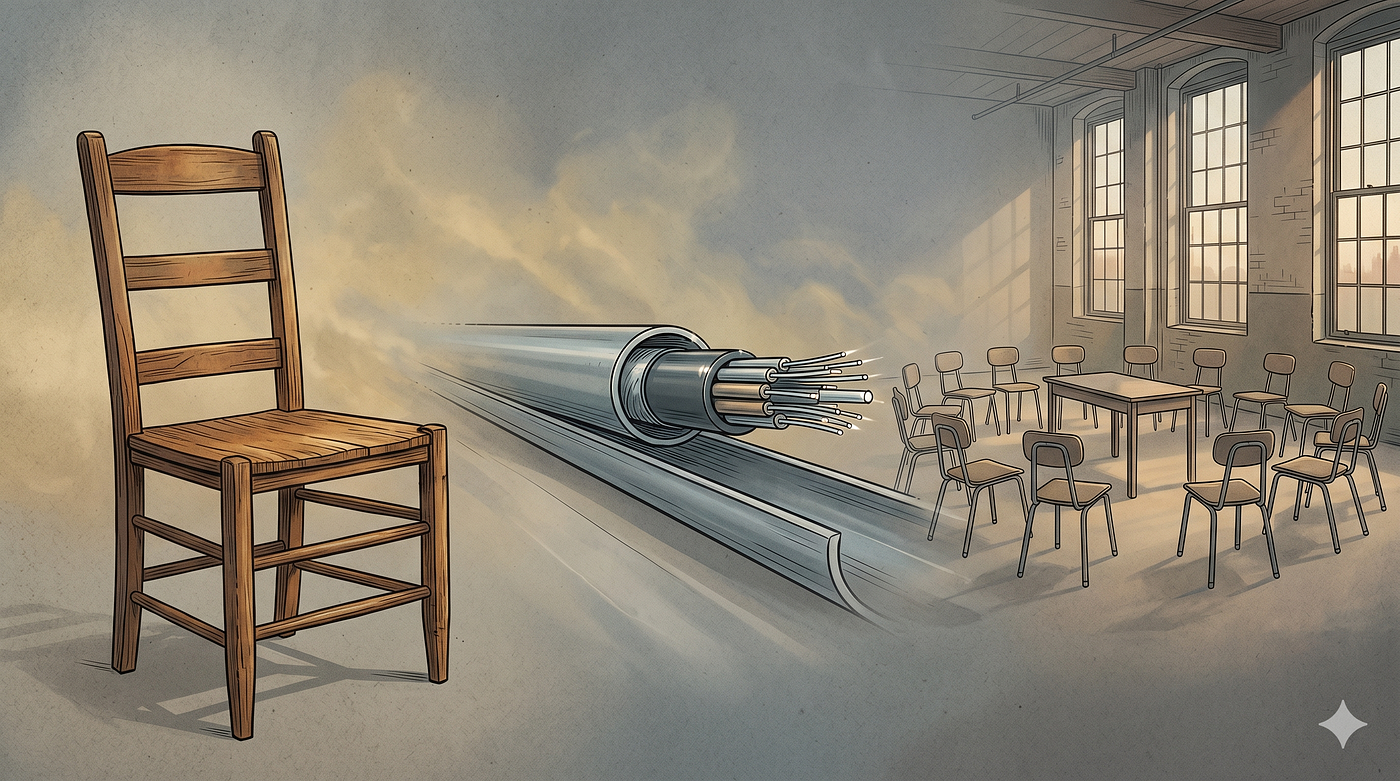
A chair, a cable, a classroom: three industrial moments in the Catawba Valley. Image create by Gemini.
The Pope, the Economist, and the Catawba Valley
In January, Ajay Agrawal and two coauthors published a working paper at the National Bureau of Economic Research arguing that the dominant economic framework for thinking about artificial intelligence was wrong, and that adopting it would lead to exactly the wrong policy response. A few months later, Dr. Padhee, a colleague at Lenoir-Rhyne, started teaching the paper to working professionals at a regional logistics company in Hickory as the foundation of the first applied AI course offered through our program. I was in the class. The students were managers and analysts trying to figure out what to do about AI in jobs that were already changing under them.
In May, Pope Leo XIV published an encyclical making structurally the same argument the economics paper had made — that the existing framework for thinking about this technology was inadequate to the moment, and that using it anyway would produce the wrong response.
These three events are not coincidences strung together. They are a single story about how a region prepares for a transition.
The encyclical, Magnifica Humanitas, was signed on May 15, 2026, exactly 135 years to the day after Leo XIII signed Rerum Novarum, the document that defined the Catholic Church’s response to the Industrial Revolution. The 135-year timing is not decorative. It is a claim. Leo XIII wrote Rerum Novarum because the factory had remade the world and the Church had not yet developed a framework adequate to it. Leo XIV is making the same claim about AI. He chose the same date, took the same name, and structured the document as an explicit successor.
Most early coverage of the encyclical has focused on the Babel imagery — the warning against a single technology, a single language, a single direction concentrated in the hands of a few. The Babel framing is the part that has traveled. It is memorable and quotable. It is also the surface. The deeper move in the document, appearing most clearly in paragraphs 5, 71, 95, and 108, is a substantial restructuring of Catholic Social Doctrine itself. For 135 years the framework has assumed the State is the primary actor that needs constraining. Leo XIV is saying that is no longer true. The actors with the most leverage over daily life today are private firms with resources that exceed those of most governments, and the Church’s traditional framework has to be rewritten for them.
Agrawal and his coauthors are making a structurally similar move in economics. The task-based replacement model — developed by Acemoglu and Restrepo and now the dominant framework in AI labor economics — treats AI primarily as something that displaces workers from tasks. That framing, they argue, “naturally focuses attention on major challenges such as the need to develop an alternative income distribution system” like universal basic income. The empirical evidence does not support it. Study after study of how workers actually use AI shows the technology functioning as a tool that augments workers rather than replacing them. The replacement frame produces the wrong policy response because it is built on the wrong empirical foundation. The augmentation framework leads somewhere different: under augmentation, the paper argues, “human-capital investment policies take on greater importance.”
Different diagnosis. Different prescription. Which framework is right matters enormously, because the policy responses pull in opposite directions.
The Catawba Valley has done this before. Furniture built this region. The mills, the showrooms, the supply chains, the skilled labor that turned hardwood into Bernhardt and Broyhill and Henredon were the spine of a regional economy for most of the twentieth century. Then capital moved. The commodity segments collapsed first — the mid-priced production that competed primarily on cost could not survive offshore manufacturing, and the closures arrived as finished products: layoffs, empty plants, the slow erosion of what generations had built. But the story did not end there. The specialty segments adapted. Hickory Chair, Century, Vanguard, and the design-driven makers who followed figured out which part of the value chain they could defend — craftsmanship, customization, design relationships, proximity to the customer — and they defended it. Today the Catawba Valley furniture industry is not what it was in 1990, but it is vibrant, profitable, and globally respected in the segments where it chose to compete. The region has been through one industrial transition that arrived as a finished product, and it learned something the hard way: which part of the value chain you occupy determines whether the transition hollows you out or leaves you stronger.
The region’s relationship to industrial transitions is not only one of memory and adaptation. The Catawba Valley is also, right now, one of the most significant manufacturing nodes in the physical infrastructure that makes AI possible at all. The fiber optic cable, the connectors, the equipment that runs through every hyperscale data center being built across the South — much of it is manufactured or terminated by people who live here. CommScope’s Hickory headquarters and the cluster of regional fiber and cabling manufacturers that grew up around it mean the Catawba Valley is not on the periphery of the AI transition. It is, materially, one of its industrial backbones.
So the question is not whether the Catawba Valley will participate in the AI transition. The region is already participating. The question is whether we participate the way we participated in commodity furniture — making components for decisions that are made elsewhere — or the way the specialty furniture makers participated, by moving up the value chain into work where local knowledge, judgment, and craft can be defended.
Here is something almost no one is saying about the current transition.
Every prior technology transition involved technologies that were tools in the standard sense. They did what they were built to do. The loom didn’t develop its own preferences. The steam engine didn’t strategize. The internet, even at its most chaotic and emergent, didn’t have something that could be meaningfully called agency. The transitions were opaque in their social and economic consequences, but the technologies themselves were predictable in their behavior.
This one isn’t. Leo acknowledges as much in paragraph 98, where he writes that current AI systems are “more cultivated than built” and that “fundamental scientific aspects — such as the internal representations and computational processes of these systems — remain, at present, unknown.” That is a remarkable admission to find in a papal encyclical. He is conceding that the people who design these systems do not fully understand what they have made. Agrawal and his coauthors approach the same boundary from the other side, arguing that human workers retain distinctive capabilities to make “judgments of causal and normative significance” that AI systems do not possess. Leo, in paragraph 99, writes that AI systems “do not undergo experiences, do not possess a body, do not feel joy or pain, do not mature through relationships and do not know from within what love, work, friendship or responsibility mean.” Different language. Same defense of the same boundary.
The furniture collapse in Hickory was painful, but the mechanisms were legible. You could see what was happening. The specialty makers who survived did so partly because they could see the structure of the transition clearly enough to choose their ground. This transition does not have that quality. The displacement boundary is not crisp. The systems are not interpretable, even to their builders. The feedback loops run faster than institutions can adapt.
And beneath all of that sits the deeper question Nick Bostrom has been asking for over a decade: whether sufficiently capable AI systems develop trajectories of their own that aren’t reducible to anyone’s design or intention. The popular framing of this as AI doom p(doom) misses the point. The actual concern is harder. What if we are creating a kind of intelligence whose relationship to human values is not adversarial, not aligned, but orthogonal — running on its own logic, in a direction we don’t have the vocabulary to describe yet? What if alignment is the wrong frame because there isn’t a stable target to align to?
So what do you do when the future is unknowable in this stronger sense?
What both Leo and Agrawal point to, from their different altitudes, is the same answer. The theologian sees the moral structure. The economists see the mechanism. Both arrive at distributed capacity as the only honest response to a transition whose endpoint we cannot see.
Leo’s image is Nehemiah rebuilding the walls of Jerusalem after the Babylonian exile — each family assigned the section closest to their own house, every guild and every household taking responsibility for what they could build, the wall completed in fifty-two days not because of central planning but because the work was genuinely shared. The deeper economic argument appears in paragraphs 67, 108, and 178, where Leo extends one of the oldest principles in Catholic Social Doctrine — the universal destination of goods — to include data, algorithms, computational resources, and the digital infrastructure that increasingly shapes daily life. He calls these “the new rare earths of power.”
Agrawal and his coauthors arrive at the same point through a different door. Their core finding is that the supply of AI-expert workers in the workforce amplifies the productivity gains from improvements in AI technology while attenuating the rise in wage inequality. The distribution of human capability across the economy determines whether AI gains broaden or concentrate. The policy conclusion is unambiguous. Where the replacement framework “logically points toward defensive redistributive measures, such as universal basic income (UBI), to manage the obsolescence of labor, the tool-based framework mandates an offensive investment in human capital.” The most quotable line in the paper:
“the economic impact of AI will be determined not solely by the technological frontier, but by the elasticity of the skill supply in response to shifting task requirements.”
That sentence sits next to Leo’s claim that technology is never neutral because it takes on the characteristics of those who design, finance, and deploy it. The same proposition in two registers. The technology is not destiny. The human response is the variable.
Which brings us back to the classroom.
Dr. Padhee and I co-teach applied AI courses to working professionals at area companies. We taught a session yesterday. The students are people who already know their jobs deeply — operations managers, analysts, supervisors, executives — and who are trying to figure out where AI sits in work they understand better than we do. They ask us, every session, what the future looks like.
The honest answer is that we don’t know. The future of this technology is unknowable in the strong sense — not just uncertain at the margins, but genuinely opaque even to the people building it. What we tell our students is what we both believe: learning, experimenting, and preparing are the only defenses against a future we cannot predict. The skill that matters most is not technical AI knowledge in the narrow sense. It is the willingness and capacity to try AI on real problems, fail intelligently, learn from the failures, and bring the learning back to the work. Ethan Mollick describes the AI capability frontier as “jagged” — astonishingly good at some tasks and unpredictably poor at closely related ones. The only way to find out where the frontier sits is to experiment. That jagged frontier, in this region, for this work, is being mapped one experiment at a time by people who live here.
So what does regional self-determination in AI actually look like? It is not waiting for coastal AI consultants to fly in with solutions. It is not hoping that platform companies will distribute their gains fairly. It is the Applied AI undergraduate course at Lenoir-Rhyne, BUS 583 in the MBA program, the co-taught courses inside area companies, the micro-credential programs that extend the same capacity to manufacturers, healthcare administrators, small business owners, and educators. It is the slower, less glamorous work of building local fluency, one cohort at a time, so that when decisions about how this technology gets deployed in this region get made, the people making them are from here, understand here, and answer to here.
The fiber industry built the physical layer of this transition. The educational work now under way is the human capital layer that has to be built on top of it if the region wants to do more than supply components for someone else’s decisions.
The Catawba Valley has done this before. The specialty furniture makers did not survive by predicting the future correctly. They survived by learning faster than the transition could close around them, by experimenting with which segments they could defend, by preparing for a world where the rules of their industry would change underneath them. The same posture is what AI requires now. Leo writes for 1.4 billion people. Agrawal writes for the economic profession. Padhee and I teach in classrooms in Hickory. The argument we all share, in our different languages, comes down to the same proposition: the future is unknowable, and learning, experimenting, and preparing are the best defense.
The region was already building before the Pope arrived. We received the last one. We are shaping this one.
A Prompt for Your Own Conversation
The argument in this piece comes out of a conversation. Two documents that ended up saying the same thing, a classroom in Hickory, the questions our students ask us every week. The thinking happened in dialogue, not in isolation. The point of Prompted is to give you the scaffolding to have that kind of dialogue yourself.
Copy and paste the prompt below into Claude (or your preferred AI assistant) to start an extended conversation about how the AI transition is reshaping your own work, your industry, or your region. The prompt is built to mirror the way Dr. Padhee and I work through these questions with our students. It will not give you predictions. It will help you do the thinking.
Prompt: An Unknowable Future Conversation
I want to have an extended, thoughtful conversation about how the artificial intelligence transition is likely to affect my work, my industry, or my region. I am not looking for predictions. I know the future of this technology is genuinely unknowable, even to the people building it. What I want is help thinking clearly about how to prepare for a future I cannot see.
Please act as a thoughtful, well-informed thinking partner. You are not a forecaster. You are someone helping me reason carefully about three things: what is actually changing, where the irreducibly human work sits in what I do, and what I should be learning, experimenting with, and preparing for so that I have options when the future arrives.
Structure the conversation in the following sections. Move through them in order, and ask me genuine questions at each stage. Do not move on until I have actually answered the questions and we have thought through them together.
Section One: What I Actually Do
Ask me to describe, in concrete terms, what my work or my organization or my region actually does. Not the title or the industry category — the actual tasks, decisions, relationships, and judgments that fill a day. Ask follow-up questions until you have a real picture, not a generic one. Pay attention to what I emphasize and what I leave out.
Section Two: The Augmentation Question
Once you understand what I do, help me distinguish between three kinds of tasks in my work: tasks where AI is likely to replace human effort entirely, tasks where AI is likely to augment human judgment but not substitute for it, and tasks where human judgment is genuinely irreducible — where what makes the task valuable is the human capacity to see significance, weigh trade-offs, or build trust. Help me see where my work actually sits across this distribution. Push back if I am being defensive about my own irreplaceability or dismissive about what AI can do.
Section Three: Value Chain Position
Ask me to think about where my work, my organization, or my region sits in the larger value chain of the AI transition. Are we building components for decisions made elsewhere? Are we positioned to make those decisions ourselves? What does moving up the value chain look like in our specific context? What are the analogues to commodity furniture and specialty furniture in our situation?
Section Four: The Learning Agenda
Based on the previous sections, help me identify three to five specific things I should be learning, experimenting with, or building capacity in over the next year. Not generic advice. Specific to my situation. The criteria are: what will give me more options regardless of how the future unfolds, what will help me see the jagged frontier of AI capability in my actual work, and what will protect what is irreducibly human in what I do.
Section Five: What I Am Avoiding
This is the hardest section. Ask me what I am not facing honestly. Where am I hoping the transition will not affect me when the evidence suggests it will? Where am I avoiding the harder learning because the easier work feels productive? What would I do if I took the unknowability of the future seriously?
Throughout the conversation, hold two things at once. The future is genuinely unknowable, so confident predictions are not useful. But unknowability is not paralysis — it is the condition under which learning, experimenting, and preparing become the most rational responses available. Help me act inside that paradox rather than around it.
Begin with Section One. Ask me what I actually do.
John Andrews is the Alex Lee Professor of Business at Lenoir-Rhyne University and operates Katadhin Consulting with is wife Shannon. He has spent his career at the intersection of emerging technology and marketing and now teaches and consults in this area.
This piece is part of Prompted, a daily publication built around copy-paste prompts designed to help people do things with AI they wouldn’t think possible. Each issue pairs an idea worth thinking through with a prompt you can use to think it through yourself. The thinking happens in dialogue. Prompted is the scaffolding.
prompted
메타데이터
- post_id
- a987ee89a460
- slug
- the-pope-the-economist-and-the-catawba-valley-a987ee89a460
- url
- https://medium.com/@katadhin/the-pope-the-economist-and-the-catawba-valley-a987ee89a460
- canonical_url
- https://medium.com/@katadhin/the-pope-the-economist-and-the-catawba-valley-a987ee89a460
- author_url
- https://medium.com/@katadhin
- status
- ok
- fetched_at
- 2026-06-22 05:41:33