The First Time A Girl Realises She Is Not Safe
On how fear does not arrive all at once, it just slowly becomes the way you move through the world.
The First Time A Girl Realises She Is Not Safe
On how fear does not arrive all at once, it just slowly becomes the way you move through the world.

Photo by Bigparadox from Pexels
Not a member? Here’s the friend link.
I have been thinking about this for a while. Not as a thesis or an argument. More like a question I keep returning to. When exactly did I start knowing that being a girl came with a different set of instructions than being a boy? When did I first understand, not politically, not intellectually, but in my body, that I was going to have to be careful in ways my brother was not?
I cannot find the starting point because it was not a starting point. It was more like a slow drip. A hundred tiny moments across years that, individually, seem like nothing, but collectively built something I’ve been living inside ever since.
This is an attempt to trace some of those moments. Not the dramatic ones. The boring ones. The ones that didn’t even register as significant at the time.
Nobody said, “Be afraid,” they just said, “Be careful”
The language of fear in girlhood is never direct. It does not arrive as a warning. It arrives as instructions.
Seedha baith. Sit properly. Don’t spread your legs. Don’t laugh too loud. Don’t stay out too late. Text when you reach. Don’t take the last bus. Walk on the well-lit side. Don’t sit in the front seat of an auto at night. Keep your phone in your hand, not your bag.
I did not receive these as a list. They came one at a time, across years, from different people in different rooms, all delivered in the tone of ordinary advice. Your mother, your mausi, an older cousin at a family lunch. Not alarmed. Just informative. Just common sense. Ladki ho, thoda dhyan rakhna padta hai. You’re a girl. You have to be a little careful.
Nobody used the word fear. Nobody needed to. The instructions were the fear, translated into behaviour before I was old enough to recognise it as such.
And here’s the thing about instructions that arrive in that tone: they don’t feel like fear. They feel like facts. The sky is blue. Summer is hot. Girls hold their keys differently at night. It just becomes the furniture of how you move through the world. You don’t notice it until someone points it out and you realise you’ve been doing it your whole life without once asking why.
The adults started preparing me for a body I did not have yet
I was ten when my home tutor pulled my mother aside after a session and suggested, helpfully, that it was probably time to get me a bra.
I want to be specific about that age because it matters. Ten. Completely flat. There is no bra designed for a ten-year-old’s body because there is nothing there requiring one. She was not responding to anything physical. She was responding to the anticipation of something physical. Planning for a body that hadn’t arrived yet.
My mother said haan haan, and the tutor left, and nothing was discussed. A few weeks later, a training bra appeared folded in my drawer. No conversation. Just there. I wore it because that was obviously what I was supposed to do.
I have heard versions of this from so many people. A friend whose PT teacher commented, and her mother went shopping the same week. Another, whose aunt brought it up at a family lunch in front of everyone, class five, just sitting there wanting to disappear. The details change. The shape is identical.
At ten, I had not yet done anything. My body had not yet done anything. But adults had already started having opinions about it, managing it, making decisions about it, without asking me or explaining anything to me. And I just absorbed this as normal. Of course, this is how things work. Of course, my body is a matter of some concern to the community. I was ten. I didn’t know yet that it was supposed to be mine.
The swimming class nobody talks about enough
I don’t know a single woman who had school swimming lessons without the tights rule. Wear your swimsuit, but also tights underneath. Shorts back on when you get out. Don’t walk around poolside.
The boys stripped down and cannon-balled in.
We were eight or nine years old. No physical difference from the boys that would explain the extra layers. If you asked, the answer was yahan ka rule hai, it’s the rule here in that voice, which means the conversation is over. So you wore the tights. You swam in them. They got heavy. You were eight and learning to float and not thinking about it much because you were eight.
What strikes me now is not the rule itself. It’s how completely we accepted it. There was no rebellion, no raised hands, no moment where any of us said: wait, why. We were eight, and we had already learned, from some source we couldn’t name, that questions like that didn’t really go anywhere useful. That this was just how things were for us. That our bodies required management, the boys’ bodies didn’t.
This is not only an Indian thing, though we tend to think it is. In Cardiff, a school made girls wear thick 50-denier tights in 30-degree heat while boys wore shorts. A parent told the local press her niece was pulled out of a mock exam to put on a pair of tights. The reason given, informally: boys might look up girls’ skirts. So the solution was to make girls hotter and more uncomfortable. The boys’ comfort was not adjusted. It never is.
We hadn’t been told this directly. We had simply been corrected enough times in enough contexts that by eight, we already knew. That’s actually the most interesting part. By eight, we already knew.

Photo by Jeremy Angerson from Pexels
What puberty actually changes
Before puberty, a girl exists in something close to freedom. She can run ahead, sit anywhere, argue at dinner, and take up space without calculating the cost of it.
Then her body changes, and the rooms start having conditions.
It doesn’t happen all at once. It’s more like the attention around you increases in a way that is hard to explain but very easy to feel. Relatives who were always warm become slightly formal. Your mother starts making small suggestions that didn’t exist before. A cousin visiting from another city means you should knock before going into certain rooms. Male relatives, you’ve known your whole life, suddenly require a different kind of navigation.
Nothing is ever explained. You just figure it out from the adjustments.
I have a friend who told me the first sign for her was that her father, who used to sit next to her on the couch, suddenly became physically awkward around her. Didn’t know where to put his hands when he hugged her. She was twelve. She felt, without understanding why, that she had done something wrong. She hadn’t. Her body had changed, and he didn’t know how to be near it anymore, and she received his discomfort as a fact about herself.
Something about her, not him, required this distance.
And the thing that nobody really talks about is how the people doing the managing are not always strangers. In 2023, over 50 girl students at a government school in Jind, Haryana, filed complaints against their own principal for sexual harassment. Sixty written complaints eventually reached the National Commission for Women. He was suspended, then arrested.
The same year, a Bengaluru school principal and trustee were arrested after students reported harassment; parents who gathered outside the school in protest demanded the girls’ uniform be changed from skirts to salwar kameez. The response to a man harassing girls was: change what the girls wear.
That logic, the danger is located in the girl’s body, the solution is to restrict the girl’s body, runs so consistently across so many different countries and contexts that at some point you have to stop calling it a coincidence and start calling it a system.
The kitni badi ho gayi comments start around this time. Said warmly, always, by relatives and family friends. Bilkul mummy jaisi lag rahi hai. You look just like your mother. And underneath the warmth, that new watchfulness. Your mother materialises next to you. You don’t understand the geometry yet. You can feel it, though.
And then sometimes the comments aren’t even warm. Sometimes they’re just anxious. My height increased rapidly when I was twelve. Puberty, biology, completely unremarkable. At a family gathering, my grandmother said something like: “ Itni” lambi ho gayi, ab ladka kahaan se milega. You’ve gotten so tall. Where will we find a boy for you now?
I was twelve. My height was a logistical problem in the project of my future marriage, which was apparently already under consideration. An imaginary future husband was already in the room, already measuring me, finding me inconvenient. And I couldn’t stop growing. I couldn’t do anything about my own height. But it had become mine to feel bad about.
I didn’t have the language for how strange that was. So I just stood slightly differently after that. For a while.
The dress code lesson
Class seven. A note came home in our school diaries. Girls’ dress code update. Five lines: kameez below the knee. Salwar is not fitted. No exceptions for any reason. Boys’ note: white shirt, dark trousers, black shoes.
My school was not conservative. English medium, co-ed, the kind of school where teachers used the word empowerment without irony. The vice principal gave a full speech every Women’s Day about how this generation of girls had no ceiling. That same vice principal had girls called out of class to check uniform length. Not boys. Girls. You’d be sitting in the middle of a lesson, and three names would be read out, and you’d stand up already knowing, before you reached the door, exactly what was waiting.
Nobody in that building appeared to experience any contradiction. The speech was the speech. The measuring tape was the measuring tape. Two separate compartments that never once had a conversation with each other.
And this is not just something that happens in Indian schools. In 2023, girls at Rainford High School in Merseyside, UK, were made to enter school separately from boys and have their skirt length inspected, reportedly by predominantly male teachers. Some came home in tears. One parent told the BBC: “My daughter was so upset about it. When pupils returned after half term, they lined girls up and examined their skirts and told them, ‘Yours is suitable, yours is not.’” Over a thousand people signed a petition calling the policy “humiliating” and “outdated.” Students protested. The school’s defence was that the skirts might make it hard for girls to sit down without being “precarious.” Again, the girls’ bodies were the problem. The solution was to police the girls.
In Japan, schools in multiple prefectures banned girls from wearing their hair in ponytails. The reason, as a former teacher explained to VICE World News: the nape of a girl’s neck might “sexually excite” male students. In Fukuoka, a 2021 survey found that 57 out of 6U junior high schools dictated the colour of students’ underwear, and girls who broke the rule were required to remove it. A former teacher who spent years criticising these rules said the most telling thing: “Because there is such a lack of criticism and it has become so normalised, students have no choice but to accept them.”
That last sentence. That is the whole thing right there.
Closer to home, in January 2025, a school principal in Dhanbad, Jharkhand, ordered 80 Class 10 girls to remove their shirts after finding them celebrating “Pen Day”, a tradition where students write good wishes on each other’s shirts before board exams. The girls apologised. The principal ordered the shirts off anyway. They were sent home in their blazers, shirtless beneath, the day before their exams. Parents filed complaints. An inquiry was launched. A candle march was held. The principal was a woman.
That last part is worth sitting with. Because the point was never about who holds the authority. It was about the belief underneath it that girls’ bodies require this level of institutional management, that a shirt with writing on it is an offence requiring the shirt’s removal, that the discomfort and humiliation of eighty girls before their board exams is a reasonable response to a piece of cloth.
The dress code, in all its versions across all these countries, is saying the same thing underneath whatever language it uses: your body is a distraction. Manage it. Make sure it is not the reason anything happens. We were twelve. We nodded. We went back to class.
The safety instructions
They don’t arrive as a list. They come across years, from different people, in different tones, and nobody says: I am now teaching you to be afraid.
From your mother: text when you reach. Don’t take the last bus. Tell me the full address, not just the area.
From an older cousin at a family function, very casually, between bites: if you’re in an auto alone at night, sit behind the driver on the left side. He can see you less clearly in the mirror that way.
From a friend whose didi passed it on: hold your keys between your fingers when you’re walking alone at night. She shows you how. You try it once in your room. You think about it for a minute. Then you forget about it. Then one evening, you’re walking to the metro, and you do it automatically without remembering that you learned it.
From group chats, from seniors in college, from a roommate: drop your live location before going anywhere late. Send the vehicle number before you get in. Keep a call running while you walk home, not because the person on the other end can actually do anything, but because someone knowing you are out and moving makes it feel like less of a solo project. You are constructing a witness out of nothing because a witness, even a useless one, feels like something.
None of this is presented as fear. It is presented as being a sensible person. Thoda dhyan rakhna. Just be a little careful. As if careful is a state you enter once and maintain. As if it is not a constant, low-level tax on your attention that you pay every single time you leave the house after dark.
And when girls push back against any of this against the rules, against the logic, against the assumption that their bodies are the problem, the response is usually more rules. In 2012, a BJP MLA in Rajasthan wrote to the state chief secretary demanding that girls above Class 10 stop wearing skirts as school uniform because, he said, skirts were “attracting lewd remarks from boys” and were “not part of Indian culture.” The girls’ clothing was to be changed. The boys’ behaviour was not mentioned as something that required addressing.
Your brother’s version of the same advice, for the same city, at the same age: don’t stay out too late. That’s it. That’s where it ends for him.
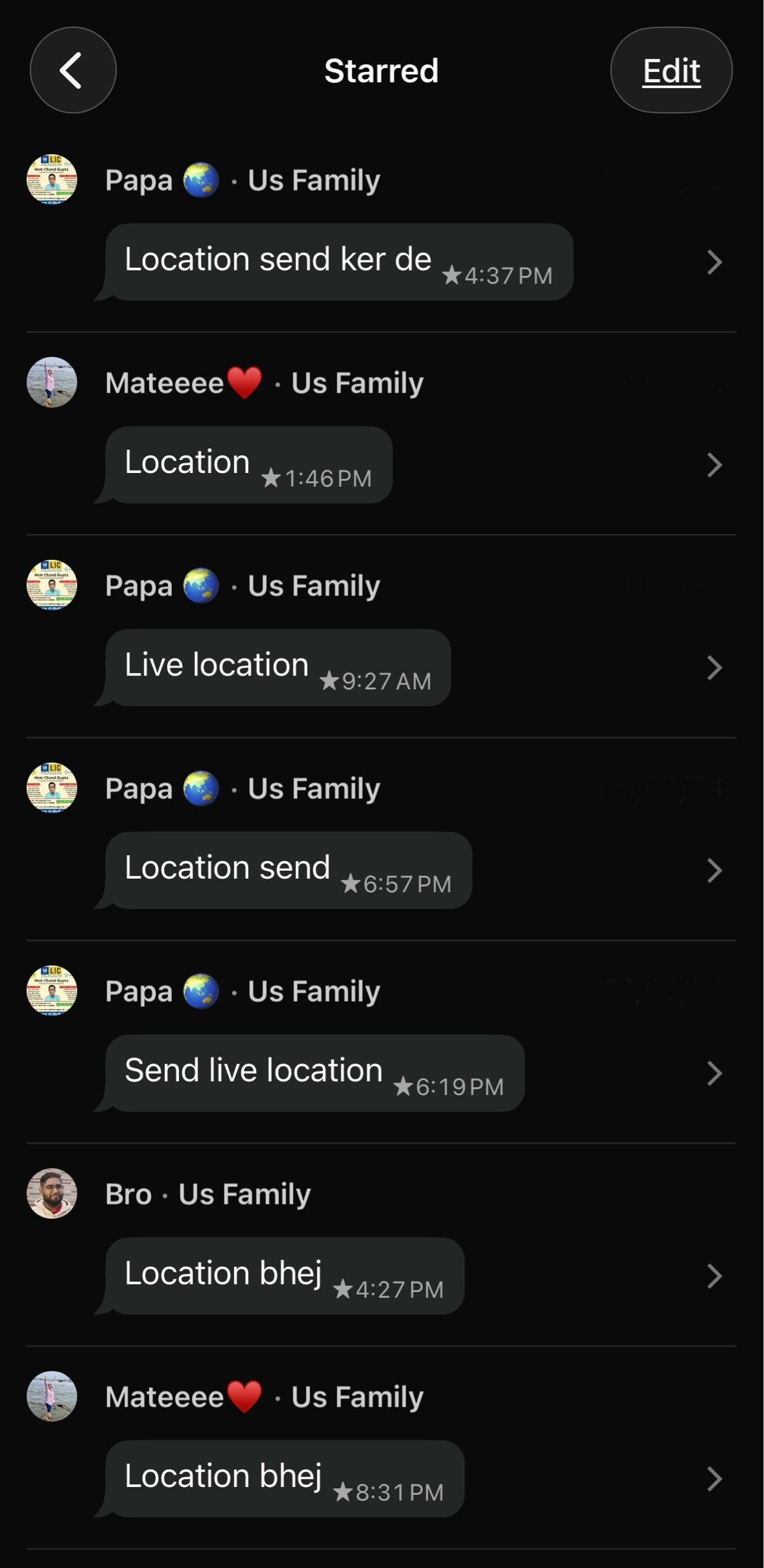
Every “share your location” carries a story girls never had to be told | Screenshot by author
The look that changes something
You’re eleven or twelve. Maybe younger. You’re outside school, at the market with your mother, walking through the park in your colony. Just doing whatever you normally do.
And then a grown man looks at you.
Nothing happens that you can point to. If someone asked what was wrong, you probably would not have an answer. You just know that something about the interaction feels off.
At that age, you do not have the language for it. You cannot explain it to your friends. You cannot explain it to yourself. But you find yourself adjusting your clothes, looking away, moving closer to another woman nearby.
The feeling stays longer than the moment does.
It is different from how adults look at children, which is either warmly or not at all. This is neither. There is an appraisal in it. A kind of attention that your body registers before your brain catches up. You feel seen in a way that makes you want to be immediately unseen.
You move. Maybe you go stand near a woman you don’t know because she is a woman, and that feels safer. Maybe you look at your phone. You just shift.
You don’t tell anyone afterwards, not because you can’t, but because you don’t have the sentence for it. A man looked at me doesn’t go anywhere as a conversation. Nothing happened. There’s nothing to say. You just file it away alongside everything else you’ve been quietly collecting, and from that day, the way you move in public is slightly different from it was before, and you couldn’t tell anyone exactly when or why it changed.
What gets built without you noticing
By the time a girl in India is fifteen or sixteen, she has an internal map she assembled without any single person drawing it for her.
Which streets are fine at which hours? Which auto stand is okay after eight PM, and which one isn’t? Which coach on the metro is better? How to make a loud phone call when you get into an unfamiliar vehicle, stating your destination, even if you’re talking to nobody, just to create the impression that someone is tracking you. She knows that mera boyfriend aa raha hai will end a conversation; her own didn’t end, and she carries that knowledge alongside the low irritation of knowing it.
She knows to keep her phone in her hand before getting out of the auto, not after. She knows how many steps behind someone is one too many. She knows how to adjust her pace without making it obvious she’s adjusting her pace.
None of this was in any syllabus. It assembled itself from every correction, every instruction, every room where she understood without being told that she was navigating something the boys around her were not. It became hers so completely that she stopped thinking of it as learned behaviour. It just feels like her. Like her own instincts. Her own common sense.
The hypervigilance feels like good judgment. The caution feels like personality. The constant low-level risk assessment feels like just being an adult woman who has her act together.
And that is exactly how complete this education is. By the time you are old enough to see the shape of it, you’ve been inside it long enough that you cannot find the seam between what you were taught and what you are. You can’t point to the lesson. You can only point to yourself.
You were six when someone said seedha baith, and you adjusted without questioning it. You were ten when a bra appeared in your drawer, and you wore it because that was clearly the point. You were twelve when your height became a conversation about your marriage, and you stood differently after, for a while. You were fourteen, and you learned to hold your keys in your fist. You were sixteen, and your phone never left your hand in an auto at night.
Somewhere in there, you became a girl who knew how to move through the world carefully. You cannot find the moment it happened. It did not happen in a moment.
It happened every day. It happened in the furniture of a thousand ordinary rooms. And the fact that you can’t find the seam between the teaching and yourself is not proof that it didn’t happen.
It’s proof of how well it worked.
For more stories about growing up female in a world that teaches girls caution before it teaches boys accountability, follow Fourth Wave. Also check out our Livestreams and sign up for our Newsletter. Let’s grow the community! Have you got a story or poem that focuses on women or other targeted groups? Submit to the Wave!
메타데이터
- post_id
- a98df9f673de
- slug
- the-first-time-a-girl-realises-she-is-unsafe-a98df9f673de
- url
- https://medium.com/fourth-wave/the-first-time-a-girl-realises-she-is-unsafe-a98df9f673de
- canonical_url
- https://medium.com/fourth-wave/the-first-time-a-girl-realises-she-is-unsafe-a98df9f673de
- author_url
- https://medium.com/@vanshikaguptaworkk
- status
- ok
- fetched_at
- 2026-06-11 06:59:45