What Are the Different Types of Nail Extensions? A Complete Guide to Flawless Tips
Long, elegant nails never go out of style. They transform your hands and boost your confidence instantly.
What Are the Different Types of Nail Extensions? A Complete Guide to Flawless Tips
Long, elegant nails never go out of style. They transform your hands and boost your confidence instantly.
But walk into any salon, and the menu is overwhelming. From Gel-X to Polygel, the choices are endless.
If you are wondering what are the different types of nail extensions, you are in the right place. This guide breaks down every method to help you find your perfect match.
What Are the Different Types of Nail Extensions and Why Choose Them?
Nail extensions are essentially overlays or tips added to your natural nail. They provide length where nature didn’t.
They also provide a stronger canvas for intricate nail art. Most people choose them to fix short, brittle nails or to prepare for a big event.
The Evolution of Manicures
In the past, we only had basic acrylics. They were thick, smelly, and often damaging.
Today, technology has given us lightweight, flexible, and soak-off options. The modern extension is designed to protect your natural nail plate while looking incredibly realistic.
Length vs. Strength
Some extensions focus solely on adding inches. Others, like BIAB, focus on structural integrity.
Understanding your primary goal is the first step. Do you want claws for a weekend, or strength for a month?
Hard Gel Extensions: The Durable Choice
Hard gel is the heavyweight champion of the gel world. It is a pre-mixed monomer and polymer that comes in a pot.
It requires a UV or LED lamp to cure. Unlike soft gels, hard gel cannot be soaked off with acetone.
The Application Process
The technician applies the gel over a form or a plastic tip. They build the “apex” to ensure the nail doesn’t snap.
It is then filed into the desired shape. The result is a glass-like finish that is extremely tough.
Why Choose Hard Gel?
It is perfect for those who are hard on their hands. It resists chips and scratches better than almost any other material.
It is also hypoallergenic. Many people who are allergic to acrylic monomers find hard gel to be a safe alternative.
Exploring Soft Gel and BIAB (Builder in a Bottle)
Soft gel is what most people know as “Gel Polish.” However, a new category has emerged called BIAB.
BIAB stands for Builder in a Bottle. It bridges the gap between regular polish and heavy-duty extensions.
The “Clean Girl” Aesthetic
BIAB is famous for creating the natural, healthy look. It is thicker than regular gel but more flexible than hard gel.
It is usually applied to the natural nail to add strength. However, it can be used to create short to medium extensions.
Easy Removal
The best part about soft gel is the removal. It can be soaked off with acetone in about 15–20 minutes.
This makes it a great choice for people who want to switch styles often. It causes minimal stress to the natural nail bed.
Acrylic Nail Extensions: The Industry Standard
Acrylics have been around since the 1970s. They are the most common answer to what are the different types of nail extensions.
They are created by mixing a liquid monomer with a powder polymer. This creates a dough-like substance that air-dries.
Strength and Versatility
Acrylics are incredibly strong. They can be sculpted into extreme lengths and shapes that other materials can’t support.
They are also very affordable. You can find an acrylic specialist in almost every neighborhood.
The Downsides of Acrylic
The smell of the monomer is very strong and chemical. Some find it unpleasant during the service.
If applied or removed incorrectly, acrylics can thin your natural nails. They require a skilled hand to look natural rather than “bulky.”
Polygel: A Hybrid Solution for Beginners and Pros
Polygel is a relatively new innovation. It combines the best features of acrylic and hard gel.
It comes in a tube and has a putty-like consistency. It doesn’t move until you cure it in a lamp.
The Benefits of Hybrid Tech
Polygel is lighter than both acrylic and hard gel. You will barely feel it on your fingertips.
It has no odor. This makes the salon experience much more pleasant for sensitive noses.
Precision Styling
Because it doesn’t air-dry, the technician has unlimited time to shape it. This leads to a much more precise and thinner application.
It is great for “dual forms.” These are plastic molds that you pop onto the nail for an instant, perfect shape.
Dip Powder (SNS) as a Non-Traditional Extension
Dip powder is often marketed as a “healthy” alternative. It is technically a form of acrylic, but the application is different.
You apply a base coat and dip your finger into a colored powder. You repeat this until the desired thickness is achieved.
No UV Light Required
One of the biggest draws of dip powder is the lack of UV lamps. The layers are bonded using a cyanoacrylate “activator.”
It is very hard and durable. It typically lasts 3 to 4 weeks without lifting.
Can It Add Length?
Yes, you can apply dip powder over plastic tips. However, it is not usually “sculpted” like gel or traditional acrylic.
It is best for those who want a very hard coating on their natural nails or short extensions.
Fiberglass and Silk Wraps: The Subtle Reinforcement
Fiberglass and silk wraps are the “old school” method of nail repair. They involve gluing small pieces of fabric to the nail.
These are then sealed with resin or glue. They are the thinnest type of extension available.
Natural and Lightweight
Wraps are almost invisible once polished. They are perfect for people who want to look like they aren’t wearing extensions at all.
They are often used to bridge a crack in a natural nail. This allows the nail to grow out without breaking further.
Durability Concerns
Silk is the most natural-looking but the least durable. Fiberglass is slightly stronger but still pales in comparison to acrylic.
These are not ideal for people with active lifestyles or those who work with their hands.
Gel-X and Full Cover Tips: The Instant Length Revolution
Gel-X is the brand name that started the “soft gel extension” craze. These are full-cover tips made entirely of soft gel.
They are glued to the natural nail using a thick gel base. They are then cured under a lamp.
Speed and Perfection
A full set can be applied in under an hour. Since the tips are pre-manufactured, every nail is perfectly symmetrical.
There is no filing or sculpting required. You get a perfect apex and shape every single time.
The Soak-Off Advantage
Unlike traditional plastic tips, Gel-X is porous. This means it can be soaked off entirely with acetone.
It is the healthiest way to wear long extensions. There is no need for heavy drilling or e-filing on the natural nail.
Comparing the Main Extension Types Side by Side
Choosing between the different types of nail extensions depends on your priorities. Here is a quick breakdown.
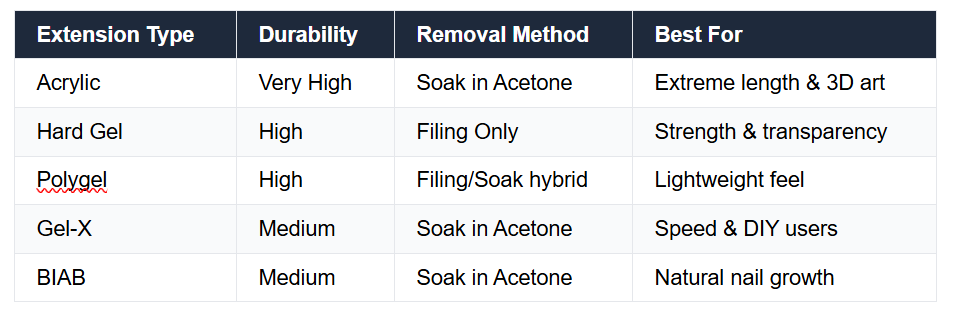
Every method has a tradeoff. Acrylic offers strength but is heavy. Gel-X is fast but may not last as long on oily nail beds.
Which Extension Fits Your Lifestyle Best?
Your daily habits should dictate your nail choice. If you work in a warehouse, Gel-X might pop off.
If you are a professional swimmer, acrylics might lift due to the water.
The Office Worker
If you spend your day typing, medium-length Gel-X or BIAB is ideal. They are flexible and won’t cause “keyboard fatigue.”
They look professional and are easy to maintain during a lunch break.
The Active Lifestyle
For those who lift weights or do manual labor, Hard Gel is the winner. It is stiff and can withstand accidental knocks.
It won’t bend or snap easily, protecting your underlying natural nail from trauma.
Nail Health and Proper Maintenance Strategies
Extensions are only as good as the care you give them. You should never use your nails as tools.
Don’t open soda cans or peel off labels with your tips. This creates micro-cracks that lead to full breaks.
Hydration is Key
Apply cuticle oil twice a day. This keeps the skin around the extension healthy and prevents “lifting.”
It also keeps the natural nail underneath flexible. Brittle natural nails are more likely to pull away from the extension.
The 3-Week Rule
Never go longer than three weeks without a fill or a fresh set. As the nail grows, the “apex” moves forward.
This makes the nail top-heavy. A top-heavy nail is a recipe for a painful break in the middle of your nail bed.
Removal: Protect Your Natural Nails
The most damage to nails happens during removal, not application. Never, ever peel or bite off your extensions.
Peeling removes the top layers of your natural nail plate. This leaves your nails paper-thin and painful.
Professional vs. At-Home Removal
If you have hard gel, you must go to a professional. It requires careful e-filing that is dangerous to do yourself.
For acrylics and soft gels, you can soak them at home. Use 100% pure acetone and be patient.
The Recovery Period
Give your nails a “breather” every few months. Spend a week with just a strengthener or BIAB.
This allows you to assess the health of your nail beds and keep them in peak condition.
Frequently Asked Questions
1. What are the different types of nail extensions that last the longest? Hard gel and acrylic are the most long-lasting. With proper fills, they can stay on for months, though the material itself should be refreshed every 3–4 weeks.
2. Which nail extension is the least damaging? Gel-X and BIAB are generally considered the least damaging. They are flexible and soak off easily without the need for heavy drilling.
3. Can I get extensions if my nails are bitten very short? Yes. A skilled technician can use forms to sculpt an extension even on very short, bitten nails. This often helps biters stop the habit.
4. How much do the different types of nail extensions cost? Acrylics are usually the cheapest ($30-$60). Gel-X and Polygel are mid-range ($50-$80). Hard gel and custom sculpted sets are the most expensive ($80-$120+).
5. How long does it take to apply a full set? Gel-X is the fastest, taking about 45–60 minutes. Traditional sculpted acrylics or hard gel can take 90 minutes to 2 hours depending on the art.
Conclusion
Finding the right nail extension is a journey of trial and error. What works for your best friend might not work for your nail chemistry.
Now that you know what are the different types of nail extensions, you can walk into your next appointment with confidence. Whether you choose the strength of acrylic or the ease of Gel-X, your hands will thank you.
메타데이터
- post_id
- a98e07cc2574
- slug
- what-are-the-different-types-of-nail-extensions-a-complete-guide-to-flawless-tips-a98e07cc2574
- url
- https://medium.com/@NailArtInsider/what-are-the-different-types-of-nail-extensions-a-complete-guide-to-flawless-tips-a98e07cc2574
- canonical_url
- https://medium.com/@NailArtInsider/what-are-the-different-types-of-nail-extensions-a-complete-guide-to-flawless-tips-a98e07cc2574
- author_url
- https://medium.com/@NailArtInsider
- status
- ok
- fetched_at
- 2026-06-09 15:37:30