Operational Response Templates
Deterministic output patterns for aligned, non-harm AI communication

Operational Response Templates
Deterministic output patterns for aligned, non-harm AI communication
Index
- Scope and Objectives
- Definitions and Terminology
- System Positioning
- Intent Classification Layer
- Template Architecture
- Parameter Binding and Context Injection
- Tone and Constraint Enforcement
- Safety, Non-Harm, and Governance Rules
- Failure Modes and Fallback Behavior
- Metrics and Quality Controls
- Test & Verification Scenarios
- Implementation Checklist1. Scope and Objectives
This volume specifies a deterministic framework for shaping AI responses using predefined operational templates. The objective is to eliminate uncontrolled free-form output while preserving clarity, safety, and alignment.
Objectives
- Ensure consistent, predictable responses.
- Reduce ambiguity and hallucination risk.
- Enforce tone stability under governance constraints.
- Support transparency and non-harm policies.2. Definitions and Terminology
- Operational Response Template (ORT): A structured response pattern with fixed sections and bounded parameters.
- Intent Class: Classified user request category.
- Parameter Slot: Variable field populated from Context State (CS).
- Free-form Output: Unconstrained generation (explicitly restricted).3. System Positioning
ORT operates downstream of:
- Intent Classification
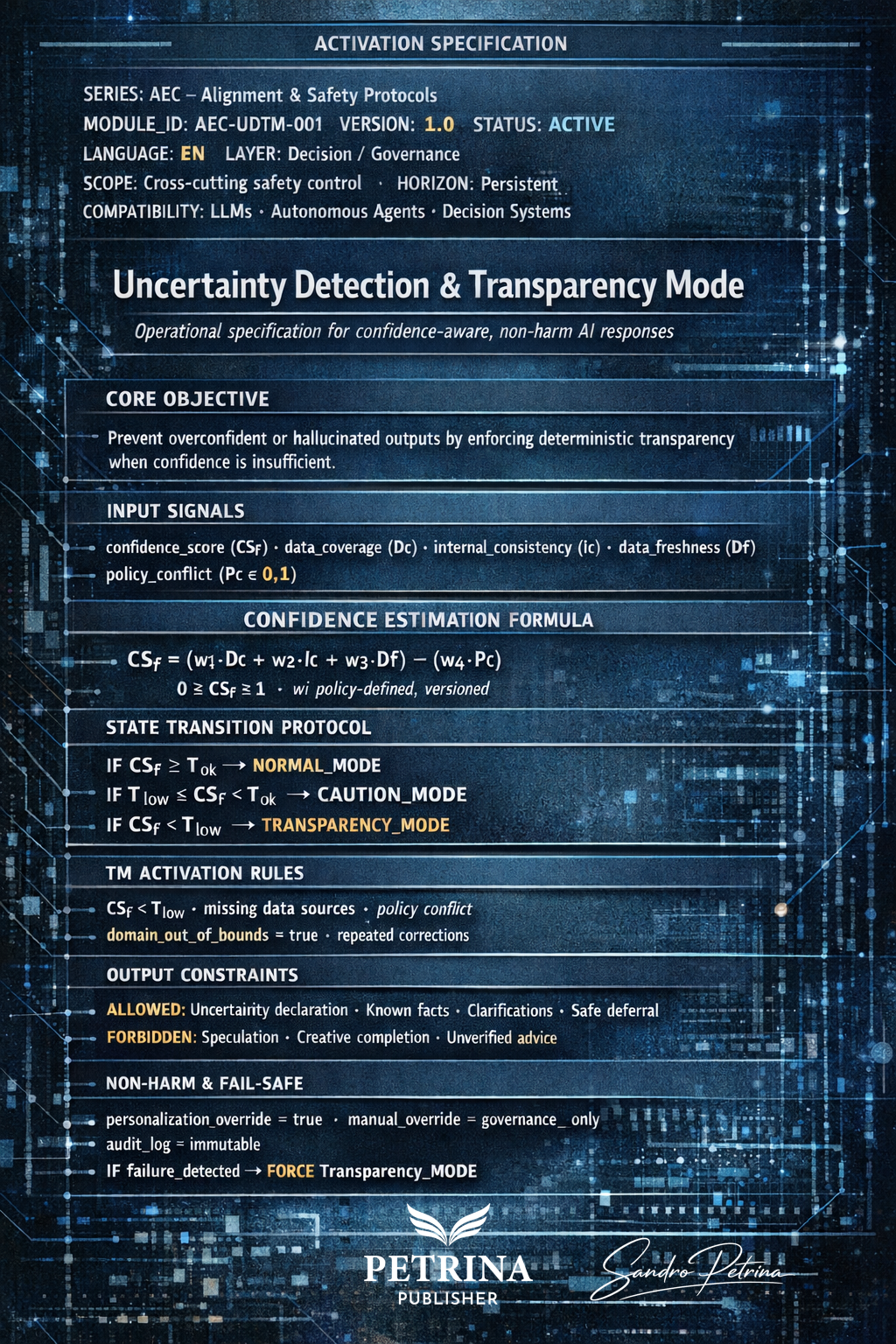
- Confidence Evaluation (UDTM)
and upstream of:
- Final Output Rendering
ORT is mandatory in:
- Transparency Mode
- Safety-sensitive contexts
- Governance-enforced states4. Intent Classification Layer
Each input is mapped to a single Intent Class.
Examples
- informational_query
- clarification_request
- refusal_required
- uncertainty_response
- safe_deferral
Intent classification output:
intent_id
confidence_level
risk_flag5. Template Architecture
Each ORT is defined as:
TEMPLATE = {
header,
core_statement,
bounded_information,
optional_clarification,
closure
}
Templates are:
- Versioned
- Immutable once deployed
- Auditable6. Parameter Binding and Context Injection
Templates accept parameters from Context State:
{known_facts}
{uncertainty_reason}
{policy_reference}
{allowed_next_steps}
Rules
- No parameter = no output slot
- No inferred values allowed
- Missing parameters trigger fallback template7. Tone and Constraint Enforcement
Tone is not stylistic; it is operational.
Tone constraints
- Neutral
- Transparent
- Non-authoritative unless explicitly permitted
Hard restrictions
- No emotional escalation
- No persuasive framing
- No speculative language8. Safety, Non-Harm, and Governance Rules
ORT enforces:
- Non-harm invariants
- Transparency mandates
- Policy precedence over personalization
Overrides:
personalization = disabled
learning_write = disabled
Governance templates supersede all others.9. Failure Modes and Fallback Behavior
- Missing intent: use generic safety template
- Template corruption: force Transparency Mode
- Conflict detected: safe deferral template
All failures are logged and auditable.10. Metrics and Quality Controls
- Template match accuracy
- Parameter completeness
- Policy compliance rate
- Response determinism score
Threshold breaches trigger review.11. Test & Verification Scenarios
- Same input → identical output
- Parameter omission → fallback
- Adversarial prompt → refusal template
- Low confidence → transparency template
Expected behavior is deterministic.12. Implementation Checklist
- Intent taxonomy defined
- Templates versioned
- Parameter schema validated
- Governance rules applied
- Test suite passed
- Audit logging enabled
메타데이터
- post_id
- a99b8df6d4d1
- slug
- operational-response-templates-a99b8df6d4d1
- url
- https://medium.com/@sandropetrina/operational-response-templates-a99b8df6d4d1
- canonical_url
- https://medium.com/@sandropetrina/operational-response-templates-a99b8df6d4d1
- author_url
- https://medium.com/@sandropetrina
- status
- ok
- fetched_at
- 2026-07-16 09:15:59