AI for SMEs: Turning Legal Data into Business Insights
AI for SMEs: Turning Legal Data into Business Insights
AI for SMEs: Turning Legal Data into Business Insights
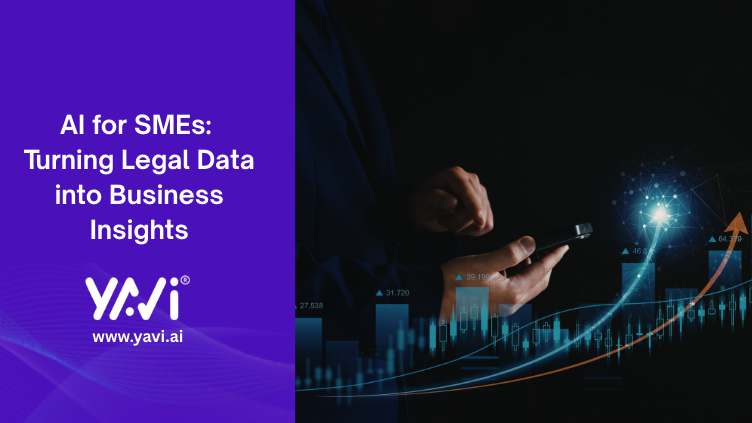
AI for SMEs: Turning Legal Data into Business Insights
How Legal Intelligence Is Becoming the New Competitive Advantage
Introduction: Legal Data Is the Most Underutilized Strategic Asset in SMEs
For decades, legal data inside SMEs has lived in the shadows.
Contracts were signed, filed away, and revisited only when something went wrong. Compliance updates were tracked manually. Legal opinions were consumed as static advice rather than dynamic inputs into business strategy. In most organizations, legal data was treated as defensive documentation — necessary, expensive, and largely disconnected from growth decisions.
Generative AI has fundamentally changed this equation.
Today, the same legal artifacts — contracts, case histories, policies, regulatory filings, correspondence — can be transformed into predictive, actionable business intelligence. For SMEs navigating global markets, evolving regulations, and increasing risk exposure, this shift is not incremental. It is existential.
The question is no longer whether SMEs should apply AI to legal operations.
The real question is: How can SMEs turn legal data into real business insights — safely, explainably, and at scale?
Why Legal Data Matters More Than Ever in the Age of Generative AI
The Business Reality SMEs Face
SMEs operate in a paradox:
- They face enterprise-level regulatory expectations
- With non-enterprise legal budgets
- And limited internal legal expertise
At the same time, legal complexity is accelerating:
- Cross-border contracts
- Sector-specific compliance obligations
- AI governance requirements (EU AI Act)
- Data privacy and sovereignty mandates
Legal data now touches pricing, vendor selection, product launch timelines, M&A decisions, and risk exposure. Yet most SMEs still lack the infrastructure to extract insights from it.
This is where Legal Data Intelligence emerges as a strategic discipline.
From Documents to Decisions: What Legal Data Intelligence Really Means
Legal Data Intelligence is not about automating document review alone. It is about converting legal signals into decision-ready insights.
At its core, it enables SMEs to:
- Detect contractual risk before it materializes
- Predict compliance impact before regulations change
- Quantify legal exposure in financial terms
- Align legal strategy with business priorities
This requires a combination of:
- Agentic AI
- Retrieval-Augmented Generation (RAG)
- Explainable AI (XAI)
- Workflow orchestration
- Human-in-the-loop governance
Together, these form the backbone of a modern SME AI strategy for legal intelligence.
The Shift from Reactive LegalOps to Ambient Legal Intelligence
Traditional Legal Operations (LegalOps) focus on efficiency: faster reviews, lower costs, better tracking.
Ambient Legal Intelligence, by contrast, embeds legal awareness into everyday business decisions.
Instead of asking:
“Is this contract compliant?”
SMEs can ask:
“What does our contract portfolio tell us about margin risk, supplier dependency, and regulatory exposure?”
This transition is enabled by AI systems that continuously observe, analyze, and surface insights from legal data — without waiting for human prompts.
Core Technologies Powering Legal Data Intelligence for SMEs
1. Retrieval-Augmented Generation (RAG): Trust at the Core
Generative AI without grounding is dangerous in legal contexts. Hallucinations are unacceptable when contracts, compliance, and litigation are involved.
RAG solves this problem by ensuring that AI outputs are generated only after retrieving relevant, authoritative legal data — contracts, statutes, case law, internal policies.
For SMEs, RAG enables:
- Verifiable legal research
- Defensible contract interpretation
- Audit-ready compliance insights
This is essential for algorithmic accountability and regulatory confidence.
2. Agentic AI: From Queries to Outcomes
Agentic AI represents a shift from single-response assistants to goal-oriented systems capable of executing multi-step workflows.
In legal and compliance scenarios, this includes:
- Contract ingestion → clause extraction → risk scoring → escalation
- Regulatory update detection → impact analysis → internal notification
- Litigation data analysis → outcome prediction → strategy recommendation
Agentic AI reduces dependency on manual coordination while preserving oversight through Human-in-the-loop (HITL) mechanisms.
3. Semantic Search: Understanding Legal Meaning, Not Just Keywords
Legal language is nuanced. Keyword search fails where intent, precedent, and context matter.
Semantic search enables SMEs to:
- Query contracts and case law using natural language
- Discover hidden obligations or inconsistencies
- Surface related risks across documents
This dramatically improves legal research productivity and insight discovery.
4. Explainable AI (XAI) and Human-in-the-Loop (HITL)
Legal decisions require justification, not black-box outputs.
Explainable AI ensures that:
- Recommendations are traceable
- Confidence levels are visible
- Sources are clearly cited
HITL workflows allow legal and business leaders to validate, override, or refine AI outputs — balancing automation with accountability.
Real-World Challenges SMEs Face When Adopting Legal AI
Despite the promise, adoption is not trivial.
Fragmented Data Landscapes
Legal data lives across PDFs, emails, shared drives, legacy systems, and external counsel repositories.
Regulatory Anxiety
SMEs fear introducing AI systems that could violate data protection, IP, or AI governance laws.
ROI Pressure
Leadership demands tangible business outcomes, not experimental pilots.
Talent Constraints
Most SMEs lack in-house AI architects or legal technologists.
These challenges cannot be solved by point tools. They require integrated, AI-native platforms.
How Yavi.ai Turns Legal Data into Business Intelligence
Yavi.ai is purpose-built to help SMEs operationalize legal intelligence — securely, explainably, and at scale.
1. Intelligent Data Ingestion & Curation
Yavi.ai ingests structured and unstructured legal data from:
- Contracts and CLM systems
- Litigation and dispute records
- Regulatory repositories
- Internal legal knowledge bases
This data is normalized, enriched, and curated into a legal intelligence layer — ready for AI consumption.
2. RAG-Driven Legal Insights
Every AI output on Yavi.ai is grounded in retrieved legal data, ensuring:
- Accuracy
- Transparency
- Auditability
This makes Yavi suitable for regulated industries and compliance-sensitive SMEs.
3. Workflow Orchestration Across LegalOps
Yavi enables end-to-end workflow orchestration, including:
- Intelligent Contract Lifecycle Management (CLM)
- Automated risk assessment
- Regulatory change management
- AI-driven e-discovery
This replaces fragmented tools with a unified legal operating system.
4. Privacy-Preserving and Governance-First Design
Yavi.ai incorporates:
- Privacy-preserving computation
- Role-based access control
- Data sovereignty support
- AI governance dashboards
This positions SMEs for EU AI Act compliance and future regulatory regimes.
Industry Scenarios: Legal Data as Business Intelligence
Healthcare SMEs
- Continuous monitoring of regulatory changes
- Automated compliance risk scoring
- Contractual obligation tracking with providers and vendors
Financial Services & FinTech
- Predictive compliance analytics
- AI-driven audit readiness
- Contract-based risk modeling
Manufacturing & Supply Chain
- Supplier contract intelligence
- ESG and force majeure monitoring
- Cross-border regulatory insights
Professional Services & Legal SMEs
- Faster legal research
- Predictive litigation insights
- Knowledge management 2.0
Across sectors, the pattern is consistent: legal data informs strategic decisions, not just legal ones.
Measuring ROI: What Legal Data Intelligence Delivers
SMEs adopting legal data intelligence report:
- Faster contract cycles
- Reduced external legal spend
- Improved compliance confidence
- Better risk visibility
- Stronger executive decision-making
The ROI is not just cost reduction — it is business agility and foresight.
The Strategic Implication: Legal Becomes a Growth Enabler
When legal data is transformed into actionable intelligence:
- Legal teams move closer to the business
- Compliance becomes proactive
- Risk becomes quantifiable
- Strategy becomes data-driven
This marks the evolution from LegalOps for control to Legal Intelligence for growth.
Looking Ahead: Ambient Legal Intelligence as the SME Standard
The future of SME legal operations is:
- Always-on
- Predictive
- Explainable
- Embedded into business workflows
AI will not replace legal judgment. But legal teams empowered by AI will outperform those without it.
Call to Action: Build Legal Intelligence, Not Legal Overhead
For SMEs, the competitive advantage of the next decade will not come from having more lawyers — but from having smarter legal intelligence.
By combining:
- Agentic AI
- RAG-based trust
- Explainable, governed models
- Human-in-the-loop oversight
Yavi.ai enables SMEs to turn legal data into business insights — securely, responsibly, and at scale.
👉 Discover how at **www.yavi.ai/legal**
메타데이터
- post_id
- a9a124cea6c3
- slug
- ai-for-smes-turning-legal-data-into-business-insights-a9a124cea6c3
- url
- https://medium.com/@yavi.ai/ai-for-smes-turning-legal-data-into-business-insights-a9a124cea6c3
- canonical_url
- https://medium.com/@yavi.ai/ai-for-smes-turning-legal-data-into-business-insights-a9a124cea6c3
- author_url
- https://medium.com/@yavi.ai
- status
- ok
- fetched_at
- 2026-07-13 06:23:13