Highway Design and Pavement Engineering: What You Learn in M.Tech Highway Engineering
Transportation infrastructure is the backbone of economic development, and highways play a vital role in connecting cities, industries, and…
Highway Design and Pavement Engineering: What You Learn in M.Tech Highway Engineering
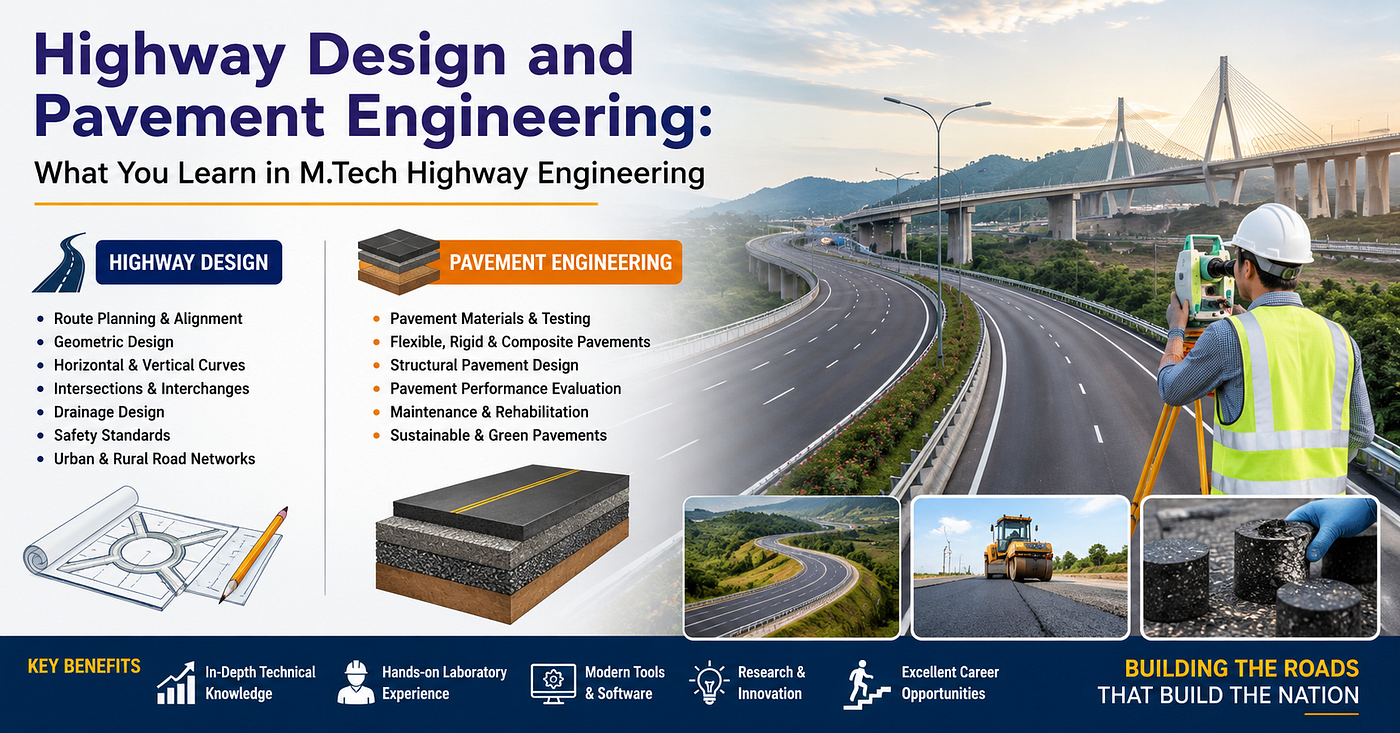
Highway design and pavement engineering overview
Transportation infrastructure is the backbone of economic development, and highways play a vital role in connecting cities, industries, and rural areas. As India continues to invest in expressways, smart roads, and large-scale transportation projects, the demand for skilled highway engineering professionals is increasing rapidly. An M.Tech in Highway Engineering equips students with advanced knowledge and technical expertise in highway design, pavement engineering, traffic management, and transportation planning.
Among the various subjects covered in the program, Highway Design and Pavement Engineering are two of the most important areas of study. These subjects provide the foundation for designing safe, durable, and efficient road networks that meet modern transportation needs.
Understanding Highway Design
Highway design involves the planning and engineering of roads to ensure safety, efficiency, and sustainability. During an **M.Tech in Highway Engineering**, students learn how highways are designed to accommodate different types of vehicles, traffic volumes, and environmental conditions.
The study of highway design includes:
- Route planning and alignment selection
- Geometric design of roads
- Horizontal and vertical curves
- Highway intersections and interchanges
- Road drainage systems
- Highway safety standards
- Design of urban and rural road networks
Students learn how to analyze terrain, traffic patterns, and environmental factors before designing transportation infrastructure. Modern highway design focuses on reducing accidents, improving traffic flow, and minimizing environmental impact.
Geometric Design of Highways
One of the most important components of highway design is geometric design. This subject teaches students how to determine road width, lane configuration, gradients, curves, sight distance, and intersection layouts.
Proper geometric design ensures:
- Safe vehicle movement
- Better visibility for drivers
- Reduced accident risks
- Improved traffic efficiency
- Comfortable driving conditions
Engineers use national and international design standards to create road networks that meet safety and performance requirements.
Introduction to Pavement Engineering
Pavement Engineering focuses on the design, construction, evaluation, and maintenance of road surfaces. Since pavements are subjected to heavy traffic loads and environmental conditions, proper design is essential for long-term performance.
In an **M.Tech Highway Engineering Course**, students gain detailed knowledge about different pavement systems, materials, and construction techniques.
The subject covers:
- Flexible pavements
- Rigid pavements
- Pavement materials and testing
- Structural pavement design
- Pavement performance evaluation
- Maintenance and rehabilitation techniques
Understanding pavement behavior helps engineers develop durable roads capable of supporting increasing traffic demands.
Pavement Materials and Testing
Students learn about the materials used in highway construction, including:
- Bitumen
- Asphalt mixtures
- Aggregates
- Cement concrete
- Recycled pavement materials
Laboratory testing helps evaluate the strength, durability, and performance characteristics of these materials. This practical knowledge enables engineers to select suitable materials for different road conditions.
Pavement Design Techniques
A major part of pavement engineering involves pavement design. Students study methods for calculating pavement thickness, load-bearing capacity, and expected service life.
Key areas include:
- Traffic load analysis
- Soil and subgrade evaluation
- Pavement layer design
- Structural analysis
- Life-cycle cost assessment
These concepts help engineers create cost-effective and long-lasting transportation infrastructure.
Modern Technologies in Highway Engineering
Today’s highway projects increasingly rely on advanced technologies. M.Tech students are introduced to:
- Geographic Information Systems (GIS)
- Intelligent Transportation Systems (ITS)
- Traffic simulation software
- Pavement design software
- Digital surveying techniques
These tools improve planning accuracy, project efficiency, and infrastructure management.
Research Opportunities
Research is an important part of the M.Tech program. Students often work on innovative projects related to:
- Sustainable pavement materials
- Smart highways
- Road safety engineering
- Traffic management systems
- Pavement maintenance strategies
- Green transportation infrastructure
Research activities help students develop problem-solving abilities and contribute to advancements in transportation engineering.
Career Benefits
The knowledge gained in highway design and pavement engineering opens doors to various career opportunities, including:
- Highway Engineer
- Pavement Engineer
- Transportation Engineer
- Traffic Engineer
- Infrastructure Consultant
- Project Manager
- Research Engineer
Graduates can work in government organizations such as NHAI, PWD, and BRO, as well as private infrastructure companies and consultancy firms.
Apply Now for M.Tech in Highway Engineering
📞 Call Us: +91–9870200541 📧 Email: admissions@muit.in
🌐 Apply Online: MUIT Lucknow Admission Portal
🏫 Visit Website: MUIT Lucknow Official Website
FAQs
1. What is Highway Design in M.Tech Highway Engineering? Highway Design focuses on planning, alignment, geometric design, safety standards, and efficient road network development.
2. What is Pavement Engineering? Pavement Engineering involves the design, construction, maintenance, and evaluation of road surfaces and pavement materials.
3. What types of pavements are studied in the course? Students learn about flexible pavements, rigid pavements, composite pavements, and modern pavement technologies.
4. Why is pavement design important? Proper pavement design ensures durability, safety, cost-effectiveness, and long service life for roads and highways.
5. What laboratory work is included in Pavement Engineering? Students perform material testing, pavement analysis, asphalt testing, aggregate testing, and performance evaluation experiments.
6. What software tools are used in Highway Engineering? GIS, traffic simulation software, pavement design software, and transportation planning tools are commonly used.
7. What research areas are available in Highway Engineering? Research topics include smart highways, sustainable pavement materials, traffic management, road safety, and intelligent transportation systems.
8. What careers are available after studying Highway Design and Pavement Engineering? Graduates can work as Highway Engineers, Pavement Engineers, Transportation Engineers, Consultants, and Project Managers.
9. Is Highway Engineering a good specialization after Civil Engineering? Yes, it offers excellent career opportunities due to increasing infrastructure development and transportation projects.
10. Can I work in government departments after M.Tech Highway Engineering? Yes, graduates can apply for positions in NHAI, PWD, BRO, state highway departments, and other infrastructure organizations.
메타데이터
- post_id
- a9a2248ace55
- slug
- highway-design-and-pavement-engineering-what-you-learn-in-m-tech-highway-engineering-a9a2248ace55
- url
- https://medium.com/@premmuit/highway-design-and-pavement-engineering-what-you-learn-in-m-tech-highway-engineering-a9a2248ace55
- canonical_url
- https://medium.com/@premmuit/highway-design-and-pavement-engineering-what-you-learn-in-m-tech-highway-engineering-a9a2248ace55
- author_url
- https://medium.com/@premmuit
- status
- ok
- fetched_at
- 2026-06-25 07:00:49