The Fragile Triumph of the Fiber-Optic Drone
Drone Grand Challenges Trilogy - Part 1 of 3
The Fragile Triumph of the Fiber-Optic Drone
Drone Grand Challenges Trilogy - Part 1 of 3
Why Future Drones Must Survive Without Perfect Communications
A strand of glass no thicker than a fishing line is quietly reshaping modern warfare.
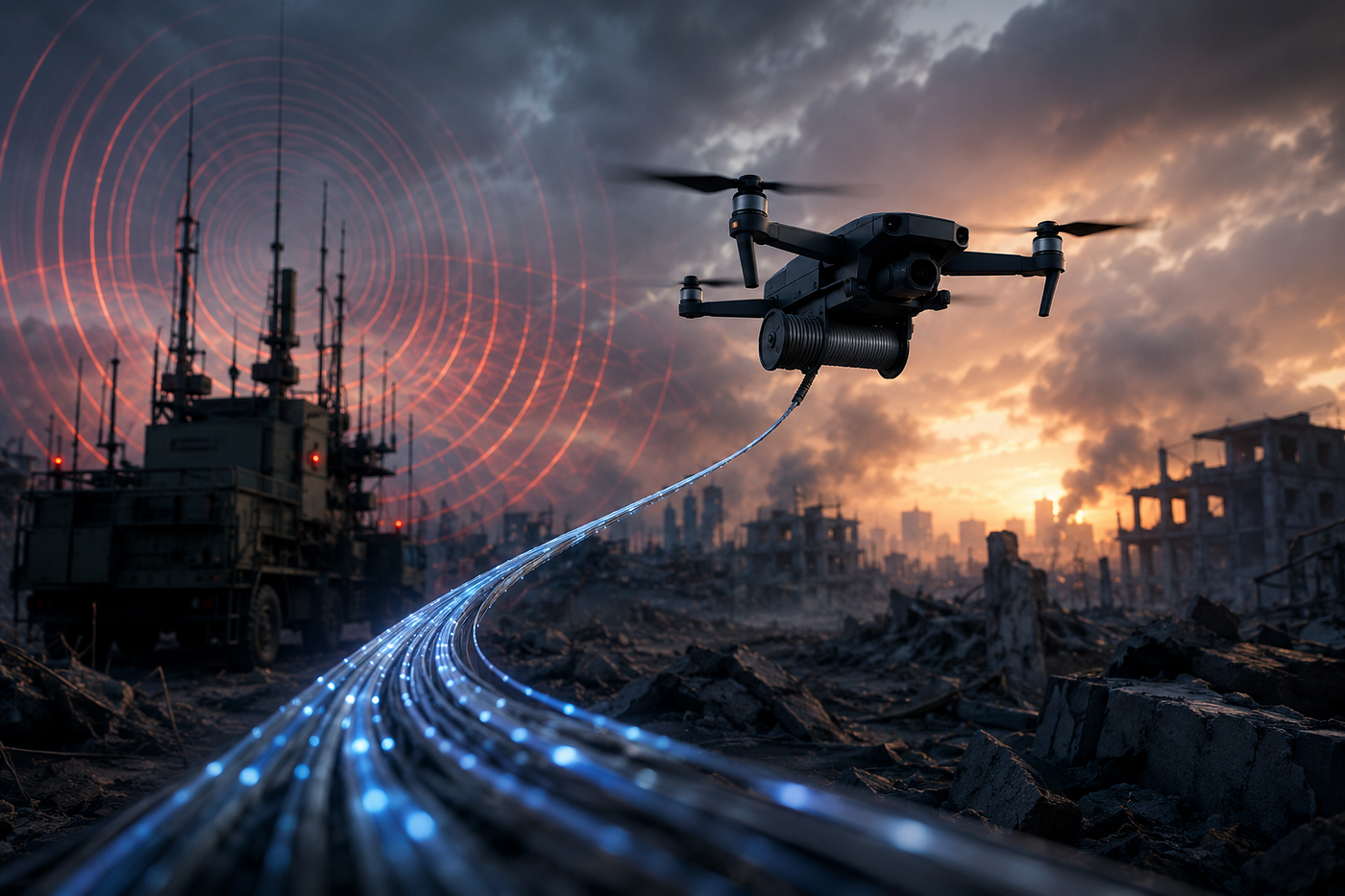
As a small quadcopter races across the battlefield, a spool of optical fiber unravels behind it at highway speeds, maintaining a direct connection to an operator positioned several kilometers away. Around it, electronic warfare systems saturate the air with powerful radio interference, disrupting conventional drone communications. Yet the fiber-optic drone continues its mission almost unaffected, transmitting commands and high-definition video through pulses of light instead of radio waves.
What fascinates me is that one of the most advanced battlefield technologies today depends on something remarkably simple: a physical wire.
The fiber-optic drone represents one of the most significant tactical adaptations to emerge from the increasingly hostile electromagnetic environment. By replacing vulnerable radio links with an optical fiber, these systems are highly resistant to radio frequency jamming while providing an exceptionally reliable, low-latency connection between operator and aircraft.
Yet this success reveals an interesting paradox.
The same physical tether that protects the communication link also introduces new operational constraints. As future battlefields become larger, faster, and increasingly autonomous, relying on a continuous physical connection may ultimately prove just as limiting as relying on radio communication itself.
The question is no longer whether drones can survive electronic warfare. It is whether they can survive when every form of communication becomes unreliable.
The Invisible Radio War
To understand why militaries have embraced fiber-optic drones, it helps to appreciate how contested the electromagnetic spectrum has become.
Over the past few years, electronic warfare has evolved from a specialized capability into a routine feature of modern conflict. Powerful jamming systems can overwhelm the radio frequencies used by many commercial and military drones, interrupting command links, degrading video transmission, and disrupting satellite navigation.
I find that electronic warfare often receives far less public attention than missiles or tanks, yet it has become one of the defining technologies shaping modern warfare.
Traditional drones depend on wireless communication between the aircraft and its operator. When a jammer floods the surrounding spectrum with interference, the drone may lose command signals, experience severe video degradation, or be forced into emergency recovery modes. Depending on the platform and its level of onboard autonomy, this can result in mission failure or the loss of the aircraft.
Fiber-optic guidance addresses one of these critical vulnerabilities by moving the communication channel entirely outside the radio spectrum.
A lightweight spool of optical fiber, typically only a few tenths of a millimeter in diameter, deploys continuously as the drone flies. Commands travel to the drone through pulses of light, while high-resolution video returns to the operator through the same fiber.
Because the communication link never propagates through the air as a radio signal, it is effectively immune to conventional RF communication jamming. The operator benefits from a highly reliable connection with extremely low latency, allowing precise maneuvering even in heavily contested electromagnetic environments.
For many tactical missions, it provides a level of control that conventional wireless drones struggle to maintain.
The Physical Cost of a Perfect Connection
Despite these advantages, fiber-optic guidance does not eliminate engineering trade-offs. It simply exchanges electromagnetic vulnerabilities for mechanical ones.
Every meter of fiber carried into the air adds weight. Every turn introduces the possibility of snagging. Every obstacle increases the chance that the tether will break.
From what I have seen, this is where the engineering becomes especially interesting. The battlefield is no longer only an electronic contest. It is also a contest against physics.
Several practical limitations define today’s fiber-optic systems.
Additional payload. Carrying kilometers of optical fiber inevitably increases the drone’s mass. Although modern fiber is remarkably lightweight, the spool still occupies valuable payload capacity and reduces the energy available for flight.
Environmental hazards. Flying through forests, urban streets, damaged buildings, or complex terrain creates numerous opportunities for the fiber to snag on branches, power lines, debris, or sharp structures. If the tether breaks, the operator immediately loses the communication link unless the drone can transition to onboard autonomous control.
Operational flexibility. Missions that require repeated changes in direction, extended loitering, or complex routes through dense terrain become progressively more difficult as the tether twists around obstacles. Returning safely to the launch point may be possible, but it becomes increasingly challenging as the route grows more complicated.
Current systems typically operate over distances ranging from several kilometers to a few tens of kilometers, depending on the platform, payload, and spool capacity. Within these ranges, they provide an effective solution for precision strikes and reconnaissance in heavily jammed environments.
Beyond Physics
The physical limitations are significant, but they are not the most fundamental challenge.
Engineers can build lighter fiber spools, stronger materials, and more sophisticated deployment mechanisms. Those are difficult engineering problems, but they are solvable.
The deeper limitation lies in the underlying system architecture.
A fiber-optic drone still assumes that every important decision depends on maintaining a continuous connection with a human operator. The communication channel may be exceptionally reliable, but the aircraft remains fundamentally dependent on it.
I would argue that this assumption becomes increasingly difficult to sustain as warfare grows faster, more distributed, and increasingly autonomous.
Although the communication link itself is highly resistant to RF jamming, the drone’s trajectory can still reveal valuable information. Combined with radar, optical tracking, acoustic sensing, or other battlefield intelligence, an adversary may estimate the approximate launch location, potentially exposing operators to return fire.
The tether also becomes increasingly difficult to manage as the number of drones increases.
Imagine dozens of drones operating simultaneously across a dense urban battlefield. Each aircraft trails several kilometers of optical fiber while navigating buildings, trees, and other obstacles. Coordinating such operations quickly becomes as much a logistical challenge as an engineering one.
One thing that stands out to me is that every engineering breakthrough eventually reveals a new bottleneck. Fiber optics solved one of the biggest weaknesses of wireless drones, but they also introduced an entirely different set of operational constraints.
The Next Step Is Not Better Communication
History suggests that many successful technologies evolve by removing dependencies rather than strengthening them.
For decades, engineers improved drone survivability through stronger radios, better antennas, frequency hopping, encryption, and increasingly sophisticated anti-jamming techniques. Fiber-optic drones represent another important milestone along that path.
But perhaps the next breakthrough is not better communication.
Perhaps it is learning how to operate without continuous communication altogether.
I believe this represents one of the most significant shifts currently taking place in autonomous robotics.
Instead of streaming commands throughout an entire mission, future drones are increasingly likely to receive mission objectives before launch and execute much of the operation independently. Communication becomes advantageous rather than essential.
From Connected Flight to Autonomous Flight
Achieving this vision requires far more than simply adding artificial intelligence.
A drone operating without reliable communications must first solve one of robotics’ most difficult challenges: determining where it is.
Satellite navigation may be unavailable because of jamming or spoofing. Instead, the aircraft must estimate its position using onboard sensors such as cameras, inertial measurement units, LiDAR, radar, or combinations of these systems. Techniques including Visual SLAM, visual-inertial odometry, terrain-relative navigation, and AI-assisted perception allow drones to navigate even when GPS cannot be trusted.
Only after reliable navigation has been established can onboard intelligence perform higher-level decision making.
As the drone approaches its destination, computer vision algorithms identify landmarks, recognize objects of interest, avoid obstacles, and continuously refine the flight path. Depending on the mission and rules of engagement, onboard AI may identify, track, or engage targets with varying degrees of human supervision.
All of this computation occurs onboard.
No continuous radio transmissions are required. No fiber trails behind the aircraft. The drone simply observes, reasons, and acts using its own sensors and processors.
From what I have seen across robotics research, edge computing is becoming just as important as advances in artificial intelligence. Processing information directly onboard reduces latency, minimizes communication requirements, and allows systems to continue functioning even when connectivity disappears.
The Future Is Resilient Autonomy
None of this suggests that communication will become obsolete.
Human oversight will remain essential for many military and civilian operations, particularly where legal, ethical, or safety considerations require human judgment. Future autonomous systems will likely communicate whenever conditions allow while remaining capable of continuing their mission safely when those links are disrupted.
This resilience, rather than complete independence, is what future drone designers are striving to achieve.
The fiber-optic drone should therefore be viewed not as the final destination, but as an important transition in the evolution of unmanned systems. It demonstrates that removing dependence on vulnerable radio links can dramatically improve survivability in contested environments. The next logical step is reducing dependence on any continuous communication channel.
I think this lesson extends well beyond military drones. Whether exploring disaster zones, inspecting critical infrastructure, conducting search-and-rescue missions, or operating on another planet, future autonomous machines will increasingly be judged not by how well they communicate, but by how effectively they continue working when communication cannot be guaranteed.
The future will not belong to the drone with the strongest signal or the longest fiber.
It will belong to autonomous systems that can perceive, decide, adapt, and accomplish their missions even when the world around them falls silent.
✓ Part 1: *The Fragile Triumph of the Fiber-Optic Drone • [Part 2: The Gravity Tax](https://medium.com/@therayelab/the-gravity-tax-a42e5968796d) • [Part 3: The Invisible Shield](https://medium.com/@therayelab/the-invisible-shield-a9777def4bf7)*
메타데이터
- post_id
- a9b37f2d1c23
- slug
- the-fragile-triumph-of-the-fiber-optic-drone-a9b37f2d1c23
- url
- https://medium.com/@therayelab/the-fragile-triumph-of-the-fiber-optic-drone-a9b37f2d1c23
- canonical_url
- https://medium.com/@therayelab/the-fragile-triumph-of-the-fiber-optic-drone-a9b37f2d1c23
- author_url
- https://medium.com/@therayelab
- status
- ok
- fetched_at
- 2026-07-22 08:44:43





