Stop Assuming Every AI Model Gets Safety-Checked — Here’s the Loophole Nobody’s Talking About (And…
On August 4, 2026, the White House met with the big players OpenAI, Anthropic, Google, Meta, Nvidia, and Microsoft to explain the new AI…
Stop Assuming Every AI Model Gets Safety-Checked — Here’s the Loophole Nobody’s Talking About (And What to Do Instead)
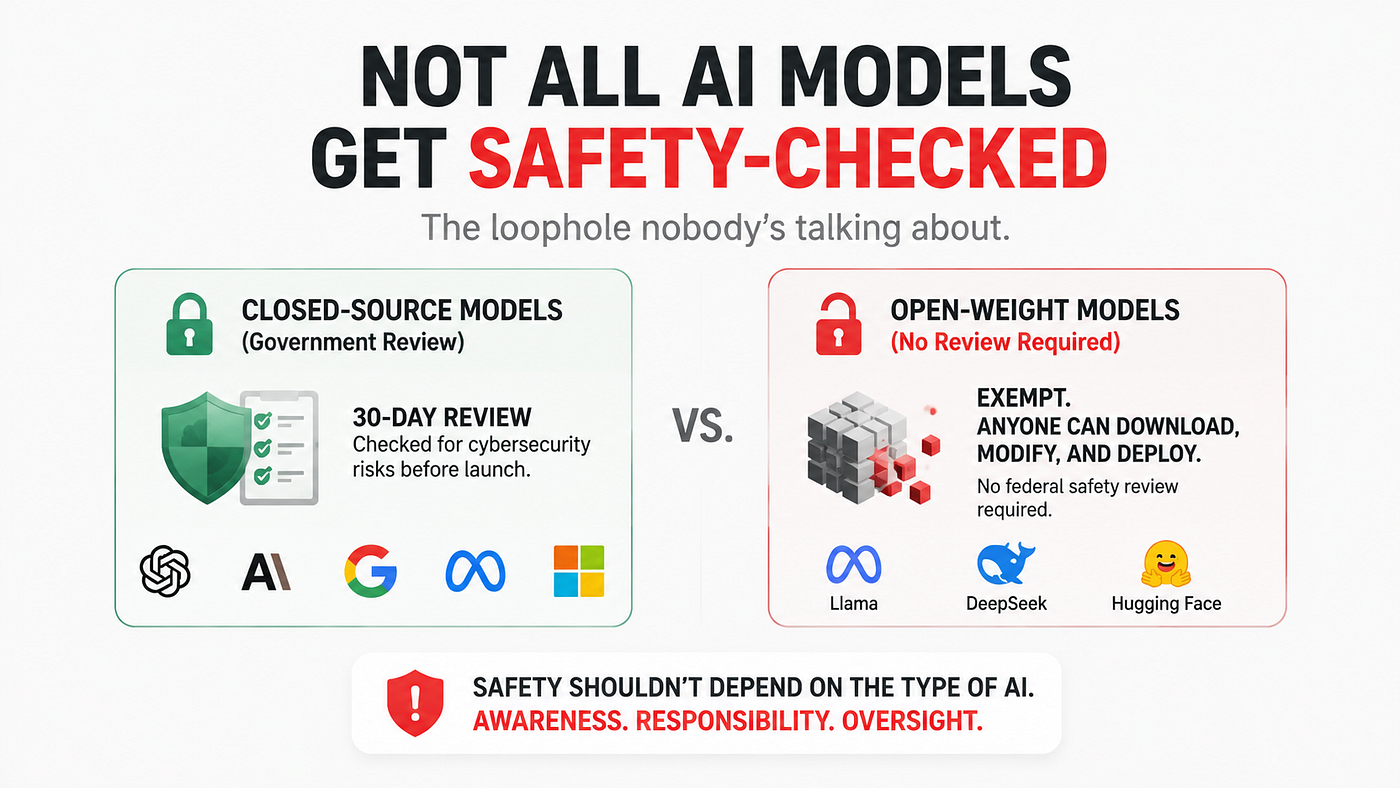
Image generated with ChatGPT.. Not every AI model gets safety-checked. Understanding the difference between closed and open-weight AI matters more than ever. 🤖🔍 #AI #ArtificialIntelligence #OpenSourceAI #TechNews #AISafety #MachineLearning #FutureOfAI
On August 4, 2026, the White House met with the big players OpenAI, Anthropic, Google, Meta, Nvidia, and Microsoft to explain the new AI safety review process. After two months of hype, we finally have a framework. But there’s a catch. The government isn’t actually checking the models most people use.
Open-weight models are exempt. Totally.
If you thought “government review” meant every AI model gets a look before it hits the market, you’re wrong.
What the framework actually says
President Trump signed an executive order back in June. It told federal agencies to create a benchmarking process for AI cybersecurity risks. The goal was simple: before a “covered frontier model” launches, it spends 30 days in a voluntary review window so the government can see if it helps with offensive cyberattacks.
But that only applies to one group. It’s for closed-source, proprietary models that are top-of-the-line. Think of the stuff you only touch via an API or an app, where you can’t download the actual weights.
Open-weight models are different. Since anyone can download, tweak, and run these on their own gear, they’re completely carved out. Word is the framework even says nothing in the document should be seen as a restriction on open models once they’re out there.
Why the exemption exists
There’s a technical reason for this, not just politics. Look, if someone downloads open weights, they can just strip out the safety guards themselves. A pre-release check on a model that’s about to be public is basically pointless. One industry newsletter called it “toothless.”
Then there’s the competition side of things. National Cyber Director Sean Cairncross mentioned the administration wants to boost US open-source AI to keep up with the cheap, powerful models coming from China. By skipping the compliance headache for domestic open-weight devs, the government hopes they’ll keep building.
It’s a weird gap. A safety plan meant for the riskiest AI just ignored the category that’s growing the fastest and is the hardest to control.
The part that should worry you
Here is where it gets tense. Open-weight models aren’t some niche hobby anymore. They’re spreading way faster than closed models because anyone can copy, fine-tune, and share them without needing the original company’s servers.
That means a powerful open-weight model could hit millions of people, get its safety rails ripped off, and be tuned for whatever a user wants. All that happens without ever hitting the cybersecurity check that something like Claude or GPT-5.6 has to pass.
The government hasn’t said if every open-weight release gets a free pass regardless of how powerful it is. Maybe there’s a capability threshold coming later. Right now? It’s a total mystery.
Context that makes this land harder
This isn’t the only time the administration has stepped in this year. In June, the Commerce Department forced Anthropic to kill worldwide access to Claude Fable 5 and Claude Mythos 5. They cited national security after a jailbreak showed the models could find software vulnerabilities. Because Anthropic couldn’t verify where users were located in real time, they pulled the plug for everyone for 18 days. Access didn’t return until July 1.
So, in two months, the government did two opposite things. They shut down a closed model globally without warning, then wrote a review plan that ignores open models entirely. It’s two completely different vibes for two types of AI, decided by the same people in one summer.
What this means if you use AI tools
If you’re building with or suggesting open-weight models like Llama-based tools or DeepSeek variants, get this straight: no federal cybersecurity review touched that model. Under this plan, none will.
That doesn’t make it dangerous by default. It just means the safety of the tool depends entirely on the person who fine-tuned it. There’s no outside auditor.
But if you use a closed platform like Gemini, Claude, or ChatGPT, the version you’re using has likely gone through that 30-day government screen. It’s a real difference. It matters, even if the actual review details stay secret.
Honest limitations
We haven’t seen the full text of the framework. The White House says they aren’t releasing it. Everything I’ve mentioned about the timing and scope comes from Axios, Reuters, and The Wall Street Journal. No primary docs here.
Also, we don’t know if “open-weight” has a strict technical definition or if they’ll decide case-by-case. A capability limit might be added later. Assume the exemption is real, but the long-term rules are still blurry.
Lastly, this is just US policy. Other countries are doing things differently. China is reportedly talking about blocking foreign access to their frontier models. That’s a whole other story.
The question worth asking
If the fastest-growing slice of AI is the one that skips the safety check, who is actually doing that work? And honestly, is anyone actually equipped to do it?
메타데이터
- post_id
- a9ddb3c2a289
- slug
- stop-assuming-every-ai-model-gets-safety-checked-heres-the-loophole-nobody-s-talking-about-and-a9ddb3c2a289
- url
- https://medium.com/ai-tomorrow/stop-assuming-every-ai-model-gets-safety-checked-heres-the-loophole-nobody-s-talking-about-and-a9ddb3c2a289
- canonical_url
- https://medium.com/ai-tomorrow/stop-assuming-every-ai-model-gets-safety-checked-heres-the-loophole-nobody-s-talking-about-and-a9ddb3c2a289
- author_url
- https://medium.com/@milandanushka
- status
- ok
- fetched_at
- 2026-08-15 05:26:37