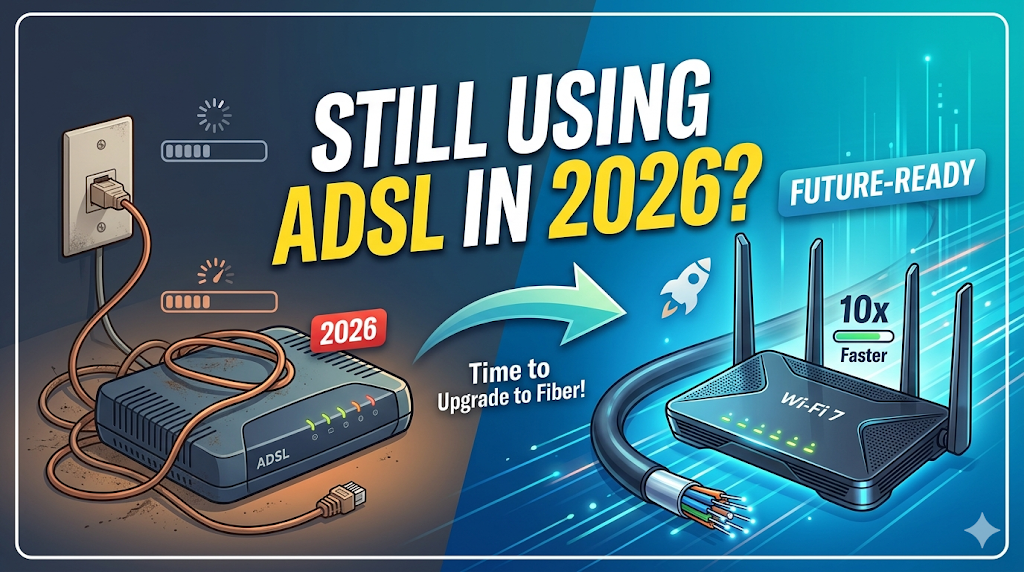
Still Using ADSL in 2026? Here’s What It’s Costing Your Network
A few months ago, we started noticing something strange in a small office network we were reviewing.
Still Using ADSL in 2026? Here’s What It’s Costing Your Network
A few months ago, we started noticing something strange in a small office network we were reviewing.
Video calls were lagging. Cloud apps felt inconsistent. File uploads took far longer than expected. At first, the assumption was the usual one — maybe the router was outdated, or the Wi-Fi needed optimization.
But after a closer look, the issue wasn’t inside the network at all.
It was the broadband connection.
The office was still running on ADSL.
The Hidden Bottleneck Most Teams Ignore
When network performance drops, many teams instinctively look inward — switches, routers, access points. But in many cases, the real bottleneck sits outside the office: the access technology itself.
Technologies like ADSL, VDSL, and fiber aren’t just different in name — they represent entirely different generations of connectivity.
If you’re not clear on how they compare, this breakdown of ADSL vs VDSL is a good starting point. But beyond definitions, what really matters is how these technologies impact real-world business usage.
ADSL: Reliable, But No Longer Enough
ADSL was built for a different era of internet usage — when browsing websites and sending emails were the primary demands.
It still works. It’s stable. And in areas with limited infrastructure, it remains a practical option.
But in a modern work environment, its limitations become obvious:
- Low upload speeds slow down cloud backups and file sharing
- Limited bandwidth struggles with multiple users
- Latency issues affect video conferencing and VoIP
In short, ADSL isn’t “broken” — it’s just outpaced by how we work today.
VDSL: A Practical Upgrade, With Limits
VDSL was designed to push more performance out of existing copper infrastructure. In many cases, it delivers a noticeable improvement over ADSL, especially for small teams.
For offices that need:
- Stable video calls
- Moderate cloud usage
- Multiple connected devices
VDSL can be a reasonable step forward.
But it comes with a trade-off that’s often overlooked: distance sensitivity.
Performance drops significantly the farther you are from the street cabinet. Two offices on the same plan can experience completely different speeds depending on location.
Fiber: Not Just Faster — More Consistent
Fiber isn’t just about higher speeds. It’s about consistency.
Because it uses light instead of electrical signals, fiber connections are far less affected by interference or distance. That translates into:
- Stable high-speed connections
- Low latency for real-time applications
- Better performance under heavy load
For teams relying on cloud platforms, remote collaboration, or large data transfers, the difference is immediately noticeable.
The Part Most People Miss: Internal Network Still Matters
Upgrading from ADSL to VDSL — or even to fiber — can solve many performance issues. But it doesn’t solve everything.
One of the most common misconceptions is that a faster internet line automatically fixes network problems.
In reality, broadband is only one part of the equation.
If your internal network isn’t designed to handle increased bandwidth — through proper switching, traffic segmentation, and routing — you may still experience bottlenecks.
We’ve seen cases where businesses upgraded to fiber but saw minimal improvement, simply because their internal infrastructure couldn’t keep up.
So, Should You Upgrade?
There’s no one-size-fits-all answer, but a few indicators make the decision clearer.
If your team relies on:
- Video conferencing on a daily basis
- Cloud-based tools (SaaS, storage, collaboration)
- Remote access or VPN connections
- Multiple users sharing bandwidth simultaneously
Then staying on ADSL is likely costing more in productivity than it saves in price.
VDSL can be a short-term improvement, especially where fiber isn’t available. But if fiber is an option, it’s usually the more future-proof choice.
Final Thought
Broadband upgrades are often treated as a simple speed decision.
In reality, they’re a foundation decision.
The type of connection you choose affects not just how fast your internet is, but how reliably your entire network operates.
And sometimes, the biggest performance issue isn’t inside your network at all — it’s the line connecting you to the outside world.
메타데이터
- post_id
- a9fbb3852efb
- slug
- still-using-adsl-in-2026-heres-what-it-s-costing-your-network-a9fbb3852efb
- url
- https://medium.com/@gongselene0/still-using-adsl-in-2026-heres-what-it-s-costing-your-network-a9fbb3852efb
- canonical_url
- https://medium.com/@gongselene0/still-using-adsl-in-2026-heres-what-it-s-costing-your-network-a9fbb3852efb
- author_url
- https://medium.com/@gongselene0
- status
- ok
- fetched_at
- 2026-06-14 13:58:26