THE MEGACITY COLLAPSE RISK | How Rapid Urbanization Is Creating Ungovernable Megalopolises
**THE MEGACITY COLLAPSE RISK | How** Rapid Urbanization Is Creating Ungovernable Megalopolises
The world is undergoing an unprecedented wave of urbanization. As of November 2025, 45% of the global population (3.69 billion people) lives in urban areas, up from just 20% in 1950. By 2050, nearly two-thirds of humanity is projected to reside in cities. More significantly, the number of megacities — urban areas with populations of 10 million or more — has more than quadrupled, from 8 in 1975 to 33 in 2025, and is projected to reach 37 by 2050.
This document examines the widening infrastructure deficits, environmental crises, and governance failures that are creating the conditions for systemic urban collapse in rapidly urbanizing developing nations. While megacities serve as powerful engines of economic growth, they are increasingly becoming pressure cookers of poverty, disease, pollution, and climate vulnerability.
1. The Unprecedented Rise of Megacities
1.1 Historical Context
In 1950, the world had just two megacities: Tokyo and New York. By 1975, that number had increased to only eight. Today, it has more than quadrupled to 33. The pace of this expansion is extraordinary — more megacities have emerged over the past 50 years than during all of recorded urban history before 1975.
As of 2025:
- Jakarta (Indonesia): 42 million residents (the world’s most populous city under the latest UN methodology)
- Dhaka (Bangladesh): 40 million residents
- Tokyo (Japan): 33 million residents
- Delhi (India): Projected to become the world’s largest city by 2050, with approximately 47 million residents
- More than half (19 of 33) of the world’s megacities are located in Asia.
- 27 of the world’s 33 megacities are in developing countries.
1.2 The Seven Countries Driving Urban Growth
The UN World Urbanization Prospects 2025 identifies seven countries that are expected to account for more than half of the world’s urban population growth between 2025 and 2050: India, Nigeria, Pakistan, the Democratic Republic of the Congo (DRC), Egypt, Bangladesh, and Ethiopia.
These countries share a critical characteristic: they are urbanizing before industrializing at scale. Unlike today’s developed economies, which largely industrialized before experiencing gradual urbanization, these nations are undergoing rapid urban population growth without the corresponding economic capacity to build the infrastructure required to support it.
2. The Infrastructure Crisis
2.1 The Gap Between Population Growth and Infrastructure Development
The fundamental challenge is that cities in developing countries are expanding 3.7 times faster than the infrastructure needed to support their growing populations. Between 2000 and 2020, urban areas expanded geographically at rates that far outpaced population densification, resulting in low-density, service-deficient urban sprawl that is difficult and costly to provide with essential services such as water, sanitation, transportation, and electricity.
In India — the epicentre of this crisis — flagship initiatives such as the Smart Cities Mission and AMRUT (Atal Mission for Rejuvenation and Urban Transformation) have completed thousands of infrastructure projects. However, these programmes continue to operate at only a fraction of the scale required to meet the country’s rapidly growing urban needs. By mid-2025, India had approved substantial investments in urban infrastructure, yet the gap between demand and available capacity remained severe.
2.2 The World’s Largest Megacities (2025)
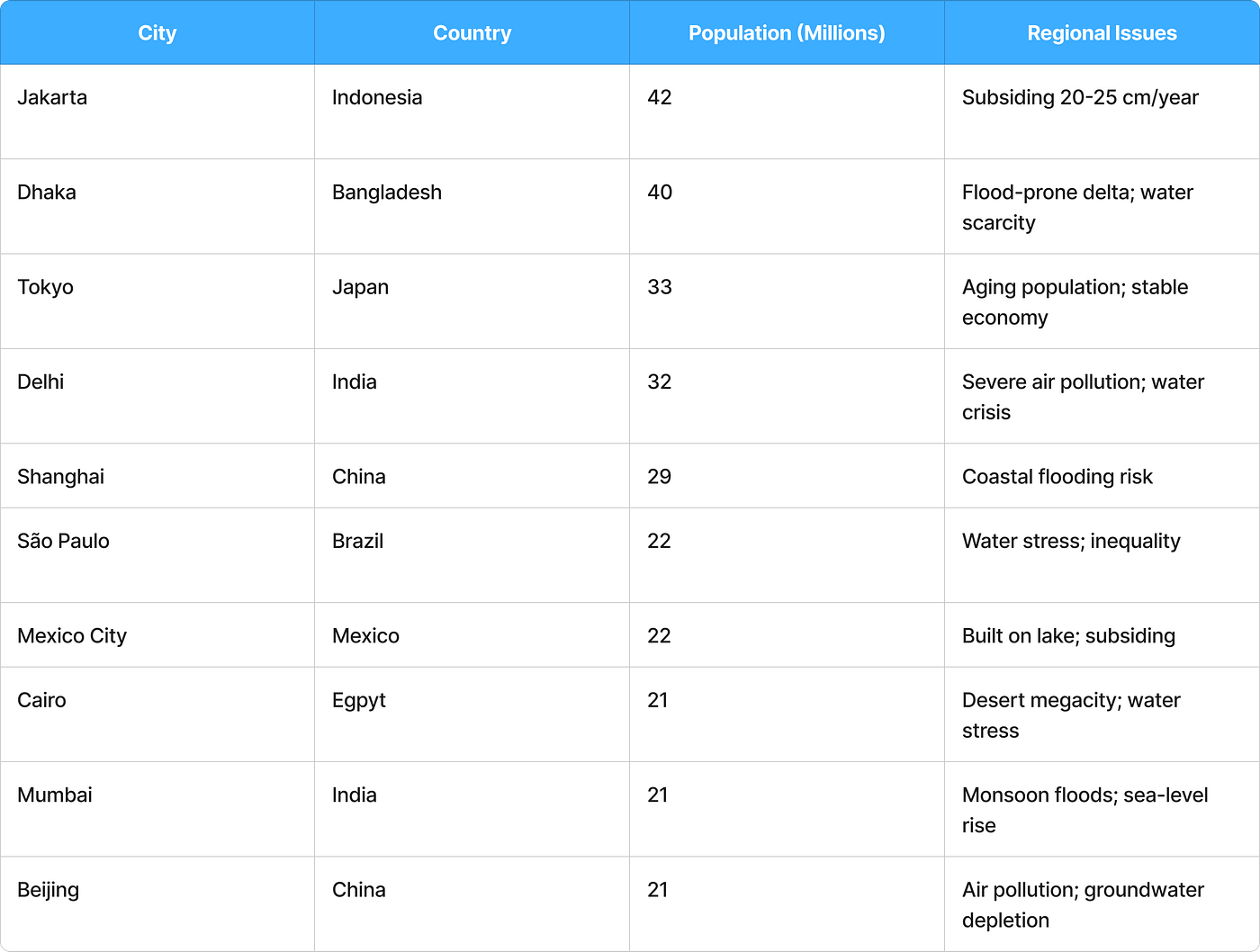
Source: UN World Urbanization Prospects 2025; Oxford Economics; various national statistical offices.
2.3 Water and Sanitation: The Core Crisis
Approximately 1.1 billion people — around one-quarter of the world’s urban population — live in slums or informal settlements that lack adequate access to clean water, sanitation, durable housing, and secure land tenure. In 2022, 24.8% of the global urban population lived in slum conditions, marking a reversal of the progress achieved over previous decades.

In South Asia specifically, only 23% of the urban population has access to safely managed sanitation services (UN-Habitat, 2024). This means that in cities such as Dhaka, Delhi, and Kolkata, a significant proportion of residents still lack access to adequate sanitation infrastructure.
The health consequences are immediate and severe: 88% of global diarrhoeal disease cases are attributed to inadequate sanitation and unsafe water. Surveys of Dhaka’s slum communities indicate that 78% of residents reported experiencing illness within the preceding two months, with diarrhoea and fever being the most commonly reported conditions. Despite the availability of improved sanitation facilities in certain areas, the use of unlined pits and open latrines in informal settlements continues to contaminate broader water systems, affecting health outcomes across all socioeconomic groups.
2.4 Electricity Access and Energy Poverty
While global electrification rates have improved significantly, many megacity slums continue to function as energy deserts, with residents facing unreliable or inadequate access to electricity. Many households rely on illegal grid connections, kerosene-powered generators, or remain completely without electricity. This energy insecurity creates a cascade of social, health, and economic challenges:
- Limited refrigeration for food and medicines, increasing the risk of spoilage and reduced access to essential healthcare supplies.
- Lack of lighting after dark, creating significant safety and security risks, particularly for vulnerable populations.
- Limited ability to charge essential devices, including mobile phones and medical equipment.
- Dependence on kerosene lamps, which pose significant fire risks and contribute to indoor air pollution and respiratory health problems.
- Absence of cooling systems during extreme heat events, increasing vulnerability to heat-related illnesses and fatalities.
3. Air Pollution and Health Crisis
3.1 The Scale of Pollution in Megacities
Air pollution represents the silent crisis of megacities. Often overlooked in policy discussions, it contributes to measurable reductions in life expectancy, particularly in highly polluted urban centres such as Delhi, Mumbai, and Dhaka.

Source: Scientific Reports (2021); Springer Nature Air Pollution Studies (2024–2025); WHO guidelines.
A 2024 study estimated that air pollution contributes to approximately 80,447 premature deaths annually across 31 major Indian cities. The leading cause of these deaths is ischaemic heart disease (47%), followed by chronic obstructive pulmonary disease (COPD) (17%) and stroke (14.7%).
The distribution of major pollution sources in India’s megacities highlights the systemic nature of the crisis:
- Industrial emissions: 30–40% of total air pollution
- Vehicle emissions: 25–35%
- Construction and road dust: 15–20%
- Biomass burning (seasonal): 10–25%
- Diesel generators and kerosene use: 5–10%
3.2 Health Impacts Across Demographics
Certain population groups bear a disproportionately high burden of the health impacts associated with urban air pollution:
- Children under five: Increased risk of acute respiratory infections and impaired lung development.
- Pregnant women: Higher risk of intrauterine growth restriction and premature birth.
- Older adults (65 years and above): Worsening of pre-existing cardiovascular and respiratory diseases.
- Manual labourers: Elevated risk of chronic obstructive pulmonary disease (COPD), compounded by prolonged occupational exposure to air pollutants.
- Residents of informal settlements (slums): Exposure to multiple pollution sources, including both outdoor air pollution and indoor emissions from kerosene use and diesel generators, combined with limited access to healthcare services.
4. Climate Vulnerability of Coastal Megacities
4.1 Sea Level Rise and Land Subsidence
Twenty-one of the world’s 31 megacities are located along coastlines. Of these, 13 are in Asia, many of which face a dual threat: rising sea levels and land subsidence.
Jakarta exemplifies the severity of this crisis:
- Land subsidence rate: 20–25 cm per year, with some areas sinking by as much as 40 cm annually.
- Extent of vulnerability: Approximately 80% of the city lies below sea level.
- Primary causes: Excessive groundwater extraction (including illegal wells), soil compaction caused by urban development, and natural aquifer subsidence.
- Projected impact by 2050: Flood-prone areas could expand by approximately 110.5 km².
- Government response: Indonesia has initiated the relocation of its capital to Nusantara in Borneo, with the project remaining ongoing.
4.2 Coastal Megacities Most at Risk

Source: India’s Ministry of Earth Sciences (2024); IPCC AR6; TERI Report (2024).
4.3 Direct Economic Impacts
Mumbai Case Study (TERI, 2024)
- More than 2,000 buildings are projected to be at risk of flooding by 2030.
- Approximately 30 km of roads is vulnerable to flooding.
- Property values in low-lying areas, such as Colaba, have declined by an estimated 10–15% since 2020.
- Estimated economic losses: ₹1–2 trillion over the next 25 years.
Chennai Case Study (2023)
The 2023 northeast monsoon floods submerged approximately 1,200 residential flats, caused an estimated ₹15,000 crore (US$1.8 billion) in damages, and halted construction on 20 planned high-rise developments.
Global Context
Research by C40 Cities estimates that, under an unabated climate change scenario, approximately 800 million people and trillions of dollars’ worth of assets will be exposed to increasingly severe climate-related hazards. Coastal cities, in particular, contain some of the world’s highest-value assets at risk.
4.4 Compounding Threats in Megacities
A 2023 Nature study on Mumbai identified a critical interaction between extreme rainfall and high tides. When these events occur simultaneously, they overwhelm urban drainage systems, intensifying flood risks far beyond the impact of either hazard occurring independently.
In Mumbai specifically:
- Extreme monsoon rainfall is associated with approximately 8% of annual deaths in the city’s coastal areas.
- Approximately 80% of flood-related fatalities occur among residents of informal settlements (slums).
- Children under five face the highest mortality risk during extreme rainfall events.
- Women experience greater flood-related risks than men, owing to factors such as mobility constraints and caregiving responsibilities.
5. Governance and Ungovernable Cities
5.1 The Governance Vacuum
Rapid urbanization has outpaced the institutional capacity of many city governments in developing megacities. As a result, municipal authorities face several persistent governance challenges:
- Weak revenue collection: An estimated 40–60% of property tax revenue remains uncollected, while large informal economies further constrain the tax base.
- Limited technical capacity: Shortages of qualified engineers, urban planners, and modern data management systems hinder effective urban planning and service delivery.
- Political fragmentation: Overlapping authority among municipal, district, and state governments often results in poor coordination and delayed decision-making.
- Corruption: Infrastructure contracts are frequently subject to corruption and misallocation of funds, while regulatory enforcement remains weak.
- Complex land tenure and informal settlements: Unclear land ownership, informal occupation, and competing legal claims complicate infrastructure planning and urban redevelopment.
5.2 The Slum Multiplier Problem
As the supply of formal housing fails to keep pace with rapid population growth, informal settlements continue to expand. By their very nature, these settlements present significant challenges to conventional systems of urban governance:
- Absence of formal property records: The lack of property registries makes taxation, land-use planning, and infrastructure investment extremely difficult.
- Lack of formal addressing systems: Without standardized addresses, the delivery of public services and emergency response becomes significantly more challenging.
- Insecure land tenure: Residents often fear eviction or demolition, reducing their willingness to engage with government authorities or participate in redevelopment initiatives.
- Informal power structures: In many settlements, local strongmen, informal landlords, criminal groups, or political intermediaries exercise authority in place of formal institutions.
- Limited enforcement of health and safety standards: Implementing building, sanitation, or safety regulations is often impractical without displacing residents or demolishing existing housing.
6. Traffic, Transportation, and Mobility Crisis
In the megacities of Asia and Africa, only 4 in 10 residents have convenient access to public transportation. The consequences are far-reaching:
- Severe traffic congestion, reducing average peak-hour travel speeds to 5–8 km/h in cities such as Delhi, Bangkok, and Jakarta.
- Elevated levels of air pollution, with vehicle emissions accounting for approximately 25–35% of total urban air pollution.
- Significant economic losses resulting from prolonged commuting times. According to the World Bank, traffic congestion costs major Asian cities an estimated 2–5% of GDP annually.
- High rates of road traffic fatalities, with approximately 1.3 million deaths worldwide each year, around 90% of which occur in low- and middle-income countries.
While infrastructure investments are essential, they are not sufficient on their own. For example, the Delhi Metro has reduced carbon monoxide (CO) concentrations in parts of the city by approximately 34%. However, the expansion of Delhi’s road network and the continued growth in private vehicle ownership have outpaced the expansion of public transit, limiting the overall impact on congestion and emissions.
7. Systemic Collapse Risks
Research from the Humanitarian Futures Programme at King’s College London outlines plausible scenarios in which multiple system failures cascade into systemic urban collapse.
Scenario A: Water Scarcity Trigger
- Climate change and population growth → water scarcity
- Pricing and rationing disputes → social conflict and crime
- Disease outbreaks (cholera, typhoid) → healthcare systems become overwhelmed
- Mortality increases, population flight accelerates, and urban systems begin to break down
Scenario B: Infrastructure Cascade
- A flooding event (monsoon or storm surge) → drainage and water systems fail
- Sewage backlogs → disease outbreaks
- Power grid failure → loss of water treatment and essential services
- Economic activity halts, leading to population displacement and urban disruption
Scenario C: Fiscal Crisis
- Declining tax revenues and rising service costs
- Governments default on debt, forcing the withdrawal of essential public services
- Private utility systems (water and electricity) fail without government subsidies
- Urban breakdown accelerates, followed by large-scale population flight
8. Policy Responses and Their Limitations
8.1 Government Programs in India (Case Study)
India has launched three major urban development initiatives:
Smart Cities Mission
- 100 cities targeted for comprehensive modernization
- Focus: IoT-enabled infrastructure, digital systems, and green buildings
- By mid-2025: Thousands of projects completed
- Limitation: The benefits have been concentrated primarily in affluent areas, while informal settlements remain largely untouched.
AMRUT (Atal Mission for Rejuvenation and Urban Transformation)
- Focus: Water supply, sewerage, and urban transport
- Target: More than 500 cities
- Limitation: Per capita funding remains insufficient to meet the scale of infrastructure demand.
Pradhan Mantri Awas Yojana (Urban)
- Target: Affordable housing for low-income urban populations
- By mid-2025: Millions of housing units sanctioned, although many remain incomplete
- Limitation: The programme has been unable to keep pace with the rapid growth of informal settlements.
8.2 Why the Programs Fall Short
- Scale mismatch: India’s annual housing requirement is approximately 12 million units, while the formal sector delivers only around 2–3 million units each year.
- Financing gaps: Public funding remains inadequate, while private investment is concentrated in profitable neighbourhoods rather than underserved areas.
- Implementation delays: Land acquisition challenges, bureaucratic delays, corruption, and legal disputes slow project execution.
- Limited inclusivity: Many projects fail to adequately serve the lowest-income urban residents.
9. Long-Term Projections and Scenarios
9.1 The Next 25 Years (2025–2050)
Under current trends:
Most Likely Scenario (Business-as-Usual)
- The number of megacities increases from 33 to 37–40.
- The urban population in developing countries grows by 1–2 billion people.
- Infrastructure deficits widen, while the quality of public services declines.
- Slum populations reach 1.5–2 billion people, accounting for more than 40% of urban residents in low-income countries.
- Climate-induced migration intensifies, and coastal cities experience repeated flooding and inundation.
- Periodic public health crises, including disease outbreaks and severe air pollution episodes, result in hundreds of thousands of deaths.
- Political instability increases, and governance fragmentation deepens.
9.2 Optimistic Scenario (Significant Policy Intervention)
If governments prioritize investment in:
- Mass transit expansion (rail-based rather than car-dependent systems)
- In-situ slum upgrading rather than demolition-based redevelopment
- The decentralization of economic activity to secondary cities
- Climate adaptation infrastructure, including flood defences and water storage systems
Possible outcomes: Stabilized megacity growth, a reduction in the size of the informal sector, and improved service delivery across many regions.
Timeline required: 20–30 years
Estimated investment required: US$10–15 trillion globally
10. Conclusion: The Ungovernable City Problem
Megacities in developing countries face a fundamental paradox: they are too large to ignore as engines of economic growth, yet too large to govern effectively with existing institutional capacity and financial resources.
The crisis is not accidental. Rapid urbanization occurring before industrialization creates a structural mismatch between population growth, infrastructure capacity, and economic output. When combined with climate change, environmental degradation, and governance failures, the result is the emergence of increasingly ungovernable megacities, where:
- One in four urban residents lives in a slum or informal settlement.
- Basic services, including water, sanitation, and electricity, remain inaccessible to hundreds of millions of people.
- Air pollution is responsible for approximately 6.7 million premature deaths annually.
- Coastal megacities face existential threats from sea-level rise, land subsidence, and increasingly frequent extreme weather events.
- The poorest residents bear a disproportionate share of the health, environmental, and climate-related burdens.
Without transformative policy interventions, scenarios of megacity collapse — once considered largely theoretical — are becoming increasingly plausible by 2050.
References & Sources
- United Nations Department of Economic and Social Affairs (UN DESA). (2025). World Urbanization Prospects 2025: Summary of Results.
- Oxford Economics. (2026). Rise of New Megacities Will Drive Global Urban Growth.
- UN-Habitat. (2024). Slum Dweller Statistics and SDG 11 Analysis.
- Springer Nature. (2024). Extreme Air Pollution in Global Megacities. Current Climate Change Reports.
- Scientific Reports. (2021). Valuing the Burden of Premature Mortality Attributable to Air Pollution in Major Million-Plus Cities of India.
- Climate Scorecard. (2026). India: Sea-Level Rise — Regional Projections and Economic Impact.
- The Energy and Resources Institute (TERI). (2024). Mumbai Coastal Climate Risk Assessment.
- Nature. (2025). Rainfall-Driven Mortality in Mumbai: The Interaction of High Tides and Extreme Precipitation.
- UN-Water. (2024). Urbanization and the Water and Sanitation Crisis.
- Coastal Wiki. (2024). Coastal Cities and Sea-Level Rise: Jakarta and Other Vulnerable Megacities.
메타데이터
- post_id
- aa0613fe3a42
- slug
- the-megacity-collapse-risk-how-rapid-urbanization-is-creating-ungovernable-megalopolises-aa0613fe3a42
- url
- https://medium.com/@manyasingh0620/the-megacity-collapse-risk-how-rapid-urbanization-is-creating-ungovernable-megalopolises-aa0613fe3a42
- canonical_url
- https://medium.com/@manyasingh0620/the-megacity-collapse-risk-how-rapid-urbanization-is-creating-ungovernable-megalopolises-aa0613fe3a42
- author_url
- https://medium.com/@manyasingh0620
- status
- ok
- fetched_at
- 2026-08-08 21:44:17