Background Verification: When AI Screening Meets the Reality on the Ground
Why the most critical hires still demand a field visit — and why Smartik delivers both
Background Verification: When AI Screening Meets the Reality on the Ground
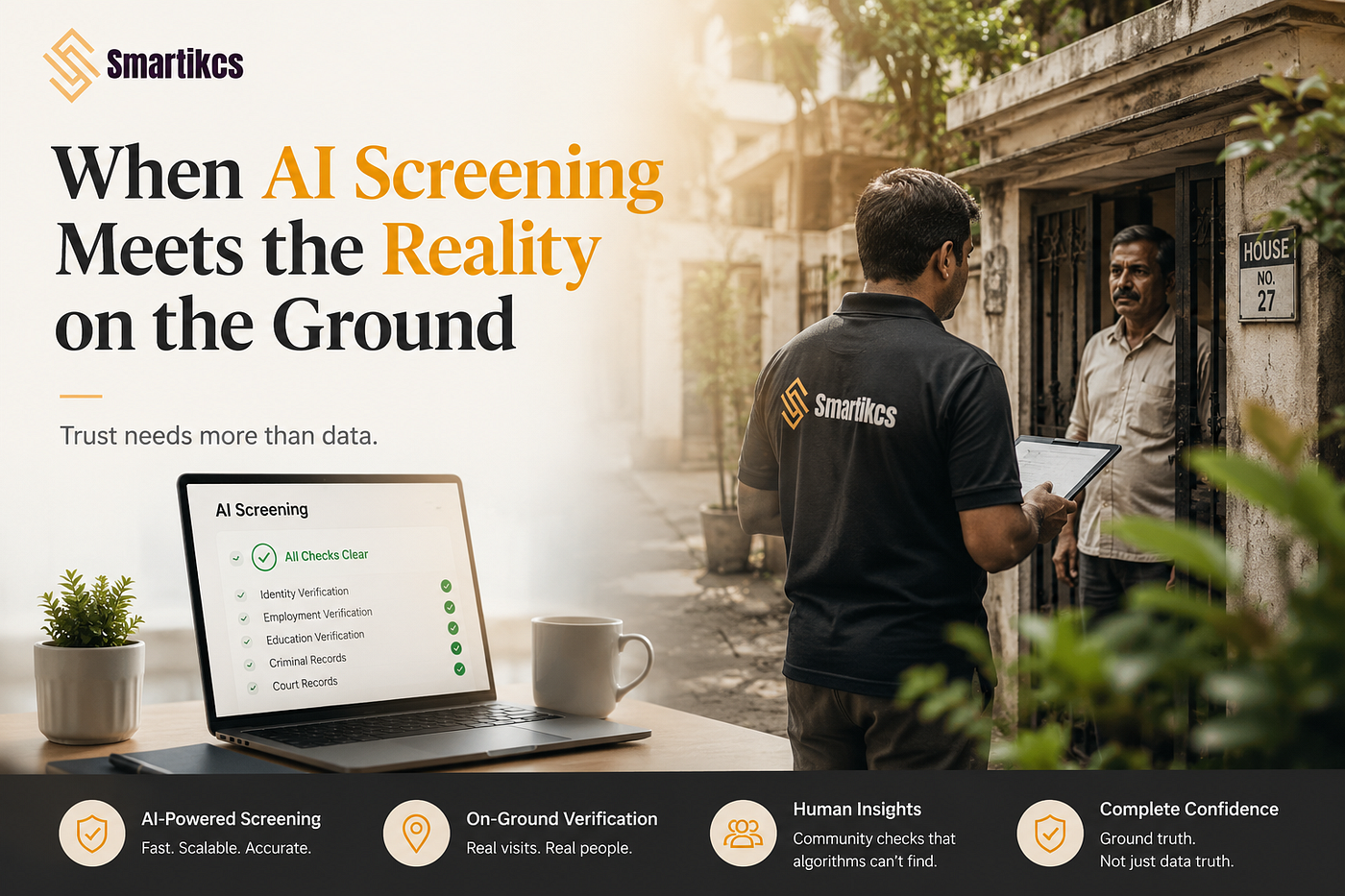
Why the most critical hires still demand a field visit — and why Smartik delivers both
AI can process a resume in seconds. It cannot knock on a door.
You have shortlisted your next senior hire. Their resume is immaculate. Their LinkedIn checks out. The AI-powered background verification system has returned a green flag across every parameter — employment history, education credentials, criminal database, court records. Clean. Fast. Confident.
And then your field verification agent visits the address on the candidate’s document.
The house doesn’t exist.
This is not a hypothetical. It happens. And it is the single most important reason why background verification — real background verification — cannot be reduced to a database query, no matter how sophisticated the algorithm powering it.
The Promise of AI in Background Verification
Let’s be clear about what AI-powered BGV has genuinely transformed.
The traditional background check was slow, expensive, and inconsistent. A recruiter would submit documents, wait days for responses, chase HR contacts at previous employers, and manually cross-reference records — all before an offer could be extended. The process was a bottleneck, and in high-volume hiring, it became a liability.
AI changed that calculus dramatically.
AI-powered BGV platforms can now:
- Instantly verify identity documents — Aadhaar, PAN, passport, driving license — against government databases with liveness detection to rule out spoofed or forged submissions
- Run criminal and court record checks at scale across national and state databases in minutes, not days
- Scan employment and education records through automated outreach and digital verification networks
- Flag anomalies — gaps in timelines, mismatched dates, inconsistencies between documents — that a fatigued human reviewer might miss
- Deliver audit-ready reports with timestamps, data sources, and compliance trails for regulated industries
The efficiency gains are real. For organizations running hundreds or thousands of background checks a month, AI-led screening compresses TAT from weeks to hours, reduces operational costs significantly, and brings a consistency that manual processes simply cannot match at volume.
At Smartik, we leverage precisely these capabilities — AI-powered KYC, digital identity verification, and automated document authentication — to give our clients the speed and scale their hiring demands.
But here is what we also know, because our field agents tell us every day:
A database is only as honest as the data inside it.
Where AI Hits the Wall
The Address That Doesn’t Exist
AI systems verify addresses against postal databases, utility records, or Aadhaar-linked information. They do not visit them.
A candidate can submit a fabricated address that passes every automated check — the pin code is valid, the locality exists, the format is correct. The AI ticks the box. Only a physical field visit reveals that the building in question is a vacant plot, a commercial establishment, or belongs to a completely different family who has never heard of the applicant.
In India’s BGV landscape — where address documentation for candidates from tier-2 and tier-3 cities, contractual workers, or migrant labor pools is often inconsistent, outdated, or borrowed — physical address verification is not a supplementary step. It is the foundational one.
The Previous Employer Who Agrees to Everything
AI-based employment verification typically works by sending digital queries to HR departments or cross-referencing professional databases. But not every previous employer is digitally indexed. Not every small business, startup, or regional firm has an HR system that responds to automated pings.
More critically — reference fraud is sophisticated. Candidates have been known to list friends or associates as “HR contacts” at previous companies, who then confirm inflated designations and fabricated tenures over phone or email.
A trained field agent conducting in-person employer verification — physically visiting the office, speaking to colleagues, cross-referencing org charts — catches this. An algorithm cannot distinguish between a legitimate HR response and a coached one.
The Neighbour Who Has Known Him for Twenty Years
There is a category of insight that no database in the world contains: community reputation.
For roles involving trust, access, or responsibility — a driver, a domestic worker, a security personnel, a senior executive with fiduciary authority — the most meaningful signal often comes from the people who have observed this individual over years. Neighbours. Local shopkeepers. Community elders. Former landlords.
These conversations do not happen through an API call. They happen when a Smartik field agent walks into a neighbourhood, introduces themselves, and asks the right questions of the right people. The information that surfaces — about character, behaviour, disputes, social standing — is irreplaceable intelligence that no AI system can generate.
The Document That Looks Right But Isn’t
AI document verification has advanced significantly. Optical character recognition, metadata analysis, tamper detection algorithms — modern systems catch a broad range of document fraud.
But document forgery has advanced too.
High-quality fake mark sheets, fabricated experience letters, and doctored address proofs can, in some cases, pass automated checks — particularly when the issuing institution’s digital records are not connected to any verification database (a common reality with older Indian universities, unregistered trade schools, or small private employers).
A Smartik field verification agent physically visiting the issuing institution — a university registrar, a previous employer’s office, a court — and obtaining manual confirmation closes this gap definitively. It is the difference between trusting a document and verifying one.
The Comparison: AI BGV vs Manual Field Verification
Parameter AI-Powered Verification Manual Field Verification Speed Minutes to hours Days Scale Thousands simultaneously Limited by agent availability Cost Low per-unit cost Higher per-unit cost Address Verification Database match only Physical confirmation Employment Check Digital query / database In-person employer visit Character & Community Check Not possible Neighbour & reference interviews Document Authenticity Digital tamper detection Source institution confirmation Fraud Catch Rate (Sophisticated)Moderate High Regulatory Admissibility Strong for digital records Essential for disputed cases Rural / Tier-3 Coverage Limited (database gaps) Ground-level reach
The table tells the story clearly. AI and manual verification are not competitors. They are complements — and the organizations that treat them as an either/or choice are the ones that end up with a problem hire.
The Smartik Approach: Ground Truth, Not Just Data Truth
At Smartik, we have built our verification practice around a simple principle: your trust in a hire should be earned on the ground, not just in the cloud.
Our AI-powered screening handles what algorithms do best — fast, consistent, scalable checks across identity, criminal records, court databases, and digital employment trails. We deliver swift, compliant, and secure background checks that meet the demands of modern enterprise hiring.
But for the checks that matter most — address verification, in-person employer confirmation, reference interviews, physical document authentication at source — our field agents are on the ground. In your candidate’s neighborhood. At their previous employer’s office. At the university that issued the degree. Speaking to people who actually know this individual.
This is the difference between background verification as a compliance checkbox and background verification as genuine risk intelligence.
Who Needs Manual Field Verification Most
Executive and Leadership Hiring: A wrong hire at the C-suite level can damage an organization's reputation, finances, and operations irreparably. Senior executive screening demands the highest standard of verification — and that standard includes field confirmation, not just digital records.
Roles Involving Physical Access or Trust: Security personnel, drivers, domestic staff, facility managers — roles where a person has unsupervised access to your premises, your assets, or your family require community-level character verification that only a field agent can conduct.
Financial Sector Onboarding: Banks, NBFCs, insurance companies, and fintech platforms face regulatory mandates around KYC and employee due diligence. For roles with fiduciary responsibility, digital verification alone may not satisfy audit requirements.
Blue-Collar and Contractual Workforce: This is arguably where AI verification is most limited. Workers with informal employment histories, limited digital footprints, and non-standard documentation require a ground-level approach — physical address confirmation, in-person reference checks, and community-based verification.
High-Stakes Client-Facing Roles: Any position where the candidate will represent your brand, manage client relationships, or handle sensitive data warrants verification that goes beyond the database.
The Cost of Getting It Wrong
The average cost of a bad hire is estimated at anywhere from six months to two years of that employee’s annual salary — accounting for recruitment costs, productivity loss, training investment, legal exposure, and the cost of re-hiring.
For a mid-level manager at ₹12–15 lakhs per annum, that is a potential loss of ₹6–30 lakhs per wrong hire. For a senior executive, the number grows by an order of magnitude.
Against that figure, the cost of a thorough background verification — including field visits — is negligible. It is not an expense. It is insurance.
Conclusion: Trust Is Built on the Ground
The future of background verification is not AI replacing field agents. It is AI and field agents working in concert — each doing what the other cannot.
Let AI give you speed. Let field verification give you certainty. And let the combination give you what every hiring decision ultimately demands: confidence.
Because at the end of the day, you are not hiring a resume. You are hiring a person. And people — their real history, their actual character, their true circumstances — exist in the physical world.
That is where Smartik meets them.
Ready to build a verification process you can actually trust?
At Smartik, we combine AI-powered background screening with on-ground field verification to give you the complete picture — fast, compliant, and thorough.
🌐 **www.smartikcs.com ✉️ [connect@smartikcs.com](mailto:connect@smartikcs.com)**
Talk to us about customizing a verification workflow that matches your hiring volume, risk profile, and industry requirements.
메타데이터
- post_id
- aa0789aa0aaa
- slug
- background-verification-when-ai-screening-meets-the-reality-on-the-ground-aa0789aa0aaa
- url
- https://medium.com/@ingolekhushbooo25/background-verification-when-ai-screening-meets-the-reality-on-the-ground-aa0789aa0aaa
- canonical_url
- https://medium.com/@ingolekhushbooo25/background-verification-when-ai-screening-meets-the-reality-on-the-ground-aa0789aa0aaa
- author_url
- https://medium.com/@ingolekhushbooo25
- status
- ok
- fetched_at
- 2026-06-09 15:37:30