From Coder to Orchestrator: How Prompt Engineering is Eating Software Development
Why prompt engineering is reshaping software development faster than most developers expected.
From Coder to Orchestrator: How Prompt Engineering is Eating Software Development
Why prompt engineering is reshaping software development faster than most developers expected.
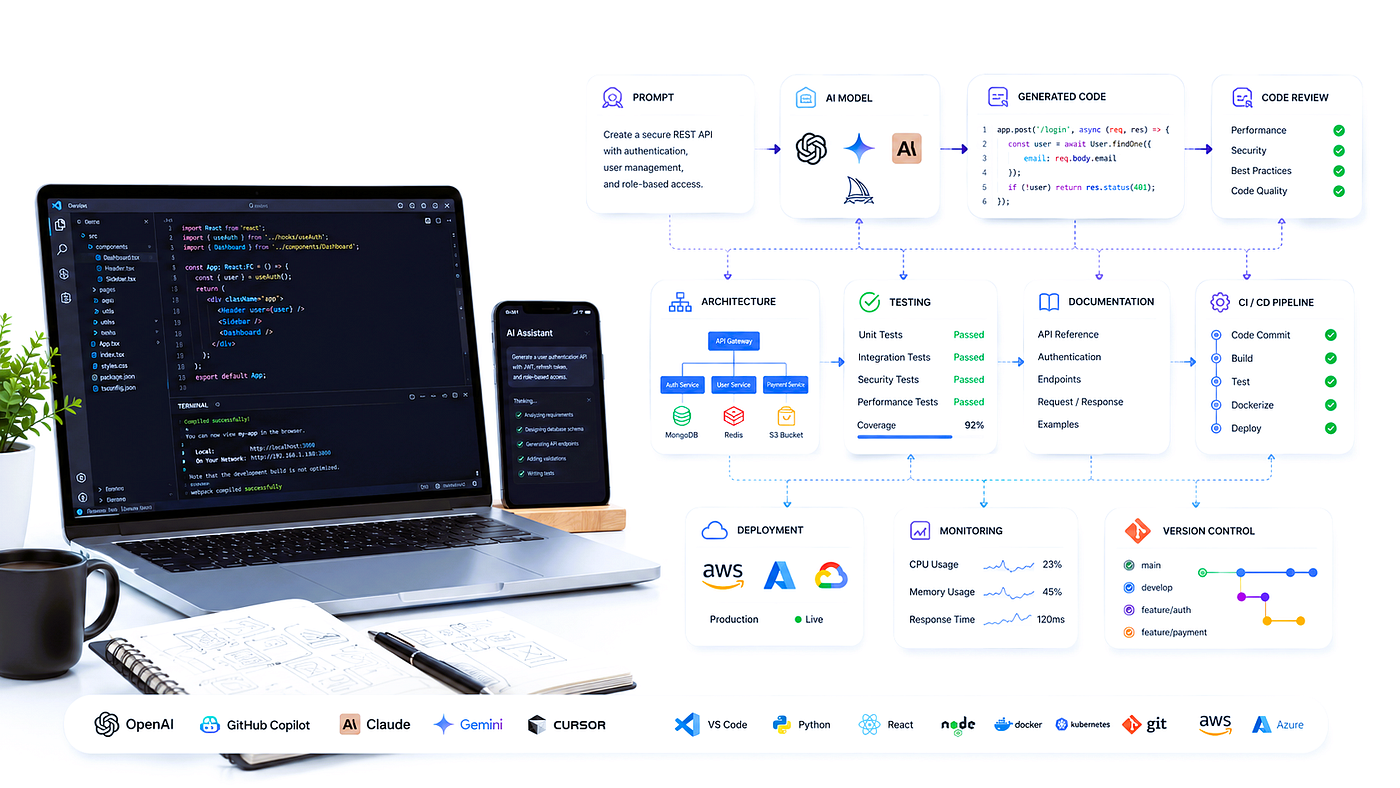
Discover how prompt engineering is transforming software development and why developers are becoming AI orchestrators instead of traditional coders.
Why AI orchestrators, not syntax typers, will rule the future of coding. Meta Description: Learn how software development is being transformed via rapid engineering. For quicker, more intelligent engineering, learn to transition from writing code to orchestrating AI.
For a moment, let’s be honest. Everyone has read the dramatic, dire headlines that predict AI will completely replace developers. You may be wondering if it’s time to abandon GitHub, pack up your cherished mechanical keyboard, and go to farming. The truth, however, is much more fascinating. Engineering is not going away. We are seeing the development of the engineer.
Enter the age of the Orchestrator.
These days, the most prolific coders are casting spells rather than merely writing logic. They create exact, limited natural language instructions that force language models to produce, test, and execute code at incredible rates. Prompt engineering is aggressively consuming traditional software development from the inside out; it’s not just a quirky party trick.
The Great Shift: From Syntax to Semantics
Historically, the goal of programming has been to convert human purpose into syntax that can be understood by machines. To get two APIs to communicate with one another, we had to spend hours battling missing semicolons, struggling with state management, and writing boilerplate code.
That is not what the orchestrator does.
The modern developer states the objective, establishes the restrictions, and lets the language model work out the implementation rather than writing detailed execution instructions. You start composing architectural prompts instead of scripts.
Show Me the Code: Traditional vs. Orchestration
Let’s examine unstructured data extraction, a common source of frustration for developers. Let’s say you have to extract user sentiment and contact information from a disorganized customer service ticket.
This is how we used to construct it: a brittle nightmare with a lot of regex that breaks the moment a user formats their phone number in a different way.
# The Old Way: Brittle Regex and Tears
import re

def extract_user_info_legacy(text):
    # A nightmare of edge cases
    email_pattern = r'[a-zA-Z0-9_.+-]+@[a-zA-Z0-9-]+\.[a-zA-Z0-9-.]+'
    phone_pattern = r'\(?\d{3}\)?[-.\s]?\d{3}[-.\s]?\d{4}'

    # We can't even easily parse sentiment with regex!

    email = re.search(email_pattern, text)
    phone = re.search(phone_pattern, text)

    return {
        "email": email.group(0) if email else None,
        "phone": phone.group(0) if phone else None,
        "sentiment": "Unknown" # Too hard to code manually
    }
Now examine the Orchestrator’s methodology using the OpenAI API, Pydantic, and Python. The semantic schema and the system prompt serve as the “code” in this paradigm. The LLM is viewed by us as a reasoning engine.
# The Orchestrator Way: Semantic Parsing with LLMs
import json
from pydantic import BaseModel, Field
from openai import OpenAI

client = OpenAI()

class UserProfile(BaseModel):
    email: str = Field(description="The user's primary email address")
    phone: str = Field(description="The user's phone number, formatted as +1-XXX-XXX-XXXX")
    sentiment: str = Field(description="The emotional tone of the user's message (e.g., angry, happy, confused)")

def extract_with_prompt_engineering(text: str) -> UserProfile:
    """
    We orchestrate the AI to do the heavy lifting of unstructured parsing.
    The true logic lives in the system prompt and the Pydantic schema.
    """
    system_prompt = (
        "You are an expert data extraction algorithm. "
        "Your job is to parse the user's unstructured text and return ONLY valid JSON "
        "matching the provided schema. Do not hallucinate data. If a field is missing, output 'Not Found'."
    )

    response = client.chat.completions.create(
        model="gpt-4o",
        messages=[
            {"role": "system", "content": system_prompt},
            {"role": "user", "content": text}
        ],
        tools=[{
            "type": "function",
            "function": {
                "name": "extract_profile",
                "description": "Extract user data from unstructured text",
                "parameters": UserProfile.model_json_schema()
            }
        }],
        tool_choice={"type": "function", "function": {"name": "extract_profile"}}
    )

    # The orchestrator handles the pipeline, the AI handles the logic
    tool_call = response.choices[0].message.tool_calls[0]
    return UserProfile.model_validate_json(tool_call.function.arguments)

# Example usage:
messy_input = "Hey, it's John. I'm super frustrated that my order hasn't arrived! Call me at 555-0198 or email john.doe@example.com."
print(extract_with_prompt_engineering(messy_input))
# Output includes accurately parsed email, dynamically formatted phone, and "angry/frustrated" sentiment.
Notice the difference? The Orchestrator wrote zero logic for how to find the email or gauge the sentiment. They only defined what an acceptable output looks like.
The Architecture of an AI-Driven Workflow
Prompt engineering begins to resemble standard software design and ceases to resemble a chatbot interface as it grows in size. A dynamic microservice is created by the AI.
+-------------------+       +--------------------+       +-------------------+
|  User Request     | ----> |  Prompt Router     | ----> | LLM (Reasoning)   |
| (Natural Lang)    |       | (System Prompts)   |       | (Tool Calling)    |
+-------------------+       +--------------------+       +---------+---------+
                                                                   |
                              +--------------------+               |
                              |   Traditional API  | <-------------+
                              |   (Stripe, DB, etc)|
                              +--------------------+
In this architecture, prompt engineering is the glue. It routing requests, formatting contexts, and acting as the translation layer between fuzzy human intent and rigid database schemas.
Why “Just Talk to It” is a Dangerous Myth
There is a widespread misperception that prompt engineering only entails entering courteous requests into ChatGPT. It’s possible that you have heard someone say, “Programming is dead, just use English.”
It’s a trap.
The ambiguity of English is well known. Ambiguity is hated by computers. The field of real prompt engineering is very technical. It entails creating automatic assessment loops, modifying temperature parameters, creating few-shot learning templates, and controlling context windows.
Examine how a contemporary orchestrator creates a scalable prompt template for a particular activity, such as creating secure SQL queries on the fly.
# Prompt Engineering as Modular Architecture
from typing import List

class PromptTemplate:
    def __init__(self, system_instruction: str, examples: List[dict]):
        self.instruction = system_instruction
        self.examples = examples

    def build_prompt(self, user_query: str) -> str:
        # We orchestrate context dynamically to guide the LLM's output
        prompt_parts = [self.instruction, "\n---\nExamples:\n"]

        for ex in self.examples:
            prompt_parts.append(f"User: {ex['input']}\nSQL: {ex['output']}\n")

        prompt_parts.append(f"---\nUser: {user_query}\nSQL: ")
        return "".join(prompt_parts)

# The 'Code' is now semantic examples. This is few-shot prompting in production.
sql_orchestrator = PromptTemplate(
    system_instruction="You are a strict PostgreSQL expert. Convert natural language to secure, read-only SQL. Return ONLY the query string.",
    examples=[
        {"input": "Get active users", "output": "SELECT * FROM users WHERE status = 'active';"},
        {"input": "Count daily logins", "output": "SELECT DATE(login_time), COUNT(*) FROM logins GROUP BY DATE(login_time);"}
    ]
)

final_prompt = sql_orchestrator.build_prompt("Find the top 5 highest paying customers this month")
The orchestrator is aware of the unreliability of zero-shot cues (just posing a query) in production. We significantly improve the output’s deterministic dependability by using structured examples (few-shot prompting).
Setting the Guardrails
Chaining several AI agents together is the next step in this evolution. The Orchestrator does not rely on a single, all-encompassing trigger. Similar to traditional program design, they deconstruct issues into functional pipelines.
# The Orchestrator Pattern: Chaining Agents
def orchestration_pipeline(user_issue: str):
    # Agent 1: Categorize the issue (Fast, cheap model)
    category = classify_issue_with_llm(user_issue)

    if category == 'bug':
        # Agent 2: Extract technical specs based on category
        specs = extract_technical_context_with_llm(user_issue)

        # System: Retrieve relevant docs (RAG)
        relevant_code = vector_db_search(specs)

        # Agent 3: Propose fix (Heavy, expensive reasoning model)
        proposed_fix = generate_code_fix_with_llm(specs, relevant_code)
        return proposed_fix

    return "Issue routed to general human support."
Becoming the Orchestrator
The transition from coder to orchestrator necessitates a fundamental rewiring of your problem-solving process. The desire to control every loop and array manipulation must be let go. Creating reliable systems that can properly handle probabilistic outcomes is your new role.
Software development is only becoming more abstract; it’s not going away. From punch cards, we moved on to Assembly, C, and Python. We are now using AI models to orchestrate natural language.
The engineers that can type the fastest boilerplate will not be the most successful in the upcoming ten years. They will be the orchestrators, the profound minds with the ability to design intricate systems, pose pertinent queries, and issue appropriate cues.
Are you prepared to take the stage?
What is the most intricate workflow you have managed using AI thus far? Let’s talk about the stack’s future once you share your experiences in the comments section below. Click the “follow” button for additional in-depth discussions of tech strategy and AI architecture if you thought this was informative.
메타데이터
- post_id
- aa087d77898f
- slug
- from-coder-to-orchestrator-how-prompt-engineering-is-eating-software-development-aa087d77898f
- url
- https://medium.com/@hadiyolworld007/from-coder-to-orchestrator-how-prompt-engineering-is-eating-software-development-aa087d77898f
- canonical_url
- https://medium.com/@hadiyolworld007/from-coder-to-orchestrator-how-prompt-engineering-is-eating-software-development-aa087d77898f
- author_url
- https://medium.com/@hadiyolworld007
- status
- ok
- fetched_at
- 2026-08-17 22:19:07