Quantum Algorithms and cryptocurrencies: the (Imperfect) resistance of Monero and Zcash
Shor and Grover’s algorithms challenge blockchain security. Monero and Zcash resist better: here’s how and why
Quantum Algorithms and cryptocurrencies: the (Imperfect) resistance of Monero and Zcash
Shor and Grover’s algorithms challenge blockchain security. Monero and Zcash resist better: here’s how and why
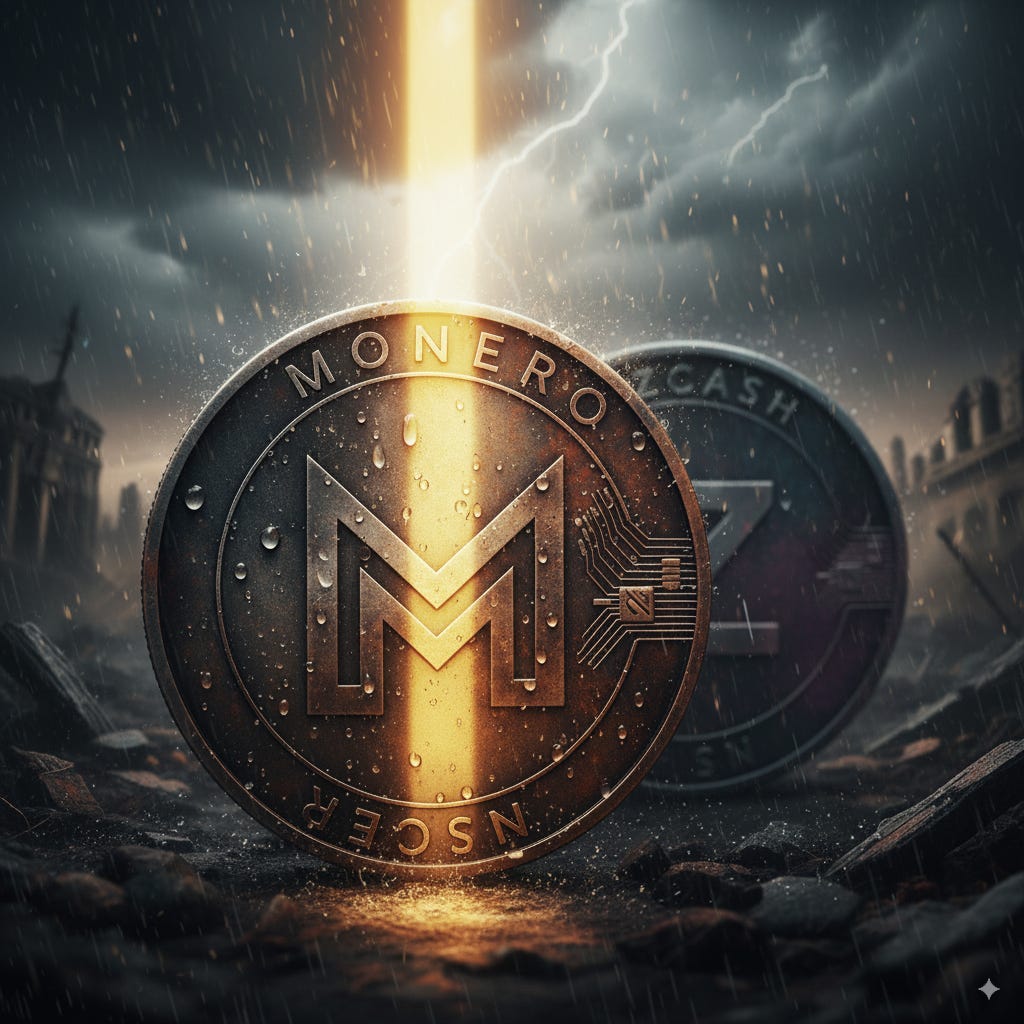
Quantum computing is no longer confined to academic papers or MIT labs. Increasingly concrete, it is beginning to emerge in fields once dominated by classical computation — and blockchain is one of them. The inevitable question now is whether cryptocurrencies are ready — or at least defensible — in the face of the new paradigm introduced by qubits.
To answer this, we need to look at two specific algorithms: Shor and Grover. You don’t need to know the math in detail, but you do need to understand their reach — to see who among Bitcoin, Monero, and Zcash really has something to fear, or something to teach.
Shor: when the public key becomes bait
Shor’s algorithm, introduced in 1994, is designed to solve factorization and discrete logarithm problems exponentially faster than classical methods. A theoretical milestone, yes — but with devastating implications for cryptocurrencies based on asymmetric digital signatures like ECDSA (used by Bitcoin and Ethereum).
In simple terms: if an attacker obtains a user’s public key, they can derive the private key using Shor. This enables a transaction hijacking attack.
How does it work? Imagine a user sending a transaction. The signature, as usual, is based on their public key. While the transaction is in the mempool, it can be intercepted. A sufficiently powerful quantum computer could derive the private key, sign a fraudulent transaction, and broadcast it with a higher fee. Since the system is trustless, it cannot distinguish between the genuine and malicious transaction. The attacker wins.
Grover: the algorithm that halves hash security
If Shor breaks signatures, Grover targets the second pillar of blockchain: hash functions. Used in consensus protocols such as Proof of Work, a secure hash ensures that finding a valid output requires an infeasible number of attempts.
Grover reduces this effort. With a quadratic quantum speedup, it cuts brute force from $2^k$ to $2^{k/2}$ attempts for a $k$-bit hash. Not magic — physics. A quantum computer, in theory, searches in parallel across an unstructured space.
Direct implication? The best-known risk is the classic 51% attack: if an attacker generates blocks faster than the honest network, they can redirect transactions, censor blocks, or double spend. With Grover, this threshold becomes less prohibitive — at least on paper.
Monero: built to hide, and resist
Unlike Bitcoin, Monero (XMR) was born with a radical privacy goal. Its architecture protects not just user data but also its cryptographic structures, making Shor’s attack ineffective.
The key point Monero uses Ring Signatures and Stealth Addresses. In practice, the user’s public key is never exposed on the blockchain. This single detail is decisive: Shor’s attack requires the public key as input. If the key is never visible, the attack is technically impossible.
It’s not just good practice. It’s a structural choice that neutralizes one of the two main quantum vectors at the root.
And Grover? Here things get subtler. Monero uses a PoW called RandomX, designed to favor CPUs and resist ASICs. It’s memory-intensive, a feature that significantly reduces the efficiency of current quantum computers.
Still, we remain in the era of quantum immaturity. Today’s NISQ systems (Noisy Intermediate-Scale Quantum) are neither stable nor fast enough to make Grover a real threat. But the scenario is evolving. Monero’s defense is solid today, but not eternal.
Zcash: cryptography that proves without revealing
Zcash takes another defensive path: it uses zk-SNARKs to enable transactions that prove validity without revealing content. Sender, recipient, amount — all hidden, including the public key.
The result? Here too, Shor’s attack is disarmed. If the key isn’t visible, the private one cannot be derived. Analysis confirms: low risk for shielded addresses.
But Zcash has a weakness: it also allows transparent addresses (t-addresses), similar to Bitcoin’s. These, if reused, expose public keys — paradoxically making users vulnerable while thinking they are using a “privacy-focused” coin.
Grover and consensus Zcash uses Equihash, another memory-hard algorithm. Its resistance is higher than traditional PoW systems. But there’s no guarantee Equihash can withstand a post-NISQ era, when quantum computers become more stable and powerful. The real challenge will be scaling defenses alongside quantum progress.
Who is really quantum-ready?
This overview shows that not all blockchains are equal when facing quantum computing.
- Monero chose to never expose keys.
- Zcash hid everything under zero-knowledge cryptography.
- Bitcoin and Ethereum stayed with ECDSA and SHA-256, exposed to known quantum limits.
The real question: how much time do we have before quantum computing becomes truly operational? And which protocols will evolve in time — without sacrificing decentralization?
📖 Reference: “Literature Review of the Effect of Quantum Computing on Cryptocurrencies Using Blockchain Technology” — arXiv link
❓ FAQ — Cryptocurrencies and Quantum Algorithms: What to Know
🔹 How do quantum computers threaten cryptocurrencies? Through two key algorithms:
- Shor, which can derive private keys from public ones, compromising digital signatures used by Bitcoin and Ethereum.
- Grover, which halves the time to brute-force hash functions, undermining Proof of Work security.
🔹 Why is Monero more resistant to Shor? Because it never exposes the public key on the blockchain. With Ring Signatures and Stealth Addresses masking senders and recipients, Shor’s attack — which requires a public key — is inapplicable.
🔹 Is Zcash truly quantum-resistant? Partially. Its shielded addresses (via zk-SNARKs) hide keys and transactions, making Shor ineffective. But transparent addresses (t-addresses), if reused, expose public keys, leaving users vulnerable.
🔹 Can Grover threaten consensus systems? Yes, but less immediately than Shor. Grover halves brute-force complexity, lowering the bar for potential 51% attacks. However, memory-hard PoW algorithms like RandomX (Monero) and Equihash (Zcash) are more resistant to current NISQ quantum computers.
🔹 Are Bitcoin and Ethereum more exposed? Definitely. Both rely on ECDSA and SHA-256, neither designed to withstand quantum attacks. Without migration to post-quantum schemes, they remain vulnerable on both key (Shor) and hash (Grover) fronts.
🔹 When will the quantum threat become real? There’s no exact date. Current quantum computers are still in the NISQ phase, too unstable for real attacks. But progress is steady, and preparation takes years. It’s not a present-day threat, but it is a real one.
메타데이터
- post_id
- aa2d99b24469
- slug
- quantum-algorithms-and-cryptocurrencies-the-imperfect-resistance-of-monero-and-zcash-aa2d99b24469
- url
- https://medium.com/@andreabelvedere/quantum-algorithms-and-cryptocurrencies-the-imperfect-resistance-of-monero-and-zcash-aa2d99b24469
- canonical_url
- https://medium.com/@andreabelvedere/quantum-algorithms-and-cryptocurrencies-the-imperfect-resistance-of-monero-and-zcash-aa2d99b24469
- author_url
- https://medium.com/@andreabelvedere
- status
- ok
- fetched_at
- 2026-06-20 20:29:01