UAE Data Protection Law (PDPL) Compliance Guide 2026: Requirements, Costs, Penalties, and…
Most UAE businesses are focused on cybersecurity threats, but many overlook a different risk that can be equally damaging: mishandling…
UAE Data Protection Law (PDPL) Compliance Guide 2026: Requirements, Costs, Penalties, and Implementation Roadmap
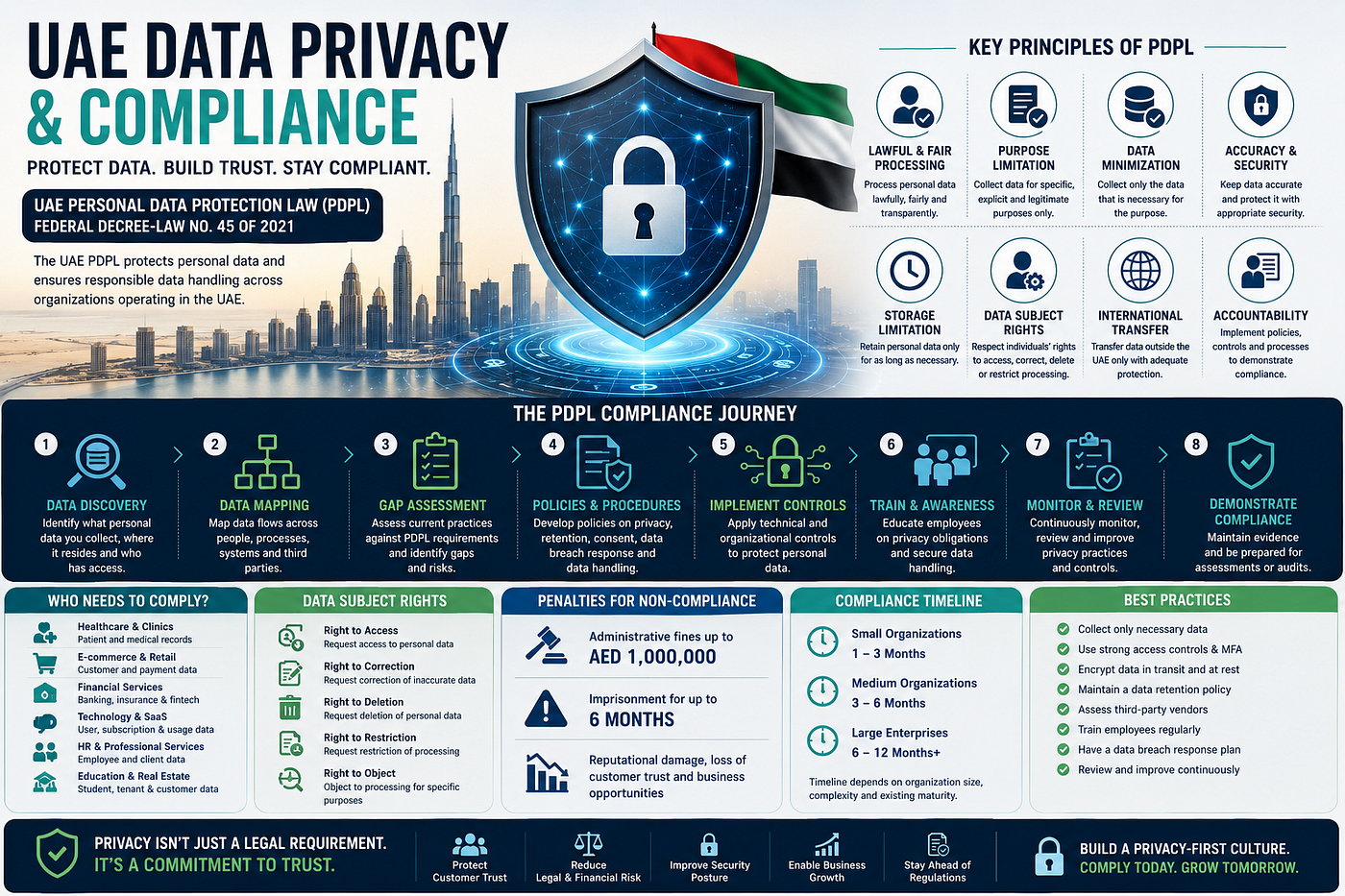
UAE Data Protection & Compliance
Most UAE businesses are focused on cybersecurity threats, but many overlook a different risk that can be equally damaging: mishandling personal data.
A single privacy violation can lead to regulatory investigations, customer complaints, contractual disputes, reputational damage, and loss of business opportunities.
Whether you operate a healthcare facility, e-commerce platform, HR consultancy, financial institution, SaaS company, marketing agency, or dental clinic, your organization is likely collecting personal information that falls under the UAE Personal Data Protection Law (PDPL).
The challenge is that many organizations still believe compliance simply means adding a privacy policy to their website.
It doesn’t.
True compliance requires understanding what data you collect, why you collect it, where it is stored, who can access it, and how it is protected.
This guide explains everything organizations need to know about UAE PDPL compliance, including requirements, implementation activities, costs, timelines, penalties, and common mistakes.
What Is UAE PDPL?
The UAE Personal Data Protection Law (PDPL), Federal Decree-Law №45 of 2021, is the UAE’s primary data protection legislation.
The law was introduced to:
- Protect personal information
- Strengthen consumer rights
- Improve trust in digital services
- Align UAE with international privacy standards
- Support economic growth and digital transformation
The law applies to many organizations operating inside and outside the UAE that process personal data relating to UAE residents.
What Is Personal Data?
Personal data includes any information that can identify an individual directly or indirectly.
Examples include:
Basic Information
- Name
- Email address
- Phone number
- Emirates ID
- Passport details
Digital Information
- IP addresses
- Device identifiers
- Cookies
- Login records
Employee Information
- HR records
- Payroll information
- Employment contracts
Customer Information
- Medical records
- Financial information
- Purchase history
- Location data
Who Must Comply?
Organizations commonly affected include:
Healthcare
- Clinics
- Hospitals
- Medical laboratories
- Dental clinics
Financial Services
- Banks
- Insurance companies
- Fintech organizations
Technology Companies
- SaaS providers
- Software companies
- Cloud service providers
Retail & Ecommerce
- Online stores
- Loyalty programs
- Mobile applications
Professional Services
- Law firms
- Marketing agencies
- HR consultancies
- Accounting firms
Why UAE PDPL Compliance Matters
1. Avoid Regulatory Issues
Data privacy regulations continue to mature across the UAE.
Organizations should prepare before enforcement actions increase.
2. Build Customer Trust
Consumers increasingly care about:
- How their data is used
- How long it is stored
- Whether it is shared
Trust directly impacts revenue.
3. Win Enterprise Contracts
Many enterprise customers now require privacy compliance evidence during vendor assessments.
4. Support International Business
Organizations working with European customers often benefit from stronger privacy controls.
5. Reduce Breach Impact
Strong privacy controls typically improve:
- Access management
- Data retention
- Encryption
- Incident response
Key Requirements of UAE PDPL
Organizations should establish controls covering:
Lawful Basis for Processing
You must have a legitimate reason to collect personal information.
Examples:
- Consent
- Contractual necessity
- Legal obligations
Data Minimization
Collect only information that is necessary.
Bad Example:
Requesting passport copies when only an email address is needed.
Transparency
Individuals should understand:
- What information is collected
- Why it is collected
- How it will be used
Security Controls
Protect personal information using:
- Encryption
- Access controls
- MFA
- Monitoring
- Backup systems
Data Subject Rights
Individuals may have rights relating to:
- Access
- Correction
- Deletion
- Restriction of processing
Data Retention
Organizations should not keep personal data indefinitely.
Retention schedules should be documented.
Activities Required for PDPL Compliance
Phase 1 — Data Discovery
Identify:
- What personal data exists
- Where it resides
- Who owns it
- Who accesses it
Phase 2 — Data Mapping
Create a complete data flow inventory.
Questions include:
- Where does data originate?
- Where is it stored?
- Who receives it?
- Is it transferred internationally?
Phase 3 — Gap Assessment
Review current practices against PDPL requirements.
Identify:
- Missing policies
- Technical gaps
- Process weaknesses
Phase 4 — Policy Development
Typical documents include:
Privacy Policy
Explains customer data processing.
Data Retention Policy
Defines storage periods.
Data Breach Response Procedure
Defines incident handling steps.
Consent Management Procedure
Ensures valid consent collection.
Phase 5 — Technical Controls
Common improvements include:
- MFA
- Encryption
- DLP solutions
- Endpoint protection
- Access control reviews
Phase 6 — Vendor Assessments
Review third parties that process personal information.
Examples:
- Cloud providers
- Marketing tools
- Payroll vendors
- CRM systems
Phase 7 — Staff Training
Employees should understand:
- Data handling responsibilities
- Reporting procedures
- Security requirements
How Long Does Compliance Take?
Small Organizations
1–3 Months
Medium Organizations
3–6 Months
Large Enterprises
6–12 Months
Timeline depends heavily on existing security maturity.
Cost of UAE PDPL Compliance
Actual cost depends on:
- Company size
- Number of employees
- Systems involved
- Existing controls
Small Business
AED 5,000 — AED 25,000
Medium Business
AED 20,000 — AED 75,000
Large Enterprise
AED 75,000 — AED 300,000+
Hidden Costs Organizations Forget
Data Discovery
Finding personal data across systems takes time.
Security Improvements
Many organizations require:
- MFA
- Encryption
- Logging
- Monitoring
Staff Training
Awareness programs are often overlooked.
Vendor Remediation
Third-party risks frequently require additional effort.
Common Mistakes to Avoid
Mistake #1
Assuming website privacy policies equal compliance.
They don’t.
Mistake #2
Collecting unnecessary personal data.
Mistake #3
No documented retention schedule.
Mistake #4
Ignoring employee data privacy.
Mistake #5
Using cloud services without reviewing data processing agreements.
Mistake #6
No breach response process.
Mistake #7
Treating compliance as a legal project only.
Privacy requires collaboration between:
- Legal
- HR
- IT
- Operations
- Security
UAE PDPL Compliance Checklist
✅ Data inventory completed
✅ Data flow mapping performed
✅ Privacy policy updated
✅ Retention policy implemented
✅ Access controls reviewed
✅ MFA enabled
✅ Vendor assessments completed
✅ Employee training conducted
✅ Incident response process established
✅ Compliance evidence maintained
PDPL vs GDPR
Many organizations ask whether PDPL is the same as GDPR.
The answer is no.
However, they share similar principles:
GDPRUAE PDPLEuropean UnionUAEExtraterritorial scopeExtraterritorial scopeStrong data subject rightsSimilar rightsPrivacy by designPrivacy-focused approachRisk-based frameworkRisk-based framework
Organizations already compliant with GDPR often have an easier PDPL journey.
Final Thoughts
Data privacy is rapidly becoming a business requirement rather than a legal checkbox.
Organizations that proactively implement UAE PDPL controls gain multiple advantages:
- Better customer trust
- Reduced regulatory risk
- Improved cybersecurity
- Stronger governance
- Enhanced competitiveness
The most successful compliance projects focus not only on policies but also on practical controls, employee awareness, and continuous improvement.
For organizations seeking UAE PDPL consulting, privacy assessments, compliance gap analysis, policy development, data mapping, risk assessments, and implementation support, working with experienced privacy and cybersecurity consultants can significantly accelerate the journey while reducing compliance risks.
메타데이터
- post_id
- aa2db0e5dcaf
- slug
- uae-data-protection-law-pdpl-compliance-guide-2026-requirements-costs-penalties-and-aa2db0e5dcaf
- url
- https://medium.com/@mukeshvermaism/uae-data-protection-law-pdpl-compliance-guide-2026-requirements-costs-penalties-and-aa2db0e5dcaf
- canonical_url
- https://medium.com/@mukeshvermaism/uae-data-protection-law-pdpl-compliance-guide-2026-requirements-costs-penalties-and-aa2db0e5dcaf
- author_url
- https://medium.com/@mukeshvermaism
- status
- ok
- fetched_at
- 2026-06-21 23:24:37

