Why Autonomous Testing Is Becoming Essential for Modern Software Development
Software development is entering a phase where code can be generated, modified, and deployed faster than conventional quality processes can…
Why Autonomous Testing Is Becoming Essential for Modern Software Development
Software development is entering a phase where code can be generated, modified, and deployed faster than conventional quality processes can validate it. Forrester’s 2025 Developer Survey found that testing was among the leading use cases for AI in the software development lifecycle, with 47% of respondents using AI for testing. Gartner has also identified agentic development as a major direction for engineering teams, indicating that software creation and validation are moving toward increasingly autonomous workflows.
This shift makes autonomous testing more than an upgrade to traditional automation. It represents a transition toward systems that can manage key stages of the testing lifecycle, from interpreting requirements and identifying risks to generating test scenarios, executing validation, analyzing results, and adapting testing activities with limited manual intervention. As AI-generated code increases the volume and speed of software change, AI testing is becoming essential for maintaining quality without creating a larger validation bottleneck.
Why Traditional Testing Is Struggling with Faster Development
Modern software is no longer released through a predictable sequence of development, testing, and deployment. Cloud native architectures, microservices, APIs, mobile applications, continuous integration pipelines, and frequent feature updates have created thousands of possible interactions that must be validated. A small code change can affect an API contract, database transaction, authentication flow, or downstream service without producing an obvious signal during development.
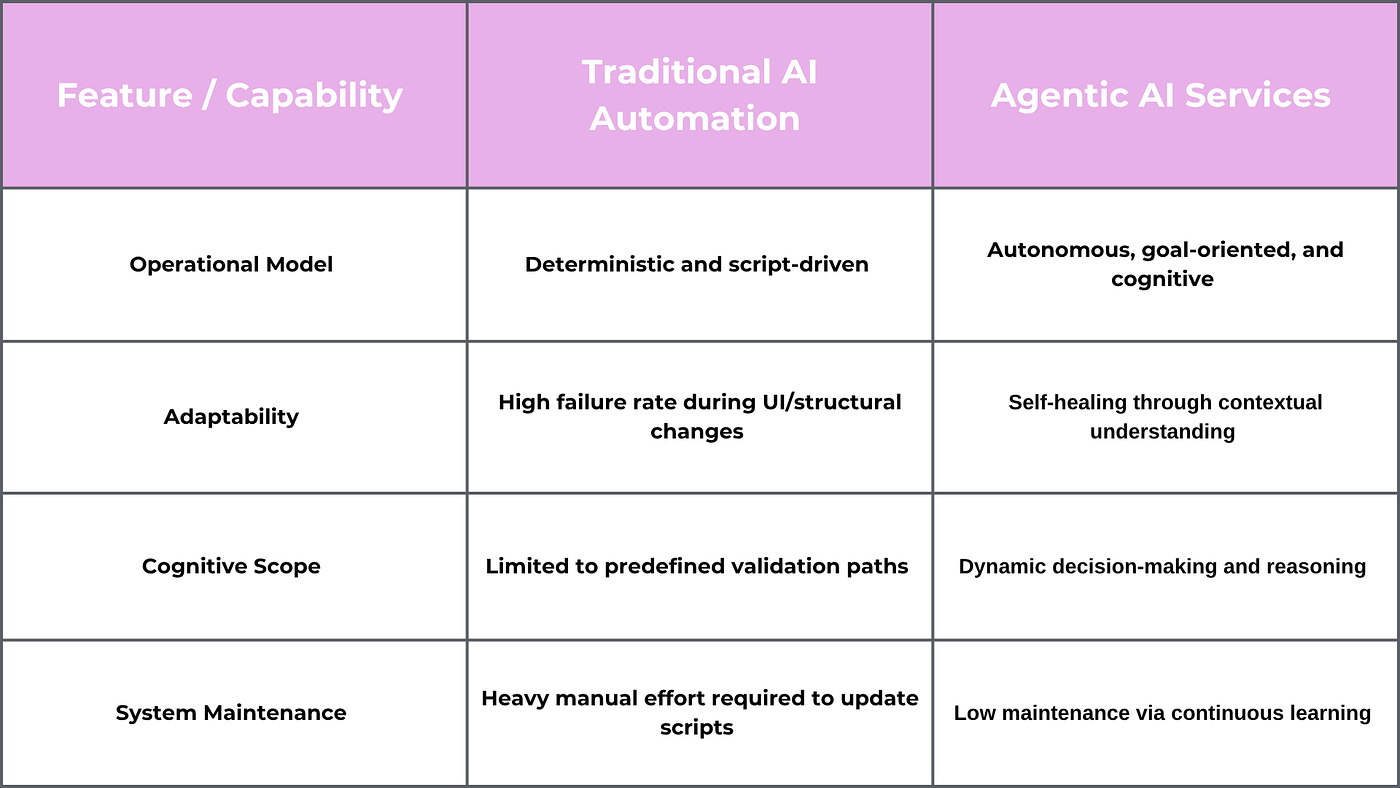
This is where AI in software testing is changing the quality process. Conventional automation follows predefined scripts, while autonomous systems can examine application behavior, historical defects, code changes, and execution results to determine which areas require deeper validation. The difference is significant because testing is no longer limited to asking whether a known test case passed. It can also determine which risks have emerged, what should be tested next, and whether existing coverage remains relevant.
1.Faster Code Generation Is Increasing Validation Demand: AI-assisted development can produce large volumes of code and configuration changes within short development cycles. Testing teams must therefore validate more changes without simply expanding manual effort.
- Application Complexity Is Increasing: Distributed systems create dependencies that are difficult to understand through isolated test cases. Autonomous testing can examine relationships between services, workflows, data, and user actions to identify broader risk patterns.
3.Test Maintenance Is Becoming Expensive: Traditional scripts can break when interfaces, locators, workflows, or data structures change. AI systems can identify the source of failure and determine whether a test requires repair, replacement, or deeper investigation.
- Quality Decisions Require More Context: A failed test does not always indicate a product defect. It can result from an unstable environment, changed data, or an outdated assertion. AI testing services can analyze these signals together and reduce the time spent investigating misleading failures.
How Autonomous Testing Works Across the Software Lifecycle
The strongest AI and software testing strategies do not treat intelligence as a separate layer added at the end of development. Instead, they connect testing activities across requirements, coding, integration, deployment, and production feedback. This allows quality decisions to become more continuous and context-driven.
Requirement Analysis and Test Design: AI systems can examine user stories, acceptance criteria, API specifications, and business rules to identify missing scenarios and generate relevant test conditions. This can expose ambiguity before development progresses too far.
Intelligent Test Generation: AI can generate functional, regression, API, integration, and negative test scenarios based on application behavior and historical defect patterns. The resulting suite can then be prioritized according to business risk.
Dynamic Test Selection: Not every code change requires a complete regression cycle. AI analyzes changed components, dependencies, and previous failures. It then selects the most relevant tests, reducing unnecessary execution while maintaining coverage of high-risk areas.
Self-Diagnosis and Maintenance: When a test fails, an autonomous system can compare the failure with recent application changes, screenshots, logs, network activity, and historical executions. It can then distinguish between a genuine defect and a broken test.
Intelligent Performance Analysis: AI in performance testing can identify abnormal response patterns, correlate them with infrastructure conditions, and highlight bottlenecks that may not be visible through basic threshold monitoring.
Benefits of Moving Toward Autonomous Testing
The business value of autonomous testing extends beyond faster execution. Its primary advantage lies in improving how quality teams allocate attention. Instead of spending most of their time maintaining scripts and reviewing repetitive results, testers can focus on complex behavior, business risk, exploratory analysis, and quality strategy.
Greater Test Coverage Without Linear Effort: AI can generate scenarios from application behavior, requirements, and previous defects. This allows teams to explore more combinations without manually writing every test case.
Faster Feedback for Development Teams: Intelligent test selection can identify the most relevant validation activities for each code change. Developers receive useful feedback sooner, reducing the time between defect introduction and discovery.
Lower Maintenance Overhead: Traditional automation often becomes difficult to manage when applications change frequently. AI-based automation testing can detect altered elements and workflow changes, helping teams update automation with less manual intervention.
Improved Defect Prioritization: Not every failure represents the same level of business risk. AI can evaluate severity, affected functionality, customer impact, and historical patterns to help teams focus on issues that matter most.
Better Use of Human Expertise: Autonomous testing does not remove the need for skilled QA professionals. Instead, it reduces repetitive work and gives testers more time for exploratory testing, domain analysis, risk assessment, and complex validation.
Challenges Organizations Must Address
Despite its advantages, autonomous testing is not a universal replacement for established quality practices. Organizations must understand their limitations before moving toward greater autonomy.
Maintaining Business Context: AI-generated test cases may appear technically valid while missing important business rules. Domain expertise remains necessary to verify whether testing reflects real operational requirements.
Avoiding False Confidence: A larger number of generated tests does not automatically mean better quality. Organizations must measure coverage by business functionality, risk, data variation, and defect detection rather than test volume alone.
Managing Data Quality: Autonomous systems depend on requirements, logs, defect histories, and test results. Incomplete or inconsistent data can cause systems to prioritize the wrong tests or misinterpret failures.
Protecting Sensitive Information: AI systems may interact with sensitive test data, production-like environments, and enterprise systems. Access controls, data protection, auditability, and approval boundaries must therefore be defined clearly.
Retaining Human Oversight: AI testing should support engineering judgment rather than replace it. Human testers remain essential for exploratory testing, unusual business scenarios, ethical considerations, and defects that cannot be inferred from historical data.
Strategies for Building an Effective Autonomous Testing Model
A successful implementation begins with a clear quality objective rather than the purchase of an AI tool. Organizations should first identify where conventional testing creates the greatest delay or risk. For one company, this may be regression maintenance. For another, it may involve API validation, performance analysis, or test data preparation.
Start With High-Value Testing Areas: Begin with repetitive, data-intensive, or maintenance-heavy activities where autonomous capabilities can deliver measurable improvement.
Establish Reliable Data Foundations: Requirements should be structured clearly, test results should be traceable, and defect histories should contain enough context for AI systems to identify meaningful patterns.
Define Human Approval Points: High-risk activities involving financial transactions, security validation, regulatory checks, or production deployment may require mandatory human review.
Measure Quality Outcomes: Useful metrics include defect detection rate, escaped defects, test maintenance time, regression cycle duration, flaky test reduction, and risk-based coverage.
Connect the Engineering Ecosystem: An AI testing solution delivers greater value when connected with requirements, source control, CI/CD pipelines, defect management, observability, and deployment systems.
Closing Thoughts
Autonomous testing is becoming essential as software development exceeds the speed and complexity that conventional validation processes can handle. AI testing can interpret requirements, assess risk, generate test scenarios, analyze failures, and adapt testing activities across the testing lifecycle. Its effectiveness, however, depends on reliable data, clear governance, strong engineering practices, and expert human judgment. The goal is not to automate every testing decision but to create a quality process that responds intelligently to changing software.
At ImpactQA, our AI testing services help organizations apply intelligent test generation, risk-based validation, automation maintenance, performance analysis, and continuous quality improvement. By combining domain expertise with an AI testing solution aligned with business requirements, we help enterprises adopt autonomous testing while maintaining control, accountability, and technical rigor.
메타데이터
- post_id
- aa38c0611a2b
- slug
- why-autonomous-testing-is-becoming-essential-for-modern-software-development-aa38c0611a2b
- url
- https://medium.com/@josephwarner079/why-autonomous-testing-is-becoming-essential-for-modern-software-development-aa38c0611a2b
- canonical_url
- https://medium.com/@josephwarner079/why-autonomous-testing-is-becoming-essential-for-modern-software-development-aa38c0611a2b
- author_url
- https://medium.com/@josephwarner079
- status
- ok
- fetched_at
- 2026-08-19 20:53:35