The Drawn Melancholy
Chapter One: The Ink of Awakening
The Drawn Melancholy
Chapter One: The Ink of Awakening
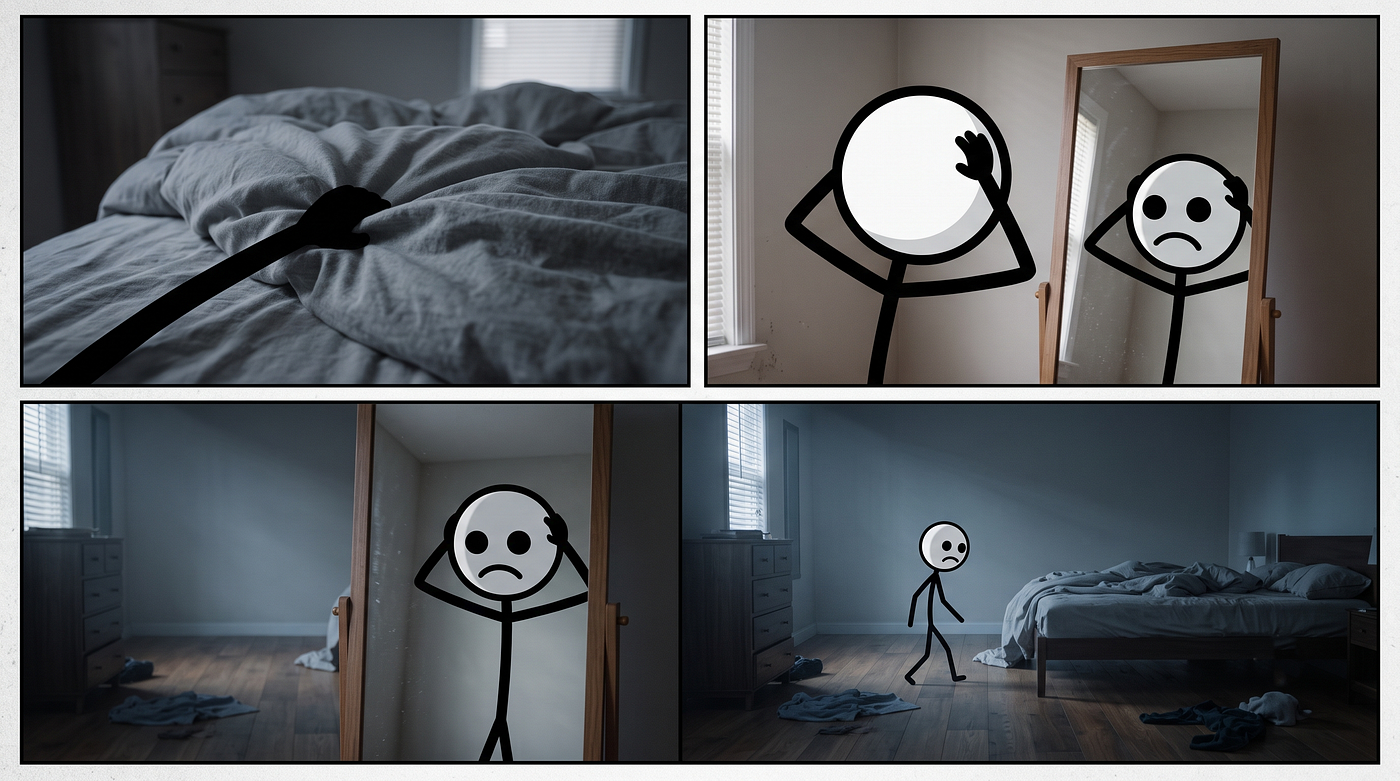
The transition from the warm, forgiving oblivion of sleep to the cold shore of consciousness is usually a subtle thing. A heavy eyelid fluttering, a stretch of the spine, the comforting weight of a blanket. But on this morning, the awakening was sharp, angular, and profoundly wrong. He opened his eyes, though the very mechanics of the action felt alien. There were no lashes parting, no bleary adjustment to the morning light filtering through the blinds. There were only two perfect, hollow black circles snapping into existence against a stark white void of a face. He tried to sit up, expecting the familiar resistance of gravity against muscle and bone, but he sprang forward with a weightless, terrifying elasticity.
He threw the blanket aside, and it was then he saw his arm. He froze. Where there should have been the soft topography of skin, veins, and hair, there was only a stark, unyielding black line. It looked like a stroke of graphite pressed too hard into parchment. Panic, pure and icy, spiked in what he presumed was his chest — a simple, vertical line connecting his round head to his bifurcated legs. He scrambled out of bed, his movements jerky, frictionless, and impossibly fast. His feet, little more than sharp right angles, hit the hardwood floor without making a sound. There was no padding of flesh, no thud of a heel.
He rushed to the full-length mirror standing in the corner of his bedroom. The glass reflected the room perfectly — the unmade bed, the rumpled sheets, the pale morning light. And standing in the center of it all was a doodle. A child’s afterthought. A stickman. He raised a trembling line of an arm to his face. The reflection mirrored the gesture perfectly. He tried to open his mouth to scream, to shatter the quiet morning with a sound of primal terror, but his mouth was merely a horizontal dash that curved downward into a tragic crescent. No sound emerged.
He backed away from the mirror, his two-dimensional hands gripping the sides of his round head. How could this be? The physics of his own existence had been rewritten overnight. He looked down at himself, trying to pinch his arm, but his stick-fingers merely slid off the solid, ink-like substance of his own body. He was devoid of substance, stripped of his humanity, reduced to the most basic geometric abstraction of a person. Was it a curse? A biological impossibility? Or had he simply faded away, his life force diluted until only the skeletal blueprint remained? He paced the room, a frantic sketch trapped in a three-dimensional world, the silence of the apartment pressing down on his non-existent shoulders. The comedy of his appearance was entirely eclipsed by the crushing, melancholic realization that he was trapped in a body that wasn’t a body at all. He was a caricature of a man, alone in a quiet room, waiting for a punchline that would never come.
Chapter Two: The Lost Archive
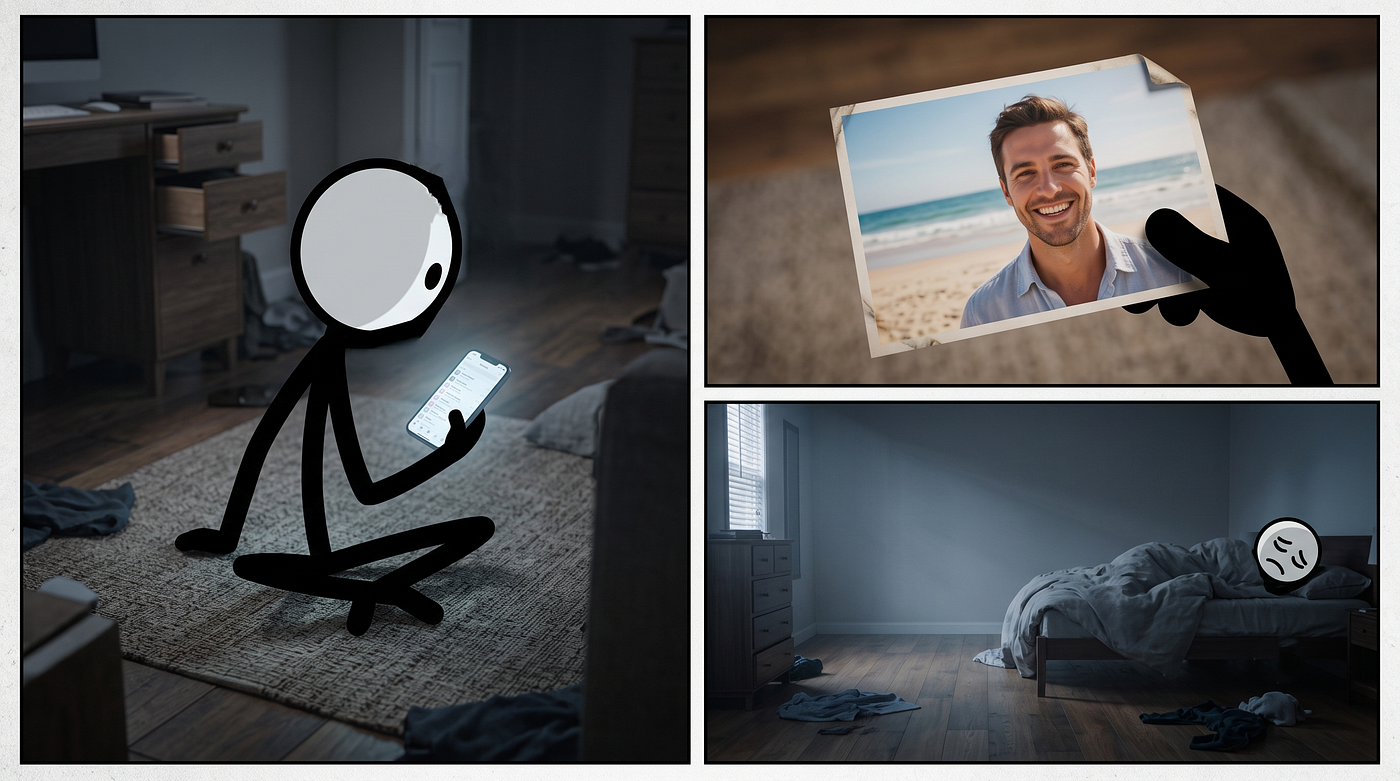
The second day dawned, though the shifting of the sun meant nothing to a creature of ink. He had spent the night huddled in the corner of his room, his knees drawn up to his chest — an acute angle of despair. The initial shock had receded, leaving in its wake a deep, hollow ache. If his body had been erased, what else was gone? He needed to know how this happened. He needed a timeline, a breadcrumb trail leading back to the moment he lost his third dimension.
He began his investigation in the living room, a space that felt both intimately familiar and aggressively foreign. He moved to his desk, pulling out drawers with his line-drawn hands. He found a calendar. The days of the past month were crossed out with red ink, but there were no notes. No appointments. He picked up his mobile phone. It felt massive and impossibly heavy in his thin grasp. He scrolled through his recent calls. Names were there — Sarah, Mom, Dave from the office — but when he stared at the glowing letters, an impenetrable fog rolled into his mind. He tried to summon Dave’s face, but all he saw was a grey blur. He tried to remember the sound of Sarah’s voice, the cadence of her laugh, but there was only a static-filled silence.
Who had he spoken to yesterday? He squeezed his eyes shut — or rather, the black circles on his face compressed into thick horizontal lines. He dug his stick-fingers into his temples, desperately trying to force the neurons to fire, to bridge the gap over the abyss of his memory. What was the last place he went? Was it the grocery store? The park? He remembered the concept of rain, the idea of pavement, but he couldn’t place himself within those memories. It was as if he were reading a biography of a stranger whose life had been violently truncated.
Hours bled away. He sat on the rug, surrounded by scattered photographs, old receipts, and opened letters. He stared at a picture of himself — a real, flesh-and-blood human being smiling on a beach. He traced the contours of the human face with his graphite finger. The man in the picture looked so happy, so oblivious to the fact that he would eventually be distilled into a minimalist nightmare. The harder he tried to remember the sensation of the sand, the warmth of the sun in that photograph, the further the memory retreated, mocking him from a distance he could no longer cross. The mental exertion was agonizing. It was like trying to grasp water; the tighter he clenched his fists, the faster it slipped away. Utterly defeated, the weight of his amnesia crushing whatever spirit he had left, he slowly stood up. He left the scattered remnants of his past on the floor, dragged his two-dimensional feet back to the bedroom, and crawled beneath the blankets, wishing for an erasure that was permanent.
Chapter Three: The Blueprint of Despair
The third day brought a strange, manic energy. He awoke with a sudden, forceful realization: wallowing in the shadows would not bring his flesh back. If he wanted answers, he needed to establish control. He needed to anchor himself to the world through the rituals that defined his humanity. Before the erasure, before he became a sketch, he was a man who drank coffee. It was a simple, grounding routine. He swung his stick-legs over the edge of the bed. He felt a surge of determination. He would walk to the kitchen. He would grind the beans. He would boil the water. He would reclaim a fragment of his life.
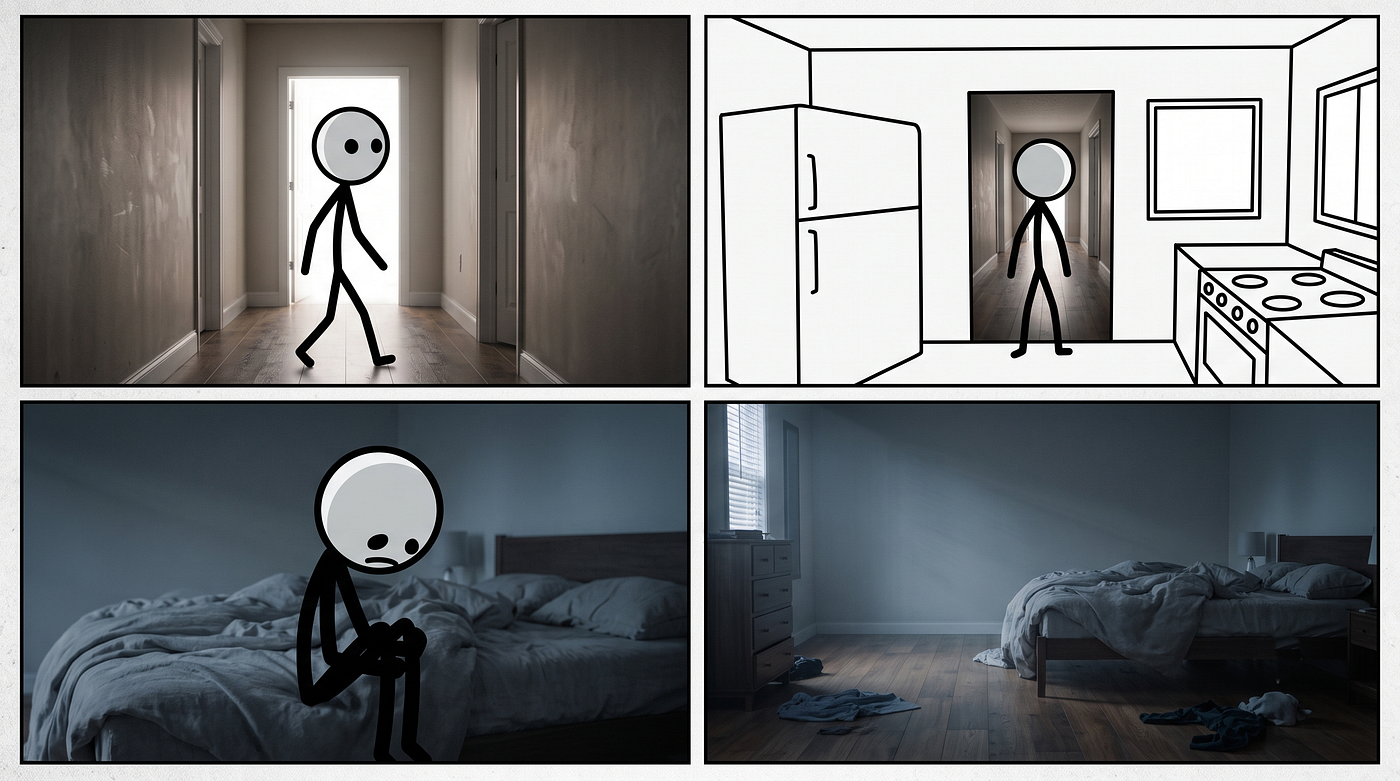
He marched down the hallway, his posture straighter, the lines of his body sharp and resolute. But as he turned the corner into the kitchen, the determination shattered, replaced by a cold, breath-stealing horror. He stopped dead in his tracks. The kitchen was wrong.
It wasn’t the realistic, three-dimensional space it had been yesterday. The stainless steel refrigerator, the tiled backsplash, the wooden cabinets — they were gone. In their place was a crude, white void populated by harsh black lines. The refrigerator was just a large rectangle with a smaller rectangle for a handle. The stove was a square with four circles on top. The window overlooking the street showed nothing but a white expanse, empty of trees, cars, or sky. The disease that had claimed his body had metastasized. It had infected his environment.
He walked slowly toward the kitchen counter, his heart — or whatever conceptual organ pumped despair through his frame — sinking into an abyssal depth. He reached out to touch the coffee maker. It was just an outline. He tried to lift the glass pot, but his hand passed right through the negative space. There was no glass, no plastic, no weight. The world had been stripped of its textures, its colors, its depth. He was not just a stickman trapped in a real world; he was a stickman trapped in a stick-world.
The realization hit him with the force of a physical blow. The absolute isolation of it was unbearable. If the world was just lines on a blank page, then there was no one to help him. There was no science to cure him, no magic to reverse it. It was just ink and emptiness. A profound, suffocating depression washed over him, drowning his brief spark of motivation. He backed out of the two-dimensional kitchen, fleeing the architectural ghost town, and retreated to his bedroom — which, to his mild relief, still retained its realistic, three-dimensional textures. He collapsed onto the edge of the mattress. He sat there, a flat drawing on a plush, realistic bed, staring at the floor. The silence was deafening. He wrapped his thin arms around himself. “Is this another nightmare?” he whispered to the empty room, his voice a dry, papery sound. “Please, let it be a nightmare.”
Chapter Four: The Phantom Ring
Sleep had abandoned him. The fourth day bled from the third without the merciful interruption of unconsciousness. He had sat on the edge of the bed for twenty-four hours, a sentinel of his own misery, his perfectly round eyes wide open in the gloom. The stillness of the apartment was a heavy, oppressive blanket. As the pale light of morning crept through the window, an irrational, stubborn thought lodged itself in his mind. The coffee. He had failed yesterday because the world had glitched. But what if the world had fixed itself?
Driven by exhaustion and a desperate need for normalcy, he rose and walked back down the hall. He hesitated at the threshold of the kitchen, bracing himself for the stark white lines of the void. He stepped through the doorway. He gasped.
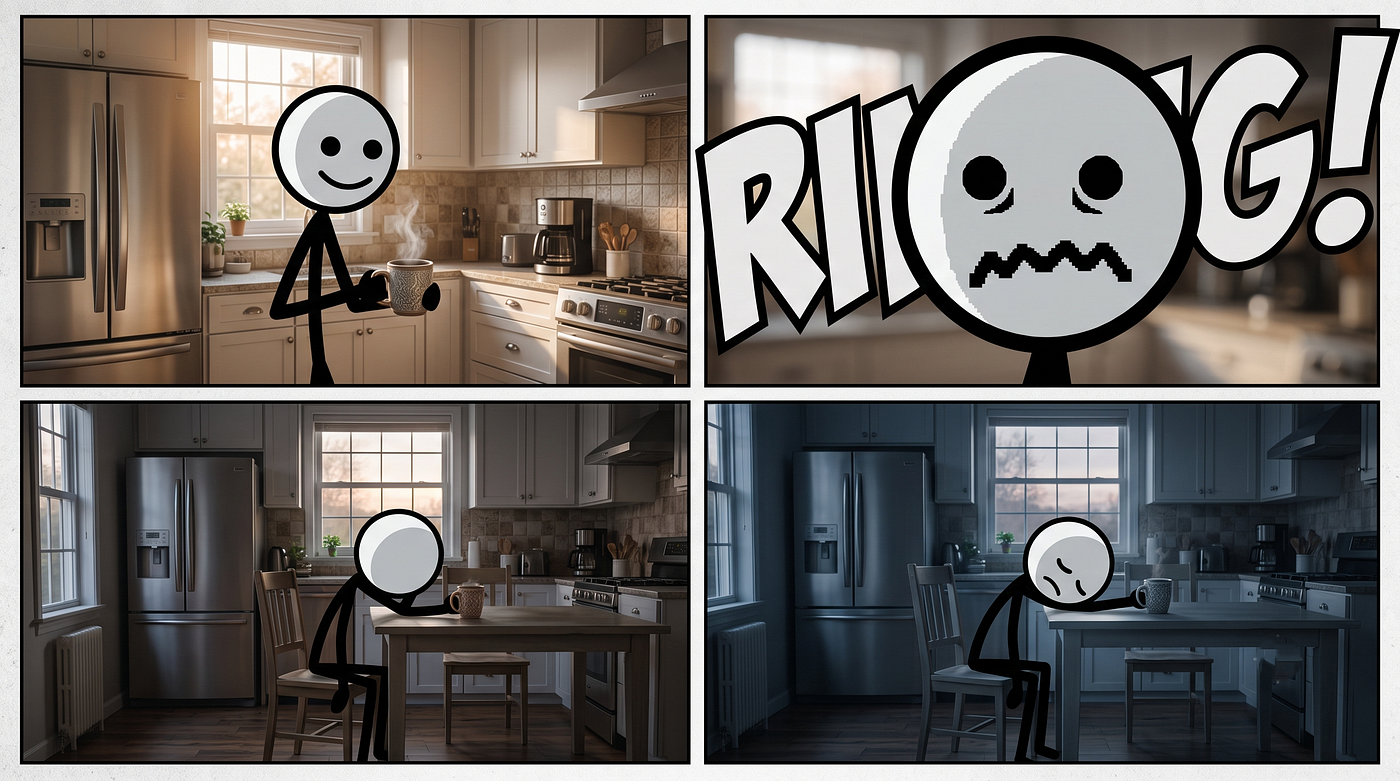
The kitchen was real. The refrigerator hummed, its stainless steel gleaming. The tiles were cool and textured. The world had returned. Trembling, his stick-hands reached for the coffee maker. It was solid. He went through the motions — the filter, the grounds, the water. The machine sputtered and hissed, sending a glorious, rich aroma into the air. When he poured the dark liquid into his favorite ceramic mug, he felt the radiant heat transferring into his two-dimensional hands. He lifted the mug to his face. It smelled divine. It smelled like Tuesday mornings, like commutes, like life. A genuine, curved smile formed on his flat face. It was working. He had his life back.
RING.
The sound violently shattered the quiet. It was a harsh, metallic, old-fashioned telephone ring, echoing from somewhere deep within the apartment. He froze, the mug stopped inches from his mouth.
RING.
Anxiety, cold and sharp, flooded his system. He didn’t own a landline. He hadn’t heard a ring like that since childhood. The joyous illusion of the coffee vanished, replaced by a creeping, paranoid dread. The outside world — whatever it was now — was trying to breach his sanctuary. The ringing was aggressive, demanding. He stared at the dark reflection of his round, white head in the coffee. The smile inverted into a deep frown.
“It is a nightmare then,” he breathed, his voice trembling.
RING.
He slowly lowered the mug. He didn’t go to find the phone. He couldn’t. The thought of what might be on the other end of that line was infinitely more terrifying than the ringing itself. He pulled a wooden chair out from the kitchen table and sat down. He placed his elbows on the table, clutching the warm mug with both hands, using it as an anchor against the rising tide of panic. He stared blankly at the wall, listening to the relentless, rhythmic assault of the bell. He waited for it to stop. He waited for the world to make sense. Slowly, the sheer exhaustion of his insomnia overtook the adrenaline. The ringing faded into a drone, the drone into white noise. Slumped forward on the table, his line-drawn hand still stubbornly gripping the handle of the realistic mug, he finally fell into a dark, dreamless sleep.
Chapter Five: Echoes on the Line
He awoke not in the kitchen, but flat on his back, staring at the familiar stucco ceiling of his bedroom. The fifth day had arrived with a teleportation trick. He lay there, his mind sluggish, trying to piece together the fragmented geography of his house. How had he moved? He remembered the chair, the warm mug, the desperate need for the ringing to stop. Did he sleepwalk? Or was the architect of this cruel reality simply resetting the board while he slept?
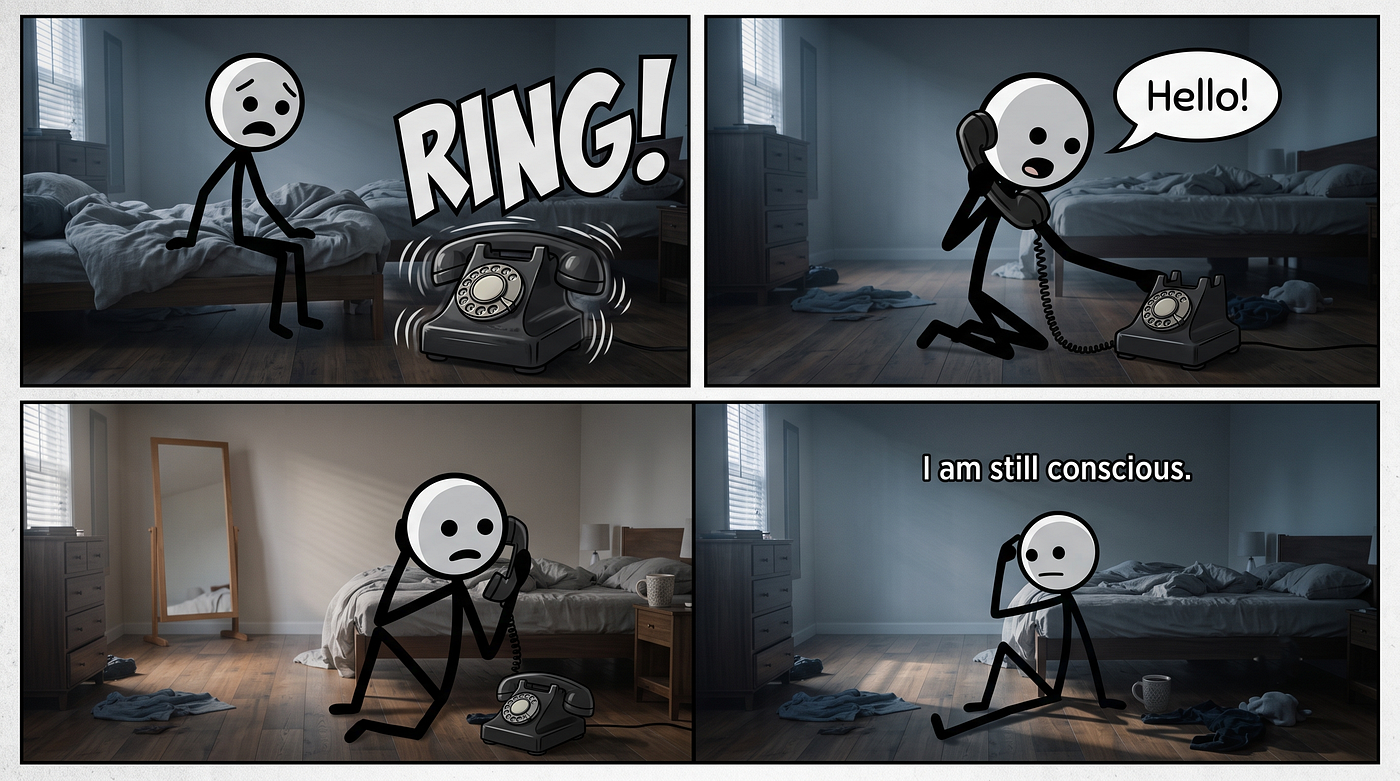
Before he could unravel the mystery, the sound tore through the room again. RING.
It was louder this time. Deafening. He jerked his head to the side. There, lying on the hardwood floor right next to his bed, was a heavy, black, rotary telephone. Its bell vibrated with a vicious intensity. He stared at it, his round eyes wide with a mixture of fear and sleep-drunk confusion. It rang again, demanding acknowledgment. He slowly sat up. The fear from yesterday was still there, but it was now tempered with a desperate, clawing curiosity.
He slid off the bed and knelt beside the violent machine. He reached out a trembling, black-line hand, wrapped it around the heavy receiver, and lifted it. The ringing ceased abruptly, leaving a heavy, pregnant silence in its wake. He brought the earpiece to his perfectly round head.
“Hello!” he blurted out, his voice sharp, cracking the stillness.
He held his breath, straining to hear. A crackle of static. The hum of a long-distance connection. But no voice.
“Hello, is someone there?” he asked again, his tone pleading, desperate for a connection, for a soul, for an explanation.
Nothing. The silence on the other end wasn’t just empty; it felt active, a void listening to him, observing him. He slowly lowered the receiver, placing it gently back on the cradle. He didn’t stand up. He sat on the floor, leaning his back against the bedframe. He looked across the room. On the bedside table sat the coffee mug from yesterday, the liquid inside now cold and stagnant.
He stared at the mug, then down at his own drawn hands. A profound, existential vertigo washed over him. The world was shifting around him, moving him, taunting him with phantom rings. The only constant was his own mind. “Is anything here real?” he whispered, the words hanging in the air. “Because I am still real.” He looked at the stark contrast of his ink-like arm against the realistic wood of the floorboards. “I didn’t change! Only my look has changed.”
He tapped his stick-finger against his temple. “I am still conscious,” he declared, his voice gaining a fraction of strength. “I see. I feel. I realize.” He was a philosopher trapped in a doodle, a ghost haunting a sketch. He spent the remainder of the day sitting on the floor in exactly that spot. The sun tracked across the floorboards, casting long, distorted shadows of his thin frame. He debated his own existence, wrestling with the demons of reality and illusion, trying to convince himself that he mattered. When night finally fell, cloaking the room in darkness, his mind exhausted itself, and he slipped back into the void of sleep.
Chapter Six: Footsteps in the Void
The sixth day began with a sound far more startling than a telephone. It was physical. A heavy, rhythmic thumping that vibrated through the floorboards and rattled the dust motes in the air. Knock. Knock. Knock.
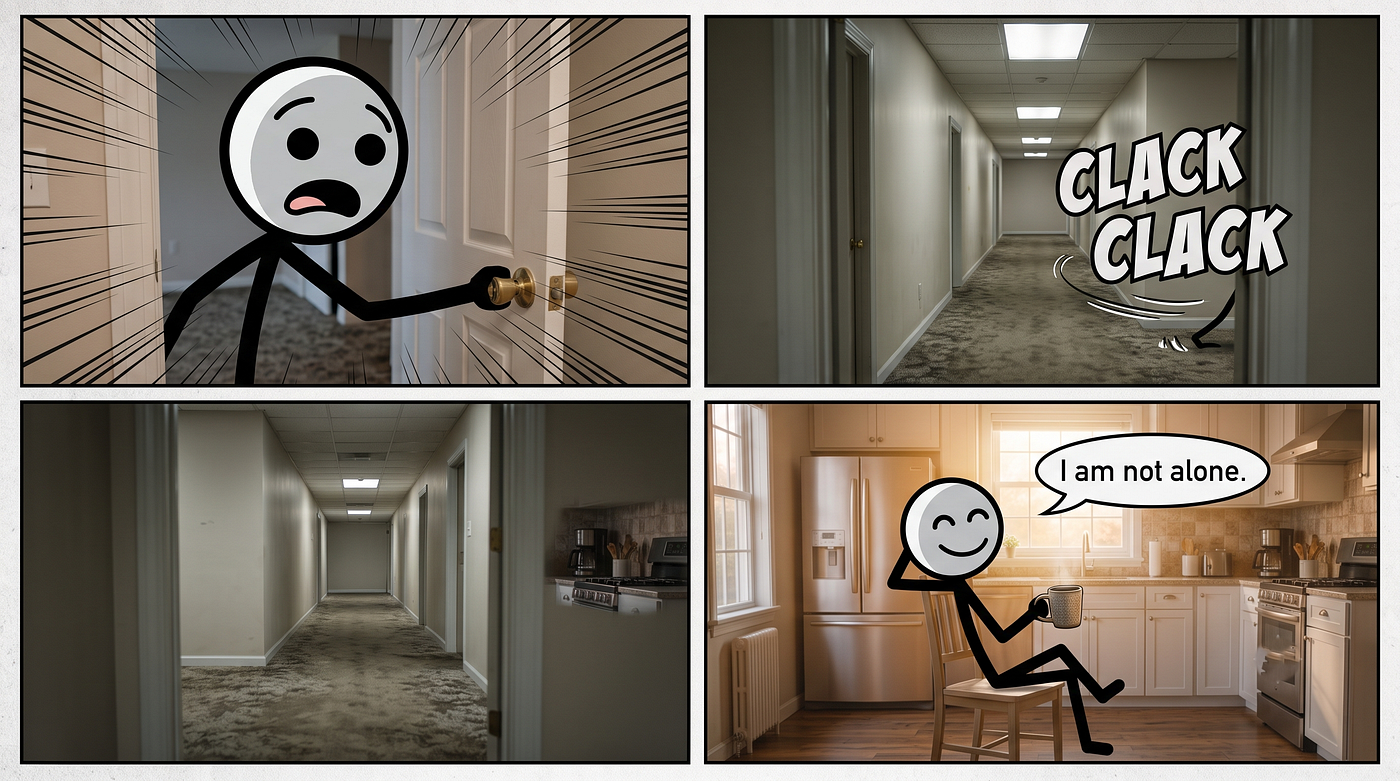
He opened his eyes slowly, the sound pulling him from a deep, dreamless abyss. Then, a voice. Muffled through the heavy wood of the front door, but unmistakably human, gruff, and casual. “Hey buddy, are you in there?”
The stickman sat up so fast his 2D geometry blurred. Shock rippled through him, an electric jolt that banished the melancholy of the previous days. He scrambled to his feet, his mind racing, trying to focus on the impossible audio. A voice. A real person. He wasn’t alone. He walked heavily toward the hallway, his stick-feet hitting the floor with a newfound, desperate weight. He practically threw himself at the front door, his thin hands fumbling frantically with the brass deadbolt. He twisted it, grabbed the handle, and threw the door wide open.
He stood in the doorway, his non-existent breath caught in his throat.
The hallway was empty. The patterned carpet stretched out under the fluorescent lights, completely deserted. But the silence wasn’t absolute. Echoing down the corridor, fading into the distance, was the distinct scuff, clack, scuff, clack of heavy shoes walking away in a severe hurry. Someone had been there. Someone had knocked. They were just out of reach.
He stood there for a long moment, staring down the empty hall, but instead of the crushing disappointment he expected, a warm, golden sensation began to bloom in his chest. It was a sign. A definitive, undeniable proof that the outside world still existed, that there were others out there, and most importantly, that they were looking for him. If there was someone outside, there were answers outside. Hope, a dangerous and intoxicating emotion, surged through his minimalist veins. He closed the door, a wide, triumphant smile curving across his white face. He would not give up yet.
He marched back to the kitchen, his steps practically bouncing. He made the coffee with practiced, rhythmic ease, relishing the scent, the heat, the reality of it all. He took his mug and sat on the wooden chair, crossing one stick-leg over the other. The existential dread of the past week evaporated, replaced by a hyper-focused, tactical clarity. He began to forge plans. He plotted scenarios, escape routes, ways to communicate. He imagined tracking down the owner of the heavy shoes.
“This is not a nightmare,” he said aloud to the empty kitchen, his voice ringing with newfound confidence. “I am just dreaming. Again.” He leaned his back against the hard wooden rungs of the chair, brought the warm mug to his chest, and closed his eyes. The smile remained etched on his face, a symbol of quiet defiance against a ridiculous universe. He was ready for tomorrow.
Chapter Seven: The Weight of Nothingness
The plan was forged. The seventh day was the day of departure. The day he would breach the threshold and confront whatever absurd reality awaited him in the hallway and beyond. He stood in the center of his bedroom, a flat drawing radiating purpose. He mentally cataloged his physical state. “I haven’t eaten in days,” he thought, placing a thin hand on his straight-line abdomen. “I am not even hungry. But it’s fine. Fuel is for the fleshy.”
He turned and walked deliberately toward the front door. He reached out, his graphite fingers wrapping around the cool brass of the handle. He took a metaphorical breath. He was ready.
But as he prepared to turn the knob, a cold, nagging sensation crept up the back of his neck. A phantom itch. Did I forget something?
He paused. He released the handle. It was an irrational thought, but it rooted him to the spot. He patted his sides. He had drawn-on pockets, little semi-circles on his thighs, and he patted them. Yes, the shape of his phone, the jingle of his keys. Everything was there. He turned around and paced back into the kitchen. The coffee maker was off. The stove was cold. All good. He walked back to the bedroom. The bed was unmade, but the room was tidy. Nothing left behind.
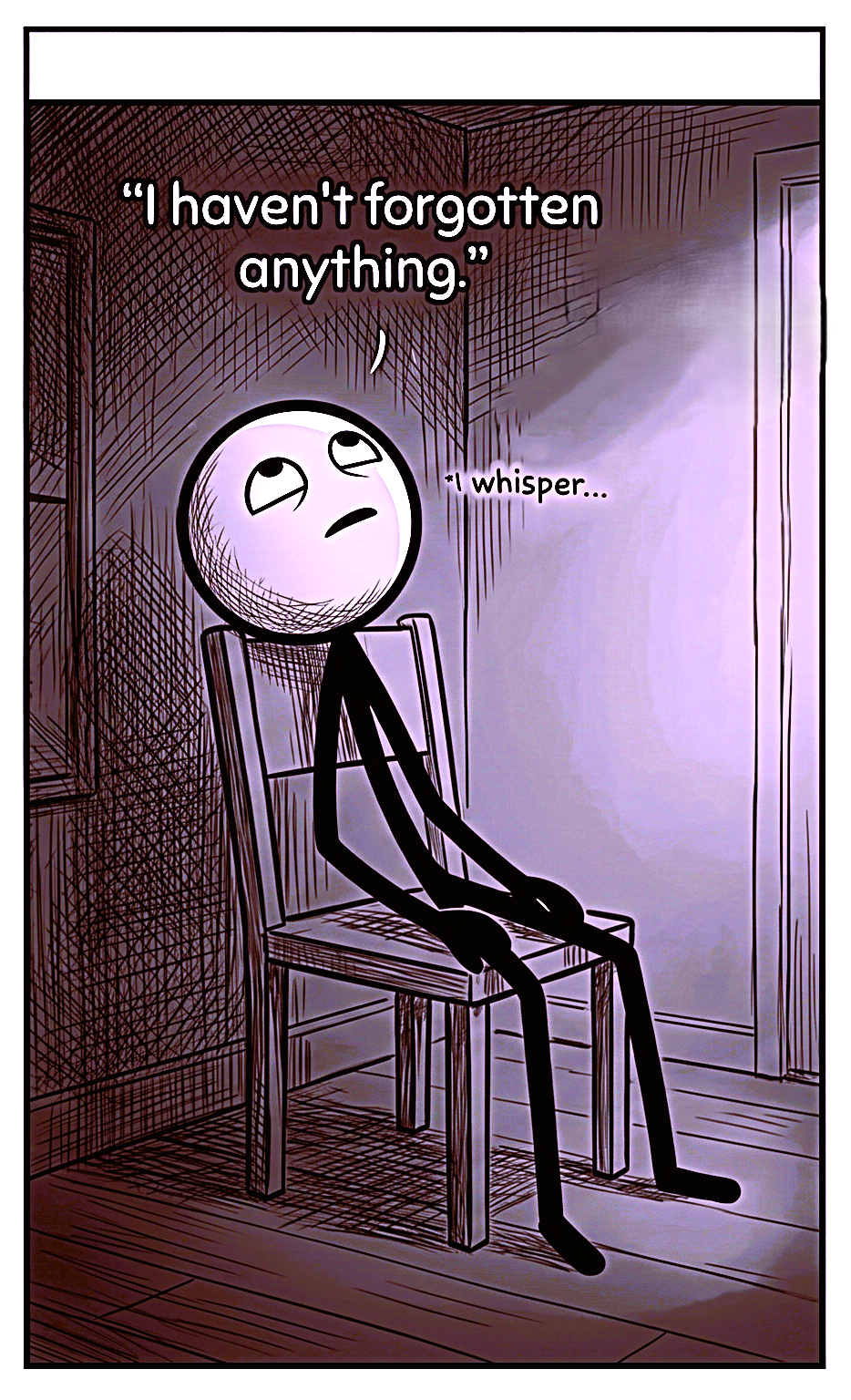
He returned to the front door. He reached for the handle again. Yet, the feeling struck harder this time, a heavy, paralyzing wave of uncertainty. It wasn’t about keys or wallets. It was a cosmic amnesia. He let his arm drop to his side. The resolve of the morning crumbled into a fine dust. He backed away from the door and collapsed into a chair in the entryway. He rubbed his face with his hands, trying to calm the sudden, erratic beating of his nonexistent heart.
“I haven’t forgotten anything,” he whispered to the silent apartment. “I have my phone. My keys.” His voice wavered, thick with a rising, nervous panic.
Time began to hemorrhage. He sat there, glued to the chair, staring blankly up at the white expanse of the ceiling. The minutes dragged into hours, and the momentum of his grand departure stagnated into a swamp of overthinking. He began to dissect the whole thing, tearing his situation down to its fundamental particles. What actually led him to this point? Was it karma? A punishment for a life poorly lived? Or was it inflicted upon him by some unseen, malevolent artist?
A terrifying new thought bloomed in the dark corners of his mind: What if there was no “before”? What if the memories of beaches and human faces were just implanted backstories? Was he born as a stickman, destined only to live like one, acting out a tragicomic play in a looping apartment? He stared at the ceiling, the questions piling up like stones on his chest. Is this new life permanent? Is this endless cycle of waking, questioning, and failing to leave the door the new “lifestyle” he was committed to until the ink faded?
The weight of the unanswered questions, the unbearable lightness of his own being, finally crushed him. The desire to know, the hope of the footsteps — it all surrendered to the profound exhaustion of existing. The stickman slowly, heavily, closed his eyes. The thin black lines of his eyelids met. The room, the apartment, the questions — they all vanished.
Everything was black.
메타데이터
- post_id
- aa449bd2ff09
- slug
- the-drawn-melancholy-aa449bd2ff09
- url
- https://medium.com/@mostafadag005/the-drawn-melancholy-aa449bd2ff09
- canonical_url
- https://medium.com/@mostafadag005/the-drawn-melancholy-aa449bd2ff09
- author_url
- https://medium.com/@mostafadag005
- status
- ok
- fetched_at
- 2026-07-19 06:10:46