Piston, Connecting Rod & Bearing Service
Piston, Connecting Rod & Bearing Service

scored piston on the right
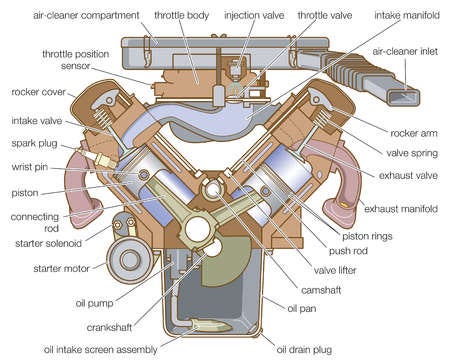
For an engine to perform at its best, its pistons, connecting rods, and bearings must operate in perfect harmony. These components move thousands of times per minute, and even a slight amount of wear can affect power, efficiency, and noise levels. Proper service ensures that pistons maintain the correct clearance to avoid piston slap, piston rings seal the combustion chamber effectively, the oil-control ring manages lubrication on the cylinder walls, and the piston pin fits precisely to eliminate unwanted movement. Likewise, connecting-rod bearings and crankshaft journals must stay smooth and within specification to prevent oil pressure loss or knocking.
Servicing these parts often begins with disassembling the piston and rod assembly. The process requires attention to detail because each component is matched to its cylinder. Piston rings are carefully unwound from their grooves, sometimes using a feeler gauge for support. Bearing shells are removed next; the top shell may include an oil feed hole, so it’s important to note differences between upper and lower halves. The piston pin fit is checked by gently rocking the rod relative to the piston any noticeable play indicates wear. Before separating the piston from the rod, alignment marks are identified to ensure the assembly is reinstalled in the correct orientation. Depending on design, the piston pin may need to be pushed, tapped, or pressed out, and once removed, the rod cap is temporarily refitted so no parts are misplaced. After dismantling, every piece is cleaned and inspected for wear.
Because engine components must go back into their original cylinders, technicians mark and label assemblies to avoid mix-ups.
Servicing Piston Pins
Piston pins are inspected closely because looseness or excessive tightness can lead to engine noise or distortion. To check the fit, the piston is held firmly while the connecting rod is rocked sideways there should be almost no movement. If the rod shifts noticeably, the piston pin or its mating surfaces may be worn, and further disassembly is required.
Floating Piston Pins
Floating pins are retained by circlips that must be removed before the pin can be extracted. Using a light hammer and a pilot-type punch, the pin is tapped out while the piston is safely supported to avoid damage. If the pin is stubborn, the piston is gently heated to expand the metal and ease removal. Once apart, the rod’s small-end bush, the piston pin, and the pin bores are inspected for wear. Some rods use a replaceable bush, which can be pressed out and replaced; the new bush must align perfectly with the oil hole in the rod. Before reassembly, the piston is heated so the pin slides in smoothly, and new circlips are always installed for safety.
Press-Fit Piston Pins
Press-fit pins require special tools because they are an interference fit in the connecting rod’s eye. The piston is supported while the pin is pressed out never hammered. Before removal, the pin’s position is noted so it can be reinstalled identically. These pins typically have around 0.02 mm of interference, and when reinstalling, the small end of the connecting rod can be warmed on a hotplate to expand the metal slightly. The pressing operation must be completed quickly, before the rod cools and contracts around the pin.
Heating Techniques
Heating the piston in hot water until nearly boiling is a safe method to expand the metal without damaging it. This technique makes both disassembly and reassembly easier. For press-fit designs, heating the rod’s small end is also effective, but direct flame must never be applied, as it can weaken the metal.
Understanding Piston-Pin Fit
The clearance between the piston pin and its mating surfaces is extremely small often just a few thousandths of a millimetre. Too tight, and the piston may distort as it expands; too loose, and a knocking sound can develop. Manufacturers specify clearances such as 0.002–0.008 mm, with wear limits around 0.02 mm. Achieving these tolerances depends on expertly finished surfaces and selective fitting during manufacturing.
In workshops, micrometers, calipers, and dial gauges are used to check pin fit. Fits are often described by how easily the pin moves: a hand-push fit requires steady pressure, a thumb-push fit moves with mild force, and a finger-push fit slides with light effort. Other descriptions tap fit, light-tap fit, drive fit help communicate how tight the pin should be in service.
메타데이터
- post_id
- aa4905ba082f
- slug
- piston-connecting-rod-bearing-service-aa4905ba082f
- url
- https://medium.com/@marklimgam/piston-connecting-rod-bearing-service-aa4905ba082f
- canonical_url
- https://medium.com/@marklimgam/piston-connecting-rod-bearing-service-aa4905ba082f
- author_url
- https://medium.com/@marklimgam
- status
- ok
- fetched_at
- 2026-06-21 15:33:18