Unifying Gravity and Quantum Mechanics — What If They Were Never Separate?
Physics has two perfect theories that refuse to talk to each other. Here’s one reason why — and a framework that may change the question…
Unifying Gravity and Quantum Mechanics — What If They Were Never Separate?

Physics has two perfect theories that refuse to talk to each other. Here’s one reason why — and a framework that may change the question entirely.
Jason Amidan · Flux Emergence Research Program · May 2026
Physics has a problem it cannot ignore. Ethan Siegel, writing in March 2026, put it plainly: General Relativity and quantum mechanics are each individually the most successful theories ever devised — and yet at a fundamental level, they simply do not work together. Not approximately. Not in edge cases. Fundamentally.1
General Relativity describes gravity as the curvature of a smooth, continuous spacetime fabric. Quantum mechanics describes everything else as discrete, probabilistic, fundamentally uncertain. One theory demands a smooth stage. The other shreds that stage into confetti.
The search for a unified theory — something that contains both — has occupied the best minds in physics for a century. String theory, loop quantum gravity, causal dynamical triangulation — each takes a different swing. None has landed. What if the reason is that both theories are descriptions of something more fundamental, and unification requires finding that something — not patching the descriptions together?
· · ·
Why They Can’t Be Reconciled
Siegel illustrates the problem with a deceptively simple image: an electron passing through a double slit. Quantum mechanics says the electron has no definite position until observed — it exists as a spread of probabilities across both slits simultaneously. That much, every physicist accepts. The problem is what you cannot then say: you cannot say what that electron’s gravitational field is doing during that journey. Quantum mechanics has no answer. General Relativity has no answer. The question has no answer within either theory.
This is not a calculation problem. It is a structural problem. General Relativity requires spacetime to be smooth and well-defined everywhere — it needs to know exactly where things are to tell you how they curve space. Quantum mechanics says things don’t have exact locations. These requirements are logically incompatible.
Near singularities — the center of a black hole, the first instant of the Big Bang — both theories simultaneously demand to be true and simultaneously break down. That is physics telling us something important: we are missing something beneath both theories.
“Both theories break down at exactly the same places. That is not a coincidence. That is a clue.”
· · ·
A Different Starting Point
Flux Emergence (FE) starts not by trying to reconcile General Relativity with quantum mechanics, but by asking a prior question: what is the simplest physical substrate that could give rise to both? Not a mathematical space. Not a field on a background. A structure — a three-dimensional lattice with a specific geometry — from which both gravitational and quantum behavior emerge as consequences.
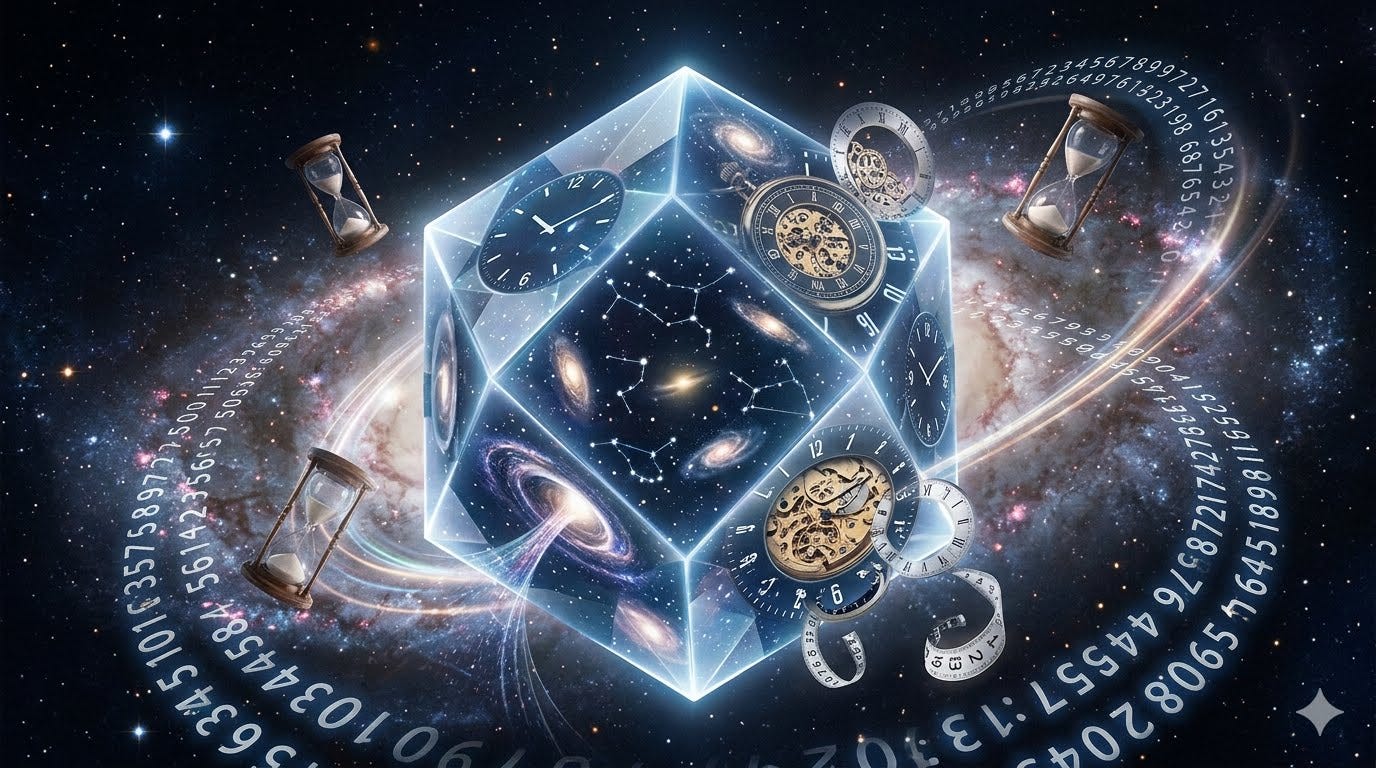
The geometry FE proposes is the rhombic dodecahedron: a twelve-faced shape that tiles all of three-dimensional space with no gaps, no overlaps, and the maximum possible connectivity between cells. It is not chosen arbitrarily. It is the unique shape produced by the densest possible packing of spheres — the configuration any physical medium would settle into if it sought minimum energy. Nature already uses it: garnet crystals grow into this shape. Honeybees independently arrived at it for their comb end-caps. The mathematics of densely packed space keeps returning the same answer.
In FE, particles are not points. They are stable, self-maintaining patterns in this lattice — like persistent whirlpools that hold their shape even as the medium flows around them. Forces are not mysterious actions at a distance. They are the influence field of one pattern reaching across the lattice and interacting with another. Gravity is not a curvature of spacetime — it is an attractive interaction between patterns mediated by the lattice field, which naturally falls off with distance in exactly the way Newton and Einstein described.
Quantum behavior — superposition, entanglement, uncertainty — emerges because the lattice field is not local. It is lattice-wide. When a pattern propagates through the lattice, its influence field spreads across the entire structure simultaneously. That is not a mystery to be explained. That is the geometry.
· · ·
What This Does to the Problem
Siegel’s double-slit problem — what is the gravitational field of a quantum particle in superposition? — has a natural answer in FE. The lattice field of a pattern in superposition is also in superposition across the lattice. There is no contradiction because there is no smooth spacetime to contradict. Gravity and quantum indeterminacy both live in the same lattice, governed by the same dynamics.
The incompatibility Siegel describes is real — but it is an incompatibility of two approximations, not of the underlying reality. General Relativity is what the FE lattice looks like at large scales, when the discrete structure is invisible and the field appears continuous. Quantum mechanics is what the FE lattice looks like at small scales, when discrete pattern behavior dominates. They are the same physics seen at different resolutions.
This is not hand-waving. FE makes specific, testable predictions that differ from both GR and the Standard Model: the gravitational force law should show measurable deviations at sub-millimeter scales, the muon’s anomalous magnetic moment discrepancy should scale predictably with particle complexity, and Casimir force measurements at nanometer separations should deviate from the standard prediction. These are not adjustable parameters — they follow from the geometry.
“General Relativity and quantum mechanics may not be rivals to be reconciled. They may be two views of the same lattice, seen from different distances.”
· · ·
Where This Stands
FE is a working research program, not a finished theory. The alignment of FE constructs with more than twenty landmark experiments — from the Cavendish gravity measurements to Bell inequality violations to the Lamb shift — is documented and ongoing. The mathematical framework is being developed systematically, transparently, with explicit statements of where FE agrees with existing physics and where it predicts deviations.
The idea that space has a structure — and that structure is a specific, discoverable shape — is testable. That is what makes it physics rather than philosophy. And the shape it points to keeps appearing in nature, independently, at scale after scale, long before anyone went looking for it.
· · ·
The incompatibility of gravity and quantum mechanics is one of the most important open problems in science. Siegel is right that it matters — and right that we don’t have the answer yet. But the shape of the answer may already be visible in the geometry of every garnet crystal and every honeybee comb on Earth.
What if the universe doesn’t need two theories — because it was always one shape?
- 1 Siegel, E. (2026). “Gravity and quantum physics are fundamentally incompatible.” Medium, March 31, 2026. — The article that frames the problem this piece responds to.
메타데이터
- post_id
- aa4ebf8bdc9c
- slug
- unifying-gravity-and-quantum-mechanics-what-if-they-were-never-separate-aa4ebf8bdc9c
- url
- https://medium.com/@jamidan/unifying-gravity-and-quantum-mechanics-what-if-they-were-never-separate-aa4ebf8bdc9c
- canonical_url
- https://medium.com/@jamidan/unifying-gravity-and-quantum-mechanics-what-if-they-were-never-separate-aa4ebf8bdc9c
- author_url
- https://medium.com/@jamidan
- status
- ok
- fetched_at
- 2026-06-14 11:28:49