When You’ve Done Everything Right and Still Have Nothing
A Reflection on Exodus 17:1–6
When You’ve Done Everything Right and Still Have Nothing
A Reflection on Exodus 17:1–6
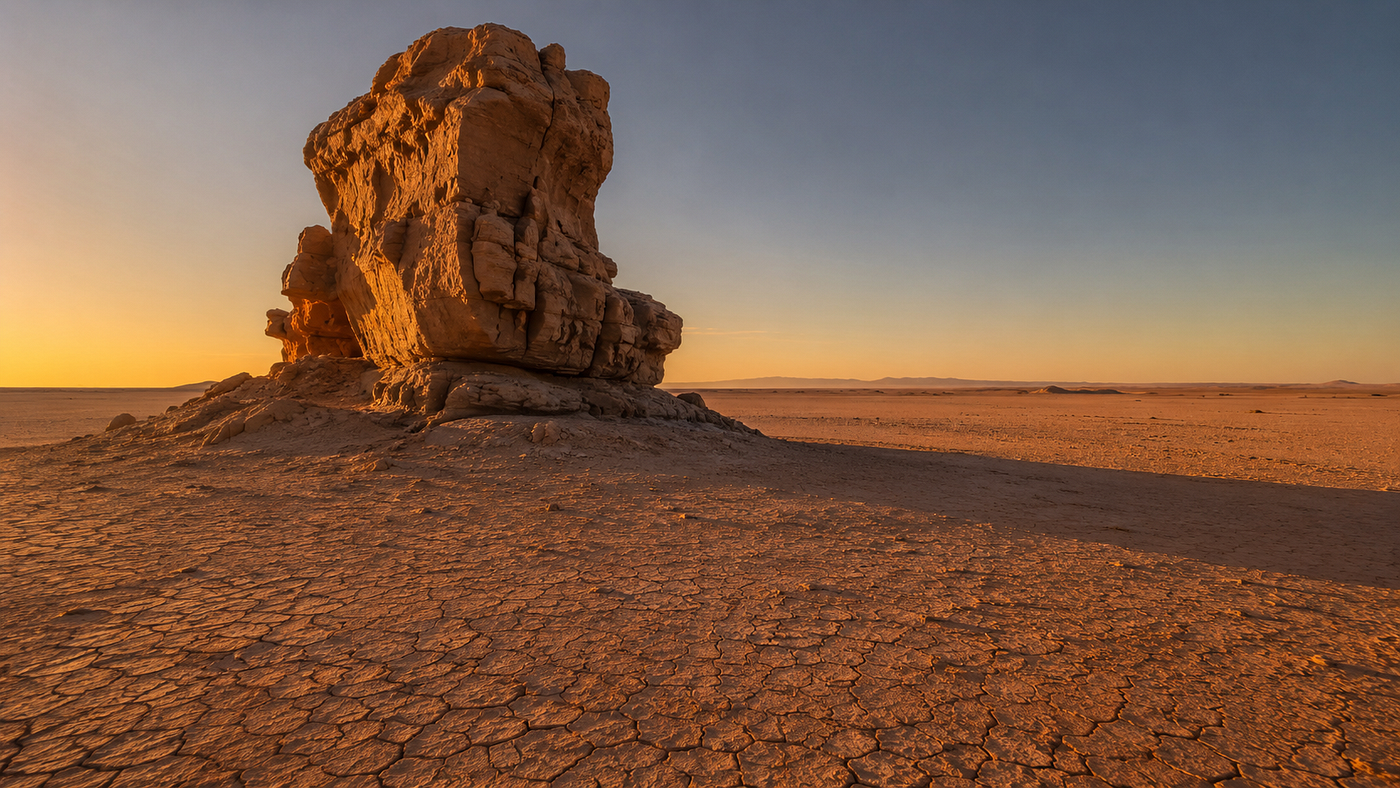
A solitary weathered rock stands in a vast desert at golden hour, surrounded by cracked dry ground and long shadows.
There’s a particular kind of fear that shows up when you run out of something you need.
Not want — need. The bank account that hits zero before payday. The diagnosis that comes after years of doing everything “right.” The job search that goes nowhere despite every effort. The prayer that’s been prayed for so long it starts to feel like static.
In those moments, a question tends to surface that’s hard to say out loud:
God, are you actually here?
That’s not a new question. It’s the oldest question in the wilderness.
Free, and Still Thirsty
By the time Israel reached Rephidim, they had already seen extraordinary things.
They had walked through the Red Sea on dry ground while it stood like walls on either side of them. They had watched their enemies destroyed. They had eaten bread that fell from the sky every single morning. If anyone had reason to trust that God was with them, it was this group of people, at this point in the story.
And then they ran out of water.
*“And there was no water for the people to drink.” — Exodus 17:1 (KJV)*
That’s the whole crisis, stated as plainly as possible. No water. And almost immediately, everything they had seen God do seemed to evaporate from memory.
*“Wherefore is this that thou hast brought us up out of Egypt, to kill us and our children and our cattle with thirst?” — Exodus 17:3 (KJV)*
This is one of the most relatable verses in the Old Testament, if you’re honest about it. It’s not really about water. It’s about a deeper question pressing up underneath the surface: if God brought us this far, why would he let us run dry now?
The Logic of Scarcity
Here’s something worth noticing: the people’s complaint wasn’t irrational. It was based on evidence.
There was no water. That was true. Their senses, their resources, their circumstances all confirmed it. And from where they stood, the absence of water looked like the absence of God.
This is the logic most of us live by, whether we’d say it out loud or not. If God were really with me, I wouldn’t be this anxious. If God were really providing, my account wouldn’t be this empty. If God were really listening, this wouldn’t still be unresolved after all this time.
We treat the presence of a problem as evidence against the presence of God.
But Exodus 17 quietly dismantles that logic — not by explaining it away, but by what happens next.
Two People, One Crisis
Faced with the exact same lack of water, Moses and the people respond in opposite ways.
The people complain — to Moses, though Scripture makes clear it was really aimed higher than that. Moses, on the other hand, does something different with his fear:
*“And Moses cried unto the LORD, saying, What shall I do unto this people?” — Exodus 17:4 (KJV)*
Same shortage. Same fear, probably. But one response turns inward and becomes blame. The other turns upward and becomes prayer.
This is worth sitting with, because most of us have both responses available to us in any given crisis. The circumstances don’t determine which one we choose. What we do with our fear does.
Standing on the Rock
God’s response to Moses is strange, if you slow down enough to notice it.
*“Behold, I will stand before thee there upon the rock in Horeb; and thou shalt smite the rock, and there shall come water out of it, that the people may drink.” — Exodus 17:6 (KJV)*
God doesn’t say, I will bring you to water. God says, I will be standing on the rock — strike it.
In other words: the place where God was already present is the same place the water was going to come from. The rock wasn’t empty. It looked like just another piece of dry desert, indistinguishable from everything around it. But God was already there, before the need was met, before the water appeared, before anything visibly changed.
The miracle wasn’t God showing up. The miracle was that God had been there the whole time — and the striking of the rock simply revealed it.
What This Means for Your Rock
Most of us have a Rephidim. A place in life that looks completely dry. A relationship, a diagnosis, a financial situation, a calling that hasn’t opened up yet — something that, from where you’re standing, looks like solid rock with absolutely nothing behind it.
The temptation is to read that dryness as the absence of God. To assume that if he were really present, this would already be resolved.
But what if the dry place isn’t proof that God is absent? What if it’s the exact place he’s already standing — quietly, before anything visible has changed?
This doesn’t mean every hard situation will resolve the way we want, or on our timeline. The text doesn’t promise that. But it does something else: it relocates where we expect to find God. Not only in the answered prayer, but in the place we’re praying from. Not only after the provision, but in the waiting for it.
The Place Got a New Name
After this, the people called the place Massah and Meribah — testing and quarreling. It became part of their story, a place they’d remember.
But notice: God didn’t leave them named only by their complaint. He answered with water. He didn’t wait for them to get their attitude right first. The provision came in the middle of the doubt, not after it.
That’s not a small detail. If God’s provision depended on our faith being clean and our doubts being resolved first, none of us would ever receive anything. Grace doesn’t wait at the end of the line for the people who finally got their hearts right. It meets people where the water isn’t.

Clear water begins to trickle from a crack in parched rock, glistening in warm golden light against the dry stone.
An Invitation
If you’re in a Rephidim right now — a place that looks dry no matter how you look at it — you’re not the first person to stand here, and you’re not wrong to feel what you feel.
But before the complaint becomes the whole story, there’s another option. Not pretending the dryness isn’t real. Not performing a faith you don’t feel. Just turning the fear upward instead of inward, the way Moses did. God, what do I do with this?
And then watching the rock. Not because it looks like it has anything in it. But because that might be exactly where God has been standing the whole time — waiting, not for your circumstances to change first, but for you to strike the rock and find out he was already there.
The dryness is not the absence of God.
It might be exactly where he’s standing.
Exodus 17:1–6 (KJV)

An empty clay water jug rests on cracked desert ground in soft morning light, evoking quiet waiting and deep need.
메타데이터
- post_id
- aa5bd1b2d210
- slug
- when-youve-done-everything-right-and-still-have-nothing-aa5bd1b2d210
- url
- https://medium.com/@stevensbooks3927/when-youve-done-everything-right-and-still-have-nothing-aa5bd1b2d210
- canonical_url
- https://medium.com/@stevensbooks3927/when-youve-done-everything-right-and-still-have-nothing-aa5bd1b2d210
- author_url
- https://medium.com/@stevensbooks3927
- status
- ok
- fetched_at
- 2026-06-23 03:48:11