AI needs a Kafka Operations Platform. (1/2)
The problems with Kafka operations isn’t execution, it’s context. Here’s how AI is changing that.
AI needs a Kafka Operations Platform. (1/2)
The problems with Kafka operations isn’t execution, it’s context. Here’s how AI is changing that.
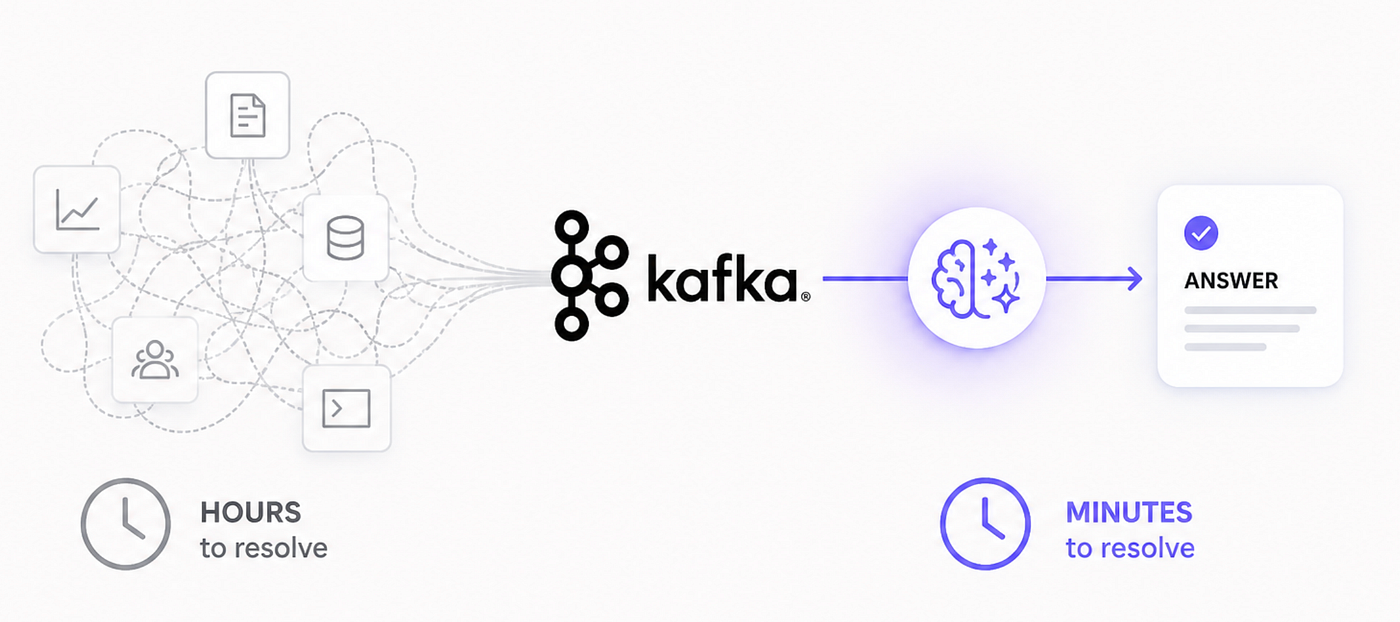
Kafka operations cause many headaches: consumer groups lagging with no obvious cause, Grafana and Datadog dashboards with plenty of metrics but no answers, schema breakages happening and downstream consumers are not happy, partition imbalances needing reassignments mid-traffic, ISR shrinking without clear cause, ACLs failing. Total investigation time: 45 minutes. Fix time: 5 minutes.
90% investigation, 10% remediation : this is how you deal with Kafka operations and this is why at Conduktor we provide a Kafka Operations Platform to ease them. Figuring out what the problem is, this is the hard problem where you need to be senior and have seen it all to be more or less comfortable with Kafka.
But this is changing: this is where I believe AI is extremely useful. Not by autonomously healing clusters (we’re not there yet, and for good reasons), but by reducing the investigation phase from hours to seconds. Instead of asking engineers to become archaeologists, digging through metrics, logs, and config files, AI synthesizes scattered context into immediate answers AND because it has all the Kafka knowledge in the world, it can do correlation and seek more answers if needed.
MCP and CLI orchestrated by an LLM enable this. What previously required custom scripts and multi-tool investigations become simple conversions:
- “Compare production and staging configurations , what’s different?”
- “Which topics were created in the last 30 days with zero consumers?”
- “All consumer groups with lag over one million messages , show ownership, retention and downstream consumers lineage for each.”
Fragmentation is the pain
Kafka environments generate an extraordinary amount of operational metadata: broker health, consumer group states, schema registries, ACL configurations, topic retention policies, partition assignments. Each piece lives in a different system, with a different query language, with different dashboards, with different mental models.
When something breaks, it becomes the primary obstacle to resolution.
How do you answer to: “Which consumers will be affected if we update the schema on the orders topic?” This requires correlating:
- the schema registry (which versions exist, compatibility mode),
- consumer group metadata (who’s reading this topic)
- application configuration (which deserializer each consumer uses)
- potentially deployment history (when were consumers last updated).
No single tool answers this question, it’s a journey.
AI changes this by turning multi-step investigations into simple natural-language queries. The same question, asked to an AI assistant with access to Kafka metadata, will fetch everything it needs and returns a complete answer in seconds. Glorious.
What’s Working Today
AI narrative tends to be massive leaps straight to the autonomous future. BS. The real usages are more simple:
- Incident triage: as we said above, ask a question and AI can find the timeline: a schema version update occurred two hours ago, the new schema removed a field that the consumer’s deserializer expects, and the consumer in this group has been failing silently ever since with weird metrics. Root cause identified in seconds.
Organizations using tools like **Conduktor’s MCP** integration have a mean time to resolution dropping from hours to minutes. The AI isn’t fixing anything, it’s just eliminating the investigation bottleneck.
- Onboarding: Barely no-one is a pure Kafka engineer. They are applications builders. So when new engineers join a team with a complex Kafka deployment, they can face a long ramp-up time to build the mental model of the data flows, upstream & downstream business impact, etc. AI shortcuts this entirely.
A new engineer asks “trace the data flow from orders-raw through all downstream consumers, who owns each component?” and gets a complete pipeline map with ownership, schemas, and dependencies.
- Compliance and audit prep. We work with regulated industries, it’s not a joke. Having the ability to find and compile evidences about data access, data retention, data policies, encryption, etc. AI generates this evidence on demand if it has access to the systems.
A query like “all topics containing PII, their retention policies, who has access, and current encryption status” produces an audit-ready report in thirty seconds. Even the auditors could just have a readonly AI access and do their job directly by asking their question!
Full Automation Is the Wrong Goal (For Now)
There’s a tempting narrative that AI should eventually “manage” Kafka clusters autonomously. Detect a problem, decide on a fix, execute it, move on. For stateless services, this is increasingly viable. For Kafka, it’s premature and dangerous.
- Kafka is a stateful, distributed system. Actions that sound “simple” have cascading consequences that depend on cluster state, traffic patterns, and consumer behavior. An AI that detects under-replicated partitions and automatically initiates rebalancing during peak traffic could cause more disruption than the original issue.
The model for 2026 isn’t autonomous remediation. It’s guided remediation: AI surfaces the problem, explains the tradeoffs of different solutions, recommends a course of action, and waits for human approval before executing. This preserves human judgment for the decisions.
The Takeaway
AI for Kafka operations isn’t about replacing SREs. It’s about giving every engineer immediate access to the context that is scattered across the infra itself, dashboards, logs, wikis, configurations, etc.
When investigation takes seconds instead of hours, Kafka seems easier and everything accelerates: faster incident resolution, continuous compliance, shorter onboarding, smarter decisions, more applications behaving correctly.
If your team regularly spends more time figuring out what went wrong than fixing it, the problem isn’t Kafka complexity. It’s that your tooling hasn’t caught up with what AI can now do.
Part II is coming soon, stay tuned.
This article is adapted from the Conduktor blog. Conduktor is a Kafka Operations PLatform providing Console and Gateway for streaming data infra. Learn more about Conduktor MCP for AI-powered Kafka operations.
메타데이터
- post_id
- aa5ca9d9c14d
- slug
- ai-needs-a-kafka-operations-platform-1-2-aa5ca9d9c14d
- url
- https://medium.com/conduktor/ai-needs-a-kafka-operations-platform-1-2-aa5ca9d9c14d
- canonical_url
- https://medium.com/conduktor/ai-needs-a-kafka-operations-platform-1-2-aa5ca9d9c14d
- author_url
- https://medium.com/@sderosiaux
- status
- ok
- fetched_at
- 2026-06-09 15:37:30