Restricting Creativity: The Hidden Cost of Favoritism and the Myth of Perfection
Innovation is often celebrated in company mission statements, leadership speeches, and recruitment campaigns. Yet, in many organizations…
Restricting Creativity: The Hidden Cost of Favoritism and the Myth of Perfection
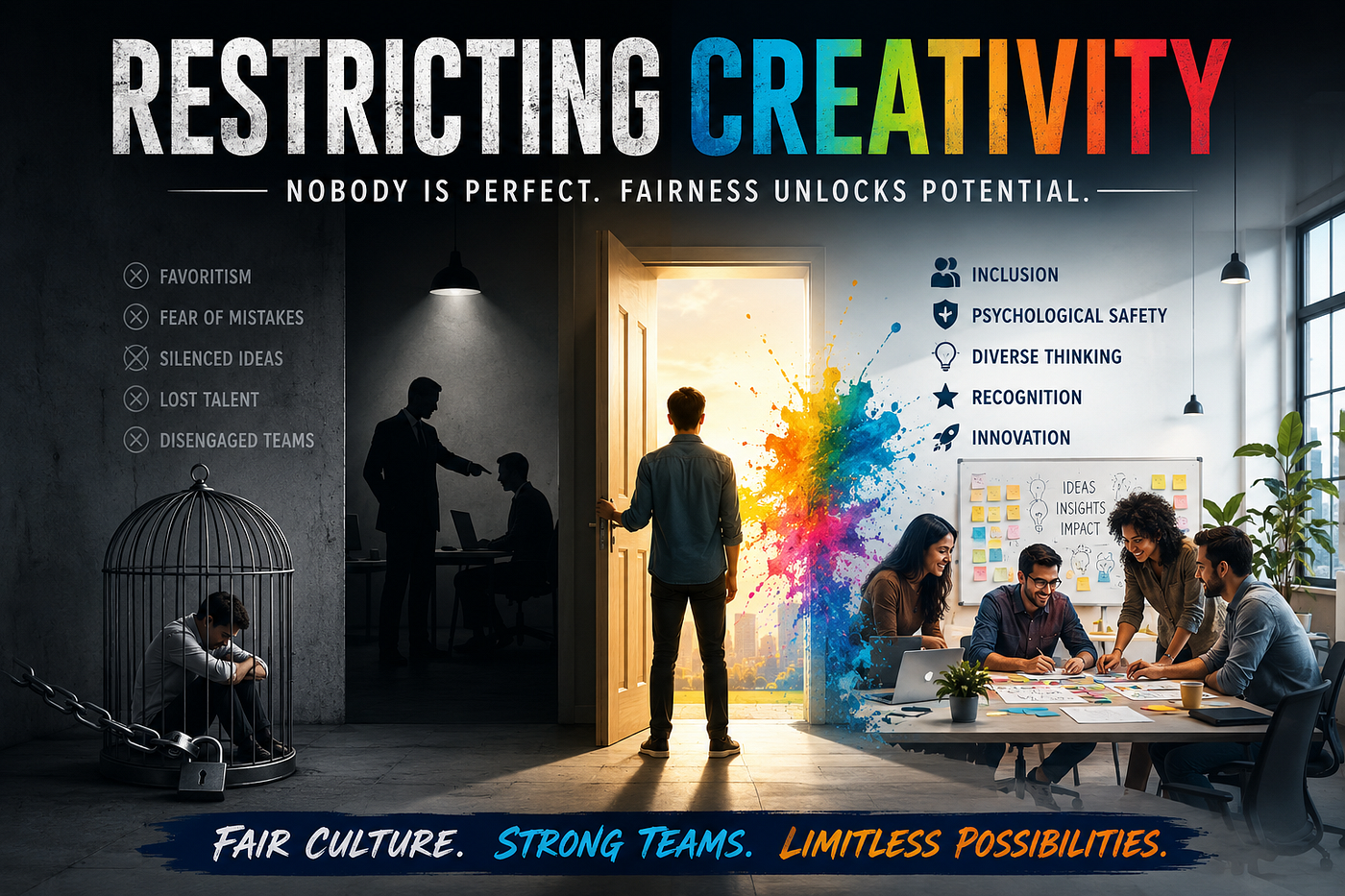
Innovation is often celebrated in company mission statements, leadership speeches, and recruitment campaigns. Yet, in many organizations, creativity is quietly discouraged — not through explicit policies, but through culture.
Ideas are welcomed only when they come from certain people.
Mistakes are remembered longer than achievements.
Employees begin optimizing for approval instead of innovation.
Over time, organizations unknowingly replace creativity with compliance.
The Myth of the Perfect Employee
Many workplaces unconsciously reward perfection over experimentation.
The “ideal employee” is often perceived as someone who:
- Never questions decisions.
- Rarely makes mistakes.
- Always agrees with management.
- Delivers predictable results.
While reliability is valuable, innovation rarely comes from people who are afraid to fail.
Every major breakthrough started as an imperfect idea.
When perfection becomes the standard, people stop sharing unfinished thoughts — the very thoughts that often become the next great product, process, or business opportunity.
Creativity Needs Psychological Safety
Creative thinking requires one important ingredient:
The freedom to be wrong.
People ask questions only when they know they won’t be judged.
They suggest improvements only when criticism is constructive.
They challenge existing processes only when disagreement isn’t treated as disloyalty.
Without psychological safety, employees begin asking themselves:
“Is it worth speaking up?”
Eventually, the answer becomes No.
Favoritism: The Silent Innovation Killer
Favoritism rarely appears in policy documents.
It appears in daily decisions.
The same people receive:
- The most visible projects.
- Leadership attention.
- Recognition.
- Promotions.
- Opportunities to experiment.
Meanwhile, equally capable employees slowly become invisible.
The damage isn’t limited to morale.
Organizations lose access to ideas they never even hear.
Talent doesn’t disappear overnight.
It simply stops contributing.
Nobody Is Perfect
Every employee has strengths.
Every employee has weaknesses.
Even the most experienced leaders:
- Make incorrect decisions.
- Miss opportunities.
- Learn from failures.
- Depend on their teams.
Expecting perfection from some while excusing mistakes from others creates resentment rather than excellence.
Fairness isn’t treating everyone identically.
It’s evaluating everyone by the same standards.
The Cost of Ignoring Talent
When talented people repeatedly feel unheard, several things happen:
- They stop volunteering ideas.
- They contribute only what is required.
- They avoid taking ownership.
- They begin searching for environments where their voices matter.
Some leave.
Others stay — but mentally check out.
The second outcome is often more expensive because disengagement spreads quietly across teams.
Healthy Work Culture Encourages Diverse Thinking
Strong organizations don’t hire intelligent people simply to tell them what to do.
They create environments where different viewpoints are welcomed.
Healthy work cultures encourage employees to:
- Question assumptions.
- Offer alternatives.
- Learn from mistakes.
- Share knowledge openly.
- Respect differing opinions.
Diversity of thought isn’t conflict.
It’s the foundation of continuous improvement.
Managers Shape Creativity More Than Policies
Companies may invest heavily in innovation labs, AI tools, brainstorming sessions, and collaboration software.
But none of these matter if managers unintentionally discourage participation.
Simple behaviors make a difference:
- Listening without interrupting.
- Giving credit publicly.
- Asking quieter team members for opinions.
- Recognizing effort, not just success.
- Treating mistakes as learning opportunities.
- Rotating ownership of important projects.
Innovation grows where trust exists.
Building a Culture Where Ideas Thrive
Organizations that consistently innovate understand a simple truth:
People create their best work when they feel respected, trusted, and included.
This doesn’t mean lowering standards.
It means creating standards that encourage growth rather than fear.
Instead of asking:
“Who made the mistake?”
Ask:
“What did we learn?”
Instead of asking:
“Who usually has the best ideas?”
Ask:
“Whose voice haven’t we heard yet?”
Small shifts in mindset often produce the biggest cultural transformations.
Final Thoughts
Creativity isn’t limited by a lack of talented people.
More often, it’s limited by environments where people don’t feel safe enough to contribute.
No one is perfect.
No leader has all the answers.
No team succeeds because only a few people are allowed to think.
Organizations flourish when they replace favoritism with fairness, fear with trust, and silence with open dialogue.
Because the next breakthrough idea may already exist within your team — it just needs a culture that allows it to be heard.
If your workplace rewards curiosity over conformity, recognizes contribution over connections, and values learning over perfection, creativity becomes more than a buzzword — it becomes part of the culture.
메타데이터
- post_id
- aa6df5bf63cd
- slug
- restricting-creativity-the-hidden-cost-of-favoritism-and-the-myth-of-perfection-aa6df5bf63cd
- url
- https://medium.com/%E0%A4%9C%E0%A5%8D%E0%A4%9E%E0%A4%BE%E0%A4%A8%E0%A4%B8%E0%A5%8D%E0%A4%B0%E0%A5%8B%E0%A4%A4%E0%A4%B8%E0%A5%8D/restricting-creativity-the-hidden-cost-of-favoritism-and-the-myth-of-perfection-aa6df5bf63cd
- canonical_url
- https://medium.com/%E0%A4%9C%E0%A5%8D%E0%A4%9E%E0%A4%BE%E0%A4%A8%E0%A4%B8%E0%A5%8D%E0%A4%B0%E0%A5%8B%E0%A4%A4%E0%A4%B8%E0%A5%8D/restricting-creativity-the-hidden-cost-of-favoritism-and-the-myth-of-perfection-aa6df5bf63cd
- author_url
- https://medium.com/@geeky.vartika
- status
- ok
- fetched_at
- 2026-07-09 05:26:43