Human Dignity in a Culture That Prefers Language Over Responsibility
After more than two decades in executive leadership across nonprofits, behavioral health systems, and faith-based institutions, I’ve come…
Human Dignity in a Culture That Prefers Language Over Responsibility
After more than two decades in executive leadership across nonprofits, behavioral health systems, and faith-based institutions, I’ve come to a less flattering conclusion about our current professional culture: we have become highly skilled at talking about care, inclusion, and innovation while steadily avoiding the discipline required to practice them.
The problem is not awareness. It is substitution.
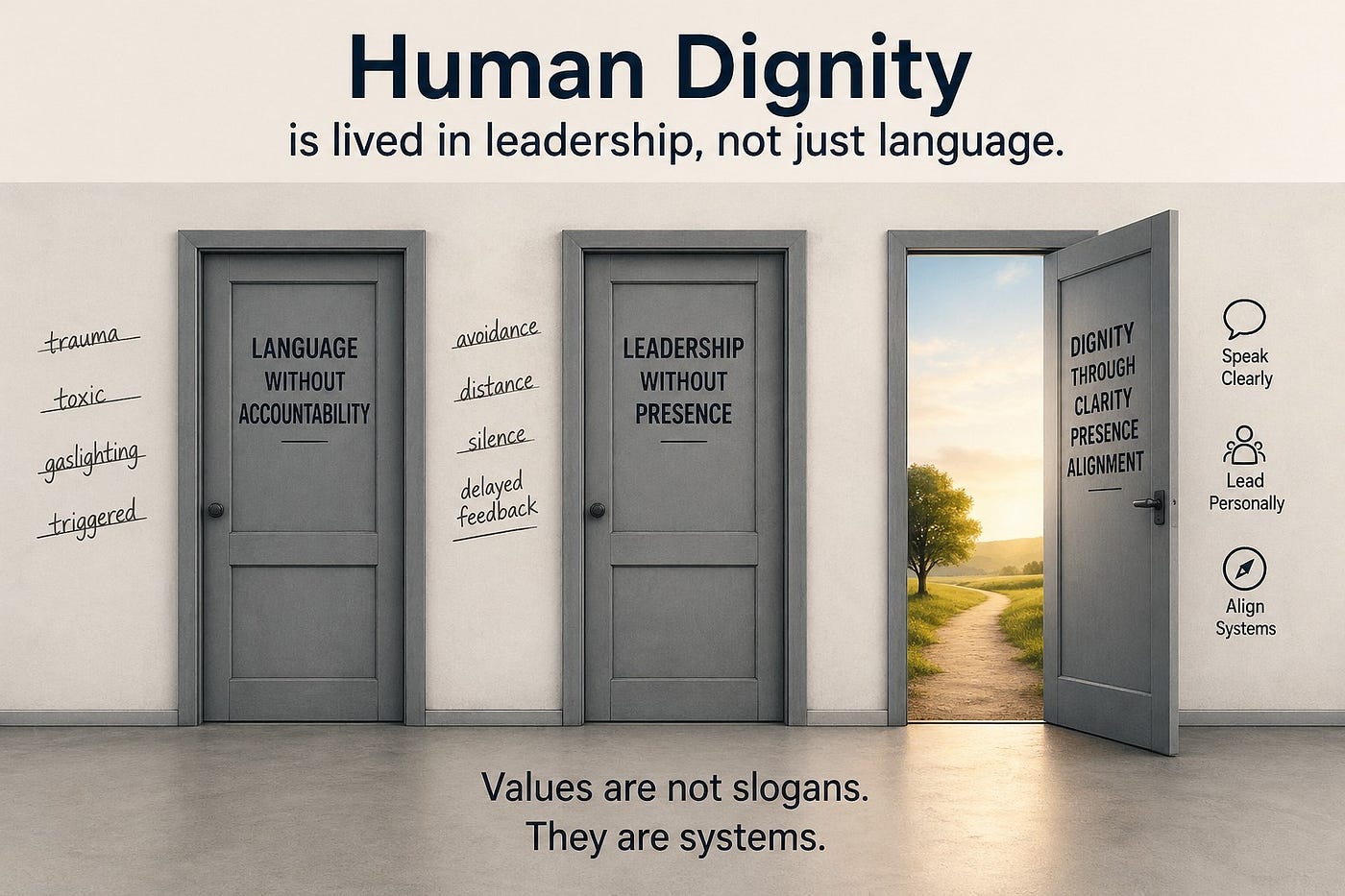
We have substituted clinical language for accountability, emotional distance for leadership, and slogans about innovation for actual structural change. Each of these trends erodes human dignity in ways that are subtle, normalized, and largely unchallenged.
When Everyone is a Clinician, No One is Accountable
Clinical language has moved well beyond its original purpose. Terms like “trauma,” “gaslighting,” and “toxicity” now show up in performance reviews, staff meetings, and casual workplace disagreements.
Nick Haslam’s research on “concept creep” explains part of this shift. Over time, psychological concepts expand to include less severe experiences, broadening the definition of harm (Haslam, 2016). What begins as an effort to increase awareness eventually reduces precision.
That loss of precision carries operational consequences.
When ordinary conflict is reframed as harm, leaders hesitate. Feedback becomes risky. Performance issues are reinterpreted as interpersonal violations. The organization shifts from managing outcomes to managing perceptions.
The result is predictable:
- Direct conversations are avoided
- Accountability becomes negotiable
- Underperformance persists without correction
This is often framed as empathy. It is not. It is ambiguity.
Human dignity is not upheld by avoiding difficult conversations. It is upheld by engaging them clearly, directly, and with respect. Without clarity, there is no real respect — only a reluctance to act.
Even the American Psychological Association has noted the growing gap between public familiarity with mental health language and the disciplined use of that language in appropriate contexts. Awareness, without boundaries, does not produce care. It produces confusion.
Avoidant Leadership is Still Avoidance
Avoidant leadership rarely announces itself. It is often interpreted as professionalism — calm, non-reactive, self-contained.
In practice, it looks different.
Attachment research shows that individuals with avoidant tendencies are less likely to seek support and more likely to limit relational engagement (Mikulincer & Shaver, 2016). In leadership roles, that translates into minimal feedback, infrequent check-ins, and a preference for distance over dialogue.
Organizations pay for that distance.
A meta-analysis in the Journal of Applied Psychology found that insecure attachment styles in leaders correlate with lower trust and weaker team performance (Harms, 2011). Employees do not interpret silence as stability. They interpret it as absence.
And absence creates its own culture:
- Expectations remain unclear
- Feedback arrives late or not at all
- High performers disengage or leave
One executive I worked with described their approach as “giving people space to figure it out.” Within a year, their strongest staff were gone. Not because of workload, but because of the lack of direction.
Autonomy without engagement is not empowerment. It is abdication.
Human dignity requires more than non-interference. It requires presence — being willing to see, challenge, and develop people in real time.
“Think Outside the Box” — But Stay Within It
Organizations consistently claim to value innovation. They rarely build environments where it can occur.
The language is predictable: We want fresh ideas. We need disruption. We encourage creativity. The structure remains unchanged — risk-averse, hierarchical, and optimized for predictability.
Research on organizational ambidexterity highlights this tension. Most organizations struggle to balance efficiency with exploration, defaulting to what is measurable and controllable (O’Reilly & Tushman, 2013).
What emerges is not innovation, but performance:
- Brainstorming sessions without implementation
- Strategy language without structural follow-through
- Encouragement that disappears when risk appears
A widely cited Harvard Business Review analysis makes the point directly: companies often claim innovation as a priority while maintaining systems that discourage it. The issue is not cultural aspiration. It is structural contradiction.
People are not failing to think creatively. They are responding rationally to systems that punish deviation.
When employees are invited to contribute ideas but penalized for acting on them, the message is clear: participation is conditional.
That is not innovation. It is theater.
The Pattern Beneath the Patterns
These issues are typically addressed in isolation — communication training, leadership development, innovation strategy. That approach misses the larger pattern.
Each reflects the same underlying failure: the absence of disciplined alignment between values and behavior.
- Language expands to avoid accountability
- Leadership withdraws to avoid discomfort
- Systems constrain to avoid risk
Together, they create environments where dignity is frequently referenced but rarely operationalized.
Human dignity is not an abstract value. It is a standard that shows up in how decisions are made, how feedback is delivered, and how risk is managed.
Without that discipline, organizations default to symbolic behavior — appearing to care, appearing to lead, appearing to innovate — while producing limited substantive change.
What Changes — If Anything
Most organizations do not need more frameworks. They need correction.
Three shifts are required:
1. Reintroduce Precision in Language Distinguish between harm and discomfort. Not every conflict is a violation. Not every disagreement requires a clinical label. Leaders must be trained — and expected — to engage directly without defaulting to therapeutic framing.
2. Treat Leadership Presence as a Requirement Feedback, visibility, and engagement are not stylistic choices. They are core responsibilities. Avoidant behaviors should be addressed as performance issues, not personality preferences.
3. Align Innovation with Consequence Structures If risk is punished, innovation will not occur. Incentives, decision rights, and tolerance for failure must reflect stated priorities. Without structural alignment, “thinking outside the box” remains rhetorical.
These are not cultural tweaks. They are operational decisions.
A More Honest Standard
The current environment rewards fluency in the language of care more than competence in leadership. That imbalance is not sustainable.
Human dignity does not emerge from what organizations say. It is reflected in what they enforce, what they tolerate, and what they are willing to confront.
To ground this more broadly, Gaudium et Spes offers a useful reminder: human dignity is inherent — it does not fluctuate based on comfort, perception, or organizational convenience.
The responsibility of leadership is not to define dignity, but to ensure that systems, behaviors, and decisions consistently reflect it.
Until that alignment exists, the gap between intention and reality will remain.
And no amount of language will close it.
Sources
Scholarly Haslam, N. (2016). Concept creep: Psychology’s expanding concepts of harm and pathology. Psychological Inquiry. Mikulincer, M., & Shaver, P. (2016). Attachment in Adulthood: Structure, Dynamics, and Change. O’Reilly, C., & Tushman, M. (2013). Organizational Ambidexterity. Academy of Management Perspectives.
Non-Scholarly American Psychological Association (2022). Stress in America Report. Harvard Business Review. Why Innovation Efforts Fail in Organizations.
Anecdotal Executive leadership experience across nonprofit, behavioral health, and faith-based systems (20+ years).
메타데이터
- post_id
- aa72ff2a9a0e
- slug
- human-dignity-in-a-culture-that-prefers-language-over-responsibility-aa72ff2a9a0e
- url
- https://medium.com/@leondixon826/human-dignity-in-a-culture-that-prefers-language-over-responsibility-aa72ff2a9a0e
- canonical_url
- https://medium.com/@leondixon826/human-dignity-in-a-culture-that-prefers-language-over-responsibility-aa72ff2a9a0e
- author_url
- https://medium.com/@leondixon826
- status
- ok
- fetched_at
- 2026-07-21 02:32:38



