The Rupee Fell. India Rose.
Why Exchange Rates Are a Terrible Way to Measure a Nation’s Success
The Rupee Fell. India Rose.
Why Exchange Rates Are a Terrible Way to Measure a Nation’s Success
Every few months, a familiar claim resurfaces on social media, in WhatsApp groups, and sometimes even in mainstream discussions:
“At independence, one U.S. dollar was worth about ₹3–4. Today it is worth more than ₹85. Look how much the rupee has collapsed.”
The implication is clear. If the rupee has weakened so dramatically against the dollar, India must have become poorer.
At first glance, the argument appears persuasive. After all, if it takes far more rupees today to buy a dollar than it did decades ago, doesn’t that mean the rupee has lost value?
Yes, it does.
But the leap from “the rupee lost value against the dollar” to “India became poorer” is where the reasoning breaks down.
Exchange rates tell us something important about an economy, but they tell us remarkably little about whether a nation is becoming more prosperous. If they were a reliable measure of national success, economists could judge countries simply by looking at their currencies. Yet nobody does that, because the relationship between exchange rates and prosperity is far more complicated.
To understand why, it helps to look at what India actually was at independence and what it has become since.
The India of 1947
The India that emerged from colonial rule in 1947 was one of the poorest countries in the world.
Life expectancy was roughly 32 years [1]. Fewer than one in five Indians could read and write; the first post-independence census recorded a literacy rate of just 18.3% in 1951 [2]. Industrial capacity was limited, infrastructure was underdeveloped, and food shortages were a recurring concern. The country’s share of global economic output had shrunk dramatically over the preceding two centuries.
Most Indians today have never experienced that India. They have grown up in a country with highways, airports, mobile networks, digital payments, universities, pharmaceutical giants, a space program, and a thriving technology sector. It is easy to forget how far the country has traveled because the transformation happened gradually, over decades rather than years.
When economists evaluate whether a country has progressed, they look at indicators such as income, productivity, poverty, health, education, infrastructure, and economic resilience. On nearly all of these measures, India today bears little resemblance to the country that became independent in 1947.
The Number That Matters More Than the Exchange Rate
Consider income per person.
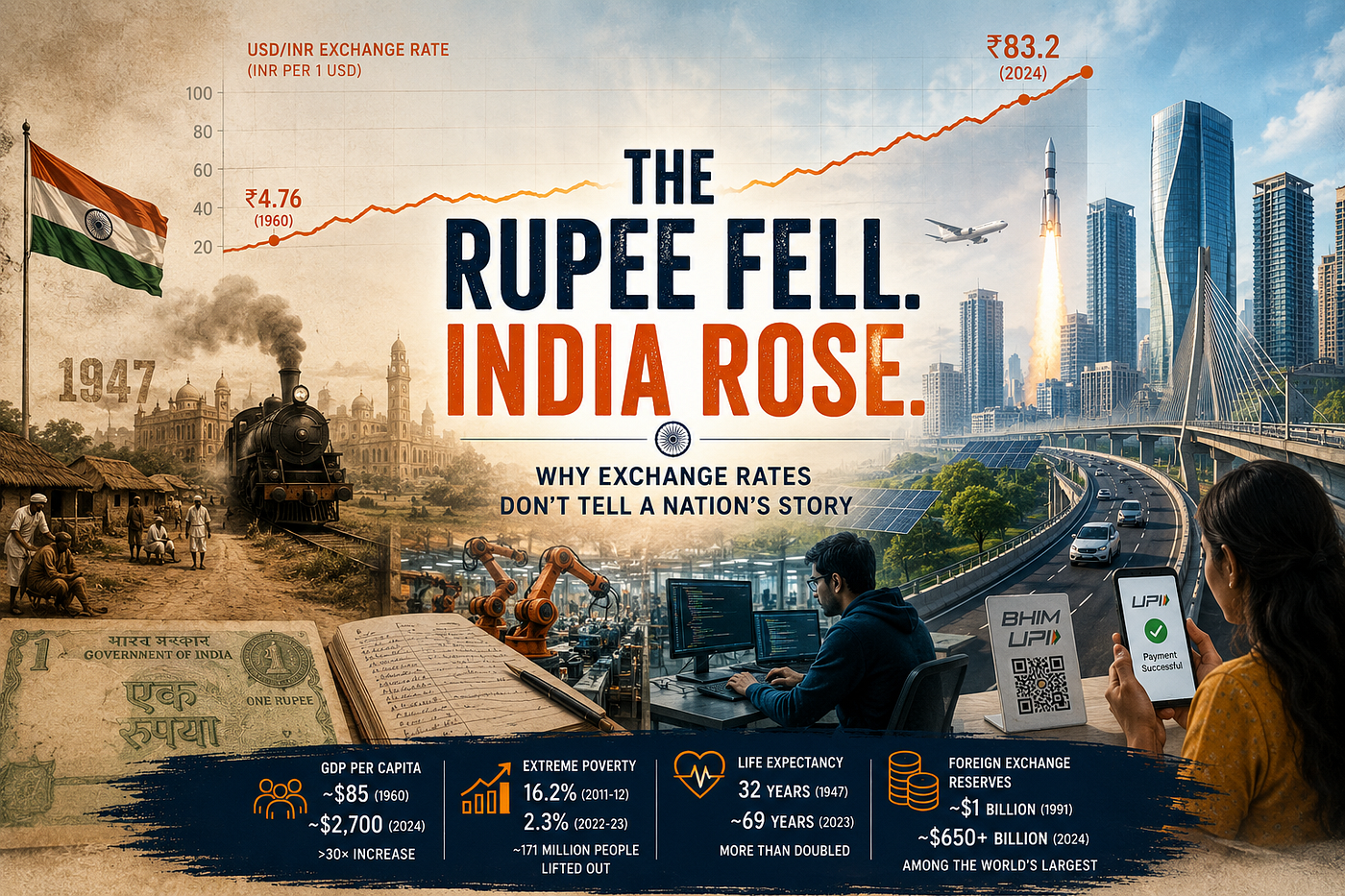
In 1960, India’s GDP per capita was approximately $85 per year [3]. Put differently, the average Indian generated about $7 worth of economic output each month.
Today, GDP per capita is close to $2,700 [3].
That represents an increase of more than thirty times in nominal dollar terms.

The significance of this figure is often lost because large numbers become abstract. Imagine a family whose annual income rises from the equivalent of ₹1 lakh to more than ₹30 lakh over a working lifetime in nominal terms. Nobody would conclude that the family became poorer simply because the rupee weakened during the same period. Yet that is effectively what many people imply when they use the rupee-dollar exchange rate as a shorthand measure of India’s economic journey.
The reality is that Indians today consume more goods, have access to better healthcare, enjoy longer lives, travel more, own more assets, and participate in a vastly larger economy than previous generations.
The Poverty Story Is Even More Remarkable
Economic growth matters because of what it does for people.

According to World Bank estimates, extreme poverty in India declined from 16.2% of the population in 2011–12 to 2.3% in 2022–23 [4].
Percentages alone do not convey the scale of this achievement.
India’s population exceeds 1.4 billion people. A reduction of nearly 14 percentage points translates into approximately 171 million people moving above the international poverty line [4].
To put that in perspective, that is more than the entire population of Russia.
Imagine an entire country the size of Russia being lifted out of extreme poverty within a little over a decade. That is the scale of what occurred.
Reasonable people can debate the pace of growth, the quality of jobs, or the effectiveness of government policies. What is much harder to debate is that hundreds of millions of Indians are materially better off today than they would have been had the economy remained stagnant.
The Crisis That Younger Indians Never Saw
One of the most revealing comparisons is not between 1947 and today, but between 1991 and today.

In 1991, India faced a severe balance-of-payments crisis. Foreign exchange reserves had fallen so low that the country had only a few weeks’ worth of import cover remaining [5]. The government was forced to pledge gold abroad to secure emergency financing.
For a nation with India’s long history and ambitions, it was a sobering moment.
Today, India’s foreign exchange reserves exceed $650 billion, placing it among the top five countries in the world in terms of foreign exchange holdings [6].
The difference is not merely numerical. Reserves are a measure of economic resilience. They provide confidence that a country can meet external obligations, manage financial shocks, and withstand periods of global uncertainty.
The contrast between a nation struggling to obtain dollars in 1991 and a nation holding hundreds of billions of dollars in reserves today tells us far more about India’s economic trajectory than the rupee-dollar exchange rate ever could.
Why the Rupee Was Never Going to Stay at ₹4
One reason the exchange-rate argument is misleading is that it assumes currencies should remain stable over many decades.
In reality, that almost never happens.
Consider a simple example.
Suppose inflation in one country averages 2% per year while inflation in another averages 6% per year. Over fifty or seventy years, prices in the second country will rise much faster. If the exchange rate never adjusted, goods produced in the higher-inflation country would become increasingly expensive relative to foreign goods. Exports would suffer, imports would surge, and economic imbalances would accumulate.
Exchange rates therefore adjust over time to reflect differences in inflation, productivity, trade flows, and capital movements.
India experienced significantly higher inflation than the United States for much of the post-independence period. Consequently, some degree of rupee depreciation was not evidence of economic failure; it was the expected outcome of two economies evolving under very different conditions.
In fact, it would have been unusual if the exchange rate had remained unchanged for seventy-five years.
This is why economists rarely view exchange rates in isolation. A weakening currency can coexist with rising incomes, growing productivity, and improving living standards. History provides many examples.
Japan became one of the world’s richest nations despite a currency that trades at well over 100 yen per dollar. South Korea transformed itself from a poor developing country into a technological powerhouse while its currency underwent substantial long-term depreciation. China’s rise to become a manufacturing giant was accompanied by multiple exchange-rate adjustments over the course of its industrialization.
The lesson is not that exchange rates do not matter. They do. The lesson is that exchange rates alone tell us very little about whether a country is succeeding.
Progress Does Not Mean Perfection
Acknowledging India’s achievements does not require ignoring its problems.
Unemployment, particularly among young people, remains a serious concern. Labor-force participation rates remain lower than many economists would like. Millions of graduates struggle to find jobs that match their qualifications. Agricultural incomes remain under pressure in many regions, and significant disparities persist between urban and rural India.
Income inequality has widened in recent decades. Public healthcare and education, while improved, still fall short of what a country of India’s aspirations ultimately needs. Tens of millions of people remain vulnerable to economic shocks despite the dramatic decline in extreme poverty.
These challenges are real and deserve serious attention.
But they should not be confused with evidence that India has failed economically.
A patient recovering from a major illness may still have health problems. The existence of those problems does not mean the recovery never happened.
Likewise, India’s remaining challenges do not erase its extraordinary progress.
Looking Beyond the Rupee
The obsession with the rupee-dollar exchange rate persists because it offers a simple narrative. It reduces a complex economic story spanning nearly eight decades into a single number.
Unfortunately, simple narratives are often misleading.
If one wishes to understand what happened to India since independence, it is more useful to look at rising incomes, longer life expectancy, expanding infrastructure, declining poverty, growing industrial capacity, stronger foreign exchange reserves, and a vastly larger economy.
The rupee did weaken against the dollar.
That much is true.
What is equally true — and far more important — is that India became dramatically richer, healthier, more resilient, and more economically significant during the same period.

The real story of modern India is not that the rupee fell from ₹4 to ₹85 per dollar.
The real story is that a nation that began its independent journey as one of the poorest countries on Earth became one of the world’s largest economies while lifting hundreds of millions of people to a better standard of living.
That is a story no exchange rate can fully capture.
References
[1] World Bank Data: Life Expectancy at Birth, India.
[2] UNESCO-IIEP, India: National Plan of Action for Education for All.
[3] World Bank National Accounts Data; GDP Per Capita (Current US$), India.
[4] World Bank Poverty and Equity Brief, India, 2025.
[5] Reserve Bank of India; Economic Survey discussions of the 1991 Balance of Payments Crisis.
[6] Reserve Bank of India Foreign Exchange Reserves Data, 2025–26.
메타데이터
- post_id
- aa767dc0155e
- slug
- the-rupee-fell-india-rose-aa767dc0155e
- url
- https://medium.com/@devraj.agarwal/the-rupee-fell-india-rose-aa767dc0155e
- canonical_url
- https://medium.com/@devraj.agarwal/the-rupee-fell-india-rose-aa767dc0155e
- author_url
- https://medium.com/@devraj.agarwal
- status
- ok
- fetched_at
- 2026-07-10 05:19:05



