The Dark Side & Bright Future of GPAI: Ultimate Guide to Global Partnership & General Purpose AI in…
Introduction
The Dark Side & Bright Future of GPAI: Ultimate Guide to Global Partnership & General Purpose AI in 2025
Introduction
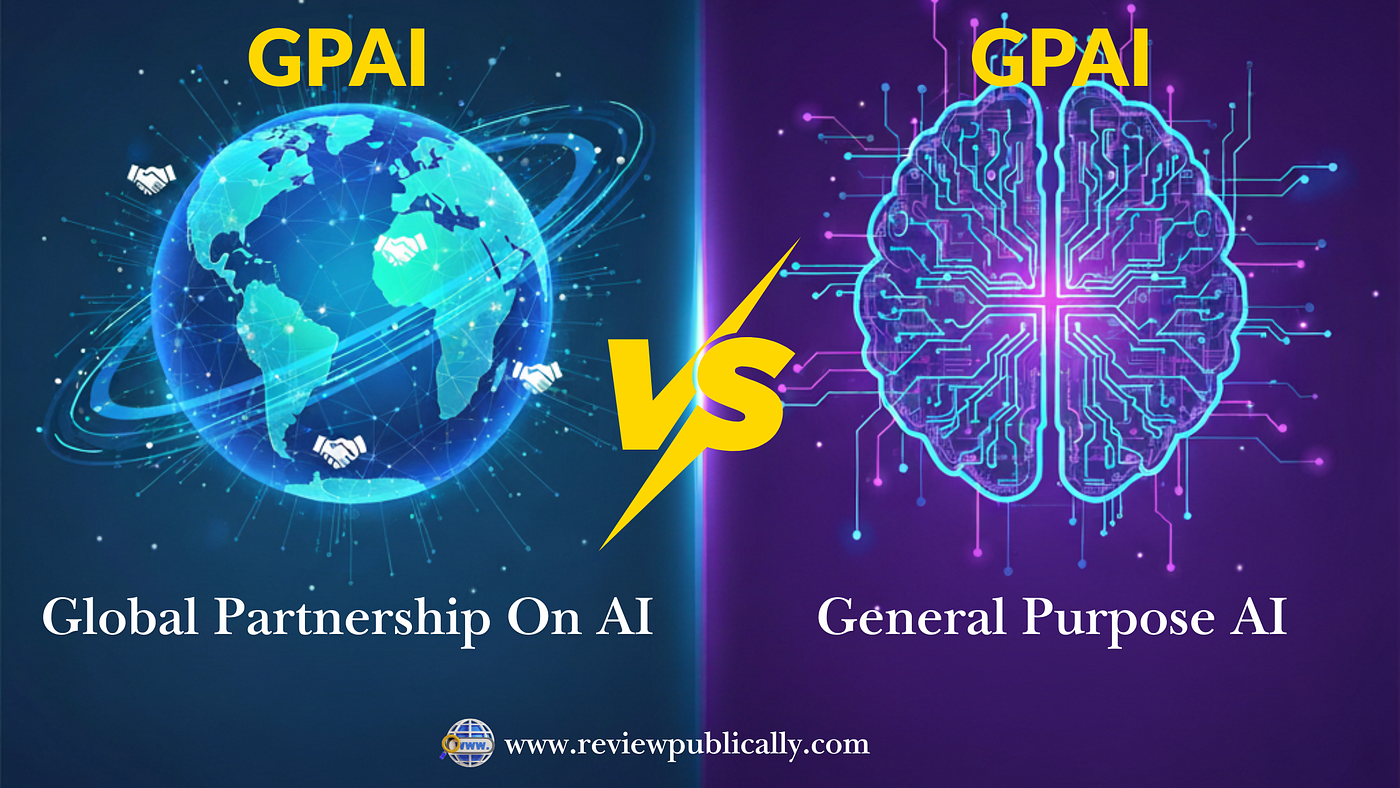
Artificial Intelligence isn’t just for research labs anymore. It is transforming government, business, and everyday life in 2025. The acronym GPAI is at the heart of rising global conversation, policy reform, and regulation. But GPAI means more than one thing and understanding both meanings is essential.
On one side, the Global Partnership on Artificial Intelligence is an international initiative that was established in 2020 and is currently operating in an integrated partnership with the OECD. Its objective is to advance AI that is human-centric, secure, and reliable, with 44 member countries located on six continents. It is responsible for the development of policy frameworks, ethical guidelines, and the promotion of collaboration among Governments, academia, industry, and civil society.
On the other side, General-Purpose AI refer to large AI systems capable of performing many different tasks language, vision, content generation, reasoning, and more. Starting August 2, 2025, providers of General Purpose AI models are required to adhere to new obligations under the EU AI Act. These obligations include transparency requirements, documentation of training data or summaries, and accountability in the use of models.
To understand why GPAI is popular, what the EU rules include, how the global partnership affects AI governance, and what this all means for companies and consumers, this article delves into the two definitions of the term.
What is GPAI? Two Meanings You Need to Know

When you observe GPAI trending in 2025, it could signify two very distinct but related things. If you’re keeping an eye on global AI policy, industry news, or the future of regulation, it’s important to know what both sides of the phrase mean.
GPAI as the Global Partnership on Artificial Intelligence
The Global Partnership on Artificial Intelligence (Global Partenership on AI) is a project that started in 2020 and involves people from across the world. It brings together governments, schools, businesses, and civil society to make and use AI in a responsible way.
Global Partenership on AI’s goal is to make sure that AI stays human-centered, trustworthy, and in line with democratic ideals. This is based on the OECD Principles on AI.
Global Partnership on AI has 44 member countries on six continents as of 2025. This makes it one of the biggest groups worldwide working on AI policy. The alliance hosts working groups, funds applied research and published best practices that help countries develop legislation and standards for AI.
To sum up, AI governance is a partnership that focuses on policy, working together, and governance.
GPAI as General-Purpose AI
General-Purpose AI , on the other hand, is a type of AI model that can do a lot of different things instead of just one.
General Purpose AI models can compose language, make images, code software, summarize legal papers, or even figure things out. This is different from restricted AI systems that merely detect faces or scan invoices. This includes well-known big language models and multimodal AI technologies.
General Purpose AI models have been a big part of discussions regarding regulation since they are flexible and can be used on a large scale. The EU AI Act, which will start to apply to AI governance model providers in August 2025, spells out clear rules on being open, keeping records, and being responsible.
In short, the model category General Purpose AI is about technology, ability, and rules.
Why GPAI is Trending in 2025

Discover GPAI: from Global Partnership on AI to General Purpose AI. Learn its benefits, challenges, regulations, and future outlook in 2025 and beyond.
We observed on Google trends across the world GPAI is trending in tech media, there are good reasons. Both meanings of GPAI ” the Global Partnership on Artificial Intelligence (AI) and General-Purpose AI are in spotlight in current year 2025.
Expansion of the Global Partnership on AI
The Global Partnership on AI still growing since its started in year 2020. Now it has 44 countries, and the European Union covers areas from North America and Europe to Asia, Africa, and South America. Global Partnership on AI is truly worldwide voice in AI governance because it consists of many members across the world.
Global Partnership on AI is becoming more powerful with the addition of new country members and it’s able to make rules, ethical framework and research collaborations. Governments are now using Global Partnership on AI output as guides to help them write their own national AI strategies.
The EU AI Act and General-Purpose AI Rules
One of the biggest reasons Global Partnership on AI or General-Purpose AI is in the news is the **European Union’s AI Act, which officially begins applying to [General-Purpose AI ](https://gpai.ai/)models in August 2025**.
This regulation is the world’s first comprehensive AI law and introduces specific obligations for GPAI developers and providers. These include:
- Requirements for transparency: Businesses must be open about what their GPAI systems can and can’t do.
- Safety and testing standards: To make sure the models don’t hurt anyone by accident.
- Frameworks for accountability: Making it clear who is responsible when GPAI systems are used wrong.
Since the EU AI Act will impact not only European firms but also global tech companies selling into Europe, the rules have worldwide consequences.
Rising Public Awareness and Industry Debate
We can say another main reason Global Partnership on AI or General-Purpose AI is in trends because of users’ interaction, because users are asking challenging queries regarding AI products such as code assistants, chatbots, image generators.
- How safe are these systems?
- Who controls them?
- What happens if they are misused?
Businesses are also looking into how General-Purpose AI may help with automation, creativity, and productivity. The mix of enthusiasm and worry has made GPAI newsworthy, a topic of legislative debates, and a popular search term on Google around the world.
Global Partnership on AI: Goals, Members & Work

GPAI — Global Partnership and General Purpose AI shaping the future of Artificial Intelligence in 2025
The Global Partnership on Artificial Intelligence is a significant multinational initiative aimed at promoting the ethical, trustworthy, and human-centric development of AI.
Origins and Foundations
Founded in June 2020, Global Partnership on AI was initiated by founding members such as Canada, France, and many OECD nations. The effort is founded on the OECD Principles on Artificial Intelligence, which underscore values including fairness, responsibility, transparency, and respect for human rights.
Initially, GPAI sought to reconcile the disparity between artificial intelligence theory and practical application by:
- Facilitating applied research in artificial intelligence.
- Promoting transnational cooperation.
- Establishing ethical foundations for responsible implementation.
Membership and Global Reach
By 2025, the Global Partnership on Artificial Intelligence contains 44 member countries and the European Union, including all continents. Membership comprises:
- North America: United States, Canada, Mexico
- Europe: France, Germany, United Kingdom, Spain, Italy, Sweden, Poland, among others
- Asia-Pacific: India, Japan, South Korea, Australia, New Zealand
- Africa: Senegal
- Latin America: Brazil and Argentina
This broad collaboration positions Global Partnership on AI as a global benchmark for AI policy, encompassing both rich and emerging economies.
Core Goals of Global Partnership on AI
The objective of the cooperation is to:
- Foster trustworthy AI that aligns with human rights and democratic values.
- Promote international collaboration in research and development.
- Support governments in drafting effective AI strategies.
- Advance AI for good, with projects on climate change, healthcare, future of work, and data governance.
Working Groups and Key Outputs
GPAI operates through expert-led working groups, focusing on:
- Responsible AI (ethics, human-centric approaches)
- Data Governance (standards for privacy and security)
- Future of Work (AI’s role in employment and skills)
- Innovation & Commercialization (supporting startups and scaling AI solutions)
Each group releases studies, best practice standards, and policy proposals for global adoption by governments and companies.
Applications and Real-World Use Cases of GPAI
Global Partnership on AI — Projects and Collaborations
The Global Partnership in AI is more active to putting their concepts into reality. Its projects are executed out of several working groups, each of which is working on a real-world problem:
- Responsible AI: Developing frameworks for fairness, accountability, and transparency in AI deployment. For example, GPAI supported guidelines on AI ethics in healthcare to make sure that medical AI tools respect patients’ rights and keep their data private.
- Data Governance: Making rules for exchanging data between countries that protect privacy and sovereignty while also making it easier for different systems to work together. Pilot projects include platforms for open data that the public can use for research.
- Future of Work: Studying the impact of AI on employment and proposing reskilling strategies for workers displaced by automation.
- Innovation & Commercialization: Helping researchers and startups turn AI research into commercial solutions that can grow, especially in smaller economies that need to work together with other countries to stay competitive.
- Climate Change & AI for Good: Using AI to help with disaster prediction, climate modeling, and sustainable farming. For example, GPAI members have explored AI-driven models to get the most out of crops while having the least effect on the environment.
These initiatives show Global Partnership on AI’s role as a global reference point for AI policy, bridging government, industry, and academia.
General-Purpose AI — Everyday Applications
General-purpose AI models like GPT-4, Claude, Gemini, and LLaMA are already a big part of everyday life and business:
- Business and Productivity
- Drafting emails, reports, and contracts with AI copilots.
- Chatbots for customer care that are available 24/7 around the world.
- Market research and trend analysis using AI-generated insights.
- Creative Industries
- AI tools create digital art, music, and video content.
- Writing drafts and content for movies, TV shows, and cartoons.
- Personalized learning materials for education platforms.
- Healthcare
- AI helps in diagnosis by looking at scans, lab records, and the patient’s medical history.
- Drug discovery accelerated through AI simulations.
- Virtual health aids that help patients in many languages.
- Government & Public Services
- AI used in detection of tax fraud, traffic management, and smart city initiatives.
- Translation and accessibility tools improving services for multicultural populations.
- Scientific Research
- Major models that sum up a lot of academic writing.
- Accelerating research in physics, chemistry, and materials science by generating hypotheses and simulating experiments.
Shared Impact
What makes both types of GPAI powerful is their global and cross-sector influence. The Partnership GPAI provides the policy and ethical guardrails.
- General-Purpose AI technologies bring raw capability.
- Together, they affect how people throughout the world use, regulate, and trust AI.
- The Partnership of GPAI provides the policy and ethical guardrails.
Advantages of GPAI

Regardless of whether we refer to the Global Partnership on AI or General-Purpose AI , both present substantial opportunities that have the potential to transform worldwide governance, societies, and industries.
Advantages of the Global Partnership on AI
International Cooperation
- Global Partnership on AI facilitates the collaboration of nations to address common AI challenges, thereby mitigating the likelihood of fragmented policies.
- Nations can establish common standards for ethical AI by combining their resources and expertise.
Development of AI that is Reliable
- The initiative advocates transparency, accountability, fairness, and respect for human rights.
- This is crucial for the adoption of AI systems, as it fosters public trust in them.
Strengthening Capabilities
- Global Partnership on AI facilitates the acquisition of knowledge, best practices, and cutting-edge research by developing nations.
- It ensures inclusive participation in the growth of AI and reduces the digital divide.
Policy Innovation
- Offers a platform for policymakers to test and refine responsible AI regulations.
- Influences frameworks such as the EU AI Act and the OECD AI Principles.
Advantages of General-Purpose AI
Sector-Wide Versatility
- Text, images, coding, and reasoning are all capable of being managed by General Purpose AI models such as Gemini or GPT.
- They increase productivity in various sectors, including healthcare, education, law, and business.
Time and Cost Efficiency
- Organizations can save millions of work hours by automating repetitive tasks.
- Provides startups and SMEs with the ability to utilize robust AI tools without the need for substantial investment.
Innovation and Creativity
- AI aids in the generation of content, the design of prototypes, and the brainstorming of ideas.
- Inspires cross-disciplinary innovations that may be overlooked by humans by themselves.
Universal Accessibility
- Small businesses and individuals worldwide can capitalize on cloud-based AI platforms.
- Allows for the democratic distribution of advanced technologies.
Opportunities for Collaboration
Economic Growth: According to a PwC estimate, AI is expected to generate $15.7 trillion in revenue for the global economy by 2030.
Sustainability: AI assists in the optimization of energy, the reduction of waste, and the mitigation of climate change.
Social Good: Diagnostics in medical and disaster predictions are two of the most difficult problems that humanity faces, and GPAI may be able to help for coming future.
GPAI’s Risks and Challenges
Both General-Purpose AI and Global Partnership on AI are promoting innovation, but they face significant obstacles that need to be overcome to ensure responsible development.
Policy and Governance Challenges of the Global Partnership on AI
Coordination Across Countries
Managing policies among over 29 countries is challenging. For instance, Canada and France, as highlighted founding members, champion robust AI ethics, whereas some Asian nations prioritize innovation over regulation.
Optional Character
The GPAI is more of a suggestion than a law, unlike the EU AI Act (2024), which is legally binding. This means that businesses in member states can ignore suggestions without facing any consequences. Misallocation of Resources
The US and EU lead AI development, whereas Africa and South America lack infrastructure. This widens the digital divide and threatens GPAI’s benefits for developing nations.
Data sovereignty issues
India has expressed apprehensions regarding the transnational sharing of extensive AI datasets due to privacy and security vulnerabilities. This impedes collaboration under Global Partnership on AI.
General-Purpose AI -Technical and Ethical Risks
Unpredictable Behavior
In 2023, ChatGPT and other LLMs occasionally provided false or biased information. This led to discussions about how reliable they are in sensitive areas, such as law and healthcare.
Bias & Fairness
Amazon got rid of its AI hiring tool in 2018 because it was found to be unfair to women who were applying. This shows how bias in AI can make current inequality worse.
Misinformation & Misuse
Before primary elections in the U.S. and India, people were worried about political misinformation campaigns that used tools like deepfake generators.
Lack of Transparency (Black Box Problem)
Many AI systems cannot explain why they made a particular choice. Self-driving car AIs, for example, have struggled to determine the cause of accidents because their decision-making processes aren’t transparent.
Regulatory Uncertainty
The EU AI Act controls GPAI, but legislation in places like the U.S. and Asia aren’t as clear, which makes things hard for companies who do business in more than one country.
Shared Risks Between Both GPAI Concepts
- Trust Deficit: In 2023, several countries, including Italy, temporarily banned ChatGPT due to concerns about privacy. This suggests that people around the world lack trust in one another.
- Security concerns: Cyberattacks powered by AI, such as phishing emails generated by GPT-like models, are becoming increasingly sophisticated.
- Ethical Dilemmas: People could lose their jobs, which is a big risk. According to the World Economic Forum (2023), 83 million jobs could be lost to artificial intelligence (AI) by 2030. People need to be ready for change because it might lead to new job possibilities.
Future of GPAI: Opportunities and Global Outlook
The future (the Global Partnership on AI and General-Purpose AI) will have an impact on how technology, government, and ethics change over the next ten years. There are problems, but there are also huge prospects for creativity, economic development, and the appropriate use of AI around the world.
Opportunities from the Global Partnership on AI
Global AI Standards Development
Global Partnership on AI acts as a platform for creating shared international standards on ethics, transparency, and data governance. This reduces conflicts between regions such as the EU AI Act and U.S. voluntary frameworks.
Developing Nations Capacity Building
Global Partnership on AI can facilitate the responsible adoption of AI in smaller economies by disseminating research, datasets, and tools. Senegal’s involvement indicates Africa’s strategic placement in the AI competition.
AI for Social Good
Global Partnership on AI promotes initiatives in the fields of agriculture, climate change, and healthcare. AI-powered early warning systems for crop failures or catastrophes have the potential to save millions of lives, particularly in vulnerable regions.
Opportunities from General-Purpose AI
Economic Growth & Productivity
A McKinsey analysis from 2024 says that General-Purpose A may add $4.4 trillion to the world’s economy every year. Healthcare, banking, logistics, and education are some of the first sectors to use this.
Boosting Creativity & Innovation
Tools like ChatGPT, MidJourney, and GitHub Copilot are making it possible for people to be more creative in many areas, including making content and writing code.
Democratization of AI
Unlike earlier AI, General-Purpose A models can be used by non-experts, making innovation more inclusive. Startups and small businesses now access advanced AI capabilities at low cost.
Global Outlook
Policy Alignment
The future will rest on how well countries like the EU, US, China, and India can work together to govern AI. Companies will have to deal with fragmented compliance costs if they don’t align.
Responsible Innovation
The next five to ten years will be defined by finding a balance between quick adoption and ethical protection. GPAI frameworks will probably work with UN efforts to develop global AI treaties.
AI and Job Transformation
While automation will replace some roles, new opportunities will arise in AI ethics, auditing, prompt engineering, and cybersecurity. Training and reskilling programs will be key.
Future Outlook — What’s Next for GPAI?

The Rapid Growth of General Purpose AI
There has been an exceptional rate of development in General Purpose Artificial Intelligence (General-Purpose A) systems, which include GPT models, multimodal AI, and autonomous agents. The following are some of the things that we can anticipate these technologies to become over the next five to ten years:
- More integrated into daily life, including education, healthcare, and customer service.
- More intelligent and self-aware, with the ability to comprehend not only language but also feelings, pictures, and the process of making complicated decisions.
This makes it possible for small enterprises and startups to utilize artificial intelligence without having to spend a significant amount of money. According to this trend, General-Purpose A will likely become more than just a tool; rather, it will be a collaborating partner in the creative process.
Future of the Global Partnership on AI
The Global Partnership on Artificial Intelligence is expected to:
- Expand its member base, involving more countries, NGOs, and private sector partners.
- Develop stronger global standards, helping align AI ethics, safety, and transparency across borders.
- Bridge gaps between policy and technology, ensuring that regulations keep pace with innovation.
Long-term, the collaboration wants to build a single AI governance paradigm that eliminates risks and promotes advancement.
Key Trends to Watch
- AI Regulation & Laws — Governments are formulating new frameworks, such as the EU AI Act, which may serve as global benchmarks.
- AI for Climate & Sustainability — Global Partnership on AI will play a role in solving urgent issues like energy efficiency, resource management, and disaster prediction.
- AI-Human Collaboration — Instead of replacing jobs, Global Partnership on AI will redefine them, focusing on tasks where human judgment and creativity complement machine intelligence.
- Ethical & Responsible AI — Transparency, fairness, and accountability will remain top priorities for both researchers and policymakers.
Final Outlook
The future of GPAI is not about choosing between innovation and regulations about balancing both. While General Purpose AI continues to break technological boundaries, the Global Partnership on AI ensures that progress benefits humanity.
If managed responsibly, GPAI can usher in a future where AI not only boosts economies but also solves global challenges in health, education, and sustainability. The next decade will decide whether GPAI becomes humanity’s most powerful ally-or its most difficult challenge.
Conclusion & Call to Action
Artificial Intelligence has transitioned from a theoretical notion to a present reality; it is shaping our lives right now. Whether we’re talking about General Purpose AI because of its capacity to carry out a diverse array of activities, or the Global Partnership on AI driving international cooperation, one truth remains clear: AI is defining the future of technology, policy, and society.
The journey of GPAI highlights two key realities:
- Innovation is unstoppable — AI systems are advancing faster than ever, becoming more capable and accessible.
- Responsibility is essential — Without proper guidelines, ethical principles, and collaboration, these systems can create risks as much as opportunities.
Global Partnership on AI guarantees that AI development is transparent, equitable, and consistent with human values by integrating state-of-the-art technology with global collaboration. We are all obligated to use AI responsibly, as individuals, enterprises, and governments, to protect the future and innovate.
Call to Action
If you’re an AI enthusiast, policymaker, business leader, or simply curious about the future of technology, now is the time to stay informed and engaged. Follow global initiatives like GPAI, explore AI tools responsibly, and contribute to conversations about ethical AI.
The next decade will not just be about AI transforming us, it will be about how we shape AI to serve humanity.
A message from our Founder
Hey, Sunil here. I wanted to take a moment to thank you for reading until the end and for being a part of this community.
Did you know that our team run these publications as a volunteer effort to over 3.5m monthly readers? We don’t receive any funding, we do this to support the community. ❤️
If you want to show some love, please take a moment to follow me on LinkedIn, TikTok, **Instagram. You can also subscribe to our [weekly newsletter](https://newsletter.plainenglish.io/)**.
And before you go, don’t forget to clap and follow the writer️!
메타데이터
- post_id
- aa7876ffda2f
- slug
- what-is-gpai-aa7876ffda2f
- url
- https://medium.com/writer-tribune/what-is-gpai-aa7876ffda2f
- canonical_url
- https://medium.com/writer-tribune/what-is-gpai-aa7876ffda2f
- author_url
- https://medium.com/@ReviewPublically
- status
- ok
- fetched_at
- 2026-07-17 03:06:15