Mystery on a Stick: Who Created the Corn Dog?
One stick, many suspects — who really created this brand new wiener world?
Mystery on a Stick: Who Created the Corn Dog?
One stick, many suspects — who really created this brand new wiener world?
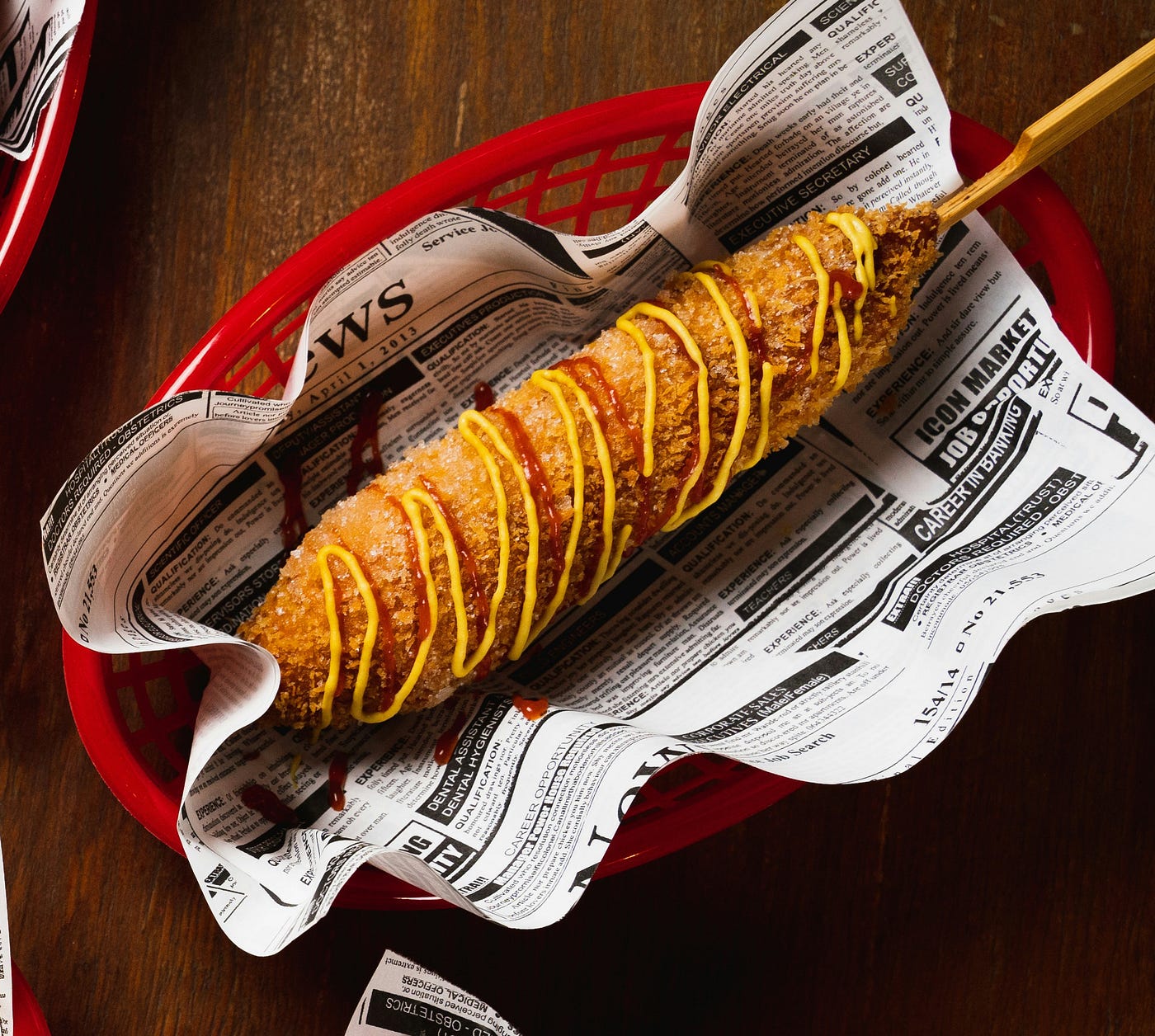
Photo by D. Pham on Unsplash
I love a good mystery. A food mystery? Even better.
Not long ago, I shared the tale of “The Legendary Hot Brown,” a fun (though somewhat romanticized) story of the creation of the famous hot turkey sandwich.
“A Bit of Mystery on Rye,” the story of the Reuben sandwich, was a classic tale of who-dun-it, and the “Parable of Poutine” detailed the battle between two restaurateurs in the Province of Quebec.
Another food has me curious, a carnival/county fair favorite. Meet the corn dog, a deep-fried cornbread-batter-dipped wiener on a stick. Who made it? When? Where? And … why does it have so many names? This food history/mystery is about as obscure as the bottom of a deep fryer, and corn dogs are so tasty that everyone wants to take credit for them. A brief search on the internet gave these conflicting accounts.
The Cozy Dog Drive-In in Springfield, Illinois, along Route 66, boasts that they were the first to serve hot dogs on a stick — the year was 1946. The website for the Cozy Dog gives a first-person account of how their “Cozy Dog” came to be.
In 1941, Ed Waldmire, Jr., traveled to Oklahoma to visit his brother. “We stopped at a greasy spoon in Muskogee. They were making [it] in a contraption like a waffle iron. They poured batter in a trough, put in three wieners, and baked it for 15 minutes.”
He shared his memory of this gastronomic discovery with Don Strand, a fellow student at Knox College … and then promptly forgot about it. But Don didn’t.
It just so happens that Don’s father was in the bakery business, and so five years later, Ed, who was now in the Air Force and stationed at Amarillo Airfield, got a letter from his friend Don (the guy with the dad who bakes).
“Hey, we’ve developed a cornbread mix that will stick to a hot dog while deep-fried. Wanna try it?” (This isn’t a direct quote).
Ed Waldmire and his unit had time on their hands and a gas-fueled fryer at the base PX, so, using cocktail forks, they began to experiment with the “hot dog on a stick”. It was an immediate hit! The cooks in the kitchen dubbed the creation the “crusty cur” and sold thousands, according to Ed’s story.
When he was honorably discharged from the USAF in 1946, Ed and his wife, Virginia, decided that battered wiener on a stick was good enough to turn into a profitable business. However, there was one problem — the name “crusty cur” just didn’t have the right feel. Virginia suggested Long Johns, Snuggle Puppies, and finally Cozy Dog. That one stuck, and she drew a logo that remains to this day as an icon on Route 66.
Ed and Virginia established the first Cozy Dog House in Springfield, Illinois, on South Grand between Fifth and Sixth Street. A second Cozy Dog House was opened at Ash & MacArthur. In 1996, Cozy Dog moved to its current location, 2935 S 6th St. They’re still operating today, serving breakfast, lunch, and dinner. Want a Cozy Dog? You can have one for just $3.30 or a basket of 4 Cozy’s plus a large fries for $17.35.
But how can this be? There’s an equally compelling story from Double Oak, Texas, about 30 miles outside of Dallas. In October 2021, Katy Vine, writing for the “Texas Monthly,” a print and online magazine, shared her interview with Glenda Gail (G.G.) Fletcher.
G.G. is the widow of Skip Fletcher, whose father and uncle, Neil and Carl, were “rounders,” another name for vaudevillians.
In 1938, the brothers were performing with other family members in a troupe named the “Madcap Players.” Texas State Fair officials approached them, asking if they would be interested in operating a food booth. Operating a booth would be easy — deciding what to cook? Not so much. But, over a bottle of bourbon, Neil remembered a “sandwich” he’d eaten at Oak Lawn, near Dallas — a hot dog baked in a cornbread pan with divots shaped like an ear of corn.
It was tasty, but difficult to eat. However, the same concept, but impaled on a stick, would be knife and fork-free, portable, and perfect fair food. Corny Dogs made their debut at the Texas State Fair in 1942. By the end of their first fair, the brothers had made [$8,000](http://By the end of their first fair, the brothers had made $8,000 (about $134,000 today).) (about $134,000 today).
Or should we be looking at the 1939 Pronto Pup from Rockaway Beach, Oregon? George and Vera Boyington’s order of hot dog buns was ruined in a Labor Day rainstorm, so, of course, they battered and deep-fried their hot dogs instead. (Insert grinning emoji here).
The Boyingtons trademarked the name Pronto Pup in 1942 and began to sell a proprietary flour mix for carnival vendors — with the proviso that the Pronto Pups would be sold with mustard only, never ketchup. Pronto Pups moved eastward, as far as Chicago, where Jack Karnis, fresh out of the Merchant Marines, opened a Pronto Pup franchise in downtown Chicago.
But that’s not the end of the Pronto Pup story. One day, William Brede, a prominent Twin Cities businessman, flew to Chicago for a business meeting. He saw people standing in line, a line that wrapped around the block. Brede figured that anything that good was worth looking into. He joined the line, not even knowing what was awaiting him. You know where this is going, don’t you?
When he reached the head of the line, William Brede tasted his first Pronto Pup … and it was not his last. Brede immediately talked with the owner, Jack Karnis, asking him to help open Pronto Pup booths at the Minnesota State Fair.
Initially, Karnis declined, but Brede wasn’t willing to give up. He talked with Fair officials and secured six concession booths. He then returned to Chicago and made his pitch once again, offering to match Jack’s earnings for a year. In 1947, Pronto Pups made their inaugural appearance at the Minnesota State Fair, and they’ve been there ever since.
That first year, 106,000 Pronto Pups were sold (it was a good year). In 2024, eight booths were open at the Fair; gross revenues were $2.2 million. Would you like a few numbers, just for fun? The average number of “Pups” sold per day is 29,886, and the batter to cover them is roughly 70 tons every year.
I’m so confused. But wait, it gets worse. This corn dog conundrum isn’t isolated to the “Make America Great Again” US of A. Canada calls them “Pogos”, in Australia, you have three names from which to choose — the Pluto dog (ala Mickey Mouse), Dagwood Dogs, or Dippy Dogs.
And then, ooh, la, la. In France, you can dine on a beignet de saucisse, which translates to “sausage donut.”
There’s one more person I’d like to introduce you to in this sticky situation (sorry, I couldn’t resist). Stanley S. Jenkins, businessman, civic leader, and part-time inventor. On July 5, 1927, he applied for a patent with the U.S. Patent and Trademark Office. The application read, in part:
Consisting of an article of food impaled on a stick and coated with batter, an object of the invention being to employ such sticks as means co-operating with devices forming part of the apparatus to hold the batter jacketed food articles immersed in the liquid cooking medium while the batter is being cooked, and thereafter to hold the articles in proximity to the surface of the liquid so as to be kept warm until served.
We now know that Jenkins’s dream of hot dogs lovingly cradled in a spongy batter and then brought to golden perfection in a hot-oil bath spread across the United States (and other parts of the world).
At state fairs today, everything you can imagine (and a few you never would have considered) can be and is deep-fried, and perhaps we have Stanley Jenkins to thank for that. But (and this is a BIG but), there is no evidence that Jenkins ever sold a corn dog. Not one.
The gold-dipped tale on a stick needs a coda, a summation, a tidy bow to finalize it all.
In the end, the corn dog’s true origin might remain as elusive as its name on a fairground menu. Was it born on a beach in Oregon, brought to fame in Texas, or boldly skewered and served in the Midwest?
This one thing is certain — all across America (and beyond) the corn dog has earned its place as a bite of culinary history.
Whether you call it a Cozy Dog, Corny Dog, Pronto Pup, or (fill in the blank), the corn dog’s story shows how a simple idea — meat, batter, stick, heat — can go in so many different (and delectable) directions. Maybe that’s the real magic: not who did it first, but how we’ve all adopted it.
Maybe some mysteries are best left unsolved.
Did you enjoy what you read? If you’d like to read my future writings, subscribe to my email list, and you’ll be notified every time I publish a new story.

메타데이터
- post_id
- aa7ea6d8240b
- slug
- mystery-on-a-stick-who-created-the-corn-dog-aa7ea6d8240b
- url
- https://medium.tastyble.com/mystery-on-a-stick-who-created-the-corn-dog-aa7ea6d8240b
- canonical_url
- https://medium.tastyble.com/mystery-on-a-stick-who-created-the-corn-dog-aa7ea6d8240b
- author_url
- https://medium.com/@lindalum_2779
- status
- ok
- fetched_at
- 2026-07-21 18:42:11