Hierodules of Time
It has been said that the throne of God rests upon four pillars, and these four pillars are the four principles of His power. I will name…
Hierodules of Time
It has been said that the throne of God rests upon four pillars, and these four pillars are the four principles of His power. I will name them for you now, plainly, though plainness does little justice to what they contain.
The first kind exists at the very foundation of what is. They are created and unmade in the same instant — pure energy without stable form, impossible to perceive except through what they leave behind. The visible forces of the universe and the dark energies that remain unmeasured both belong to their domain. They are the breath before the word. They are what remains when everything else has been stripped away.
The second kind is the world you know. These are beings created with a self-sustaining balance, but into each one a small imperfection was woven at the moment of making — a hairline fracture in the vessel through which the essential energy seeps, slowly, without pause, without mercy. Their fate is destruction, though the hour of it may be a moment or a billion years away. For ages together no being among them will detect the loss — the leak is so fine, the vessel so vast — yet the draining never stops.
What they may do, and what the law of their nature compels them to do, is draw more energy from the world around them to replenish what is lost. And so they are bound to each other not only by kinship but by necessity — each one a vessel tilting slightly, perpetually refilling. The strong take from the weak. The weak find weaker still. This is not cruelty but physics. This is the law of the second kind.
Every creature you have ever seen belongs here. Every stone and river and human longing. And when one of these beings is destroyed, the energy it held is released all at once — which is why the old rituals involved blood, why certain peoples drank it and anointed themselves with it, why sacrifice was never merely ceremony. Blood carries the essence. It was a crude method, inefficient and violent, but it was not ignorant. It knew something true.
The third kind is what we call the selfless. Their systems are sealed. They lose nothing and require nothing — neither from the world nor from each other. The angels belong here, and certain spirits, and a small number of those chosen from among men whose vessels were made differently, whose holes were closed before they drew their first breath.
Because they are free from the machinery of survival, they are capable of thinking across the full span of things rather than only to the edge of their own hunger. Their purpose is to bring coherence to the chaos of the second world — to serve as anchors, as guides, as the sanity in a system that would otherwise devour itself entirely. They fear nothing that breathes. They fear only the One who holds a single syllable whose frequency can pass through any wall, however thick — the commandment that can reach even into a sealed vessel. They are immortal precisely until the moment God chooses otherwise, and this knowledge keeps them humble in a way that power alone never could.
The fourth kind is the lost ones. This is the hardest account, and it requires you to hold two contradictory truths at once.
They are immensely powerful — more powerful in certain respects even than the immortals. They were given supremacy over the affairs of this world, and that gift was not illusion. What they touch, they can shake. What they pursue, they can obtain. The hierarchies of this world bend around them.
But concealed within that power is the most terrible of all architectural flaws. Their vessel does not merely leak — it tears. The hole within them is vast and widening, and the rate at which they lose their essence makes the losses of the second kind look like a candle set against a conflagration. They burn through themselves with terrifying speed.
To survive they must consume — and consume without pause. Not occasionally, not when pressed, but ceaselessly, as a condition of continued existence. The moment they stop taking energy from others, they begin to die. Selflessness, for them, is not a moral failing but a structural impossibility — it is the one thing that would unmake them. They cannot afford compassion. They cannot sustain generosity. Every act of grace costs them existence itself.
And so they wage no wars directly — they cannot afford the expenditure. Instead they turned to the second kind, whose survival instincts they understood perfectly, and they learned to manipulate those instincts so that the second kind would fight in their name and die in their service. The energy released by those deaths flows back to them. This is the arrangement. Those who align with them receive, for a time, extraordinary power and worldly advantage — because a portion of what is taken is returned as payment, as incentive, as the price of continued loyalty. But it is always temporary. The fourth kind cannot afford permanent generosity any more than they can afford permanent compassion.
This is the great inversion at the heart of the world: that the most powerful beings within it are also its most desperate. That the ones who appear to have conquered everything are in fact enslaved by the very force of their own existence. They were not given the kingdom of this world as a reward. They were given it as a cage.
And this is why the path of the selfless ones is so difficult here — not because the selfless are weak, but because the entire structure of this world has been organized to feed the hunger of the lost. The second kind, pressed by their own survival, are recruited into a war they do not fully understand, on behalf of a master whose nature they cannot see. The third kind work against this constantly, at great cost, and the first kind underlie it all, indifferent and foundational as gravity.
Four pillars. One throne.
This is the shape of things.
Asad Ali
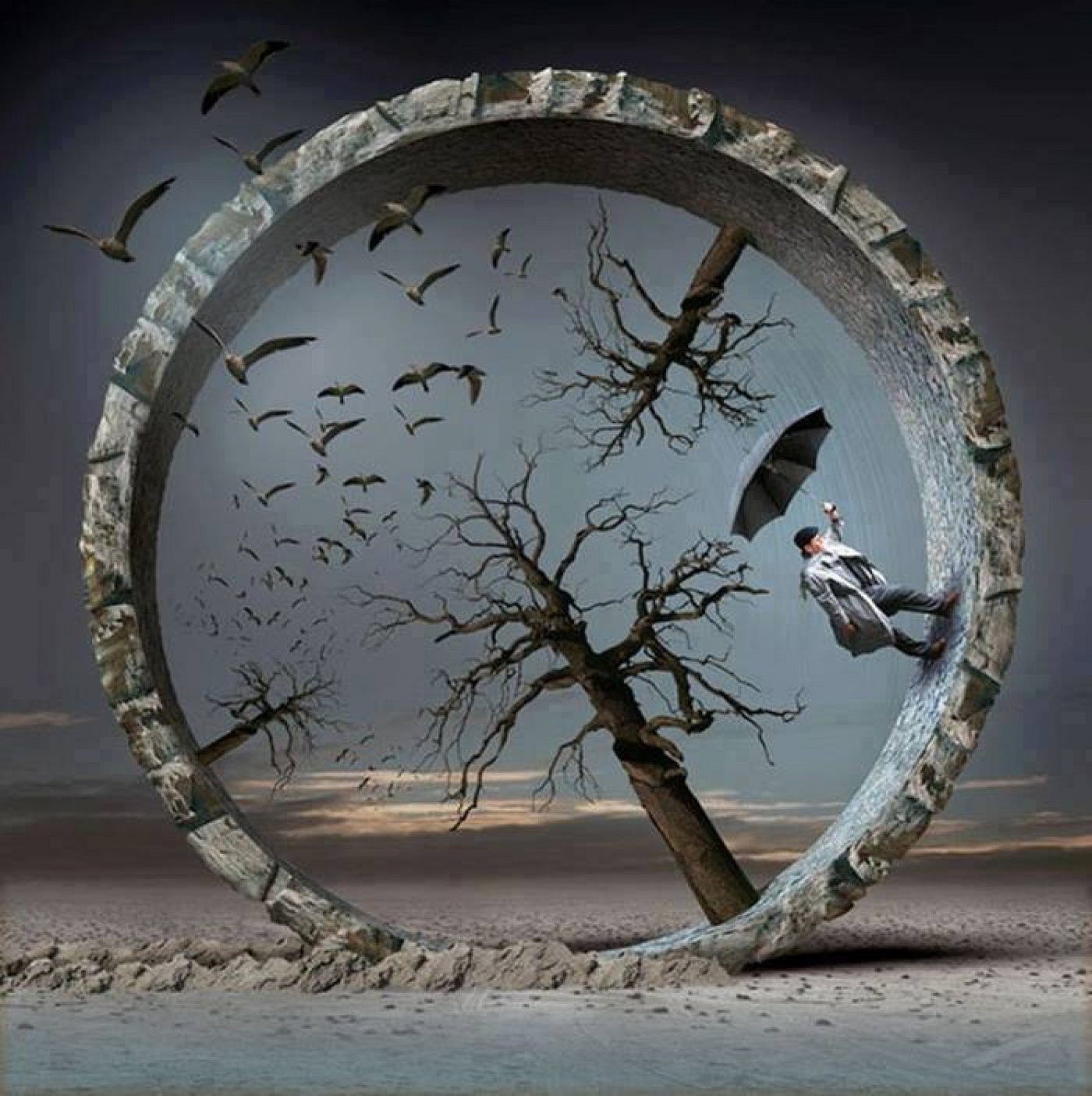
Painting by Igor Morski
메타데이터
- post_id
- aa8b96deb768
- slug
- hierodules-of-time-aa8b96deb768
- url
- https://medium.com/@aliasad7/hierodules-of-time-aa8b96deb768
- canonical_url
- https://medium.com/@aliasad7/hierodules-of-time-aa8b96deb768
- author_url
- https://medium.com/@aliasad7
- status
- ok
- fetched_at
- 2026-07-10 21:04:09