Would Christianity Survive Without the Physical Resurrection?
If the empty tomb is a metaphor, does it change the truth of Jesus’ teachings?
Would Christianity Survive Without the Physical Resurrection?
If the empty tomb is a metaphor, does it change the truth of Jesus’ teachings?
Image Source.
Jesus Christ was executed by the Romans in AD 33, but 347 years later, the Roman Empire worshiped him as a divinity. What happened? The traditional answer is the resurrection. The historical answer, however, is deeply tied to the survival of an empire.
The Political Power of a Miracle
In AD 33, Jesus was a threat to the authority of the Roman empire and the religious orthodoxy of his day. In AD 380, Roman Emperor Theodosius I issued The Edict of Thessalonica¹ to unify the Roman empire under a single religious doctrine in the hope of preventing its eventual split. Politically it was a failure; in AD 395 the Roman Empire was permanently divided into two administrative halves. Religiously it was a success; it was the birth of Christianity as we know it today.
Theodosius I chose Nicene Christianity² — one of at least 8 different forms of Christianity³ in the 4th century. Nicene Christianity included the physical resurrection of Jesus Christ upon which Jesus’ divinity is based⁴. Christian theology considers this story the foundational event (1 Corinthians 15:12–19). Jesus’ divinity gave Theodosius I the authority to declare opinions contrary to those of the Roman Catholic Church heresy punishable by death. The first victim was Priscillian⁵ in AD 385; the last was Cayetano Ripoll⁶ in 1826.
In addition, the Latin Vulgate Bible published in AD 382 served as the text for the Gutenberg Bible in the 1450s, was revised in 1592, and became the official Bible of the Roman Catholic Church until 1979. Latin made the Bible readable for literate, Latin-speaking clerics and scholars, but not for the average Roman citizen or for people in other provinces. Translating the Bible into other languages was heresy. William Tyndale was executed in 1536 for translating the Bible into English⁷.
The resurrection story went unchallenged for ~1,500 years, because the integrity and interpretation of the bible was protected by both law and language. The protestant reformation in the 16th century and the age of enlightenment in the 17th to early 19th centuries finally removed these restrictions and allowed consideration of alternative views of traditional Christian beliefs.
Miracle or Metaphor?
Given the absence of evidence to the contrary, the resurrection of Jesus is either a miracle or a metaphor. A miracle is not explicable by natural or scientific laws and is therefore considered to be the work of a divine agency. That Jesus was physically resurrected from a dead body to a live body would be a miracle. A metaphor is a word or phrase applied to an object or action to which it is not literally applicable. That Jesus was resurrected into the hearts and minds of Christians would be a metaphor. The miracle offers the promise of life after death; the metaphor shows the way.
Jesus said to his disciples, “I am the way and the truth and the life. No one comes to the Father except through me.” (John 14:6). “If you hold to my teaching, you are really my disciples. Then you will know the truth, and the truth will set you free.” (John 8:31–32). As a metaphor, the resurrection story confirms the triumph of Jesus’ teachings on love and forgiveness as ‘the way’ to God and the life Jesus promised his disciples. Jesus commanded them⁸: “Love God”, “Love your neighbor”, and “Love one another.” Jesus illustrated his commandments through extended metaphors (parables), such as The Prodigal Son (Luke 15:11–32), The Good Samaritan (Luke 10:25–37), and The Sower (Matthew 13:1–23). The same events that were interpreted as a miracle in the 4th century can be recognized as a metaphor in the 21st century.
Caveats to The Resurrection Story
There are 4 caveats to the resurrection story. First, the resurrection story is unique to the New Testament of the bible. Although 8 non-Christian sources from the 1st and 2nd centuries confirmed the historical existence of Jesus and his execution by Pontius Pilate, none of them confirmed the resurrection of Jesus following his crucifixion⁹.
Second, only 7 of the 27 books in the New Testament describe post-mortem appearances of Jesus, and they were written decades after Jesus’ crucifixion (Fig. 1). Thus, our knowledge of the resurrection depends on the memories of 5 New Testament authors.
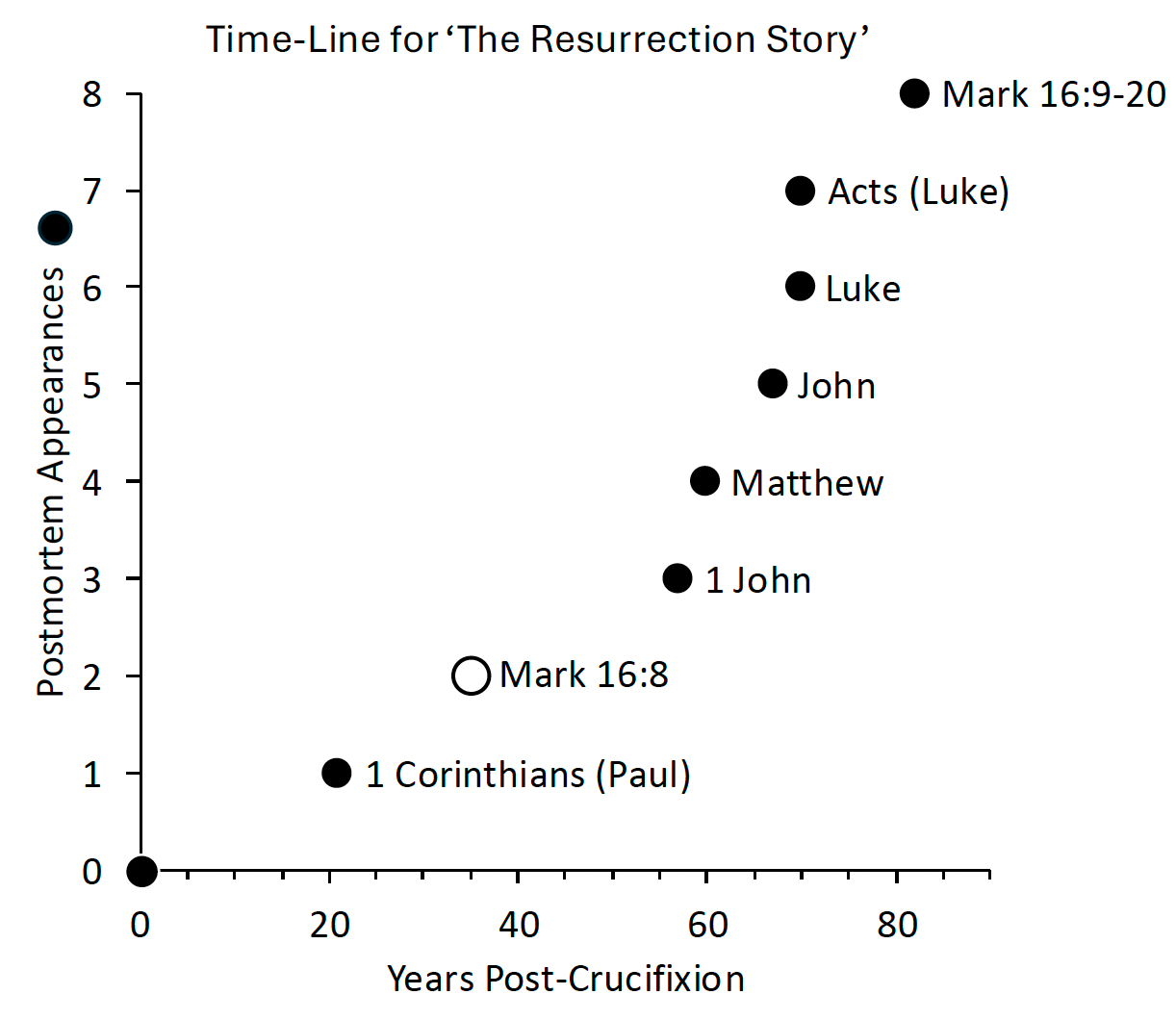
Figure 1: Created by Author
Third, original manuscripts of the gospel of Mark dated ~35 years post-crucifixion do not contain post-mortem descriptions of Jesus, whereas the gospel of Mark that appears in Tyndale’s 16th-century English translation as well as the King James Bible published in 1611 is a longer version of Mark (Mark 16:9–20) that does contain post-mortem appearances of Jesus⁹.
The long version of Mark was written ~82 years after the crucifixion. Finally, the Gospel attributed to Matthew appears to have copied most of the Gospel of Mark 16:8 and then added new material that supported Jesus as the promised Messiah and the importance of the Christian Church¹¹.
Two Views of The Resurrection Story
The miracle that Jesus was resurrected in body is based on three events:
(1) Transformation of Disciples: Jesus’ disciples changed from fearful individuals at the crucifixion to bold proclaimers of the resurrection who faced persecution and death. Their willingness to suffer and die for preaching the resurrection story proved that they believed the story to be true.
(2) The Empty Tomb: Jesus’ followers found the tomb where Jesus was interred empty shortly after his crucifixion. They concluded that Jesus had been resurrected as foretold in Old Testament prophecies.
(3) Post-mortem Appearances: The most compelling evidence for Jesus’ resurrection is that many people believed they saw Jesus after his crucifixion and interacted with him. The New Testament contains 10 examples (Figure 2).
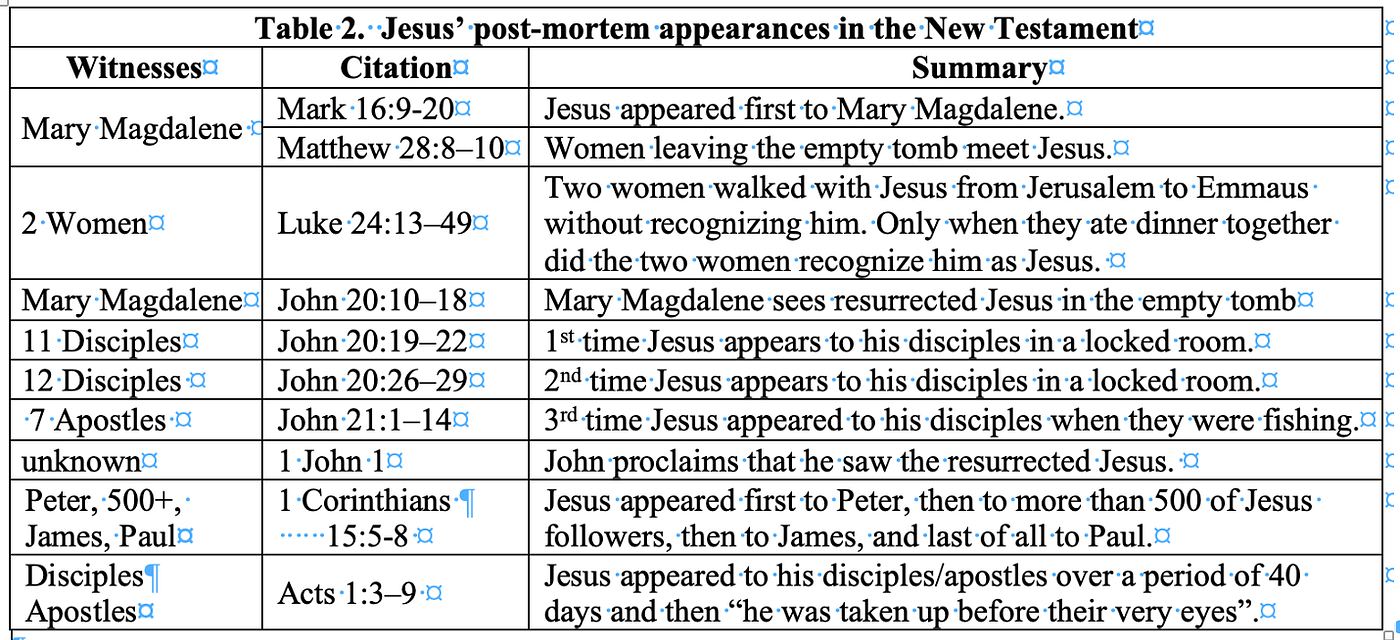
Figure 2: Created by Author
The Evidence Supports a Metaphor
The metaphor that Jesus was resurrected in spirit, not in body, is based on the same three events:
- Transformation of Disciples: That Jesus’ disciples believed in Jesus’ resurrection confirms their faith in Jesus, not the fact that he was resurrected.
2. The Empty Tomb: Someone removed Jesus’ body from the tomb.
3. Post-mortem Appearances: Events that were interpreted as miraculous in the 1st century AD, would be understood as apparitions, visions and wishful thinking in the 21st century.
Let’s look at them in more detail below.
- Transformation of Disciples
Martyrdom confirms our faith in what we believe, not that what we believe is fact. The Disciples who knew Jesus presumably believed that they had witnessing Jesus’ resurrection. Their willingness to accept abuse and even death for preaching the resurrection story is a testament to their faith in what they saw, but it is not evidence that what they saw was the human form of Jesus.
The New Testament reports that only James was martyred (Acts 12:1–2) and other apostles suffered terrible abuse (Acts 5:40–42, 2-Corinthians 11:23–27). However, according to the Roman Catholic Church, at least 14,154 individuals have been formally recognized as martyrs over the centuries¹². Except for those in 33 AD, none of these martyrs witnessed Jesus’ resurrection. They died for their faith in the miracle of the resurrection.
The power of faith is not unique to Christianity. Judaism is the foundation of both Christianity and Islam. Judaism (~0.2% of global population) does not recognize Jesus either as a prophet or as divine. Islam (~25%) reveres Jesus as a prophet, but not as divine. Christianity (~30%) views Jesus both as a prophet and as divine. All three religions have martyrs who died for their beliefs.
The power of faith is not unique to religion. For centuries, the Japanese had been taught to believe their Emperor was a living God, making obedience to their Emperor a sacred duty. Consequently, in 1945 when it was clear that Japan was losing the war, from 3,800 to 4,000 Japanese pilots (kamikazes) died in suicide attacks against American ships in the battle for Okinawa. After Japan surrendered, Emperor Hirohito renounced his divine status and affirmed his humanity, transforming his role from a divine sovereign into a constitutional monarch. The kamikazes’ martyrdom did not make their emperor divine.
2. The Empty Tomb
The simplest explanation is that the tomb was empty, because someone removed the body. Perhaps Christians took the body to prevent its further desecration, or they thought Jesus was still alive, or they believed that Jesus would be resurrected. Perhaps Romans took the body to prevent Jesus becoming a martyr to his followers. Perhaps Jews took the body to prevent the tomb becoming a place of pilgrimage.
So obvious is this explanation that the Apostle Matthew felt compelled to dismiss it by blaming that story on the Jews.
“When the chief priests had met with the elders and devised a plan, they gave the soldiers a large sum of money, telling them, You are to say, ‘His disciples came during the night and stole him away while we were asleep.’ If this report gets to the governor, we will satisfy him and keep you out of trouble. So, the soldiers took the money and did as they were instructed. And this story has been widely circulated among the Jews to this very day.” (Matthew 28:12–15)
However, when Mary Magdalene, a devoted follower of Jesus, discovered the tomb was empty she assumed that someone had taken the body.
“They (two angels) asked her, ‘Woman, why are you crying?’ ‘They have taken my Lord away’, she said, ‘and I don’t know where they have put him.’ At this, she turned around and saw Jesus standing there, but she did not realize that it was Jesus. He asked her, ‘Woman, why are you crying? Who is it you are looking for?’ Thinking he was the gardener, she said, ‘Sir, if you have carried him away, tell me where you have put him, and I will get him.” (John 20:13–15).
3. Post-Mortem Appearances
Numerous reports of spiritual encounters with Jesus have been reported throughout history including the 20th century¹³. Recent examples include Saint Pio of Pietrelcina (1910s), Sister Josefa Menendez (1919–1923), Mormon elder Melvin J. Ballard (c. 1920), Saint Faustina Kowalska (1931), and Blessed Maria Pierina De Micheli (1936).
That some of Jesus followers thought they saw Jesus alive after he was dead is a fact. Whether they saw a physical body or an image of a physical body brought on by the shock of Jesus’ cruel execution is the question. The Roman Catholic Church defines an apparition as a physical, exterior manifestation, of a heavenly being (such as Jesus, Mary, angels, or saints) often seen by multiple people¹⁴. The Catechism of the Catholic Church¹⁵ states that the resurrection was not a return to earthly life, but the bodily glorification of the same Jesus who was crucified. Perhaps that’s another way of saying the resurrected Jesus was an apparition.
(a) Jesus appeared to his disciples as an apparition.
The apostle John describes two very similar encounters in which the resurrected Jesus apparently passed through a locked door and speaks to his disciples. Since the living Jesus could not pass through locked doors, the resurrected Jesus must not have had the same body as the living Jesus.
“On the evening of that first day of the week, when the disciples were together, with the doors locked for fear of the Jewish leaders, Jesus came and stood among them and said, “Peace be with you! ”After he said this, he showed them his hands and side. The disciples were overjoyed when they saw the Lord.”
“A week later his disciples were in the house again, and Thomas was with them. Though the doors were locked, Jesus came and stood among them and said, “Peace be with you!”” (John 20:19–20; 26–9).
Since the living Jesus could not walk through locked doors, the resurrected Jesus was not the same as the living Jesus. This would account for the experience of Mary Magdalene.
When Mary Magdalene saw the resurrected Jesus in the empty tomb, she did not recognize him at first.
“At this, she turned around and saw Jesus standing there, but she did not realize that it was Jesus. He asked her, “Woman, why are you crying? Who is it you are looking for? ”Thinking he was the gardener, she said, “Sir, if you have carried him away, tell me where you have put him, and I will get him.” Jesus said to her, “Mary.” She turned toward him and cried out in Aramaic,“Rabboni!” (which means “Teacher”).” John 20:14–16.
If Jesus’ close companion Mary Magdalene mistook him for the gardener, then the appearance of the resurrected Jesus must have been very different than the living Jesus. This was confirmed by the response from the resurrected Jesus, “Do not hold on to me, for I have not yet ascended to the Father.” (John 20:17).
The apostle John relates a similar story about “the third time Jesus appeared to his disciples after he was raised from the dead.” (John 21:1–14). John and 7 other disciples went out in a boat to fish.
“Early in the morning, Jesus stood on the shore, but the disciples did not realize that it was Jesus.” Later, John recognized it was Jesus. They all joined the resurrected Jesus on shore and ate together. “None of the disciples dared ask him, “Who are you?” They knew it was the Lord.”
Even though Jesus’ disciples had twice seen the resurrected Jesus when he entered their locked room (John 20:19–20; 26–9), none of them recognized the resurrected Jesus standing on shore. Then John (the disciple whom Jesus loved) recognized Jesus, but whether the others were also convinced is not clear. John assumed they did.
The apostle Paul explained such encounters by saying that Jesus was transformed from a “lowly body” to a “glorious body” (Philippians 3:20–21) or a “spiritual body” (1 Corinthians 15:42–44). Apparently, the glorious body could pass through locked doors and eat food, but its appearance was significantly different from the living Jesus.
(b) Jesus appeared to the apostle Paul as a vision.
The Roman Catholic Church defines a vision as an interior experience, occurring in the mind, imagination, or intellect of a single person13. The Apostle Paul, originally named Saul of Tarsus, was a Pharisee and a Roman citizen who initially persecuted Christians, so he was fully aware of their beliefs. In the New Testament, Jesus appeared to Saul in a vision when Saul was struck blind by an event known in contemporary times as hysterical blindness; a temporary loss of vision triggered by severe psychological stress, trauma, or internal conflict. Paul’s traveling companions did not share Paul’s vision, because Jesus did not appear to Paul as a physical body that others could see.
“As he neared Damascus on his journey, suddenly a light from heaven flashed around him. He fell to the ground and heard a voice say to him,“Saul, Saul, why do you persecute me? Who are you, Lord? Saul asked. I am Jesus, whom you are persecuting, he replied. Now get up and go into the city, and you will be told what you must do.
The men traveling with Saul stood there speechless; they heard the sound but did not see anyone. Saul got up from the ground, but when he opened his eyes, he could see nothing. So, they led him by the hand into Damascus. For three days he was blind and did not eat or drink anything.” (Acts 9:3–9).
Henceforth, Saul was known as the Apostle Paul. In Paul’s letter to the Corinthian Church, written ~21 years after Jesus’ death and ~26 years before Luke wrote the Acts of the Apostles, Paul wrote,
“For what I received I passed on to you as of first importance: Christ died for our sins according to the Scriptures, that he was buried, that he was raised on the third day according to the Scriptures, and that he appeared to Cephas (Peter the disciple and later apostle) and then to the Twelve (disciples).
After that, he appeared to more than five hundred of the brothers and sisters (Christians) at the same time, most of whom are still living, though some have fallen asleep. Then he appeared to James (Jesus’ half-brother), then to all the apostles, and last of all he appeared to me also, as to one abnormally born.” (1 Corinthians 15:3–8).
Thus, Paul stated that Jesus had appeared to those who followed Jesus just as he had appeared to Paul as described by Luke — as a vision, not in a physical form that others could also see.
c) Jesus appears from ‘wishful thinking’.
Contemporary psychology recognizes that humans often make decisions based on ‘wishful thinking’, forming beliefs or making decisions based on what is pleasing to imagine rather than on what is factual¹⁶. Luke 24:13–49 tells the story of two Christian women who walked 7 miles from Jerusalem to Emmaus with a strange man for company.
The women knew all about Jesus’ crucifixion, the empty tomb, and that some people thought Jesus was alive. The stranger knew all the Scriptures concerning Jesus. Remarkably, the two women never recognized him as the resurrected Jesus until they sat down to dinner. “When he was at the table with them, he took bread, gave thanks, broke it and began to give it to them. Then their eyes were opened and they recognized him, and he disappeared from their sight.”
As with the other encounters, the resurrected Jesus was not recognized at first. In fact, the two women on the road to Emmaus didn’t recognize him long after they should have. In the 21st century, their story would be an example of ‘wishful thinking’. The other encounters were consistent with the apparitions and visions recognized by the Roman Catholic Church and reported from the 1st century to the 20th century by people convinced of the reality of their claim¹⁷ ¹⁸.
Can Christianity Endure Without a Miracle?
The question is not whether the resurrection story is meaningful, but how its meaning is understood. The same historical observations — the transformation of the disciples, the empty tomb, and the reported appearances of Jesus after his death — that were understood as a miracle in the 1st century AD can be understood in the 21st century as expressions of human perceptions shaped by expectation, grief, and conviction. This ambiguity is not a weakness, but a recognition of its limitations. It is precisely within that uncertainty that faith finds its strength.
The resurrection story does not depend on whether it was a literal event. If it was a miracle, then the resurrection story confirms divine intervention and offers the promise of life beyond death. If taken as a metaphor, it affirms that Jesus’ teachings and examples of unconditional love and forgiveness are what free us from the fear of death. “Whoever does not love does not know God, because God is love.” (1 John 4:8). Both interpretations speak to something real: not necessarily the same reality, but realities that profoundly shape our lives.
Faith is a powerful force. It has inspired individuals to endure hardship, to build communities, and to commit acts of extraordinary courage and sacrifice. It is important to recognize, however, that faith confirms the sincerity of belief, not the factual nature of the belief itself. History provides many examples of individuals who have acted — and died — with absolute conviction. The power of the resurrection story is not that it inspires belief, but that it inspires reflection.
The resurrection story is a story of anticipation and optimism for the future. Faith cannot change the laws of nature, but it can motivate discovery, reshape understanding, and reveal possibilities that might otherwise remain unseen. In this way, the resurrection remains both a matter of faith and a subject of interpretation — one that continues to invite reflection on the relationship between science, history, and the enduring quest to understand God.
Can Christianity endure without a miracle? Miracles inspire martyrdom; metaphors inspire love. Jesus’ teachings and examples — love of neighbor, forgiveness of enemies, humility, and compassion — do not depend on a miracle, they depend on whether Christians live their lives as Jesus lived.
Jesus said to his disciples: “A new command I give you: Love one another. As I have loved you, so you must love one another. By this everyone will know that you are my disciples, if you love one another.” (John 13:34–35).
Acknowledgements
The author is indebted to Almon Packard for editing the manuscript and providing the Conclusion, to Jeannette Bair for balancing his views of miracles and metaphors, and to his brother Don and sister-in-law Cheryl for reminding him that every coin has two sides.
[1] History Today, https://www.historytoday.com/archive/months-past/edict-thessalonica
[2] The Council of Nicaea, https://libguides.regent.edu/nicaea/history
[3] Bart D. Ehrman, The Lost Christianities: The Battles for Scripture and the Faiths We Never Knew, 2005
[4] ‘New International Version’ Bible published in 1995
[5] https://www.britannica.com/biography/Priscillian
[6] https://medium.com/@johnwelford15/the-final-victim-of-the-spanish-inquisition-2c9b5d9a1ca6
[7] https://christianhistoryinstitute.org/magazine/article/tyndale-timeline
[8] Matthew 22:37–39, John 13:34
[9] Flavius Josephus, Tacitus, Pliny the Younger, Mara Bar-Serapion, Suetonius, Thallus, Celsus, and the Talmud
[10] https://www.thegospelcoalition.org/article/was-mark-16-9-20-originally-mark-gospel/
[11] https://isthatinthebible.wordpress.com/2015/03/10/how-editorial-fatigue-shows-that-matthew-and-luke-copied-mark/
[12] https://www.catholicworldreport.com/2023/01/30/saints-by-the-numbers-catholic-martyrs-from-the-first-century-to-the-twentieth/
[13] Phillip H. Wiebe, ‘Visions and Appearances of Jesus’, 2014
[14] Dicastery for the Doctrine of the Faith
[15] https://www.catholicculture.org/culture/library/catechism/index.cfm?recnum=2409
[16] https://www.psychologytoday.com/us/blog/the-stories-we-tell/202509/wishing-doesnt-make-it-so
[17] Phillip H. Wiebe, ‘Visions and Appearances of Jesus’, 2014
[18] https://en.wikipedia.org/wiki/Visions_of_Jesus_and_Mary
메타데이터
- post_id
- aaa4698ef2d3
- slug
- would-christianity-survive-without-the-physical-resurrection-aaa4698ef2d3
- url
- https://medium.com/backyard-theology/would-christianity-survive-without-the-physical-resurrection-aaa4698ef2d3
- canonical_url
- https://medium.com/backyard-theology/would-christianity-survive-without-the-physical-resurrection-aaa4698ef2d3
- author_url
- https://medium.com/@meldepamphilis
- status
- ok
- fetched_at
- 2026-06-20 20:29:01