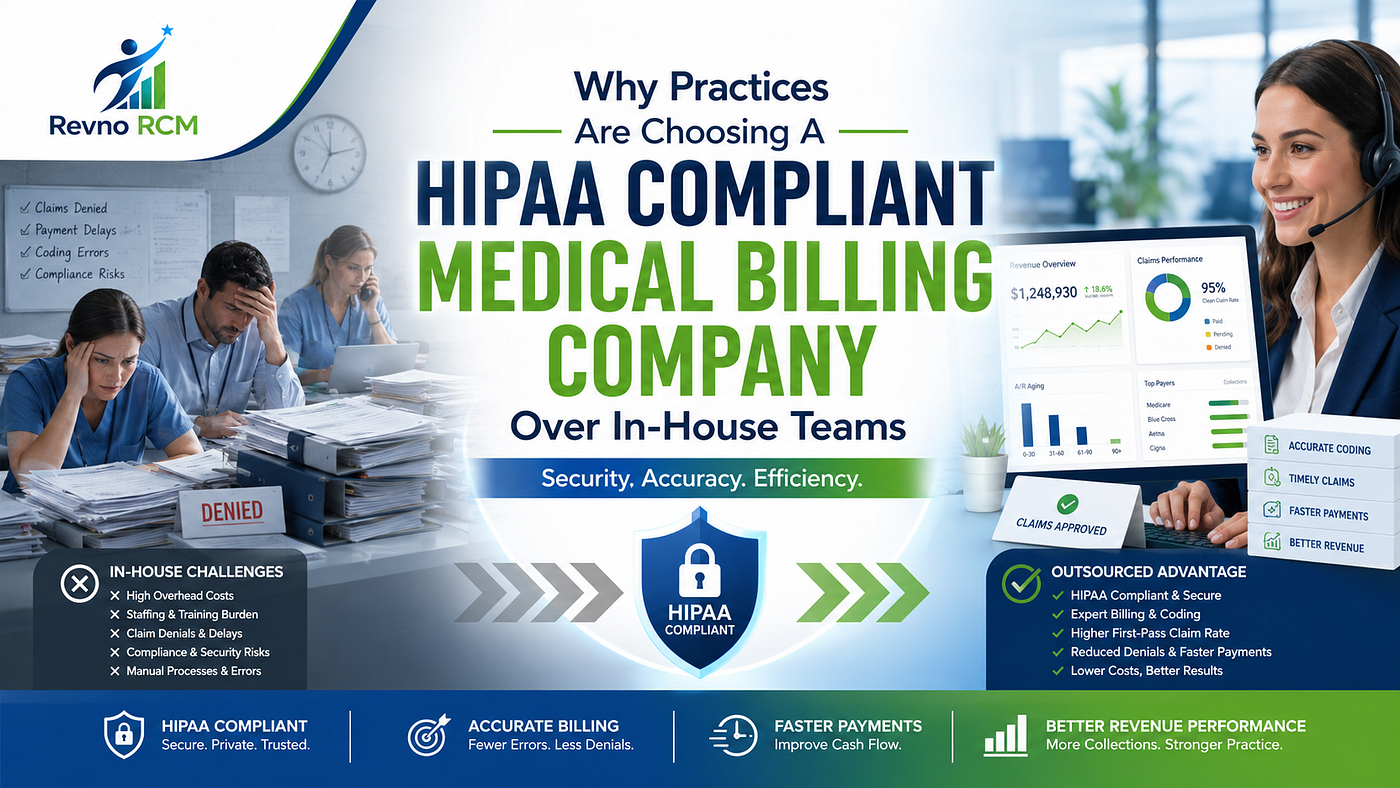
Why Practices Are Choosing A HIPAA Compliant Medical Billing Company Over In-House Teams
Every claim a practice submits carries protected health information — names, diagnoses, insurance details — and every one of those claims…
Why Practices Are Choosing A HIPAA Compliant Medical Billing Company Over In-House Teams
Every claim a practice submits carries protected health information — names, diagnoses, insurance details — and every one of those claims is a potential compliance risk if it’s handled carelessly. That’s why more healthcare practices are partnering with a HIPAA compliant medical billing company instead of managing billing internally or trusting it to a vendor that treats compliance as an afterthought.
Healthcare data breaches remain the most expensive of any industry, and the risk doesn’t discriminate by practice size — solo practitioners and small clinics face OCR penalties just as often as large hospital systems. As a team that’s worked inside healthcare billing for years, we’ve watched practices lose more time and money cleaning up after a compliance gap than they ever would have spent preventing one. In this guide, you’ll learn what HIPAA compliant billing actually requires, why it matters for claim approval rates, and how to evaluate a billing partner properly — without wading through legal jargon.
What Is HIPAA Compliant Medical Billing?
HIPAA compliant medical billing is the process of submitting, coding, and managing healthcare claims while meeting the privacy and security standards set by the Health Insurance Portability and Accountability Act. It works by restricting access to protected health information, encrypting data in transit and at rest, and maintaining audit trails for every claim touched. It’s most commonly used by practices that outsource billing to a HIPAA compliant medical billing company rather than managing sensitive patient data with unverified in-house systems.
Compliance isn’t a single checkbox — it spans administrative safeguards (staff training, access controls), technical safeguards (encryption, audit logging), and physical safeguards (secured devices and facilities). Missing any one of the three creates exposure.
Why Does HIPAA Compliance Matter for Billing Specifically?
Billing touches more sensitive data more frequently than almost any other part of a practice’s operations — every claim, every resubmission, every payment record. That volume is exactly what makes billing one of the more common places compliance gaps slip through.
The financial stakes back this up. IBM’s Cost of a Data Breach Report (2025) puts the average healthcare data breach at roughly $7.42 million — and healthcare has held the title of costliest industry for breaches for 14 years running. On the enforcement side, 2026 HIPAA violation penalties can range from a little over $100 to well past $2 million per violation, depending on culpability — and that’s before factoring in state-level fines or reputational damage. A HIPAA compliant medical billing company exists specifically to keep practices on the right side of that line.
How Does Non-Compliance Actually Happen in Billing Workflows?
Compliance failures are usually not about hacking problems. They are more like when a staff member sends a spreadsheet with names and diagnosis codes to the wrong person.. A billing vendor keeps claims on a server that is not protected. A practice might also forget to do a required risk analysis because nobody remembered it was due.
Risk analysis failures are a common problem that the Office for Civil Rights finds when they take action. This shows that compliance problems usually happen because of mistakes in the way things are done, not because someone is trying to do something. This is a problem that can be fixed. Only if the billing process is set up to follow HIPAA rules from the beginning. It does not work if the billing process is put together without following the rules and then someone tries to fix it.
What Should a Practice Look for in a Billing Partner?
Not every billing service takes HIPAA seriously, and that gap is hard to spot until something goes wrong. A few concrete things worth checking before signing on:
- Signed Business Associate Agreement (BAA) — legally required for any vendor handling PHI
- Encrypted data storage and transmission — both at rest and in transit
- Documented access controls — who can see what patient data, and why
- Regular risk assessments — not a one-time setup, an ongoing process
- Staff HIPAA training — refreshed on a set schedule, not left to onboarding alone
A genuinely HIPAA compliant medical billing company will have clear, documented answers to all five — not vague reassurances.
Does Compliance Slow Down the Billing Process?
It’s a fair worry — stricter processes can sound like more friction. In practice, it tends to work the other way. Claims built on accurate coding and secure, well-documented workflows are less likely to get flagged, delayed, or denied in the first place. Compliance and speed aren’t actually in competition here; sloppy, non-compliant processes are usually what create delays, not the safeguards themselves.
Real Cost Comparison: In-House vs. Outsourced Compliant Billing
Creating a billing system that follows HIPAA rules in your office can be very expensive. You have to train your staff, have secure computer systems, and constantly check to make sure everything is working correctly. You also need a person who’s in charge of making sure you are following all the rules. For a medium-sized medical office, these costs can add up very quickly.
If you hire a company that specializes in billing, they can split these costs with all their clients. This makes it possible for medical offices to have a high level of security for their billing, which they might not be able to afford on their own. This is a reason to hire someone else to do your billing besides just being easier. It is often the way a small medical office can get a billing system that really follows all the HIPAA rules.
The Bottom Line
HIPAA compliant billing is not something; it’s what every medical practice should get from a billing partner. Practices that think it’s optional are more likely to face problems later. When you work with a billing company that really follows HIPAA rules, your claims are handled by people who make sure they are compliant. It’s how they work every day. This helps keep trust and also keeps your revenue moving.
메타데이터
- post_id
- aaa4f8cdceb3
- slug
- why-practices-are-choosing-a-hipaa-compliant-medical-billing-company-over-in-house-teams-aaa4f8cdceb3
- url
- https://medium.com/@kaaisha264/why-practices-are-choosing-a-hipaa-compliant-medical-billing-company-over-in-house-teams-aaa4f8cdceb3
- canonical_url
- https://medium.com/@kaaisha264/why-practices-are-choosing-a-hipaa-compliant-medical-billing-company-over-in-house-teams-aaa4f8cdceb3
- author_url
- https://medium.com/@kaaisha264
- status
- ok
- fetched_at
- 2026-08-15 16:05:07