5 Famous Sayings of Jesus You May Have Misunderstood
The historical background behind five familiar phrases that become far more challenging once you hear them as Jesus’ first audience did.
5 Famous Sayings of Jesus You May Have Misunderstood
The historical background behind five familiar phrases that become far more challenging once you hear them as Jesus’ first audience did.
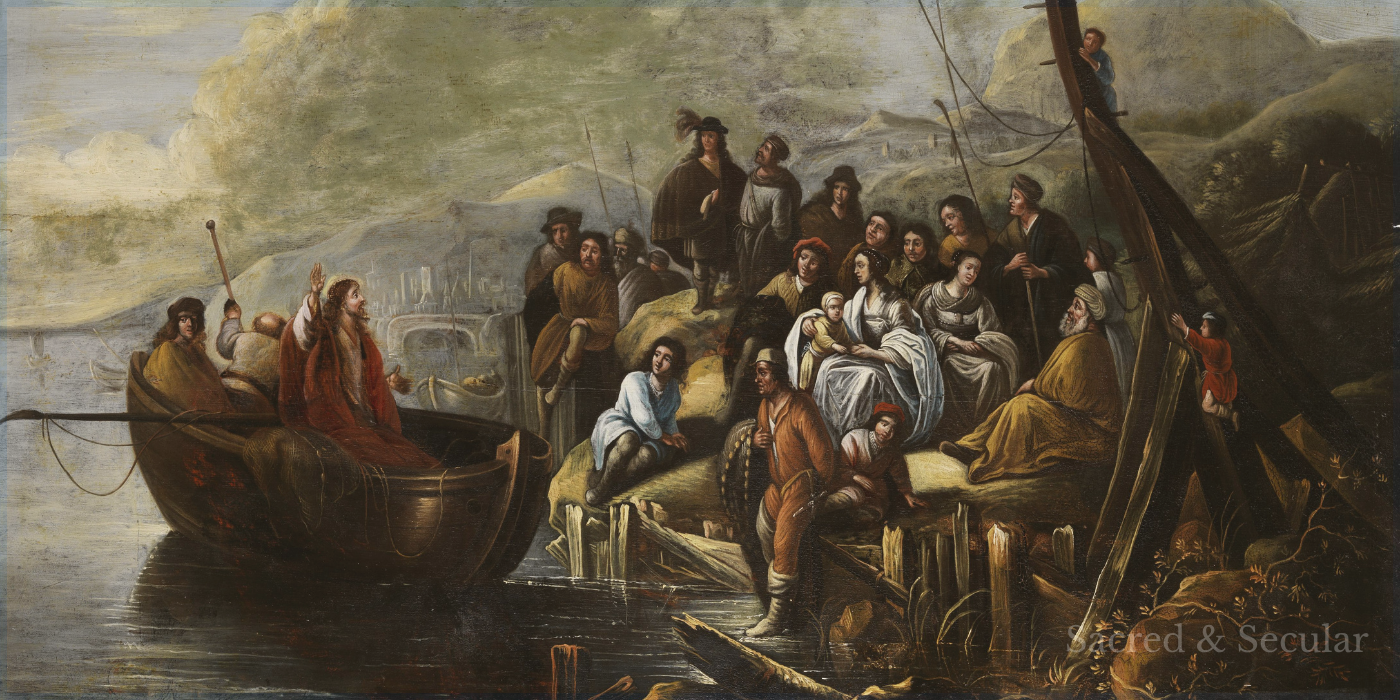
Jesus taught using vivid images and memorable sayings that his first audience immediately understood. Two thousand years later, some of those familiar phrases still surprise us when we hear them in their original context. Attributed to Gerbrand van den Eeckhout, Public domain, via Wikimedia Commons
The Bible is full of phrases we think we understand.
Some have become so familiar that they no longer sound particularly strange. We hear people speak about “turning the other cheek”, “going the extra mile” or having “a cross to bear” without necessarily remembering that these expressions came from Jesus. They have passed into everyday English, softened by repetition until they sound like harmless pieces of advice.
But they did not sound harmless when Jesus first said them.
Jesus taught as a first-century Jewish teacher speaking to people living under Roman occupation. He used exaggeration, wordplay, vivid images and phrases drawn from ordinary life. His listeners understood the social customs, political tensions and religious assumptions behind his words. We usually do not.
That does not mean every saying contains a secret code that only specialists can uncover. The problem is that words spoken in one world can sound very different when carried into another.
Here are five sayings of Jesus that have become so familiar we may have stopped hearing how startling they originally were.
1. “Turn the other cheek”
“Turn the other cheek” can be understood as a command to accept whatever treatment people give us.
Someone insults you? Say nothing.
Someone mistreats you? Endure it without complaint.
Someone hits you? Offer them another opportunity.
Read this way, Jesus appears to be telling vulnerable people to become willing victims, and sadly, I have met lovely people who think like this. Yet the wording in Matthew’s Gospel is more specific than we sometimes notice:
“If anyone slaps you on the right cheek, turn to them the other cheek also.”
Why specify the right cheek?
In the honour-and-shame culture of the ancient Mediterranean, a slap could carry a social meaning beyond physical violence. It was not merely intended to hurt. It could be a way for someone of higher status to humiliate a person considered beneath them.
One influential interpretation suggests that a strike to the right cheek would most naturally have been delivered with the back of the right hand. The gesture was therefore not the punch of two equals fighting; it was the dismissive blow of a superior asserting dominance over an inferior.
Turning the other cheek, in this reading, is not passive submission. It is a refusal to play the part assigned by the aggressor.
The victim neither retaliates nor retreats. Instead, they stand their ground and present themselves again, almost as if to say, “You may strike me, but you will not define me as less than human.”
Jesus does not tell his followers to return violence for violence, but neither does he praise humiliation or abuse, and perhaps that’s why this remains one of Jesus’ hardest teachings. Most of us instinctively swing between fighting back and giving up. Jesus seems to imagine another possibility altogether.
He offers a third way.
That is much more demanding than simply being nice.
2. “Go the extra mile”
Today, going the extra mile means making more effort.
A business goes the extra mile for its customers. A teacher goes the extra mile for a struggling pupil. A friend goes the extra mile by doing more than anyone expected.
The phrase has become so positive that we can easily miss the coercion in Jesus’ original words:
“If anyone forces you to go one mile, go with them two miles.”
But Jesus was not describing a voluntary walk.
The word translated as “forces” points towards the Roman practice of compulsory service. Roman soldiers and officials could require local people to carry equipment, deliver messages or provide transport. For a Jewish person living under occupation, being forced to carry a soldier’s pack was certainly not an opportunity to demonstrate generosity. It was a humiliating reminder of who held power.
The Gospels give us a grim example of this during the crucifixion. Simon of Cyrene does not offer to carry Jesus’ cross. The soldiers compel him.
The first mile, then, belonged to Rome.
The second mile did not.
A soldier might legally compel someone to carry his equipment for a limited distance, but taking it farther could expose him to disciplinary action. Under that interpretation, the Roman who had confidently issued the order might suddenly find himself trying to recover his own pack from the person he had forced to carry it.
Whether every detail of that reconstruction can be proven is uncertain. But Jesus’ central reversal is difficult to miss. The person who appeared powerless unexpectedly chooses the next move.
The first mile is imposed.
The second is freely given.
By continuing beyond what was demanded, the oppressed person transforms compulsory labour into a voluntary act. The soldier may still possess military power, but he no longer controls the entire situation. Jesus’ listener has reclaimed the ability to choose.
I suspect that’s one reason this saying still speaks to us today, because it resonates much more deeply than ‘try harder’. We all know what it feels like when somebody else seems to control our circumstances.
Jesus reminds us that they never have complete control over our response and that others’ cruelty does not have to determine the kind of person we become.
3. “Let the dead bury their own dead”
Of all Jesus’ sayings, this may be one of the coldest at first hearing.
A man says:
“Lord, first let me go and bury my father.”
Jesus replies:
“Follow me, and let the dead bury their own dead.”
It sounds as though the man has just received news of his father’s death, and Jesus refuses to let him attend the funeral.
That would be especially shocking in a Jewish culture where burying the dead was considered a sacred obligation. Caring for the body, mourning properly and honouring one’s parents were not optional acts of kindness. They were fundamental duties.
Yet the situation may not have been as immediate as modern readers imagine.
The phrase “let me bury my father” could mean that the man wanted to remain at home until his father died, whenever that might be. In that case, he was not requesting a day away for a funeral. He was effectively saying, “I will follow you later, once my family responsibilities have finally ended.”
Another possibility is that the father had already received an initial burial. Jewish burial could take place in stages. After the body had decomposed, the bones might later be gathered and placed in a stone box known as an ossuary. The man may have been asking to complete that longer process before joining Jesus.
We cannot know with certainty which situation lies behind the saying. What we can see is that Jesus recognises a delay disguised as a duty.
The request sounds respectable, and that is what makes it dangerous.
Of course, Jesus is not issuing a general command to neglect funerals, abandon ageing parents or treat grief as unimportant. Elsewhere, he condemns religious people who use devotion to God as an excuse for avoiding responsibility towards their parents.
The point is urgency.
There will always be another reason to postpone the life we believe we are being called to live. The most dangerous excuses are often the honourable ones. They arrive wearing the clothes of duty, prudence and good timing.
4. “Take up your cross”
We sometimes speak about minor difficulties as “our cross to bear”.
An irritating colleague, a recurring inconvenience or even a bad back might be described this way. The phrase has come to mean almost any unpleasant burden we cannot avoid.
Unsurprisingly, that is not what Jesus’ first listeners would have heard.
When Jesus told people to take up their cross and follow him, he had not yet been crucified, and the cross was not a Christian symbol. It did not appear on jewellery, church walls or greeting cards. It belonged to Rome.
Crucifixion was a public form of execution used particularly against slaves, rebels and people who threatened imperial order. Its purpose was not simply to kill. It was to humiliate, terrorise and warn.
Victims could be stripped, beaten and paraded through public places. They might be forced to carry the crossbeam to the site of execution. Crowded roads were chosen because the empire wanted people to see what happened to those who resisted.
A condemned person carrying a cross was not managing a difficult season.
They were walking towards death.
Jesus, therefore, chooses one of the most frightening images available to him. To follow him is to surrender the instinct to preserve status, safety and control at any cost. It is to accept that allegiance to the kingdom of God may place a person in conflict with the systems that dominate the world.
I get why we soften this saying, because the original is deeply uncomfortable. We naturally want a discipleship that fits neatly around the life we already planned, but Jesus offers something much more costly.
But Jesus does not say, “Carry the inconvenience that happens to bother you.”
He says, in effect, “Follow me even when doing so costs you the version of yourself you are desperate to protect.”
Only after the resurrection did the cross become a symbol of hope.
5. “If your eye causes you to sin, tear it out”
Jesus could be alarmingly graphic.
In the Sermon on the Mount, he says that if your right eye causes you to sin, you should tear it out. If your right hand causes you to sin, you should cut it off.
Taken literally, this appears to command self-mutilation.
Yet Jesus was teaching within a Jewish tradition that frequently used hyperbole: deliberate exaggeration intended to shock, expose and make an idea unforgettable.
When Jesus speaks about a camel passing through the eye of a needle, swallowing a camel or carrying a log in your eye, he is not offering anatomical instructions. His audience probably didn’t reach for a knife. They recognised the exaggeration immediately.
Like many great teachers, Jesus sometimes used absurd images to make unforgettable points. He painted impossible pictures that lodged in people’s imaginations.
The violence of the image is meant to reveal the seriousness of the problem. People often deal with destructive behaviour as though it were a minor inconvenience. We promise to manage it, reduce it or keep it safely contained. Jesus tells us to stop negotiating with whatever is damaging us and others.
Sometimes we must remove access, change habits, end patterns or walk away from environments that continually pull us towards destruction. What sounds excessive may be exactly what is needed when we have spent years pretending that small adjustments will solve a deep problem.
His listeners would have recognised the exaggeration.
But they would not have mistaken it for softness.
Familiar words from another world
There are many more sayings of Jesus that could perhaps form another article, but the common takeaway from each is that they are often a lot more difficult than our current culture has interpreted them.
“Turn the other cheek” is not permission for abuse. It is a refusal to let violence dictate our response.
“Go the extra mile” is not merely advice about effort. It is a way of recovering freedom in a situation designed to remove it.
“Let the dead bury their dead” is not contempt for grief. It is a warning about the respectable excuses that keep us permanently waiting.
“Take up your cross” is not a description of everyday inconvenience. It is a call to follow Jesus without making personal safety the highest good.
And tearing out an eye is not a command to damage the body. It is a shocking image of how seriously we should take the things that destroy us.
Jesus spoke to be remembered. He exaggerated, provoked, challenged and painted pictures in the imagination. His language was not designed to sit on a page only to be watered down. If some of this article is challenging, it is because the more I explore the historical world of the Bible, the harder it becomes to ignore the force of Jesus's words.
The problem is not that his sayings have become too difficult.
It may be that they have become too familiar.
Sometimes we need to step back into the world of his first listeners before we can hear the shock in his words again.
Only then can we decide whether we are willing to let these familiar sayings challenge us again.
If you enjoyed this article, you might also enjoy my daily Substack, Sacred & Secular.
While Medium is where I often explore hidden details, difficult questions, and surprising insights from Scripture, my Substack is a daily pause rather than a news feed.
You can join hundreds of readers here: www.sacredandsecular.co.uk
My new book, ***Sacred & Secular: Finding God in the Ordinary***, is also now available worldwide on Amazon and brings together many of the themes explored in both publications.
메타데이터
- post_id
- aaae29dd3aff
- slug
- 5-famous-sayings-of-jesus-you-may-have-misunderstood-aaae29dd3aff
- url
- https://medium.com/sacred-secular/5-famous-sayings-of-jesus-you-may-have-misunderstood-aaae29dd3aff
- canonical_url
- https://medium.com/sacred-secular/5-famous-sayings-of-jesus-you-may-have-misunderstood-aaae29dd3aff
- author_url
- https://medium.com/@paulianclarke
- status
- ok
- fetched_at
- 2026-07-18 12:05:23