Autism, Disability, and the Obscenity of the Grift
There’s a particular kind of tired that comes from being autistic in public.
Autism, Disability, and the Obscenity of the Grift
There’s a particular kind of tired that comes from being autistic in public.
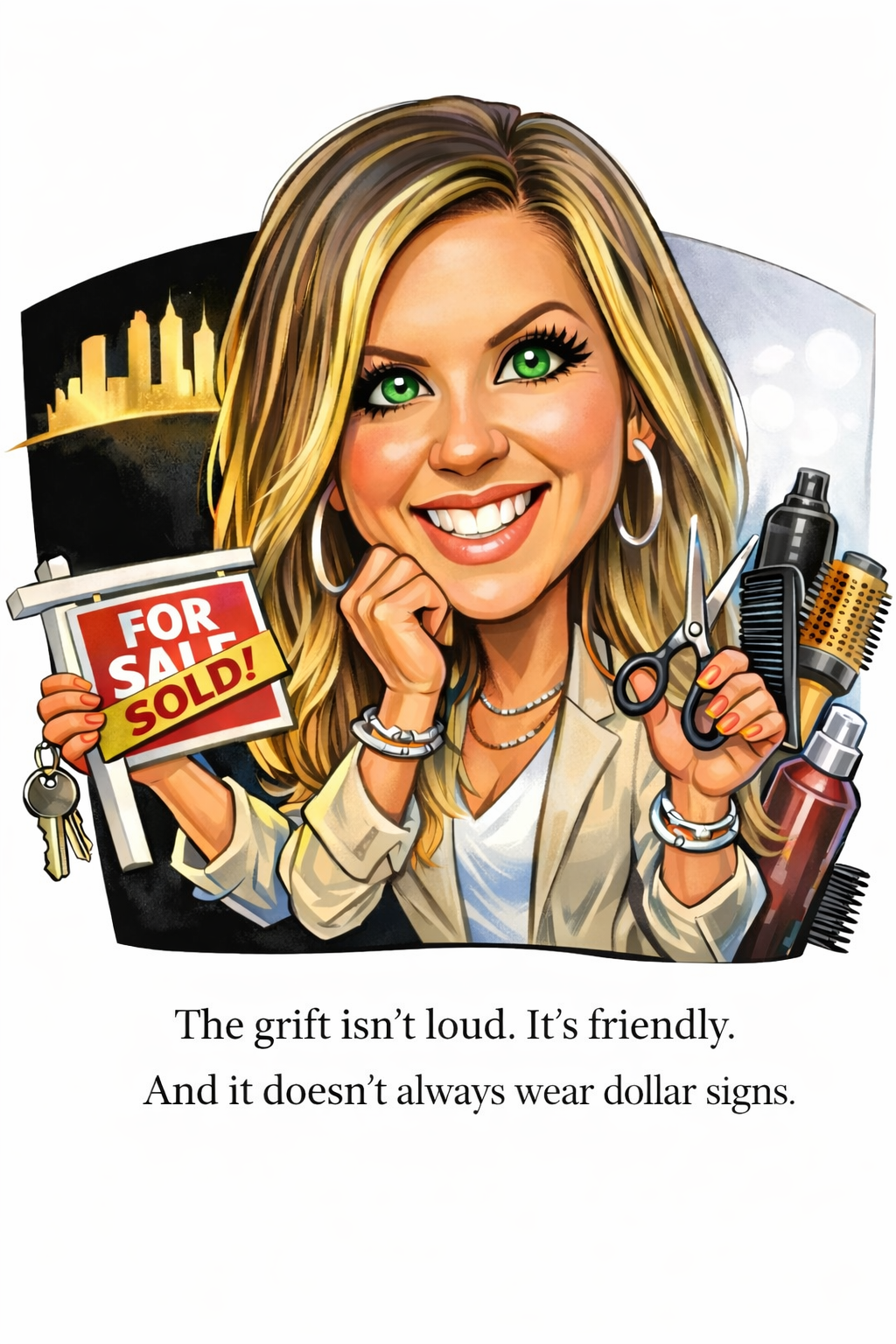
This is the AI photo my former hairdresser uploaded to Facebook, edited by me to remove her name. It had originally said, “realtor and hairstylist” under her name, which I’ve removed for her privacy.
Not the tired of socializing.
Not the tired of sensory overload.
A different tired.
The tired of watching something unfold in slow motion — something patterned, something predictable — while everyone around you insists it’s just “life.”
Or worse:
That you’re being negative.
That you’re reading too much into it.
But autism is, in many ways, a life of reading too much into things — not because we want to, but because our brains don’t filter the way other people’s do.
We see the pattern.
We see the structure.
We see the script.
And once you see it, you can’t unsee it.
The Grift Doesn’t Look Like a Scam
I had a hairdresser once.
She was genuinely kind — the kind of person who remembers your kids’ names, who asks follow-up questions, who makes you feel like you matter for the hour you’re in her chair.
This is important:
She wasn’t cruel.
She wasn’t calculating.
She was nice.
That’s what makes this story complicated.
She was divorced from a MAGA plumber.
Now she’s married to a chiropractor.
She became a realtor.
Now she’s planning a podcast with another MAGA guy from the town I thankfully moved away from.
And her social media has become a steady stream of self-help slogans, “healing” language, and influencer wisdom.
I can feel the shape of it forming.
Not because I’m psychic.
Because I’ve seen this pattern before.
Autistic Pattern Recognition Isn’t a Superpower
People love to romanticize autism as quirky intelligence.
“Oh, autistic people are so detail-oriented!”
“Oh, you must be great at noticing things!”
But noticing things isn’t always a gift.
Sometimes it’s a burden.
Autistic pattern recognition means you don’t just see individual choices.
You see the pipeline.
The ecosystem.
The cultural machinery underneath the aesthetic.
You see how certain professions, ideologies, and influencer cultures cluster together like mold spores in damp air.
You see how “wellness” becomes politics.
How self-help becomes moral superiority.
How branding becomes identity.
And how grift doesn’t announce itself with a villain laugh.
It arrives smiling.
The Mel Robbins Industrial Complex
Lately, she’s obsessed with Mel Robbins.
Mel Robbins, who has built an empire out of repackaging other people’s ideas into bite-sized affirmations.
Most recently: the “Let Them” theory.
And I’m sorry (not really), but it’s stupid as hell at its core.
Not because boundaries are bad.
Boundaries are necessary.
But because “let them” isn’t wisdom.
It’s resignation dressed up as empowerment.
“Let them” ignores power.
It ignores disability.
It ignores injustice.
It ignores the reality that some people cannot simply opt out.
“Let them” works if your biggest problem is someone being annoying.
It works less well when your body has become a battleground.
Some of Us Don’t Get to Treat Healing as a Brand
Here is the part that makes influencer healing feel obscene to me:
I have survived a stroke.
I live with a brain tumor.
I have navigated the kind of disability that changes everything — not metaphorically, not aesthetically, but materially.
Disability is not a mindset issue.
Stroke recovery is not a slogan.
Chronic illness is not something you “manifest” your way out of.
Healing is not a five-step morning routine.
It is not a podcast microphone.
It is not a beige Instagram quote that says choose peace while the world burns.
Real suffering strips you down to the essentials.
It teaches you quickly what is real and what is performance.
And once you’ve lived through that kind of reality, watching people monetize “healing” as content feels… grotesque.
Not because people don’t deserve comfort.
But because the comfort is being sold as enlightenment.
Justice Fatigue When You’ve Actually Been Through It
Many autistic people don’t experience injustice as background noise.
We experience it as volume.
As interruption.
As something that cannot be mentally filed away as “just how things are.”
And disability sharpens that even further.
Because when you become disabled, you learn very quickly how little the world is built for you.
You learn how easily people disappear you.
How quickly institutions abandon you.
How often the burden is placed back on your body to “adapt.”
So when I see grift culture — wellness culture — influencer culture — selling “healing” while aligning itself with politics that actively harm disabled people…
I don’t experience it as cringe.
I experience it as violence with a smile.
The Loneliness of Seeing Too Clearly
Autism can be profoundly lonely, not because we don’t want connection…
…but because we often see through things that other people use to connect.
Other people bond through shared illusions:
- hustle culture
- influencer therapy
- “good vibes only” spirituality
- politics as personality
- slogans instead of substance
And when you don’t participate, you become the problem.
You become “too intense.”
You become “negative.”
But I am not trying to ruin anyone’s fun.
I am trying to name what is real.
The Temptation to Call It Out
I want to comment sometimes.
I want to say:
This is a grift.
This is recycled.
This is a scam with better lighting.
This is wellness culture laundering ideology.
But autistic people learn early what happens when we speak plainly.
We get punished for clarity.
We get told we’re rude.
We get told we’re harsh.
So instead, I do what I’ve learned to do.
I don’t engage.
I hide her posts.
Not because I don’t see.
But because I do.
Protecting My Joy Is Not Silence
Ignoring grifters isn’t surrender.
It’s self-preservation.
I have spent too much of my life trying to be the person who names what others won’t name.
Trying to be the one who refuses the script.
Trying to be the one who says, this is wrong, even when everyone wants comfort instead of truth.
But disability teaches you something else:
Energy is finite.
Attention is finite.
Life is finite.
And I deserve softness, too.
So I am learning:
Not every pattern needs my voice.
Not every grift needs my attention.
Not every illusion deserves my energy.
Sometimes the most radical thing an autistic disabled person can do…
is stop volunteering to be everyone’s mirror.
The Grift Will Continue
This isn’t about one hairdresser.
It’s about a culture that monetizes vulnerability.
A culture where everyone is encouraged to become a brand.
A culture where healing becomes a marketplace.
And autistic people — disabled people — people who have survived real bodily catastrophe…
often end up watching it all with exhausted clarity.
We see the machine.
We see the performance.
We see the obscenity of calling it wisdom.
And we are so, so tired of being told not to.
I don’t want a mantra. I want a world that doesn’t require one.
메타데이터
- post_id
- aab8cc77cdbe
- slug
- autism-disability-and-the-obscenity-of-the-grift-aab8cc77cdbe
- url
- https://medium.com/unheard-voices/autism-disability-and-the-obscenity-of-the-grift-aab8cc77cdbe
- canonical_url
- https://medium.com/unheard-voices/autism-disability-and-the-obscenity-of-the-grift-aab8cc77cdbe
- author_url
- https://medium.com/@juliet_
- status
- ok
- fetched_at
- 2026-06-22 12:55:45