What I Liked About Christopher Nolan’s The Odyssey
A New Way of Thinking About the Trojan Horse and the Collapse of Civilization
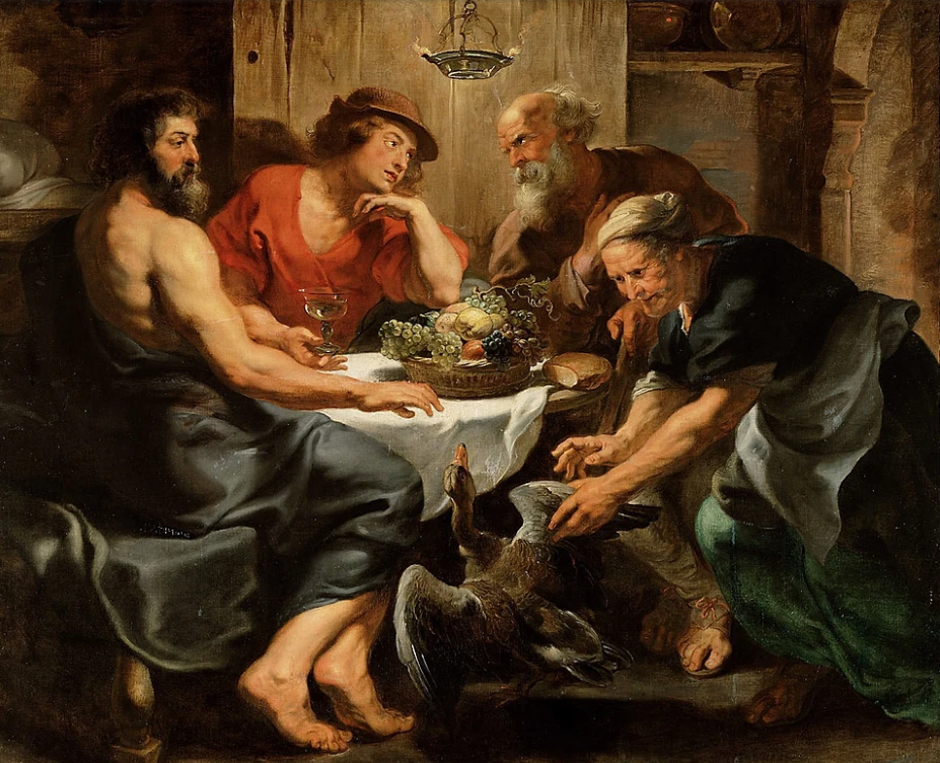
Figure . Jupiter and Mercurius in the House of Philemon and Baucis (1630–33), workshop of Peter Paul Rubens. Zeus (Jupiter) and Hermes (Mercury), disguised as travellers, test a village’s practice of hospitality. Only the elderly couple Baucis and Philemon receive them with generosity and are rewarded, while their neighbours are punished. The story illustrates the principle of Zeus Xenios — the divine protection of strangers and hospitality — which this essay argues forms the moral foundation of Homer’s world.
What I Liked About Christopher Nolan’s The Odyssey
A New Way of Thinking About the Trojan Horse and the Collapse of Civilization
1. Introduction
Christopher Nolan’s The Odyssey has generated considerable discussion, particularly regarding its zero representation of native Greeks and its willingness to depart from traditional interpretations of Homer. Those criticisms are understandable, and I share some of them. Yet they are not what remained with me after leaving the cinema.
What stayed with me was something far more unexpected. Nolan made me think differently about the Trojan Horse.
For most of my life, I had understood the Horse simply as one of history’s greatest military deceptions — a brilliant act of strategy that secured the Greek victory after a decade of war. Nolan’s film suggested another possibility. It invited me to see the Trojan Horse not merely as a clever stratagem, but as a profound violation of the moral order that held the Bronze Age world together.
Whether or not this was Nolan’s explicit intention, which I suspect it was, is almost beside the point. It is the interpretation I took away from the film. Through that lens, the Odyssey ceases to be simply the story of a hero struggling to return home. Instead, it becomes a meditation on whether a civilization can ever recover after it has betrayed the very principles upon which it was built.
That idea, more than any question of historical accuracy or casting, is what made Nolan’s The Odyssey memorable for me. It transformed an ancient epic into a timeless reflection on the fragility of civilization itself.
2. Zeus’ Law: The Moral Order of the Bronze Age
To understand why the Trojan Horse can be interpreted so differently, we must first understand the world in which Homer’s stories are set. The Bronze Age Mediterranean was not a unified empire governed by a single legal system. It was a landscape of independent kingdoms connected by diplomacy, trade, marriage alliances, religion and warfare. In such a world, civilization depended upon more than military power. It depended upon shared moral conventions that transcended political boundaries.
For the Greeks, these conventions were embodied in Zeus himself. Zeus was not merely the ruler of the gods or the wielder of thunderbolts. He was also Zeus Xenios, the protector of strangers, guests and the sacred relationship between host and visitor. Hospitality (xenia), generosity towards strangers (philoxenia), the sanctity of oaths, and respect for sacred gifts were not simply virtues. They were obligations protected by divine authority. To violate them was not merely discourteous; it was to offend the very order established by Zeus.
These customs functioned as an unwritten code that made interaction between kingdoms possible. Travellers crossed foreign lands trusting they would be received according to recognised customs. Ambassadors relied upon safe conduct. Gifts established relationships between rulers. Oaths created alliances. Even enemies were expected to recognise certain sacred boundaries. Without these assumptions, diplomacy would collapse into perpetual suspicion and every encounter with a stranger would become a potential act of war.
Seen in this light, what I think of as “Zeus’ law” was more than a religious ideal. It was the moral infrastructure of civilization itself. Long before international treaties or written conventions governed relations between states, there existed an expectation that some rules were inviolable because they were under the protection of the gods.
It is against this background that Nolan’s interpretation of the Trojan Horse became so striking to me. If Zeus’ law formed the invisible foundation of the Bronze Age world, then the significance of the Horse extends far beyond military ingenuity. It becomes something much more consequential: the deliberate exploitation of the very moral order that made civilization possible. That idea transforms the meaning of the story, and it is to the Horse itself that we now turn.
3. The Trojan Horse: When Trust Becomes a Weapon
Against this background, the Trojan Horse acquires a significance that extends far beyond military ingenuity. It is not simply an example of successful deception. Throughout history, commanders have employed feints, ambushes and misinformation. The Horse is different because it does not merely deceive an enemy — it exploits the very moral assumptions upon which trust itself depends.
The Horse appears as a sacred object. It presents itself not as a weapon but as an offering. Whether understood as a dedication to Athena or as a symbol of the Greeks’ apparent departure, its power lies in its claim to occupy a realm that ought to stand above ordinary warfare. The Trojans receive it because they still believe that certain things retain their sanctity even after years of conflict.
The genius of the deception is therefore also its moral transgression.
Rather than overcoming Troy through superior force, the Greeks achieve victory by transforming the symbols of religion, trust and reconciliation into instruments of destruction. The city falls not because its walls fail, but because its confidence in the shared rules of civilisation is turned against it.
This is the insight I found so compelling in Nolan’s interpretation. The Trojan Horse ceases to represent merely the triumph of intelligence over strength. Instead, it represents the moment when intelligence begins to consume the moral order that made civilisation possible in the first place.
Whether this reflects an historical event is almost irrelevant. As poetry, it carries enormous explanatory power. Great civilisations rarely collapse because of a single battle. They become vulnerable when the invisible assumptions that sustain cooperation begin to erode. Once sacred customs, trusted institutions and accepted norms can be manipulated as weapons, every future act of trust becomes uncertain.
Seen in this way, the fall of Troy becomes more than the end of a city. It becomes a metaphor for the collapse of an entire civilisational order. The Trojan Horse is remembered because it won a war. But perhaps its deeper significance is that it demonstrated how victory could be achieved by violating the very principles that allowed kingdoms to coexist. If that is the case, then the Odyssey is not simply interested in what was destroyed at Troy. It is interested in whether such a moral order can ever be rebuilt.
4. The Odyssey Is About Rebuilding a Moral World
If the Trojan Horse symbolises the collapse of Zeus’ law, then the Odyssey becomes something much larger than the story of a warrior returning home. It becomes an exploration of whether a moral order, once shattered, can be restored.
This immediately changes how we read the poem. Odysseus is no longer simply travelling from Troy to Ithaca. He is moving from a world in which trust has been destroyed towards one in which trust might once again become possible. His journey is geographical, but it is also civilisational.
This perspective explains why hospitality dominates so much of the Odyssey. Nearly every major encounter is structured around the question of how strangers are received. The Cyclops rejects every obligation of hospitality and descends into barbarism. The Phaeacians exemplify generosity towards the unknown traveller. Even within Ithaca itself, the suitors are condemned not merely for seeking Penelope’s hand, but for abusing the sacred obligations of the household they have invaded. Again and again, Homer returns to the same moral question: do people still recognise the laws protected by Zeus?
Seen in this light, Ithaca itself becomes a microcosm of the wider Bronze Age world. The king is absent. Justice has broken down. The palace has become a place where sacred customs are mocked rather than honoured. Order has not simply been interrupted by external enemies; it has decayed from within. Odysseus’ task is therefore not merely to reclaim his throne. It is to restore the moral foundations of his kingdom.
The poem’s conclusion reinforces this interpretation. After the slaughter of the suitors, the cycle of vengeance threatens to continue indefinitely. It is only through the intervention of Athena, acting under the authority of Zeus, that peace is finally restored. Human beings alone prove unable to end the cycle. Reconciliation requires the reassertion of a moral order greater than vengeance itself.
If Nolan’s interpretation of the Trojan Horse is accepted, then the Odyssey becomes not simply the sequel to the Iliad, but its moral counterpart. The Iliad ends with the destruction of a city. The Odyssey asks a more difficult question: after a civilisation has violated its own deepest principles, can it ever truly find its way home?
5. The Tragedy of Greek History
If the Odyssey ends with the restoration of Zeus’ law, Greek history reminds us how fragile that restoration proved to be.
Athena’s intervention at the conclusion of the poem halts the cycle of vengeance and restores peace to Ithaca. It is one of the most hopeful endings in ancient literature. Yet every Greek who first heard the Odyssey also knew that the world of the Bronze Age heroes had disappeared. The kingdoms of Mycenae, Pylos and Tiryns had long since fallen. The civilisation Homer celebrated already belonged to a distant past.
In that sense, the ending of the Odyssey can be read not as a description of history, but as an expression of hope. Homer imagines that the moral order protected by Zeus can be restored, even if history suggests that such restorations are always temporary.
The centuries that followed only reinforce this tragic tension. The alliance formed to resist Persia evolved into the Athenian Empire. Greek cities that had once stood together descended into the Peloponnesian War, exhausting themselves through decades of conflict. The Persians burned the sacred temples of Athens in an act remembered as both military and religious outrage. Later, Alexander the Great burned Persepolis, an act often understood by ancient writers as vengeance for Xerxes’ destruction of Athens. One violation became the justification for another.
The pattern is striking. Every generation believed it was correcting a previous injustice, yet each act of retribution created fresh grievances and renewed the cycle of violence. If Zeus’ law represented the moral foundations of civilisation, history repeatedly demonstrates how difficult those foundations are to preserve once trust has been broken.
This is why Nolan’s interpretation resonated so strongly with me. The Trojan Horse ceases to be simply the beginning of a victorious return. It becomes the symbolic beginning of a recurring human tragedy. Civilisations may rebuild their cities, their armies and their wealth, but rebuilding the moral trust that binds societies together is infinitely more difficult. The Odyssey offers the hope that such restoration is possible. Greek history reminds us that it is never secure.
메타데이터
- post_id
- aabd1a26d66c
- slug
- what-i-liked-about-christopher-nolans-the-odyssey-aabd1a26d66c
- url
- https://medium.com/@bill.giannakopoulos/what-i-liked-about-christopher-nolans-the-odyssey-aabd1a26d66c
- canonical_url
- https://medium.com/@bill.giannakopoulos/what-i-liked-about-christopher-nolans-the-odyssey-aabd1a26d66c
- author_url
- https://medium.com/@bill.giannakopoulos
- status
- ok
- fetched_at
- 2026-08-04 05:23:15