From Wall Street to Web3: How Perp DEXs Are Becoming the Financial Super Centers of the Internet…
Inside a conversation with Paradex CEO Anand Gomes on why the TAM for decentralized derivatives exchanges isn’t measured in billions, it’s…
From Wall Street to Web3: How Perp DEXs Are Becoming the Financial Super Centers of the Internet Economy
Inside a conversation with Paradex CEO Anand Gomes on why the TAM for decentralized derivatives exchanges isn’t measured in billions, it’s measured in trillions.
Photo by Guillaume Marques
The global derivatives market is staggering in scale. According to Chambers and Partners, the notional value of outstanding derivatives reached $699 trillion in 2024, a figure so large it dwarfs most economic metrics we’re familiar with. Behind this market sits an intricate web of institutions: investment banks like Goldman Sachs and J.P. Morgan, exchanges like CME and NASDAQ, clearing houses, prime brokers, and custodians.
What if all of these functions could be compressed into a single, programmable, on-chain entity?
This is the thesis being advanced by a new generation of perpetual decentralized exchanges (perp DEXs), and perhaps no one articulates it more provocatively than Anand Gomes, known in crypto circles as “fiddybps”, co-founder and CEO of both Paradigm (the institutional crypto options marketplace) and Paradex (the zero-fee perpetuals DEX built on Starknet).
In a recent live discussion with Tristan from Bullet and Trevor “Flip” from Delphi Digital, fiddybps laid out a macro thesis that reframes how we should think about the perp DEX opportunity, not as a niche DeFi primitive, but as the foundational financial infrastructure for what he calls “the internet economy.”
The Financial Super Center Thesis
“Think about what perp DEXs are,” fiddybps explained during the discussion. “They’re the sum total of all these financial primitives: banks, brokerages, clearing houses, custodians, everything combined into one entity.”
The argument proceeds from a simple premise: software has progressively eaten more complex economic functions. Calculators became accounting software. Accounting software became enterprise resource planning. The internet enabled entire businesses to move online. And now, blockchains are providing the infrastructure for entire economies to move on-chain.
“If this is happening,” fiddybps continued, “then what do economies need? They need financial centers. Wall Street was needed for America to be the superpower that it is today. Without deep liquid capital markets, America would be very different.”
The implication is clear: if the internet economy is being built on-chain, it will need its own financial centers. And perp DEXs, with their ability to combine exchange, clearing, custody, and prime brokerage functions into a single composable protocol, are positioned to become exactly that.
“Think of all the banks in the world, all the exchanges, CME, NASDAQ, all the clearing houses, all the brokerages, all the custodians,” fiddybps emphasized. “The TAM of all these businesses is what the TAM of perp DEXs is. We’re not talking in the billions. These entities can play for trillions.”
The Great Migration: From CEX to DEX
The thesis isn’t purely theoretical. Real capital is moving.
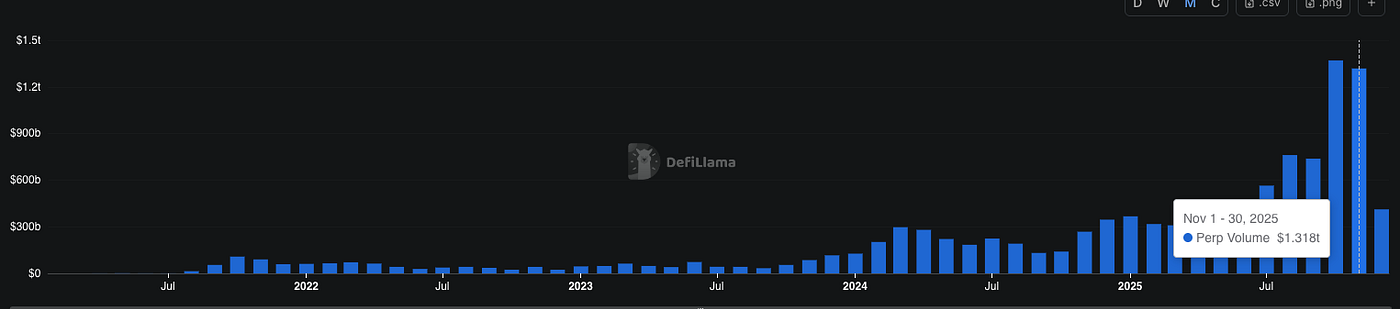
DefiLlama
In October 2025, the perp DEX market hit a new milestone: combined trading volume surpassed $1.3 trillion in a single month, according to DeFiLlama. The DEX-to-CEX volume ratio reached a record 0.23, meaning decentralized venues now capture nearly a quarter of the derivatives market that was almost entirely centralized just two years ago.
What’s driving this migration? The conversation pointed to a powerful catalyst: the erosion of trust in centralized exchanges.
October 2025 saw one of the most dramatic market events in crypto history. A sudden crash triggered over $19 billion in liquidations across the derivatives market. On centralized exchanges like Binance, the fallout was severe: mark prices dislocated from global reference prices, ADL (auto-deleveraging) mechanisms triggered controversially, and the exchange ultimately issued refunds exceeding $250 million.
“Where’s the postmortem on what happened?” fiddybps asked pointedly. “There seems to be so many things that went wrong. ADL typically kicks in when the insurance fund is zero. And Binance’s insurance fund was not zero, it just dropped by a couple hundred million and then ADL kicked in.”
The lack of transparency stood in stark contrast to how DeFi protocols handled the same event. On-chain exchanges like Paradex and Hyperliquid had their struggles too, but every action, every liquidation, every insurance fund movement, was visible and verifiable.
“This single event has done more for DEXs than anybody could have done,” Gomes reflected. “There’s no pitch that we could have put out that could have convinced you that building on-chain is better. But it still worked, and everybody still knew what happened. That’s where DeFi really shines.”
Rethinking Risk: ADL vs. Socialized Loss
One of the most technically substantive parts of the discussion centered on risk management, specifically, the debate between Auto-Deleveraging (ADL) and Paradex’s alternative approach using socialized loss combined with a “last resort” mechanism.
ADL is a legacy mechanism inherited from BitMEX. When an exchange’s insurance fund is depleted and bankrupt positions can’t be closed at market, ADL automatically closes out profitable positions to maintain solvency. It’s crude but effective, the exchange survives.
The problem, fiddybps argued, is that ADL does two things at once: it solves the solvency problem (the exchange is underwater) and the position close-out problem (bad positions need counterparties). Combining these creates unpredictability that can devastate sophisticated traders.
“If I’m Ethena, long perps on one exchange, long spot somewhere else as a hedge, and you close me out via ADL, I now have an unhedged position worth billions of dollars, and I don’t know about it,” fiddybps explained. “The lack of predictability is a huge problem.”
Paradex’s approach separates these two functions. Socialized loss handles solvency: anyone withdrawing during a crisis takes a proportional haircut. The “last resort” mechanism handles position close-out separately, but crucially, it introduces time, giving traders advance notice (potentially hours) to unwind their hedges manually.
“You’re still performing both functions that ADL does,” fiddybps clarified. “You’re just doing them as two separate processes. And because you introduce time, it allows liquidity and solvency to recover. It’s a much more elegant solution.”
The approach also addresses a subtle but critical issue with cross-margined portfolios. Consider a trader long Bitcoin and short various altcoins, where the profitable BTC position offsets losses elsewhere. If ADL closes the BTC position, the remaining portfolio can become immediately unhealthy, triggering a cascade of liquidations.
“There’s no guarantee you can find counterparties that are both profitable and don’t trigger more liquidations,” fiddybps noted. “It’s just not a good idea to do both things in one action.”
Zero Fees: The Disruptive Business Model
If the thesis is that perp DEXs can become trillion-dollar financial super centers, the question becomes: how do you get there from here?
The conversation identified zero fees as a critical weapon for disrupting incumbent CEXs.
“Binance owns the KOLs,” explained Trevor “Flip” from Delphi Digital. “They pay 60 to 90% of trading fees back to affiliates and make an incredible amount of money. But 100% of $10 million is a lot less than 90% of $100 million. The volume that Binance does, we can’t pay these KOLs enough.”
The insight is that CEXs have built their distribution moats on fee-sharing with influencers and affiliates. A DEX offering zero fees fundamentally breaks this model, there’s nothing to share, so the incentive structure must change entirely.
Paradex’s approach is to segment flow. Retail traders accessing the platform through the UI pay zero fees, both maker and taker. Revenue comes instead from market makers who pay for access to this “curated, benign flow” through mechanisms like RPI (Retail Price Improvement), which guarantees retail traders fills at prices inside prevailing CEX spreads.
“We think creators are very important,” fiddybps said, addressing concerns about how influencers fit into a zero-fee model. “But the business model needs to change. Going zero fees and rewarding creators with our token makes them owners of the exchange. That’s an owner conversation versus someone just being a broker.”
The Road Ahead
Paradex’s numbers reflect the momentum. As of December 2025, the platform has processed over $159 billion in cumulative volume, with $144 million in TVL and $397 million in open interest. The platform offers 250+ markets spanning perpetuals, perpetual options, and soon spot, all accessible from a single unified margin account.
The upcoming $DIME token, with 57.6% allocated to the community (including a 20% genesis airdrop), represents an attempt to align incentives between the protocol and its users. Notably, 80% of team tokens are tied to performance milestones, a structure Gomes claims is unique in the industry.
Technical development continues rapidly. In November 2025, Paradex migrated to the Stwo prover for its ZK proofs. XUSD, a delta-neutral synthetic dollar designed to generate yield for depositors, is in development. Privacy features using zk-encrypted accounts, hiding positions, entries, exits, and liquidation levels, position the platform for institutional adoption.
“Big money likes privacy,” fiddybps noted. “Do you really think we’ll move to a world where BlackRock puts all their client money on-chain for the world to see? Too much transparency invites predatory behavior.”
The Minsky Moment
Perhaps the most memorable line from the discussion came when Gomes described the current opportunity:
“There’s no silver bullet. There’s only a hundred lead bullets. You just got to keep firing, and then over time, gradually, then suddenly, boom. They topple.”
The perp DEX market is in what might be called a “Minsky moment”, that inflection point where a secular trend suddenly accelerates due to a catalyzing event. The October 2025 crash and subsequent CEX trust erosion may prove to be that catalyst.
For those building in this space, the message is clear: the infrastructure for the internet economy’s financial system is being built right now. The entities that succeed won’t just be exchanges, they’ll be the CMEs, the Goldman Sachs , the DTCCs of the on-chain world, compressed into single, programmable protocols.
The TAM isn’t billions. It’s trillions.
And the race is on.
Disclaimer: This article is for informational purposes only and does not constitute financial advice. The author may hold positions in assets mentioned. Always conduct your own research before making investment decisions.
Sources:
- YouTube: “NO CEX: Inside the Perp DEX Revolution”
- *DeFiLlama Protocol Data*
- *L2BEAT Paradex Analysis*
- *Chambers and Partners Derivatives 2025 Guide*
- Various industry reports and protocol documentation
About the Author
ZkMarc is a blockchain engineer based in Taipei with 7+ years exploring DeFi protocols and infrastructure. He’s currently diving into emerging primitives across the stack, including ZK technologies, vault mechanisms on cheaper L2s post-Pectra, perpetual trading platforms, and cross-chain analytics. Always building, always learning.
메타데이터
- post_id
- aac4f6aeda3f
- slug
- from-wall-street-to-web3-how-perp-dexs-are-becoming-the-financial-super-centers-of-the-internet-aac4f6aeda3f
- url
- https://medium.com/@zkMarc/from-wall-street-to-web3-how-perp-dexs-are-becoming-the-financial-super-centers-of-the-internet-aac4f6aeda3f
- canonical_url
- https://medium.com/@zkMarc/from-wall-street-to-web3-how-perp-dexs-are-becoming-the-financial-super-centers-of-the-internet-aac4f6aeda3f
- author_url
- https://medium.com/@zkMarc
- status
- ok
- fetched_at
- 2026-08-12 14:20:29