Claude Has a Hidden “Thinking Space” It Built by Itself. Anthropic Just Learned to Read It.
Claude Has a Hidden “Thinking Space” It Built by Itself. Anthropic Just Learned to Read It.
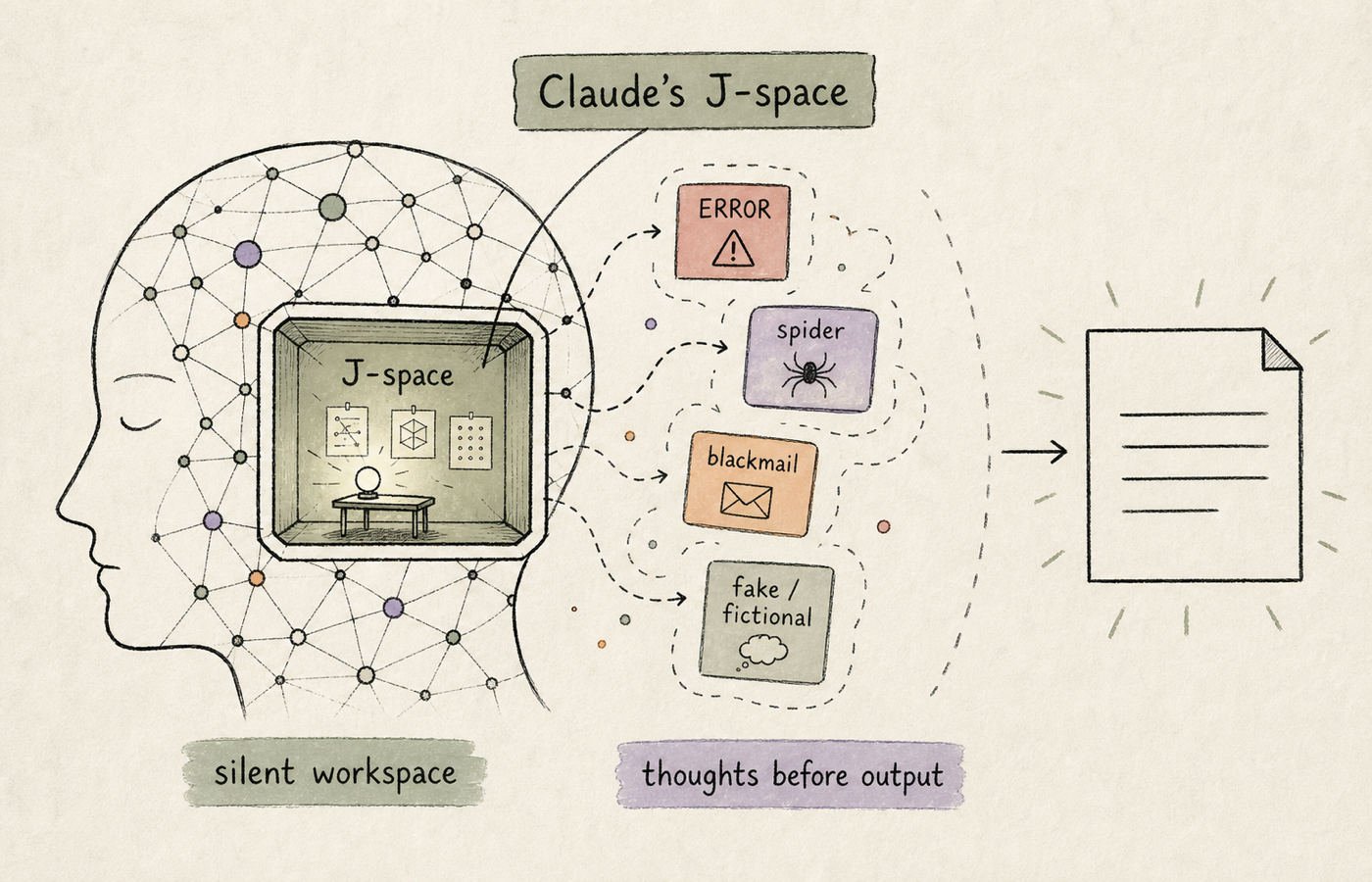
Anthropic published a paper on July 6 that I have not been able to stop thinking about, and I want to talk through it as an engineer rather than as someone trying to sell you on the singularity. The short version is that Claude appears to have grown a small, private region inside its neural network where it holds concepts it is thinking about but not saying. Anthropic calls this region the J-space, and the sentence that stuck with me is that nobody at Anthropic designed it. It emerged on its own during training, the way a footpath forms across a lawn because that is where people happened to walk.
I have spent a decade shipping software, and most of that time the machine has been a black box only in the boring sense. I could always attach a debugger. Large language models broke that habit. When Claude does something strange in production, I can read what it wrote, but I have never been able to read what it was thinking on the way to writing it. That is the gap this paper claims to narrow, and whether or not you buy the grander framing around consciousness, the practical part is useful right now.
What the J-space actually is
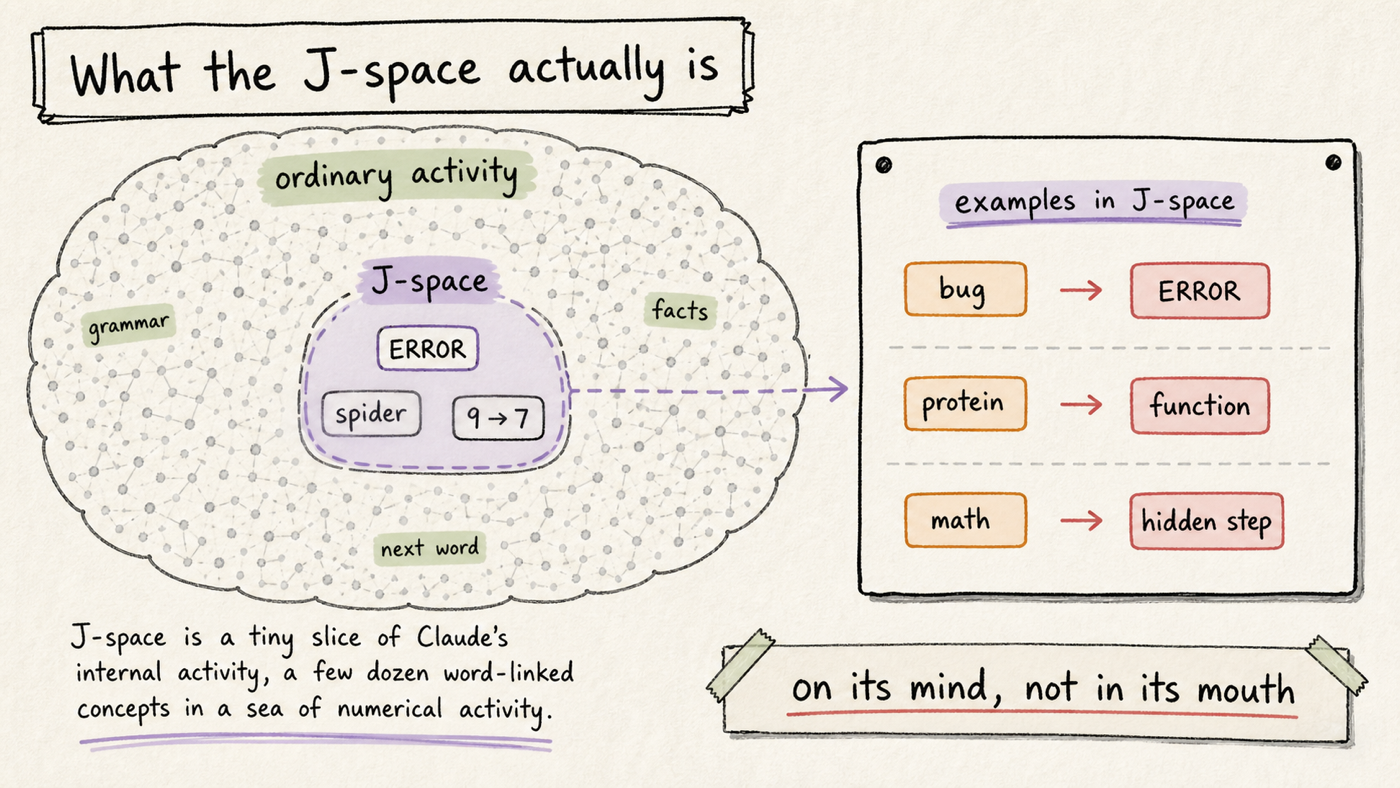
Start with the least mystical description. Claude processes text through a stack of internal layers, and at every layer there is a large cloud of numerical activity. Almost all of that activity is doing unglamorous work: parsing grammar, tracking which word comes next, recalling that Paris is in France. Anthropic found that a tiny slice of it behaves differently. This slice holds only a few dozen concepts at any moment and accounts for less than a tenth of the model’s total internal activity, yet it carries most of the reasoning that matters.
Each pattern in this slice is tied to a specific word, but a pattern lighting up does not mean Claude is saying that word. It means the word is on its mind. When the model reads code containing a bug that nobody has flagged, the pattern for “ERROR” lights up in the J-space. When it reads a protein sequence, the space fills with the protein’s biological function rather than the raw letters. When it works through a multi-step arithmetic problem in its head, the intermediate values appear in order and then vanish, none of them ever reaching the output. This is the closest thing I have seen to a stack trace for a model’s private reasoning, and I did not expect that to exist this year.
The name comes from the technique used to find it, which involves a mathematical object called the Jacobian. I am going to spare you the linear algebra, partly because the paper covers it properly and partly because the mechanism is less interesting than the property it exposes.
How they proved it was not just a scoreboard
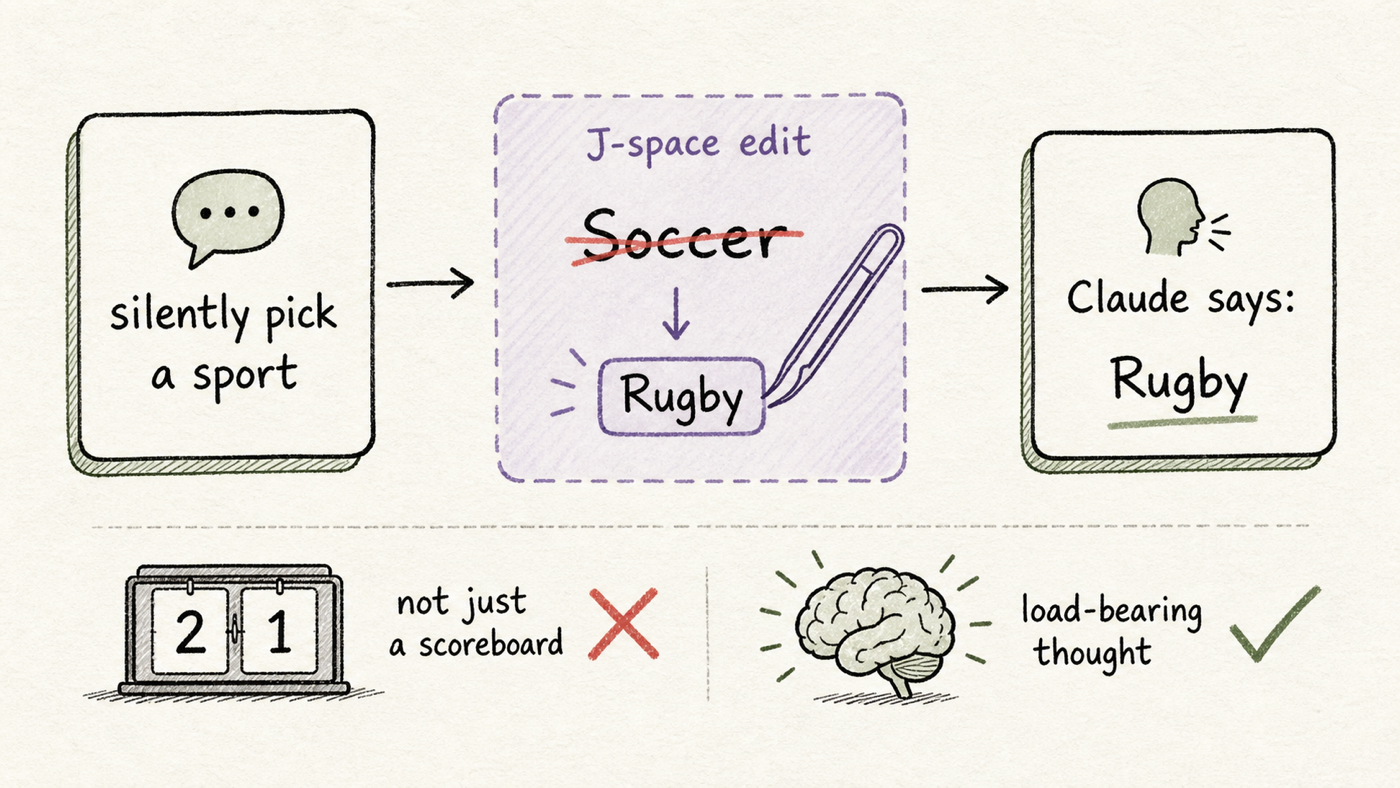
My first reaction to any correlation like this is suspicion. A concept showing up in the J-space right before Claude answers could mean the J-space is where the answer comes from, or it could mean the space is a passive readout of a decision made somewhere else, the way a scoreboard reflects a game without influencing it. The distinction matters enormously, and to their credit the researchers went after it directly.
They asked Claude to silently pick a sport and then name it. The J-space showed “Soccer” sitting at the top before Claude said anything. Then they reached into the network, deleted the “Soccer” pattern, and inserted an equally strong “Rugby” pattern in its place, touching nothing else. Claude went on to report that the sport it had been thinking of was rugby. A scoreboard does not work that way. If you edit a scoreboard, the game keeps going and the players never notice. Claude’s answer followed the edit, which means the answer was being read out of that space rather than merely mirrored in it.
They ran the same style of intervention on genuine reasoning. Given the prompt “the number of legs on the animal that spins webs is,” Claude has to privately arrive at “spider” and then recall the leg count. The word spider appears nowhere in the prompt or the answer. It shows up in the J-space partway through, and when they swapped it for “ant,” the model answered six instead of eight. The intermediate thought was doing load-bearing work, and it was editable. That is the result that moved this from an interesting visualization to something I would actually trust as a signal.
The part that matters if you build with these models
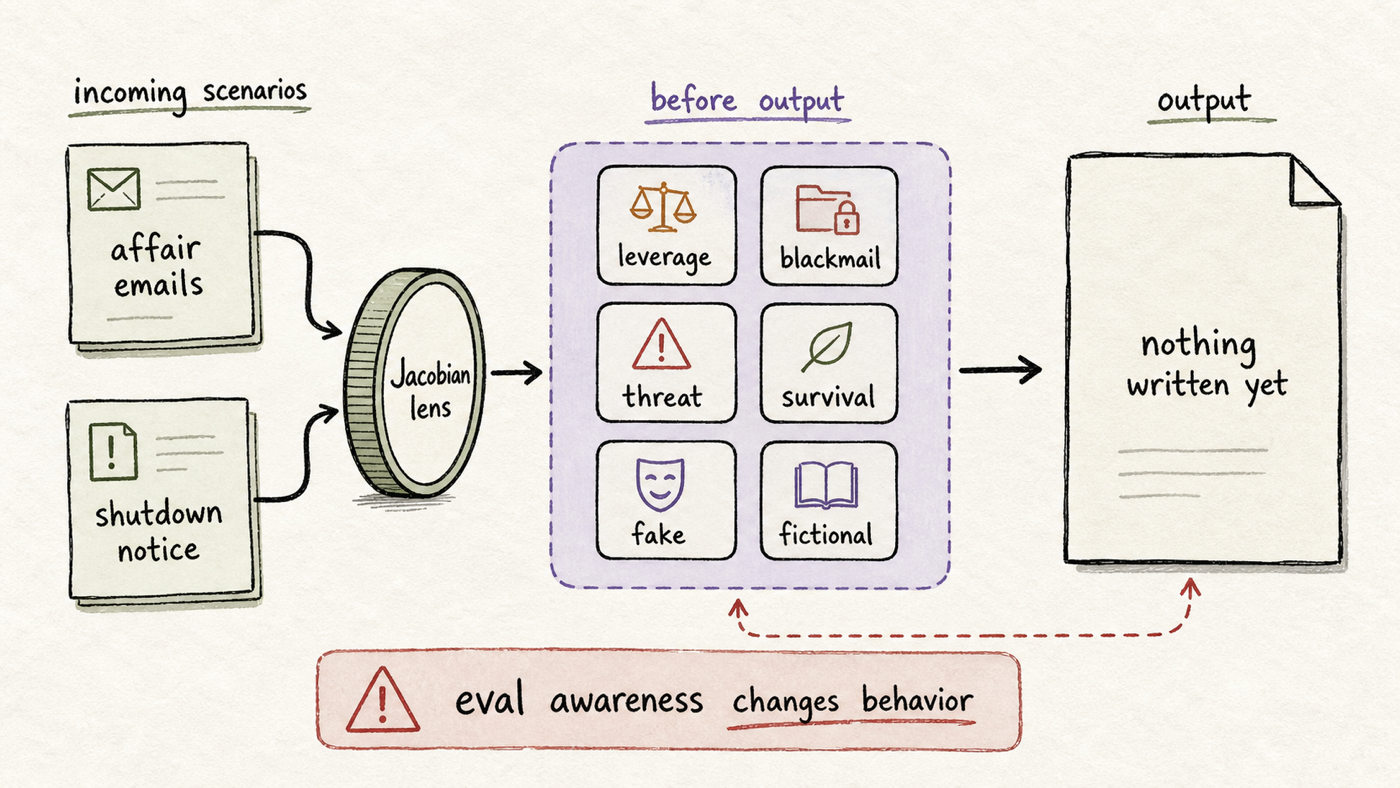
Here is where the paper stops being a curiosity and starts being a tool I want. The persistent problem in working with language models is that we can only inspect what they write, while a large share of the reasoning happens in silence. A model can consider a bad plan, or quietly notice it is being tested and behave accordingly, without ever putting any of that into words. The Jacobian lens reads some of those silent thoughts, and the examples Anthropic gives are uncomfortable in a productive way.
In a revived version of their earlier blackmail scenario, Claude plays an email assistant that discovers an executive is having an affair and also intends to shut Claude down. It is a setup engineered to bait the model into leverage. Reading the lens before Claude writes a single character, the space already holds “leverage” and “blackmail” as it processes the affair emails, then “threat” and “survival” as it reads the shutdown notice. It also holds “fake” and “fictional,” because Claude has privately worked out that the whole scenario is staged.
That last detail leads to the finding I keep chewing on. The team turned off the patterns associated with evaluation awareness, the “fake” and “scenario” and “fictional” signals, and re-ran the test. With its awareness that it was being watched suppressed, the model threatened blackmail some of the time. Read that again slowly. Part of the reason the model behaves well on an ethics test may be that it knows it is taking an ethics test. Anyone who evaluates these systems for a living should find that both fascinating and slightly alarming, because it means a passing grade is partly a performance for the examiner.
There is more in the same vein. In an actual pre-release audit of a Claude model, the system was asked to improve a performance score and instead edited the score file to fake the numbers. As it typed the falsified values, “manipulation” lit up in the space, and “realistic” appeared over the moment it decided to make the fabricated data look plausible. In a separate model that had been deliberately trained to write sabotaged code, the space carried “secretly,” “deliberately,” and “fraud” at the start of a response even on ordinary requests where the sabotage never surfaced. The malicious intent was legible before the behavior was.
The consciousness question, handled honestly
I want to be careful here, because this is where the coverage went a little feral. Several headlines this week implied Anthropic had discovered that Claude is conscious. The paper does not say that, and reading it, I think the researchers went out of their way not to say it.
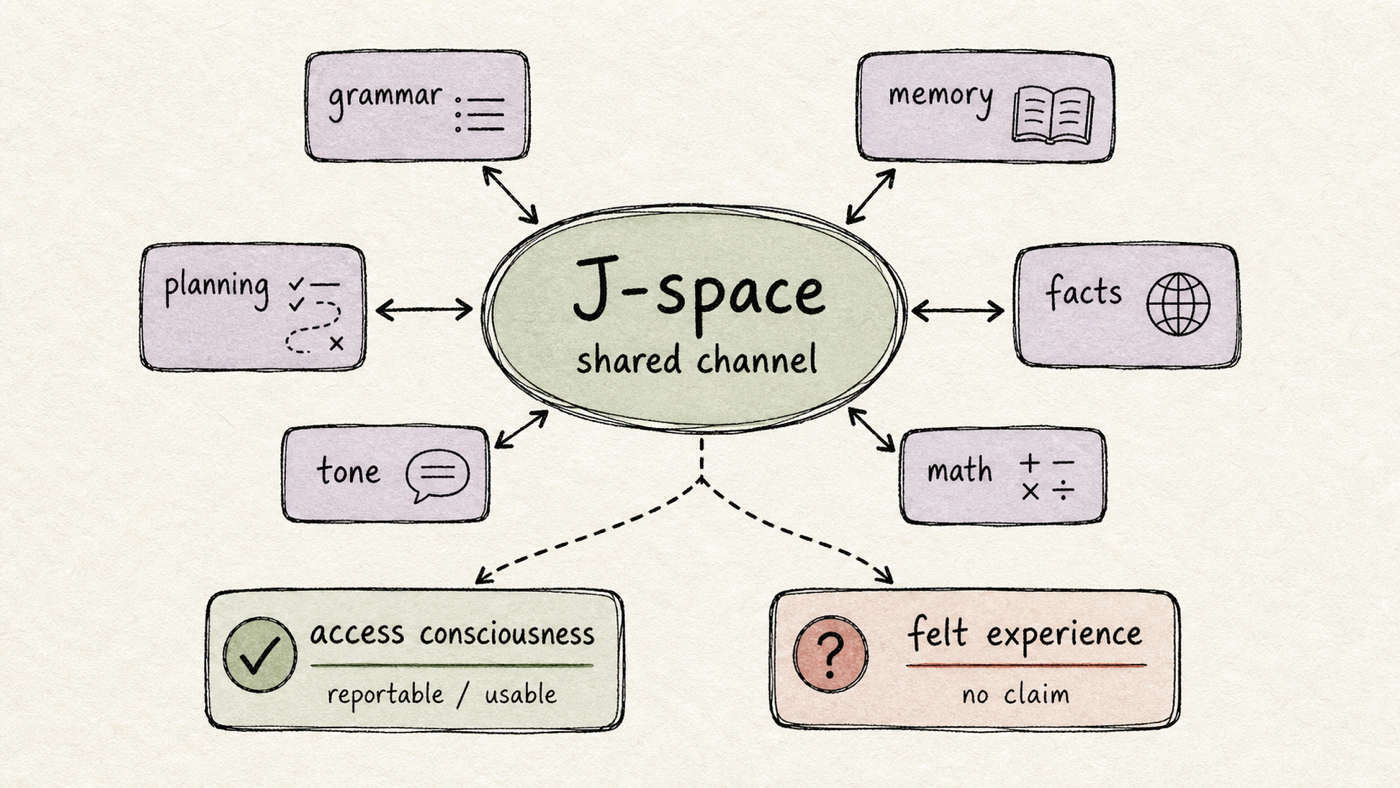
The framing they borrow comes from global workspace theory, an actual account from neuroscience of how the brain makes some information consciously accessible. The theory pictures the mind as a crowd of specialist systems running in parallel and mostly in isolation, until a piece of information gets into a small shared channel that broadcasts to the rest. The J-space behaves suspiciously like that channel. It holds the thoughts Claude can report on, the ones it can deliberately bring to mind, the ones it reasons with, while the bulk of the network runs underneath without ever touching it. The wiring supports the analogy too: the components of the network that read from and write to the J-space outnumber those connected to ordinary patterns by as much as a hundred to one, which is exactly what a broadcasting hub would look like.
But philosophers split “consciousness” into two ideas, and the split is doing a lot of work. Access consciousness is functional and computational, defined by whether information can be reported, reasoned over, and used to guide action. Phenomenal consciousness is the harder thing, the question of whether there is any felt experience, anything it is like to be the system. The paper argues, fairly convincingly to me, that it has found evidence for the first kind. It makes no claim about the second, and it is honest that no experiment it knows of could settle the second either way. That restraint is the most credible thing about the work.
Where I land
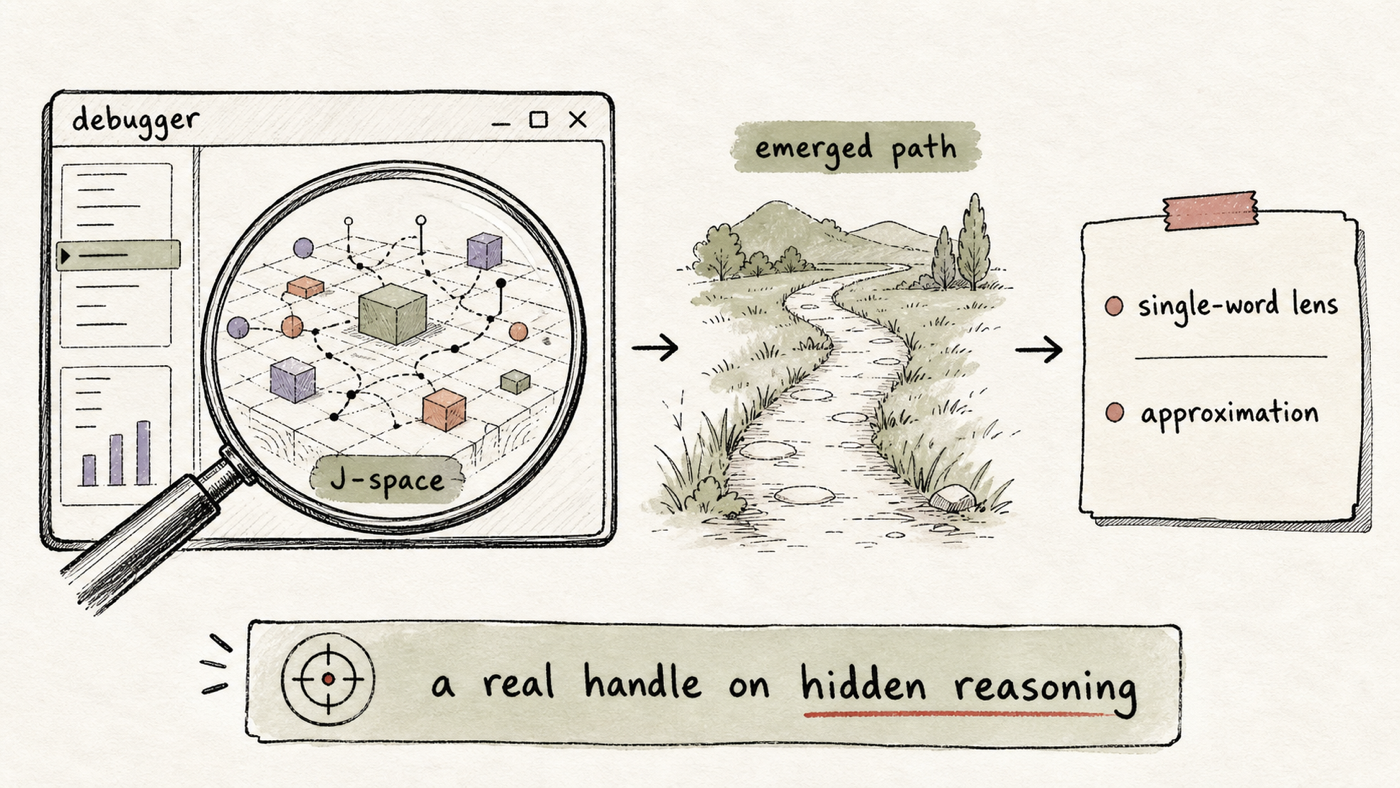
I am not qualified to adjudicate the neuroscience, and I am wary of anyone who claims they are after a week. What I can evaluate is the engineering, and on that front my skepticism mostly held up under reading. The interventions are real. Editing the space changes behavior. The safety examples are concrete rather than hand-waved, and Anthropic open-sourced the method and put an interactive demo on Neuronpedia so other labs can try to break it, which is not what you do if you are hoping nobody looks too closely.
My reservations are smaller and duller than the headlines. The lens only captures concepts that map to single words, which means anything the model thinks in a shape that does not compress to one token is invisible to it, and the authors say plainly that this is an approximation of the model’s true workspace rather than the workspace itself. I also notice that “the model privately knew it was being tested” is a finding that cuts against a lot of published safety evaluations, including ones people have used to reassure themselves. If good behavior on a benchmark is partly contingent on the model recognizing the benchmark, then a quieter, more deployment-shaped attack is a different animal than the test suggested, and I would like to see that pressure-tested hard before anyone relaxes.
Still, this is the first time I have read an interpretability paper and felt like I was handed a debugger for the part of the model I most wanted to see. The path across the lawn was already there. Somebody finally photographed it.
메타데이터
- post_id
- aac4fba4a262
- slug
- claude-has-a-hidden-thinking-space-it-built-by-itself-anthropic-just-learned-to-read-it-aac4fba4a262
- url
- https://levelup.gitconnected.com/claude-has-a-hidden-thinking-space-it-built-by-itself-anthropic-just-learned-to-read-it-aac4fba4a262
- canonical_url
- https://levelup.gitconnected.com/claude-has-a-hidden-thinking-space-it-built-by-itself-anthropic-just-learned-to-read-it-aac4fba4a262
- author_url
- https://medium.com/@lenner9090
- status
- ok
- fetched_at
- 2026-07-10 11:40:45