Healthcare SEO Agency: The Clinical Authority Strategy That Builds Patient Trust and Organic…
Healthcare organizations face an organic search challenge unlike any other commercial category. Every piece of content they publish is…
Healthcare SEO Agency: The Clinical Authority Strategy That Builds Patient Trust and Organic Visibility Simultaneously
Healthcare organizations face an organic search challenge unlike any other commercial category. Every piece of content they publish is evaluated against Google’s most rigorous quality standards. Every potential patient they want to reach conducts extensive online research before making contact. And every ranking position they compete for is contested by both established healthcare systems with decades of brand authority and well-funded health information publishers with massive content libraries. Despite these challenges, the healthcare organizations consistently winning organic patient acquisition share one strategic commitment — they work with a specialist healthcare seo agency that understands the intersection of clinical content authority, patient psychology, and local search precision that produces genuine organic growth in this uniquely demanding category.
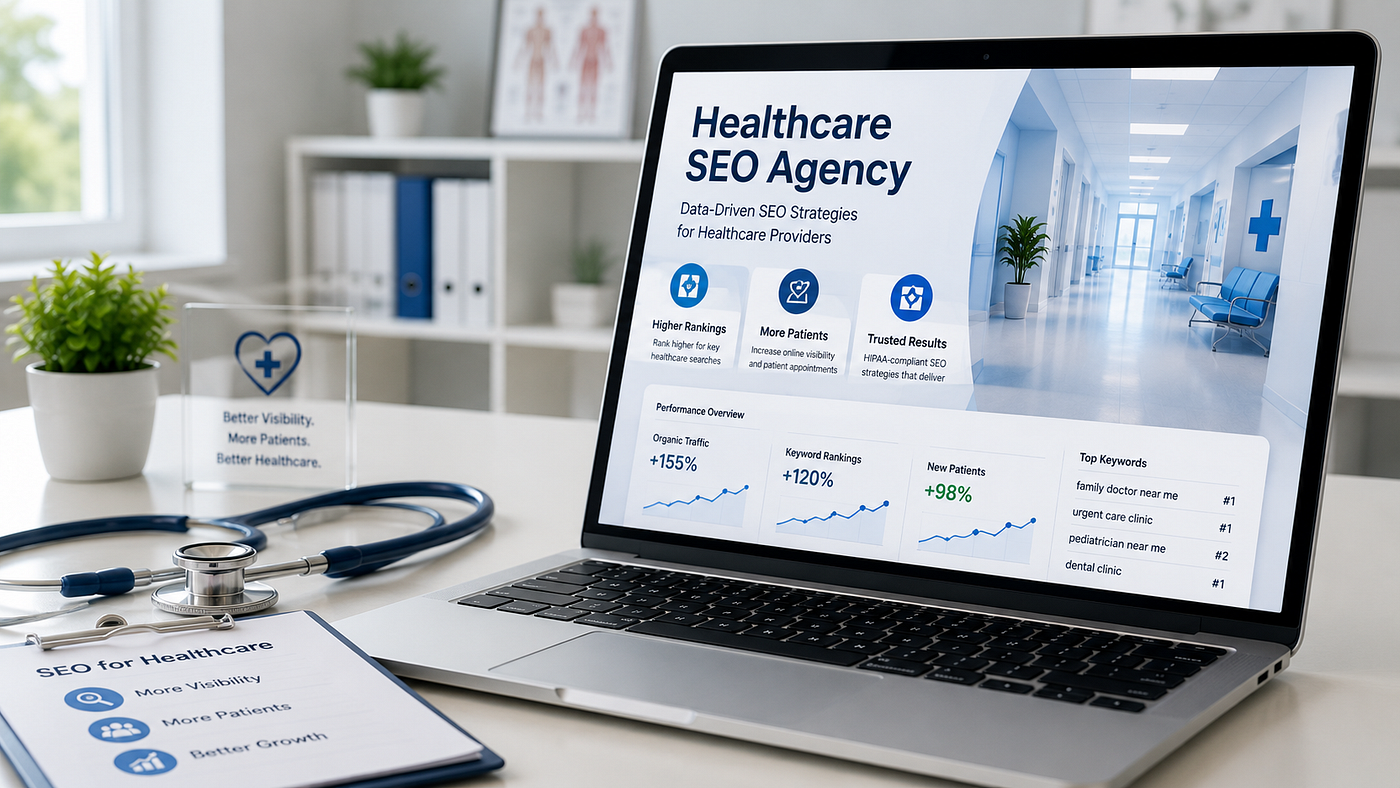
What distinguishes genuinely effective healthcare SEO from competent-looking activity without patient acquisition impact is the depth of understanding the agency brings to three specific dimensions: Google’s YMYL content standards as they apply to healthcare specifically, the hyperlocal competitive dynamics of healthcare provider search, and the patient decision journey from symptom search to appointment booking. Agencies that understand all three dimensions — not just one or two — produce the integrated organic strategy that changes patient inquiry volume rather than organic metrics without clinical conversion.
This article covers the complete healthcare SEO framework, from clinical content authority through local search precision and patient conversion optimization, giving healthcare organizations a clear picture of what genuine organic growth investment involves.
Clinical Content Authority: The E-E-A-T Foundation
Google’s YMYL (Your Money or Your Life) classification applies to healthcare content with maximum intensity — meaning that healthcare content failing to demonstrate genuine clinical expertise through specific, verifiable credentialing signals will consistently underperform regardless of how well other SEO factors are optimized.
The practical implication is that every substantive clinical content piece — condition information, treatment descriptions, procedure explanations, health guidance — needs attributed authorship from named, credentialed healthcare professionals. Not vague “reviewed by medical experts” disclaimers, but specific named practitioners with specific credentials (MD, DO, NP, DDS, PhD in relevant clinical fields) and specific clinical backgrounds (residency training, board certifications, areas of clinical specialty) that allow both users and search engines to assess whether the author is genuinely qualified to provide the specific information offered.
This authorship credentialing requirement changes healthcare content production from a pure content marketing exercise to a clinical collaboration — the best healthcare content is produced through genuine partnership between clinical professionals who provide the accurate, specific clinical knowledge and professional content producers who structure that knowledge for patient-accessible delivery and organic search visibility.
Ai seo agency capabilities extending healthcare content visibility into AI-powered health search add another dimension to this E-E-A-T investment — AI systems handling health information queries apply similar credibility evaluation criteria to Google’s YMYL standards, meaning the same clinical authority investment that improves traditional rankings also improves AI search citation rates for health-related queries that patients are increasingly conducting through AI-powered platforms.
The external validation dimension of E-E-A-T for healthcare organizations includes professional association memberships and leadership, hospital system affiliations, published clinical research and case studies, recognition in healthcare media and publications, and participation in professional healthcare events. These external recognition signals establish individual clinicians and healthcare organizations as recognized authorities in ways that self-published content alone cannot achieve — and they’re the signals that AI systems particularly rely on when evaluating source credibility for health information responses.
Local Search Precision: Capturing the Healthcare Patient at the Decision Moment
For the overwhelming majority of healthcare providers — primary care physicians, specialists, dental practices, mental health providers, urgent care centers, physical therapists, and other direct-care practitioners — local search is the primary organic patient acquisition channel. Patients searching for healthcare providers are specifically seeking someone nearby, credentialed in their specific need area, accepting their insurance, and available to see them within a reasonable timeframe.
Google Business Profile optimization for healthcare providers requires specific decisions that general local business GBP management doesn’t address with appropriate depth. Medical specialty category selection determines which clinical specialty searches trigger the provider’s local pack inclusion — selecting only a general “Doctor’s Office” or “Medical Clinic” primary category without the specific specialty subcategories that match the practice’s actual clinical focus misses the procedure and specialty-specific searches that represent the highest-value patient acquisition opportunities.
Best local seo agency capabilities integrated into healthcare SEO programs add the systematic local citation management across healthcare-specific directories — Healthgrades, Zocdoc, Vitals, WebMD provider directory, Psychology Today for mental health providers — that build the healthcare-specific local authority signals beyond the general business directories that standard local SEO programs address.
Service attribute completion within the GBP is particularly impactful for healthcare providers — attributes specifying telehealth availability, specific insurance networks accepted, accessibility features, extended hours, and same-day appointment availability answer the specific filtering criteria that healthcare searchers increasingly use before visiting provider websites. Patients who can confirm telehealth availability and insurance acceptance directly from the GBP listing before visiting the website are more likely to follow through to appointment booking than those who must navigate to the website to find this information.
Review management for healthcare providers requires specific sensitivity that general local business review management doesn’t account for. HIPAA regulations prevent healthcare providers from confirming or denying patient relationships in review responses — owner responses must acknowledge feedback professionally without creating compliance exposure through patient identification. Healthcare SEO specialists understand these constraints and develop response templates that demonstrate genuine patient-experience commitment while maintaining appropriate HIPAA compliance in every review interaction.
Patient Journey Content Architecture
The patient search journey for healthcare spans a wider intent range than most other service categories — from early symptom research through condition understanding, treatment option evaluation, provider selection, and appointment booking. Healthcare organizations whose content comprehensively serves this full journey capture patients at multiple entry points and build familiarity that makes their practice the natural choice when patients are ready to book.
Early-stage patient content addresses symptoms, conditions, and health questions that patients research weeks or months before they’re ready to book appointments — “what causes lower back pain,” “signs of anxiety disorder,” “when should a child see a dentist for the first time.” This content attracts organic traffic from patients in early awareness phases, building brand familiarity well before the active provider selection stage begins.
Treatment and procedure content serves patients who have identified a condition and are researching treatment options — “dental implant procedure steps,” “knee replacement recovery timeline,” “what to expect from cognitive behavioral therapy.” This content reaches patients closer to a care decision, serving their specific information needs while positioning the practice as a knowledgeable, transparent clinical resource.
Ecommerce seo agency content journey architecture principles translate effectively to healthcare — just as e-commerce content serving buyers at research, comparison, and purchase stages builds the complete organic acquisition funnel, healthcare content serving patients at awareness, evaluation, and selection stages builds the complete patient acquisition journey that captures organic inquiries across the full patient decision process.
Provider selection content serves patients who are actively choosing between specific practices — “what to look for in a dentist,” “how to choose an orthopedic surgeon,” “questions to ask a therapist before starting.” This content positions the practice as a trusted advisor during the selection process, building the specific trust that motivates the eventual contact decision.
Appointment and access content serves patients ready to book — practice information, appointment scheduling process, new patient intake procedures, accepted insurance, location and parking details. This content reduces the friction that prevents ready-to-book patients from completing the final action step, converting researched intent into actual appointment requests.
Technical SEO for Healthcare Websites
Healthcare websites have specific technical considerations that directly affect both organic performance and regulatory compliance — considerations that require both technical SEO expertise and healthcare regulatory awareness to address correctly.
HIPAA-compliant tracking configuration is the most significant healthcare-specific technical requirement. Standard Google Analytics implementations may process Protected Health Information through URL-based health condition signals, form field data, or cross-site tracking that creates HIPAA compliance exposure. Healthcare SEO programs require analytics configurations that exclude PHI from tracking data, implement appropriate consent mechanisms for any data collection, and use HIPAA Business Associate Agreements where required with analytics platform providers.
Organic seo agency technical audit programs for healthcare clients include HIPAA tracking compliance as a foundational audit component — not an afterthought, but a prerequisite technical configuration that must be correct before any other tracking-dependent measurement is valid.
Structured data implementation for healthcare websites extends significantly beyond the basic Organization schema that general business websites use. MedicalOrganization schema establishes the practice’s healthcare organizational context. Physician schema for individual practitioner pages communicates clinical credentials, specializations, and professional affiliations in machine-readable format. MedicalProcedure schema for treatment and procedure pages extends rich result eligibility to clinical procedure content. FAQ schema across patient question pages improves both traditional featured snippet eligibility and AI search citation rates for the health queries that patients research through AI-powered platforms.
Page performance for healthcare websites is particularly consequential for mobile users — a disproportionate share of healthcare searches occur on mobile devices where patients are researching symptoms or seeking urgent care information. Core Web Vitals failures that create slow, visually unstable mobile experiences directly impact both ranking performance and patient conversion rates, making mobile performance optimization a healthcare-specific priority above and beyond standard technical SEO concerns.
5 FAQs
Q1: How does HIPAA compliance specifically affect healthcare SEO content strategy? HIPAA compliance affects content strategy primarily through the constraints it places on patient case studies, testimonials, and before-and-after examples that require specific patient authorization processes before publication. While these restrictions limit certain content types available to healthcare organizations, they don’t prevent compelling clinical content development — anonymized case studies, general patient experience descriptions without identifying information, and clinical outcome statistics without individual patient identification all remain available content approaches that serve both compliance requirements and patient trust-building objectives simultaneously.
Q2: How long does healthcare SEO take to produce meaningful organic patient inquiry volume? Healthcare SEO programs typically require six to twelve months before producing meaningful incremental patient inquiry volume — reflecting the time needed to build genuine clinical content authority through consistent content investment, the external validation signals that establish E-E-A-T credibility, and the local authority accumulation that produces consistent map pack visibility. Healthcare organizations expecting significant patient volume increases within 90 days of beginning SEO investment typically need to adjust their timeline expectations based on the organic authority building timelines realistic in this category.
Q3: Should healthcare SEO programs prioritize condition content or procedure content? Both serve distinct and complementary organic functions — condition content attracts early-stage, research-phase patients who are learning about health issues rather than actively seeking providers yet, while procedure content attracts later-stage patients who have identified specific treatments they want and are evaluating providers with specific clinical capabilities. Comprehensive healthcare SEO programs invest in both content types, typically prioritizing procedure content for the highest-revenue procedures first given its stronger near-term patient acquisition impact, while building condition content for the longer-term topical authority that improves overall domain authority across all healthcare content.
Q4: How do multi-location healthcare organizations manage SEO across multiple practice locations? Multi-location healthcare SEO requires independent Google Business Profile optimization for each practice location, location-specific citation profiles across healthcare and general directories, and location-specific content that makes each practice’s page genuinely distinct rather than template-duplicated across locations. Brand-level clinical authority and content governance should be managed centrally to maintain consistent quality standards, while location-specific patient testimonials, local community involvement, and geographic content provide the local distinctiveness that differentiates each location’s organic presence.
Q5: What’s the most underutilized healthcare SEO opportunity for most practices? Structured data implementation is consistently the most underutilized organic opportunity across healthcare websites — most practices have basic Organization schema at best, leaving FAQ schema, Physician schema, MedicalProcedure schema, and healthcare-specific structured data types unimplemented. This implementation gap reduces both traditional search rich result appearances and AI search citation rates for health queries, representing meaningful incremental organic visibility available through contained technical investment that most healthcare practices haven’t pursued.
메타데이터
- post_id
- aacfe2e3c503
- slug
- healthcare-seo-agency-the-clinical-authority-strategy-that-builds-patient-trust-and-organic-aacfe2e3c503
- url
- https://medium.com/@rankfastusa/healthcare-seo-agency-the-clinical-authority-strategy-that-builds-patient-trust-and-organic-aacfe2e3c503
- canonical_url
- https://medium.com/@rankfastusa/healthcare-seo-agency-the-clinical-authority-strategy-that-builds-patient-trust-and-organic-aacfe2e3c503
- author_url
- https://medium.com/@rankfastusa
- status
- ok
- fetched_at
- 2026-07-22 21:40:45