Superforecasting: He lost his daughter, and still chose probability over fate
This is the most emotionally affecting data book I have read so far.
Superforecasting: He lost his daughter, and still chose probability over fate
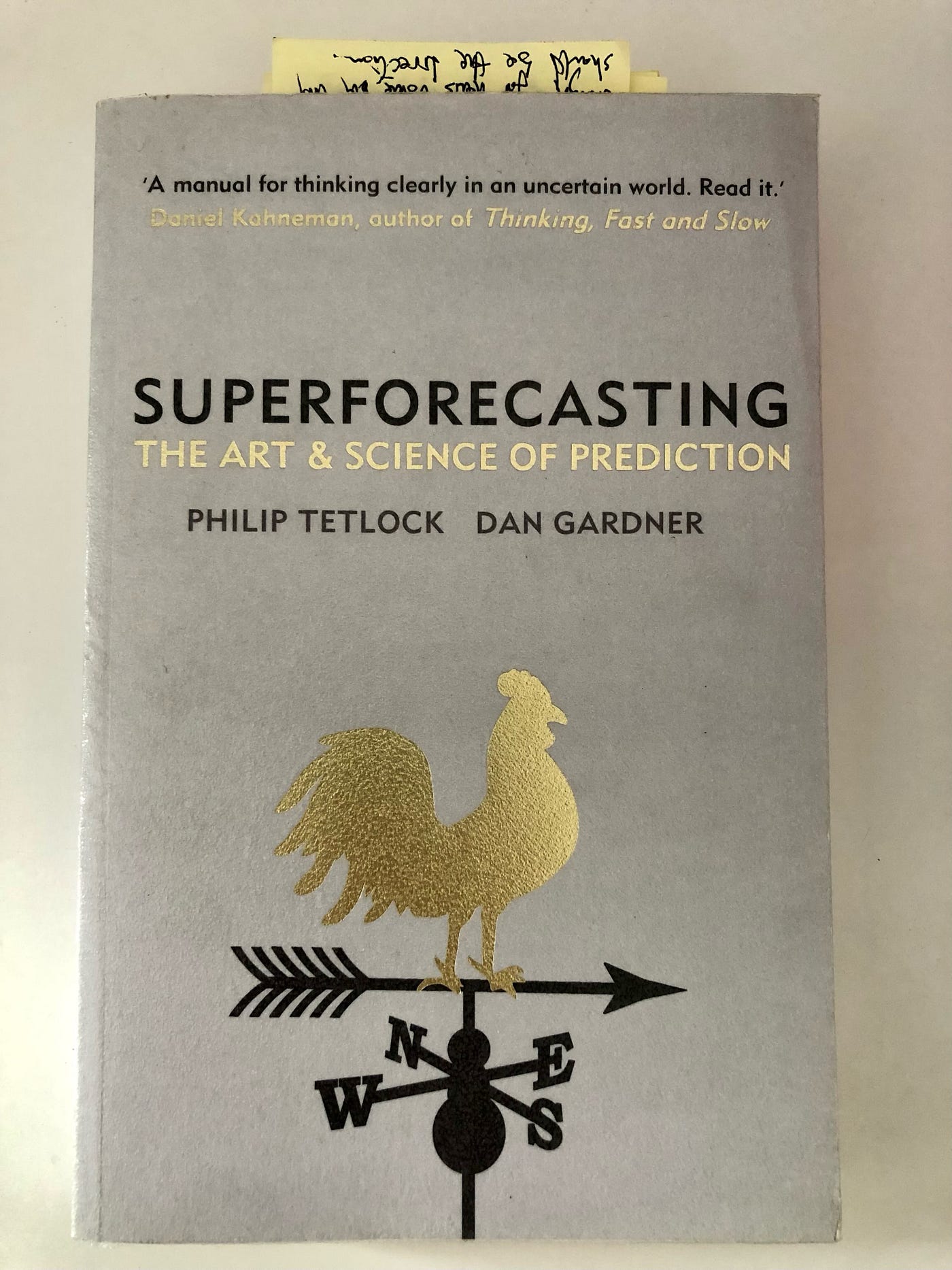
Superforecasting: The Art & Science of Prediction by Philip Tetlock and Dan Gardner
This is the most emotionally affecting data book I have read so far.
The very first page stopped me cold:
Jenny, alive forever in the hearts of your mother and father, as if that day were yesterday.
A quick search led me to an old blog called Jenny’s Journey, written by Philip Tetlock and Barbara Mellers. It documented their daughter’s battle with a rapidly degenerative neurological disease before she died in 2009 at just 15 years old.
Knowing this changed how I read the book.
It gave the entire book a quiet weight beneath its humour. Superforecasting explains how Tetlock and his wife Barbara Mellers created the Good Judgment Project, recruited ordinary people to forecast world events, and ended up outperforming trained intelligence analysts with access to classified information.
But underneath all the statistics and forecasting methods, I kept thinking about something else: this was written by someone who had experienced profound tragedy and still chose to believe in probability.
The refusal to believe in fate
One section especially stayed with me. Tetlock discusses probabilistic thinking and the human tendency to search for meaning in events.
A probabilistic thinker spends less time asking why and more time asking how.
Why did this happen to me? Why now? Why my child?
Those questions feel natural because humans desperately want meaning. We want events to make sense. We want tragedy to feel destined rather than random.
But superforecasters tend not to think that way. They are uncomfortable with fate.
There is a particularly striking passage in the book:
Yes, there was an almost infinite number of paths that events could have taken, and it was incredibly unlikely that events would take the path that ended in my child’s death. But they had to take a path and that’s the one they took. That’s all there is to it.
Tetlock never explicitly says he is talking about himself. But clearly, he is.
And what struck me most was not the sadness of the idea, but the discipline of it. Even after losing a daughter, he still refused to retreat into comforting narratives about destiny.
At another point, he acknowledges something uncomfortable:
Finding meaning in events is positively correlated with well-being but negatively correlated with foresight. Is misery the price of accuracy? I don’t know. But this book is not about how to be happy.
That line lingered in my head long after I finished reading.
Thinking about life probabilistically
I always think about life, especially my daughter’s future, in probabilities.
Every decision changes the odds of a certain future unfolding.
Education. Friends. Habits. Discipline. Confidence. Environment.
None of these guarantee an outcome. But they shift probabilities.
My wife sometimes disagrees with me. She believes many things are simply meant to be. That fate exists. That some paths are already written.
I still cannot fully buy into that idea.
Perhaps probabilistic thinking is worse for mental health. Perhaps believing in destiny genuinely helps people cope with uncertainty and pain. Tetlock himself hints at that possibility.
But I still think the world is fundamentally probabilistic.
Predictions are rarely tested properly
Another argument Tetlock makes is that most predictions are never properly evaluated.
They are vague. Unmeasurable. Impossible to score accurately.
And even when predictions fail, people rarely learn from them.
Tetlock compares this to medicine before clinical trials. George Washington’s doctors repeatedly bled him because they genuinely believed it worked. The practice could be traced back centuries to Galen, one of the most influential physicians in Roman history.
The logic was absurd:
All who drink of this treatment recover in a short time, except those whom it does not help, who all die.
Reading this in 2026, I still see versions of this everywhere.
Before becoming a data scientist, I worked in newsrooms for years. And many newsroom cultures still operate exactly like this.
Senior editors become god-like decision-makers. They decide which stories matter because they feel important. Their instincts become institutional truth.
Then platforms and algorithms arrive and suddenly expose a painful reality: audiences often do not want what newsrooms think they want.
For the past fifteen years, the gap between editorial judgement and audience behaviour has become impossible to ignore.
I still believe journalism needs far more rigorous experimentation. Proper A/B testing. Measurable hypotheses. Evidence-based editorial decisions.
But meaningful editorial experiments are expensive. Tech companies optimise mainly for engagement and revenue, not editorial quality or public value.
That is why I think organisations like the BBC are in a unique position. They have both the responsibility and the institutional stability to explore whether better editorial judgement can actually be measured, not just whether a product generates more clicks like platforms such as Meta or TikTok optimise for.
The “bait and switch” we all do
Another idea I loved was “bait and switch.”
This happens when someone answers an easier question instead of the difficult one they were actually asked.
I see this constantly with my daughter.
If I ask: “Why didn’t you finish your meal?”
She might reply: “I was unhappy today because I fell over at school.”
That response sounds related, but it does not actually answer the question. The difficult truth may simply be that she was distracted and not concentrating on eating.
What fascinates me is how easily adults fall for the switch.
An inexperienced adult might immediately follow the emotional bait: “Oh no, what happened at school?”
And suddenly the original issue — table manners, focus, responsibility — disappears entirely.
The conversation has been redirected without anyone noticing.
Once you learn this concept, you start seeing it everywhere: politics, interviews, corporate meetings, even family conversations.
The “wrong side of maybe” fallacy
One of the most useful statistical ideas in the book is the “wrong-side-of-maybe” fallacy.
We instinctively treat probabilities above 50% as “basically certain” and probabilities below 50% as “unlikely.” Machine learning classification systems often reinforce this thinking because they default to binary outcomes. But probabilities do not work that way.
A 90% prediction failing does not necessarily mean the prediction was bad. It simply means reality landed inside the 10% outcome. That sounds obvious mathematically, yet humans struggle emotionally with it.
If something with a 90% chance happens repeatedly 100 times, we should still expect failure roughly 10 times. Those failures are not evidence the model is broken. They are part of the model.
At work and in life, people often evaluate systems purely based on outcomes. Good outcome? Good decision. Bad outcome? Bad decision. But that is wrong.
A terrible process can occasionally produce a brilliant outcome. A strong process can still fail. People who drop out of school and become wildly successful are a perfect example. The outcome was extraordinary. But that does not mean the underlying decision was statistically wise.
Why the media rewards hedgehogs
Thinkers are divided into “hedgehogs” and “foxes.”
Hedgehogs believe strongly in one grand idea. Foxes are more cautious. They constantly adjust their beliefs as new information arrives.
Journalism absolutely rewards hedgehogs. Hedgehogs make better headlines. Better television guests. Better social media clips. They sound decisive and confident.
Foxes sound hesitant. But foxes are usually better forecasters.
Reading this made me rethink a lot about newsroom culture. We often mistake confidence for competence because confidence is easier to package into media.
The loudest pundit becomes the most memorable one, not necessarily the most accurate.
Start with the outside view
Another idea I found incredibly useful is the importance of starting with a “prior,” or what is called the outside view.
Most people begin with the inside view: the unique details of their current situation.
But the outside view asks: What usually happens in situations like this?
For example, imagine applying for a job.
Most people focus immediately on the specifics: the hiring manager, the company, the interview performance, the job description.
But perhaps the first thing we should examine is base rates: What is my historical success rate in interviews? How many applicants typically receive offers?
It is less emotionally satisfying than focusing on anecdotes. But it is usually more accurate.
Groupthink and the fear of disagreement
Tetlock also discusses precision questioning as a way to reduce groupthink.
This resonated deeply with me because I see groupthink constantly in large organisations.
I often feel people avoid open disagreement in favour of harmony. Meetings become performative exercises in alignment. But excessive harmony creates intellectual stagnation. There is little point hiring people from diverse backgrounds if everyone is pressured into converging toward the same acceptable opinion.
I realised while reading this that I have started drifting into that behaviour myself. Coming from journalism, I naturally approached problems differently from many people in the data community. Journalists are trained to challenge assumptions quickly and cut directly to contradictions.
Over time, though, corporate culture smooths those edges down. You start saying things like: Great collaboration! Fantastic work! Really aligned thinking!
Sometimes those things are true. Sometimes they are just social lubrication.
Reading Superforecasting reminded me that disagreement is valuable. I should probably preserve more of that instinct to challenge ideas directly instead of automatically seeking consensus.
All you see is all there is
This is essentially sampling bias.
For example, we see a group of badly behaved teenagers on the high street and conclude that modern teenagers are terrible.
But we do not see the far larger number of teenagers quietly studying at home, reading in libraries, training in sports, or simply staying out of trouble.
Visible examples distort our perception of reality.
I constantly remind myself of this now. The loudest examples are rarely the most representative ones.
Perpetual beta
The final idea that stayed with me was “perpetual beta.”
Superforecasters are not necessarily geniuses. Tetlock repeatedly emphasises that disciplined improvement matters more than raw brilliance.
They keep updating. Keep learning. Keep refining.
That mindset resonates deeply with me.
When I transitioned from being a journalist of more than ten years into a data analyst, I was not the smartest person in the room.
But I worked hard. I improved bit by bit. That is still my mentality today.
I keep reading. I keep writing. I keep learning.
And maybe one day my daughter will look back and understand why her father spent so much time doing this. Not only for himself, but for her too.
메타데이터
- post_id
- aad1645d628f
- slug
- superforecasting-he-lost-his-daughter-and-still-chose-probability-over-fate-aad1645d628f
- url
- https://medium.com/data-science-explained/superforecasting-he-lost-his-daughter-and-still-chose-probability-over-fate-aad1645d628f
- canonical_url
- https://medium.com/data-science-explained/superforecasting-he-lost-his-daughter-and-still-chose-probability-over-fate-aad1645d628f
- author_url
- https://medium.com/@billychanhub
- status
- ok
- fetched_at
- 2026-06-15 20:49:13