Introduction
When we think about space missions, the first things that come to mind are rockets launching, planets, and astronauts floating in zero…
Introduction
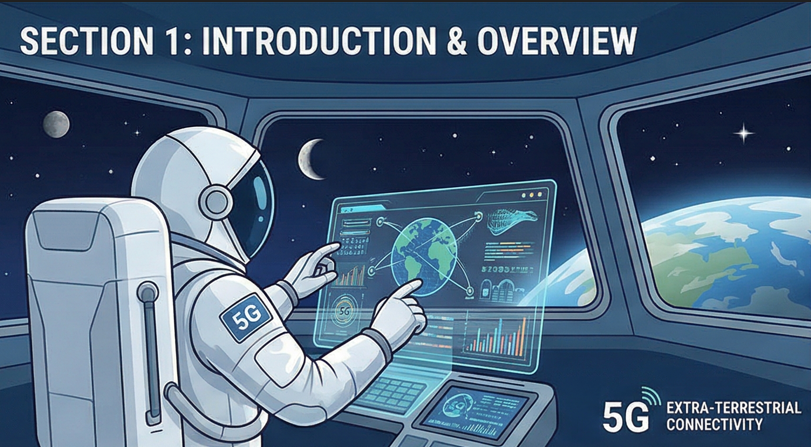
When we think about space missions, the first things that come to mind are rockets launching, planets, and astronauts floating in zero gravity. But there’s something equally important that we don’t usually notice — communication.
Without proper communication systems, astronauts would basically be cut off from Earth. They wouldn’t be able to send data, receive instructions, or even ask for help if something goes wrong. In a way, communication is what keeps every mission alive.
In this blog, I’ll try to explain how astronauts stay connected with Earth and what kind of mobile communication technologies make it possible, even across huge distances.
The Need for Communication in Space
Space is not just empty, it’s also extremely harsh and silent. There are no mobile towers or Wi-Fi signals like we have on Earth.
Because of that, astronauts depend completely on advanced communication systems. These systems help them to:
- Receive instructions from mission control
- Send back important scientific data
- Handle emergency situations
- Even talk to their families sometimes
Without this, managing a space mission would be almost impossible.
How Communication Works in Space
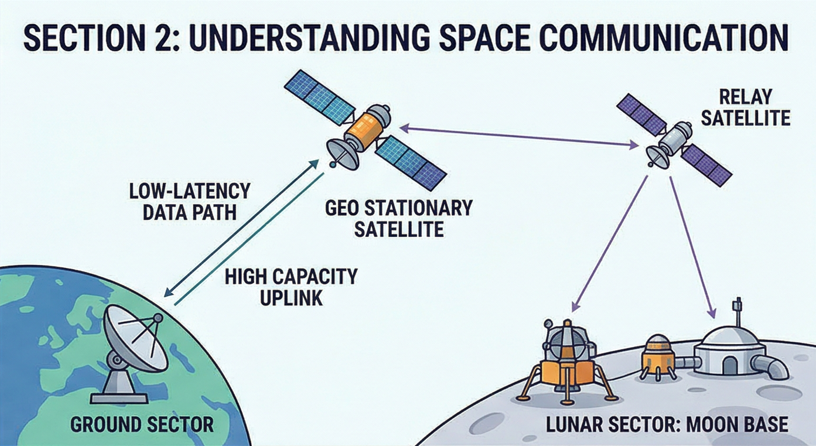
Communication in space is quite different from what we use daily. There are no towers, so everything works through satellites and ground stations.
1. Radio Waves — The Main Medium
Communication mainly happens through radio waves. These signals can travel through the vacuum of space, which makes them perfect for this purpose.
They are used for voice, video, and data transmission. Also, they don’t need any physical medium to travel, which is a big advantage.
2. Satellites and Relay Systems
Astronauts, especially those on the International Space Station (ISS), communicate using relay satellites.
The process is something like this: spacecraft → satellite → ground station → mission control
This setup helps maintain communication even when the spacecraft is not directly facing Earth.
3. Deep Space Network (DSN)
For missions that go much farther, like to Mars or beyond, a system called the Deep Space Network is used.
It consists of large antennas placed in different parts of the world. These antennas make sure signals are always received, even when Earth is rotating.
Mobile Communication Technologies Used in Space
Even though astronauts don’t carry smartphones, many concepts from mobile communication are still used.
- Digital Signal Processing: helps in compressing and sending signals efficiently
- Error Detection and Correction: fixes any distortion in signals
- High-Frequency Bands: like S-band, X-band, and Ka-band for different uses
Communication with Astronauts
Astronauts communicate with Earth in different ways depending on the situation.
Voice Communication They can talk to mission control almost in real-time, although sometimes there’s a small delay.
Video Communication Live video is used for monitoring missions and sometimes even shared with the public.
Data Transmission A lot of scientific data, health information, and system updates are continuously sent back to Earth.
The Challenge of Delay (Latency)
One major issue in space communication is delay.
- For the Moon, it’s around 1–2 seconds
- For Mars, it can go up to 20 minutes or more
Because of this, real-time control becomes difficult in deep space missions.
Challenges in Space Communication
Even with advanced technology, there are still some problems:
- Signals become weak over long distances
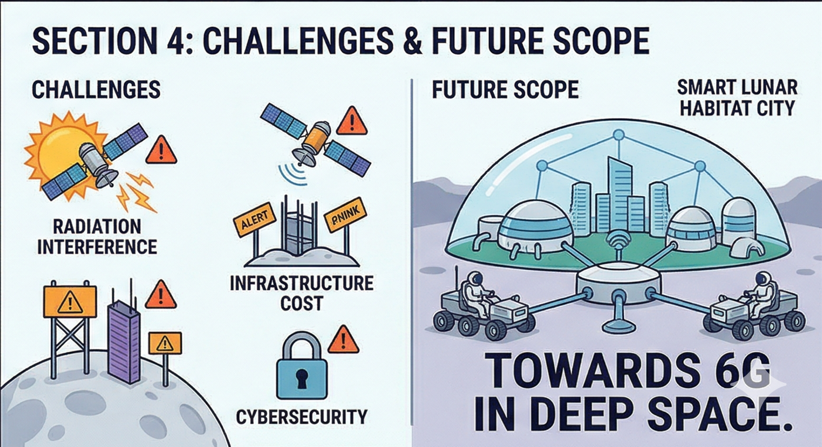
- Space radiation can interfere
- Bandwidth is limited
- Infrastructure is expensive
These challenges make space communication a complex task.
Future of Space Communication
Things are improving fast, and the future looks interesting.
Some developments include:
- Laser-based communication for higher speed
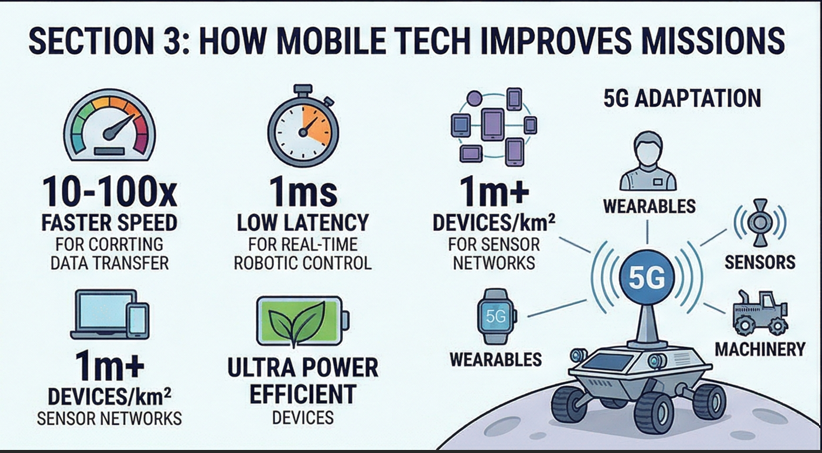
- Use of 5G-like systems in space
- Interplanetary internet concepts
- AI to manage communication more efficiently
Real-World Applications
Interestingly, many of these technologies are also useful on Earth.
- Satellite TV and GPS
- Disaster communication systems
- Internet in remote areas
- Aviation and defense communication
Conclusion
So, mobile communication in space is not just a technical feature it’s actually a lifeline.
It keeps astronauts connected, ensures missions run smoothly, and allows us to explore space safely. As technology keeps improving, communication systems will become even better, helping us go farther into space.
“I found this topic really interesting while studying mobile communication, so I decided to explore it deeper.”
메타데이터
- post_id
- aae24f80ff2b
- slug
- introduction-aae24f80ff2b
- url
- https://medium.com/@anshulkirde.99/introduction-aae24f80ff2b
- canonical_url
- https://medium.com/@anshulkirde.99/introduction-aae24f80ff2b
- author_url
- https://medium.com/@anshulkirde.99
- status
- ok
- fetched_at
- 2026-07-28 22:30:08



