SOC 2 + ISO 42001: The Smarter Way to Build AI Trust Without Compliance Chaos
How continuous monitoring, unified controls, and embedded evidence collection can turn two demanding frameworks into one seamless…
SOC 2 + ISO 42001: The Smarter Way to Build AI Trust Without Compliance Chaos

How continuous monitoring, unified controls, and embedded evidence collection can turn two demanding frameworks into one seamless compliance engine
Estimated read time: 8 minutes | Tags: SOC 2, ISO 42001, AI Governance, Compliance, Cybersecurity, Risk Management
The Compliance Trap Most AI Companies Fall Into
You’ve built something remarkable with AI. Your platform is scaling. Customers are asking for your SOC 2 report. Enterprise deals are stalling behind a compliance questionnaire. And now someone in the boardroom mentions ISO 42001 — the new AI management system standard — and the room goes quiet.
Most organizations treat SOC 2 and ISO 42001 as two separate mountains to climb. Two separate audit cycles. Two separate sets of documentation. Two separate rounds of evidence collection. Two separate headaches.
But they don’t have to be.
The smartest compliance teams in 2025 are doing something different: they’re combining SOC 2 and ISO 42001 into a single, continuous, embedded compliance program — one where controls are defined once, evidence flows automatically, and audits become a formality rather than a fire drill.
This article shows you exactly how to do it.
Why SOC 2 and ISO 42001 Belong Together
SOC 2: The Trust Baseline the Market Already Demands
SOC 2 (Service Organization Control 2), defined by the AICPA, is built around five Trust Service Criteria: Security, Availability, Processing Integrity, Confidentiality, and Privacy. It tells your customers and prospects one thing clearly: “We have controls in place and they actually work.”
What makes SOC 2 powerful — and what most people overlook — is that it is not a prescriptive framework. The AICPA does not tell you exactly which controls to implement. It tells you what outcomes you must achieve. This flexibility is your greatest asset when combining it with ISO 42001.
ISO 42001: The AI Governance Standard the Enterprise Is Starting to Require
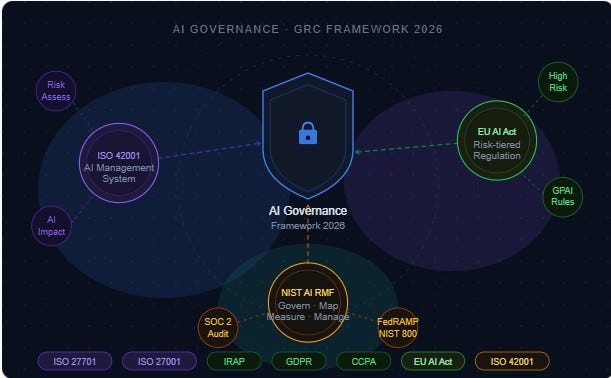
ISO/IEC 42001:2023 is the world’s first international standard for Artificial Intelligence Management Systems (AIMS). It provides a structured framework for organizations that develop, deploy, or use AI systems — covering everything from AI risk assessment and bias management to transparency, human oversight, and lifecycle governance.
Think of ISO 42001 as the “how do you govern your AI responsibly” question, while SOC 2 is the “how do we know your systems and data are secure and trustworthy” question. Enterprise customers, regulators, and partners are increasingly asking both.
The opportunity: these two frameworks share significant conceptual overlap — risk management, access control, incident response, vendor management, monitoring, and documentation. Building them together is not just efficient; it creates a more robust compliance posture than either alone.
The Unified Strategy: Four Pillars
Pillar 1 — Finalize a Unified Control Set (Write Once, Satisfy Both)
The foundational step is to map your controls across both frameworks simultaneously before writing a single policy.
Start by listing the core control categories that appear in both SOC 2 and ISO 42001:
Control DomainSOC 2 CriteriaISO 42001 ClauseRisk AssessmentCC3.1, CC3.26.1, 8.2Access ManagementCC6.1, CC6.26.3, 8.4Incident ResponseCC7.3, CC7.48.7, 10.1Vendor/Supplier ManagementCC9.28.4, 9.1Monitoring & LoggingCC7.1, CC7.29.1, 9.3Change ManagementCC8.18.3, 8.5AI-Specific Risk (Bias, Transparency)Processing Integrity6.1.2, 8.2, 8.6Documentation & RecordsAll criteria7.5
Practical action: For every control you define, tag it with the SOC 2 criterion and the ISO 42001 clause it satisfies. A single “AI Model Risk Assessment” control, for example, can satisfy SOC 2’s CC3 (risk assessment), CC4 (monitoring), and ISO 42001 clauses 6.1 and 8.2 simultaneously.
This is where SOC 2’s flexibility becomes your superpower. Because SOC 2 lets you choose your controls, you can shape them to align with ISO 42001’s structure — and build a control library that does double duty from day one.
Key insight: Don’t write 40 controls for SOC 2 and 35 controls for ISO 42001. Write 45 well-designed controls that satisfy both. Your audit burden drops by nearly half.
Pillar 2 — Embed Controls Into Processes (Kill the Compliance Busywork)
This is where most compliance programs fail. Controls exist on paper. Evidence gets scrambled together in a panic three weeks before the audit. Engineers resent the security team. The cycle repeats.
The solution is process embedding — making compliance a natural output of how your team already works, not a separate activity that runs alongside it.
What process embedding looks like in practice:
For AI model development (ISO 42001 + SOC 2 Processing Integrity):
- Build bias and fairness checks into your CI/CD pipeline as a mandatory gate — not a manual review
- Require model cards to be completed as part of the deployment checklist — not filed retrospectively
- Log all model version changes automatically to your audit trail system
For access management (SOC 2 CC6 + ISO 42001 Clause 6.3):
- Trigger automatic access reviews when an employee changes roles — don’t wait for quarterly reviews
- Link your HR system to your identity provider so offboarding revokes access in real time
- Document access decisions in the ticket or PR that prompted them
For vendor risk (SOC 2 CC9.2 + ISO 42001 Clause 8.4):
- Add a security and AI-ethics review step to your procurement workflow
- Score AI vendors on transparency, bias documentation, and data handling as standard due diligence
The test of a well-embedded control: If your engineering team can say “we already do this as part of shipping software,” you’ve succeeded. If compliance requires a separate calendar reminder, it’s not embedded yet.
Pillar 3 — Continuous Monitoring (SOC 2’s Best-Kept Secret)
Here is the single biggest shift that separates high-performing compliance programs from struggling ones: moving from point-in-time auditing to continuous monitoring.
Traditional SOC 2 Type II covers a period (typically 6–12 months) and auditors sample evidence from that window. Most organizations scramble to produce evidence at the end. Continuous monitoring flips this: evidence is produced constantly, automatically, and is always audit-ready.
What continuous monitoring looks like:
- Automated control testing: Tools like Vanta, Drata, Secureframe, or Sprinto connect to your infrastructure (AWS, GCP, Azure, GitHub, Okta, etc.) and continuously check whether controls are operating. Failed controls trigger alerts immediately — not six months later during an audit.
- Real-time dashboards: Your compliance status is visible at any moment. Stakeholders, customers, and auditors can see a living picture of your security posture.
- Always-on evidence collection: Every access log, configuration check, encryption validation, and policy acknowledgment is captured automatically and timestamped. No more chasing engineers for screenshots.
For ISO 42001, continuous monitoring extends to AI-specific signals:
- Model performance drift monitoring (is the model behaving as designed?)
- Bias metric tracking across demographic groups
- Human oversight logs (when did a human review, override, or correct the AI?)
- Incident and near-miss logs for AI-specific failures
The business case for continuous monitoring is clear: Organizations using automated compliance platforms report spending 60–80% less time on audit preparation and detecting control failures weeks or months earlier than those relying on manual processes.
Bottom line: Continuous monitoring transforms SOC 2 from a stressful annual event into a quiet, always-running background process. Combined with ISO 42001’s ongoing review requirements (Clause 9.3), it satisfies both frameworks with a single investment.
Check put templates that I have put together- Complete GRC Template Bundle — ISO 27001 + SOC 2 + ISO 42001 Integrated Compliance Toolkit
Free SOC 2 Evidence Checklist — What Auditors Actually Look For
[AI Governance Templates & Checklists — Audit Ready in Hours, Not Weeks](http://AI Governance Templates & Checklists — Audit Ready in Hours, Not Weeks)
Pillar 4 — Streamlined Evidence Collection (One Source of Truth)
Evidence collection is where compliance programs go to die. Auditors ask for 200 pieces of evidence. Your team spends weeks exporting logs, writing explanations, and formatting spreadsheets. Half the evidence is inconsistently formatted. The auditor asks follow-up questions. Repeat.
The solution is a unified evidence repository — one system where every piece of compliance evidence lives, tagged to the controls and framework clauses it supports.
Building your evidence architecture:
- Centralize: Use your compliance automation platform or a dedicated GRC (Governance, Risk, and Compliance) tool as the single source of truth. Every control has an owner, a description, a testing procedure, and a live evidence feed.
- Automate collection: Where evidence can be pulled automatically (system logs, configuration states, access reviews), automate it. Reserve manual collection only for things that genuinely require human judgment (policy approvals, training records, risk decisions).
- Tag evidence to both frameworks: Every evidence item should be tagged to its SOC 2 criterion and its ISO 42001 clause. When an auditor asks for evidence of your AI risk assessment process, you produce one document — not two versions.
- Maintain an evidence calendar: For evidence that cannot be automated (monthly management reviews, quarterly risk assessments, annual policy reviews), maintain a calendar with clear owners and due dates. Treat these like product releases — non-negotiable deadlines.
- Standardize formats: Agree on how evidence looks before the audit begins. A consistent format for access review records, for example, means your auditor spends minutes reviewing — not hours asking clarifying questions.
The Combined Compliance Roadmap
Here is a practical phased approach for organizations building this unified program:
Phase 1 — Foundation (Months 1–2)
- Map all existing controls to both SOC 2 criteria and ISO 42001 clauses
- Identify gaps specific to AI governance (bias, transparency, human oversight)
- Select and implement a compliance automation platform
- Define your AI system inventory (ISO 42001 Clause 6.1.2 requires this)
Phase 2 — Control Finalization (Months 2–3)
- Draft or update all policies and procedures with dual-framework tagging
- Assign control owners across engineering, legal, HR, and product
- Embed controls into development, deployment, and vendor processes
- Begin automated evidence collection
Phase 3 — Continuous Monitoring Launch (Month 3 onwards)
- Activate automated control testing across your infrastructure
- Set up alerting for control failures
- Conduct first internal audit against both frameworks
- Begin 6–12 month SOC 2 Type II observation period
Phase 4 — Audit & Certification
- SOC 2 Type II audit (typically 2–4 weeks with a qualified CPA firm)
- ISO 42001 certification audit (Stage 1 + Stage 2 with an accredited certification body)
- Publish SOC 2 report; receive ISO 42001 certificate
Phase 5 — Ongoing (Perpetual)
- Continuous monitoring runs automatically
- Quarterly control reviews and risk reassessments
- Annual surveillance audits (ISO 42001) and SOC 2 renewal
- Controls updated as AI systems evolve
Common Mistakes to Avoid
1. Treating them as separate programs. If you have two separate teams, two separate policy libraries, and two separate audit calendars, you’re doubling your cost and halving your effectiveness.
2. Ignoring AI-specific controls until the ISO audit. The AI-specific requirements of ISO 42001 — bias testing, human oversight, transparency documentation — take time to operationalize. Start early.
3. Relying on manual evidence collection. Manual evidence collection is slow, inconsistent, and expensive. Automate everything you can from the beginning.
4. Writing controls that exist only in documents. If a control isn’t embedded in an actual process, it will fail in practice — and a good auditor will find that out.
5. Underestimating the AI system inventory. ISO 42001 requires you to catalog all AI systems in scope. For organizations with multiple models or AI-powered features, this is more complex than it sounds. Do it thoroughly upfront.
Why This Approach Wins in the Market
Organizations that implement a unified SOC 2 + ISO 42001 program with continuous monitoring and embedded controls gain more than compliance certificates. They gain:
- Faster enterprise sales cycles — customers see both reports and trust is established quickly
- Lower compliance costs — one control library, one evidence system, one team
- Earlier risk detection — continuous monitoring catches problems before they become incidents
- Stronger AI governance story — increasingly important as AI regulation accelerates globally (EU AI Act, US Executive Orders, emerging Asian regulations)
- Team efficiency — engineers and product teams spend less time on compliance busywork because compliance is built into how they work
Final Thought: Compliance as a Competitive Advantage
The organizations winning enterprise AI deals in 2025 are not just the ones with the best models. They’re the ones who can prove — continuously, transparently, and without scrambling — that their AI systems are secure, well-governed, and trustworthy.
SOC 2 and ISO 42001, combined intelligently, are not a burden. They’re a market differentiator.
Finalize your controls once. Embed them deeply. Monitor continuously. Collect evidence automatically. And walk into every audit — and every sales conversation — with total confidence.
Check put templates that I have put together- Complete GRC Template Bundle — ISO 27001 + SOC 2 + ISO 42001 Integrated Compliance Toolkit
Free SOC 2 Evidence Checklist — What Auditors Actually Look For
[AI Governance Templates & Checklists — Audit Ready in Hours, Not Weeks](http://AI Governance Templates & Checklists — Audit Ready in Hours, Not Weeks)
Have questions about implementing a unified SOC 2 + ISO 42001 program? Drop a comment below . Follow for more practical compliance and AI governance content.
메타데이터
- post_id
- aae950a9bd87
- slug
- soc-2-iso-42001-the-smarter-way-to-build-ai-trust-without-compliance-chaos-aae950a9bd87
- url
- https://medium.com/@simplebyrasika0/soc-2-iso-42001-the-smarter-way-to-build-ai-trust-without-compliance-chaos-aae950a9bd87
- canonical_url
- https://medium.com/@simplebyrasika0/soc-2-iso-42001-the-smarter-way-to-build-ai-trust-without-compliance-chaos-aae950a9bd87
- author_url
- https://medium.com/@simplebyrasika0
- status
- ok
- fetched_at
- 2026-06-09 15:37:30