Paradigm for Happiness
More than a millennium ago, the Prophet Muhammad articulated a deceptively simple metric for a successful human existence: “Whoever among…
Paradigm for Happiness
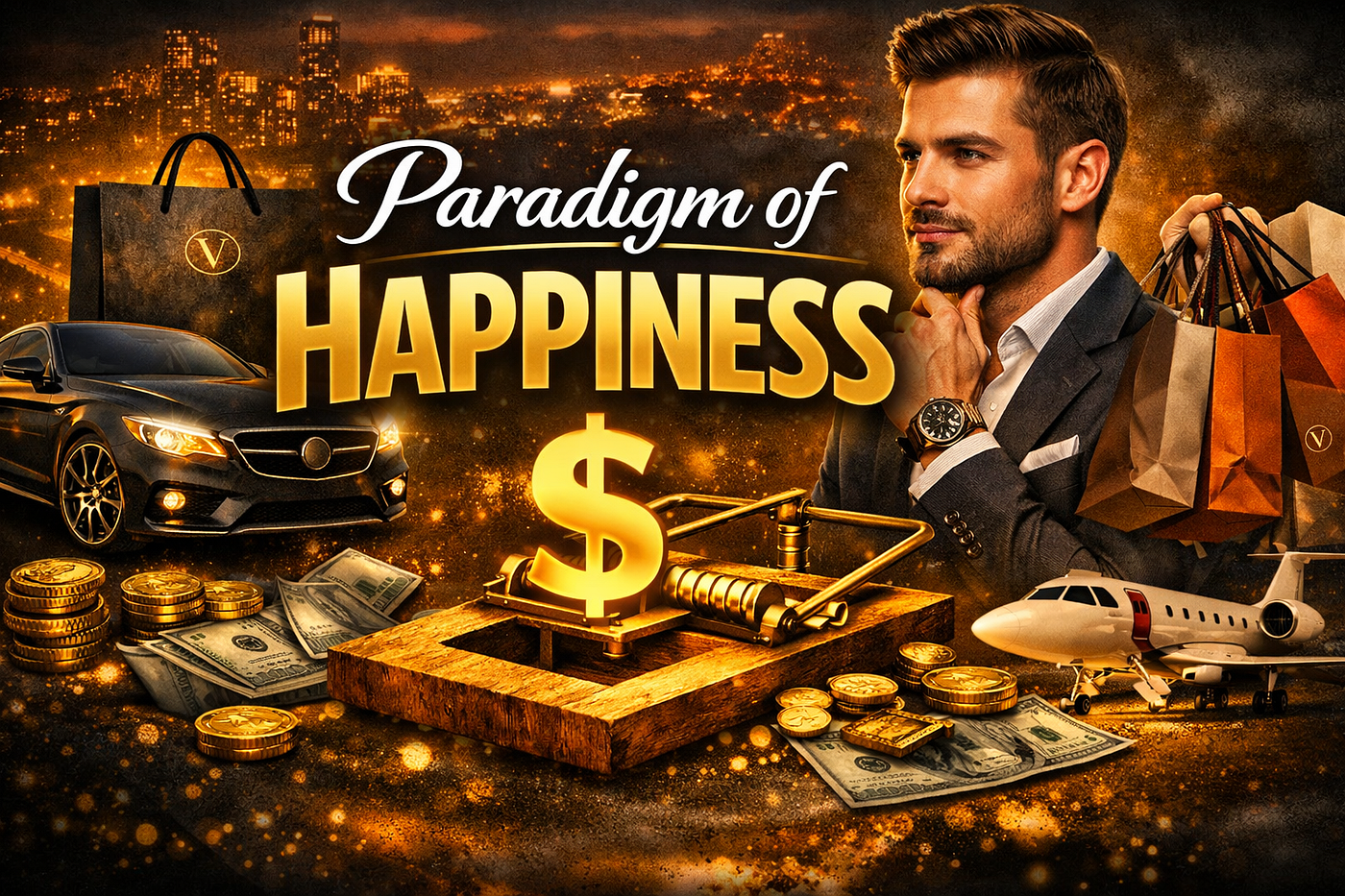
More than a millennium ago, the Prophet Muhammad articulated a deceptively simple metric for a successful human existence: “Whoever among you wakes up secure in his home, healthy in his body, and possessing food for the day, it is as though he has been given the entire world” (Sunan al-Tirmidhi). In the parlance of modern subjective well-being, this Hadith defines a baseline of absolute utility — a state where existential security, physical vitality, and basic sustenance converge to guarantee peace of mind.
Yet, walk through the financial districts of New York, the tech hubs of San Francisco, or the affluent suburbs of any rapidly developing metropolitan area today, and you will find an epidemic of chronic discontent. We live in an era of unprecedented material abundance, where the average citizen enjoys comforts that medieval monarchs could not conceive. Why, then, do so many individuals who possess safety, health, and a surplus of food fail so spectacularly to achieve happiness?
The answer does not lie in a deficit of resources, but in a pathology of perspective. The baseline of absolute happiness is consistently sabotaged by the mechanism of social comparison. We do not evaluate our lives by what is inside our homes, but by what is parked in our neighbor’s driveway.
To understand how this psychological self-sabotage became systemic, we must turn to the foundational work of institutional economist and sociologist Thorstein Veblen. In his 1899 masterpiece, The Theory of the Leisure Class, Veblen diagnosed a structural deformity in human economic behavior that explains exactly why modern society has weaponized consumption against its own well-being. By examining Veblen’s critique of the “leisure class,” we can trace how our modern obsession with status, pecuniary emulation, and identity-driven consumption has turned happiness into an mirage.
At the heart of Veblen’s (1899) treatise is the concept of conspicuous consumption — the practice of consuming goods not for their intrinsic utility or functional capacity, but to display wealth and assert social status. As noted in contemporary sociological reviews, this form of consumption is entirely decoupled from objective human needs; it is powered by a relentless desire for social recognition (Kemple, 2017; Schor, 2015).
When an individual engages in conspicuous consumption, the utility of an object is no longer derived from what it does, but from what it signals. A timepiece is no longer an instrument to measure time; it is a declaration of capital. A vehicle is no longer a means of transport; it is a mobile boundary marker between classes.
This behavior directly triggers what psychological literature calls the “hedonic treadmill,” rendering sustained happiness structurally impossible. Because status is inherently relative, a satisfaction model built on status requires a perpetual escalation of luxury. If happiness is derived from owning a premium brand item to signal superiority, that happiness evaporates the moment that item is democratized or surpassed by a newer, more exclusive tier of luxury (Talay & Townsend, 2015).
By anchoring satisfaction to the external validation of an anonymous audience, the conspicuous consumer surrenders emotional sovereignty. Happiness becomes a hostage to market trends, luxury branding, and the shifting perceptions of peers.
Veblen’s analysis cuts deeper than a superficial critique of the ultra-wealthy. His most devastating insight is the concept of social emulation, which describes how the psychological urge to mimic lifestyles cascades down the socioeconomic ladder (Scott, 2013; Dunlap, 2010). Veblen argued that society is organized in a series of interlocking status hierarchies. Instead of revolting against the leisure class, the lower and middle classes seek to emulate them, striving to achieve the “standard of decency” dictated by the stratum immediately above them (Scott, 2013).
This competitive comparison turns daily life into an exhausting, zero-sum game. Consider a mundane example: a university professor who routinely walks or takes public transit to campus. Functionally, the professor is healthy, secure, and mobile. However, when a student asks, “Why do you walk while other professors drive?” the student is acting as an agent of Veblen’s emulative hierarchy. The student is pointing out a mismatch between the professor’s institutional status and their consumption signals.
This structural pressure creates an pervasive sense of relative deprivation. A person riding a bicycle for exercise or utility can feel completely satisfied until they see a peer driving a luxury sedan. The bicycle has not lost its mechanical efficiency, nor has the rider lost their physical health. What has been destroyed is the rider’s relative social standing. This demonstrates how emulative comparison turns objective abundance into subjective scarcity, ensuring that no matter how much an individual possesses, they feel perpetually impoverished.
In the modern capitalist landscape, consumption has evolved from an economic activity into a substitute for identity. Veblen recognized that consumption fulfills mental and spiritual cravings rather than merely satisfying bodily needs (Schor, 2015; Özbey, 2025). In a secularized, hyper-commodified world, we construct our personas out of the brands we patronize, the travel destinations we log, and the premium experiences we curate on social media.
This commercialization of identity is a primary driver of psychological distress. When our sense of self is tied to the premium brands we consume, our internal stability becomes dependent on market variables (Özbey, 2025). We are forced to constantly project an idealized version of our lives to secure social proof.
This dynamic is amplified by social media platforms, which serve as highly optimized arenas for digital conspicuous consumption. On these platforms, the “leisure class” lifestyle is curated, filtered, and broadcasted around the clock. By turning our identities into a portfolio of luxury goods and experiences, we treat ourselves as commodities to be evaluated by others. When identity is externalized, internal peace is compromised.
The material consequences of Veblen’s theories are frequently displayed in modern news headlines. Consider the bizarre yet instructive case of a high-earning corporate professional in Indonesia — making upwards of IDR 60 million per month — who resorted to robbing the very bank where he was employed because he was drowning in debt. To the average citizen, a monthly income of that magnitude represents absolute financial freedom. Yet, under the influence of competitive emulation, even a high income can be entirely consumed by lifestyle inflation.
When an individual integrates into an elite social circle, the baseline for what is considered an acceptable lifestyle shifts dramatically. The neighborhood they live in, the private schools their children attend, the country clubs they join, and the luxury vehicles they lease all demand a massive, non-negotiable capital outflow.
“Conspicuous consumption of valuable goods is a means of reputability to the gentleman of leisure.”
This creates a high-stakes trap where individuals incur massive debts just to maintain a facade of financial solvency. They are haunted by the terror of downward social mobility — the fear that their peers will discover they no longer belong to the elite tier. This dynamic proves that without internal benchmarks for satisfaction, a high income merely scales the magnitude of one’s financial anxieties, locking individuals into a cycle of structural despair.
Veblen wrote The Theory of the Leisure Class during the twilight of the American Gilded Age, a historical period defined by unprecedented wealth concentration and overt economic inequality (Frank, 2010; Wakeman, 2012). His work was a scathing critique of an economic elite that wasted societal surpluses on non-productive, competitive vanity displays that offered zero collective utility (Frank, 2010).
This institutional focus shows how consumerism locks people into a cycle of waste. Instead of investing capital into public goods, education, healthcare, or community infrastructure, resources are squandered on an arms race of personal luxury (Wakeman, 2012). Modern advertising exploits these entrenched status anxieties, standardizing a lifestyle that is financially impossible for the majority of the population. We are trapped within economic institutions that require us to spend money we do not have, on things we do not need, to impress people we do not like (Peukert, 2023).
Ultimately, the synthesis of Thorstein Veblen’s institutional sociology and Islamic spiritual wisdom yields a clear diagnosis of our modern crisis of well-being. The root cause of our collective unhappiness is not material scarcity, but the externalization of our criteria for fulfillment. By allowing the mechanics of conspicuous consumption and pecuniary emulation to dictate our choices, we hand over our peace of mind to a relative social hierarchy that is designed to keep us perpetually unsatisfied.
To break free from this cycle, we must deliberately dismantle our reliance on external status signals. Authentic well-being requires a stubborn return to internal baselines — a conscious decision to decouple personal worth from comparative consumption.
True contentment is found by stepping off the emulative treadmill and embracing the minimalist wisdom of the Tirmidhi Hadith: recognizing that when we have security, health, and sustenance for the day, we already possess everything that matters. Until we learn to be anchor our satisfaction within ourselves, we will continue to be wealthy accomplices in our own emotional poverty.
References
Dunlap, R. (2010). What would Veblen wear? Leisure Sciences, 32(3), 287–293. Source Link
Frank, R. H. (2010). Thorstein Veblen: Still misunderstood, but more important now than ever. In Thorstein Veblen: Economics for an Age of Crises. Source Link
Kemple, T. (2017). Veblen, Thorstein. The Wiley Blackwell Encyclopedia of Social Theory. Source Link
Özbey, Ö. (2025). The 21st century consumption trend: The Veblen effect in sports business. International Encyclopedia of Business Management. Source Link
Peukert, H. (2023). Thorstein Bunde Veblen: A founder of evolutionary economics. Routledge Handbook of Evolutionary Economics. Source Link
Schor, J. B. (2015). Conspicuous consumption. The Wiley Blackwell Encyclopedia of Consumption and Consumer Studies. Source Link
Scott, D. (2013). The leisure class: From Veblen to Linder to MacCannell. Routledge Handbook of Leisure Studies. Source Link
Talay, M. B., & Townsend, J. D. (2015). Liability of localness and cross-cultural variance in conspicuous consumption: The case of the global automotive industry. Developments in Marketing Science: Proceedings of the Academy of Marketing Science. Source Link
Veblen, T. (1899). The Theory of the Leisure Class. Macmillan.
Wakeman, R. (2012). Veblen redivivus: Leisure and excess in Europe. The Oxford Handbook of Postwar European History. Source Link
메타데이터
- post_id
- aaf7420ef13d
- slug
- paradigm-for-happiness-aaf7420ef13d
- url
- https://medium.com/@andi.rwn/paradigm-for-happiness-aaf7420ef13d
- canonical_url
- https://medium.com/@andi.rwn/paradigm-for-happiness-aaf7420ef13d
- author_url
- https://medium.com/@andi.rwn
- status
- ok
- fetched_at
- 2026-06-14 11:28:49