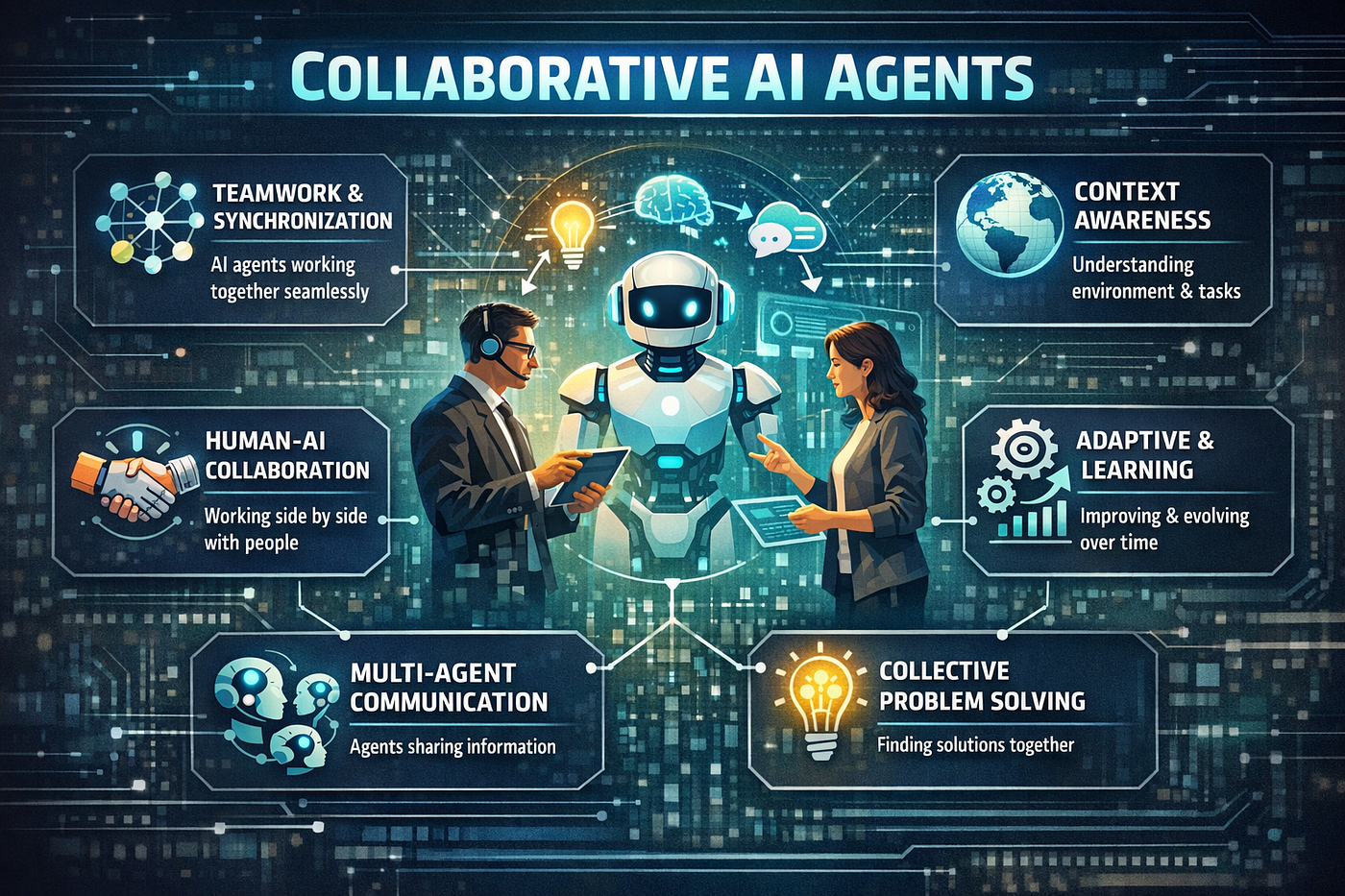
The Rise of AI Agents: Autonomous Intelligence and the Next Digital Revolution (2026 & Beyond)
Artificial Intelligence is no longer just about chatbots generating text or tools creating images.
The Rise of AI Agents: Autonomous Intelligence and the Next Digital Revolution (2026 & Beyond)
Artificial Intelligence is no longer just about chatbots generating text or tools creating images.
We are entering the Age of AI Agents — systems that don’t just respond, but reason, plan, execute, and collaborate.
After the explosive growth of generative AI tools like OpenAI’s ChatGPT and visual platforms such as Midjourney, the frontier has shifted.
The next transformation is bigger:
From AI that answers To AI that acts.

This article explores what AI agents are, why they are trending globally, how they are reshaping industries, and what this means for professionals, startups, and the future economy.
What Exactly Are AI Agents?
An AI agent is an intelligent system capable of:
- Understanding complex goals
- Breaking them into smaller tasks
- Planning execution steps
- Using tools and APIs
- Making decisions
- Learning from feedback
- Operating autonomously
Unlike traditional chatbots, agents can persist across time and tasks.
If a chatbot is a calculator, an AI agent is a project manager.
Why AI Agents Are Exploding in 2026
Several breakthroughs converged to make this possible.
Advanced Large Language Models (LLMs)
Modern models like GPT-4 and Claude are no longer simple text predictors.
They now demonstrate:
- Structured reasoning
- Chain-of-thought planning
- Long context memory
- Tool usage capabilities
- Multimodal understanding
These improvements allow AI to think in steps rather than produce one-shot responses.
Tool-Calling & Execution Capabilities
AI agents can now:
- Browse the web
- Write and execute code
- Access databases
- Send emails
- Interact with enterprise software
- Automate workflows
Frameworks accelerating this shift include:
- LangChain
- AutoGPT
- CrewAI
These platforms enable developers to build structured, goal-driven AI systems instead of single-prompt bots.
Multi-Agent Collaboration
The most powerful innovation?
Agents working together.
Instead of one AI doing everything, we now see:
- Research Agent
- Strategy Agent
- Writing Agent
- Coding Agent
- Review Agent
This mirrors human team architecture — except it operates 24/7.
Multi-agent systems simulate organizational intelligence.
Real-World Applications of AI Agents
AI agents are no longer experimental. They are actively transforming industries.
Marketing & Growth
Autonomous marketing agents can:
- Analyze competitors
- Generate ad creatives
- Run A/B tests
- Optimize budgets
- Track performance metrics
This shifts marketing from manual experimentation to continuous AI optimization.
Software Development
With tools integrated into platforms like GitHub, AI coding systems can:
- Generate production-ready code
- Debug applications
- Write documentation
- Suggest architecture improvements
The next step is autonomous development pipelines where agents build, test, and deploy software with minimal supervision.
Data Science & Analytics
AI agents can:
- Pull data from multiple sources
- Clean and preprocess datasets
- Run statistical models
- Create dashboards
- Deliver executive-level summaries
From raw CSV files to boardroom insights — automatically.
Enterprise Operations
Businesses are deploying AI agents to:
- Handle customer service tickets
- Schedule meetings
- Generate financial reports
- Manage CRM systems
- Screen job applicants
This reduces operational overhead and increases efficiency dramatically.
The Shift: From AI Tools to AI Workforce
The real revolution is not productivity.
It’s structural.
We are witnessing the early stages of:
Autonomous Digital Workforces
Imagine a startup where:
- Marketing is handled by AI agents
- Analytics is autonomous
- Support is AI-driven
- HR screening is automated
Human teams focus on:
- Vision
- Strategy
- Innovation
- Ethical governance
AI handles execution.
Will AI Agents Replace Jobs?
This is the critical question.
The answer is nuanced.
AI agents will:
✔ Replace repetitive workflows ✔ Augment skilled professionals ✔ Increase productivity by 5–10x ✔ Lower entry barriers for startups
But they will also create demand for new skills:
- AI system design
- Prompt engineering
- Workflow architecture
- AI oversight & governance
- Strategic integration
The job market will shift from task execution to AI orchestration.
Challenges and Risks
Despite excitement, AI agents present serious concerns.
Reliability & Hallucinations
Autonomous systems can misinterpret instructions.
Without proper guardrails, they may:
- Make incorrect decisions
- Generate false information
- Execute unintended actions
Human-in-the-loop systems remain essential.
Security & Data Access
AI agents with access to:
- Financial systems
- Email accounts
- Internal databases
Create potential cybersecurity risks.
Agent-level permissions must be carefully managed.
Ethical & Regulatory Questions
Key global concerns include:
- Accountability
- Transparency
- Bias
- Control mechanisms
Governments are increasingly examining AI governance frameworks.
The conversation is shifting from capability to responsibility.
The Future: AI-Native Organizations
Forward-thinking companies are restructuring around AI-first models.
These “AI-native” organizations:
- Automate internal workflows
- Use agents for rapid experimentation
- Scale operations with minimal headcount
- Deploy multi-agent systems as digital departments
In the next 3–5 years, competitive advantage may depend on:
How effectively a company integrates AI agents.
How to Position Yourself for the AI Agent Era
Whether you are a student, developer, entrepreneur, or content creator — this shift matters.
Here’s how to stay ahead:
1. Learn AI Agent Frameworks
Explore LangChain, CrewAI, and AutoGPT architectures.
2. Understand LLM Reasoning
Study how GPT-4 and similar systems break down tasks.
3. Build Real Projects
Create small agents that:
- Automate research
- Generate reports
- Scrape insights
- Summarize daily news
4. Combine AI with Domain Expertise
AI alone is powerful. AI + your expertise is exponential.
The Bigger Picture
We are transitioning from:
Internet Era → Mobile Era → Cloud Era → AI Agent Era
This isn’t just another productivity upgrade.
It’s a redefinition of digital labor.
For centuries, organizations scaled by hiring humans.
Now, they scale by deploying intelligence.
The leaders of the next decade will not be those who simply use AI tools.
They will be those who:
- Design AI workflows
- Architect digital teams
- Govern autonomous systems responsibly
Final Thoughts
AI agents represent a fundamental shift in computing:
From passive software To autonomous collaborators.
The transformation is already underway.
The only question left is:
Will you adapt early and lead — or observe and follow?
The era of autonomous intelligence has begun.
And 2026 may be remembered as the year AI stopped answering questions — and started getting things done.
메타데이터
- post_id
- aaf97a85d121
- slug
- the-rise-of-ai-agents-autonomous-intelligence-and-the-next-digital-revolution-2026-beyond-aaf97a85d121
- url
- https://medium.com/@vipulkem/the-rise-of-ai-agents-autonomous-intelligence-and-the-next-digital-revolution-2026-beyond-aaf97a85d121
- canonical_url
- https://medium.com/@vipulkem/the-rise-of-ai-agents-autonomous-intelligence-and-the-next-digital-revolution-2026-beyond-aaf97a85d121
- author_url
- https://medium.com/@vipulkem
- status
- ok
- fetched_at
- 2026-07-13 06:23:13