The Truth About Building Apps in 2026 Nobody Wants to Admit
The industry handed you the best tools in history, and most teams are still shipping garbage
The Truth About Building Apps in 2026 Nobody Wants to Admit
The industry handed you the best tools in history, and most teams are still shipping garbage

Here is something nobody in a conference talk will say out loud: the average app being built today is slower, more brittle, and harder to maintain than apps built five years ago. Not because developers got worse. Not because the problems got harder. Because the tooling got so good that people stopped thinking.
I watched a team spend four months building a SaaS product with a Next.js frontend, a microservices backend spread across six Lambda functions, a Redis cache they barely needed, and an AI-powered onboarding flow that nobody asked for. The app launched. Crickets. Three months later, they were rewriting the core in a single Express service because the operational overhead was killing them. The CTO told me, “We built what we thought a modern app looked like.” That sentence should be tattooed somewhere visible in every engineering war room.
2026 is a strange time to be building software. The gap between what the tooling promises and what teams actually deliver has never been wider. AI assistants write your boilerplate. Deployment platforms abstract your infrastructure. Component libraries give you a polished UI in an afternoon. And yet, post-mortems are longer, tech debt accumulates faster, and the average developer spends more time debugging their own architecture than building features users care about. Something is broken, and it is not your stack.
Everyone Is Optimizing for the Wrong Thing

The biggest shift in the last few years is not technical. It is psychological. Developers have started optimizing for the appearance of good engineering rather than the substance of it. You pick the trendy stack because it looks impressive in a README. You add observability tooling before you have anything worth observing. You design for scale before you have users.
This is not a new problem, but the blast radius is much larger now. When setting up a Kubernetes cluster used to take a week, teams thought carefully before doing it. When it takes an afternoon, you do it without thinking and then spend the next six months learning why distributed systems are hard. The friction that used to force deliberate decisions is gone, and nothing replaced it.
I have reviewed codebases from startups, mid-size product companies, and enterprise teams, and the pattern is consistent. The early architectural decisions were made based on what the founding engineers knew, what was trending on Hacker News, and what sounded defensible in a technical discussion. Almost never were they made based on the actual constraints of the problem. The result is always the same: a system that looks coherent from the outside and is a maintenance nightmare from the inside.
Senior engineers recognize this because they have been burned by it. They have shipped the elegant distributed system that fell apart under real load. They have maintained the “clean” microservices architecture that required four teams to coordinate every database migration. They have watched the well-intentioned abstraction layer become the thing everyone works around. The lesson takes time to internalize, but it is simple: complexity you do not need is liability you cannot afford.
The correct optimization target is not the architecture diagram. It is the P99 latency, the deployment frequency, the time it takes a new engineer to make a meaningful contribution, and the number of 3am pages per quarter. Those are the numbers that tell you whether your system is working. The diagram tells you what you hoped it would be.
AI-Assisted Development Is Creating a Skills Debt We Are Not Talking About
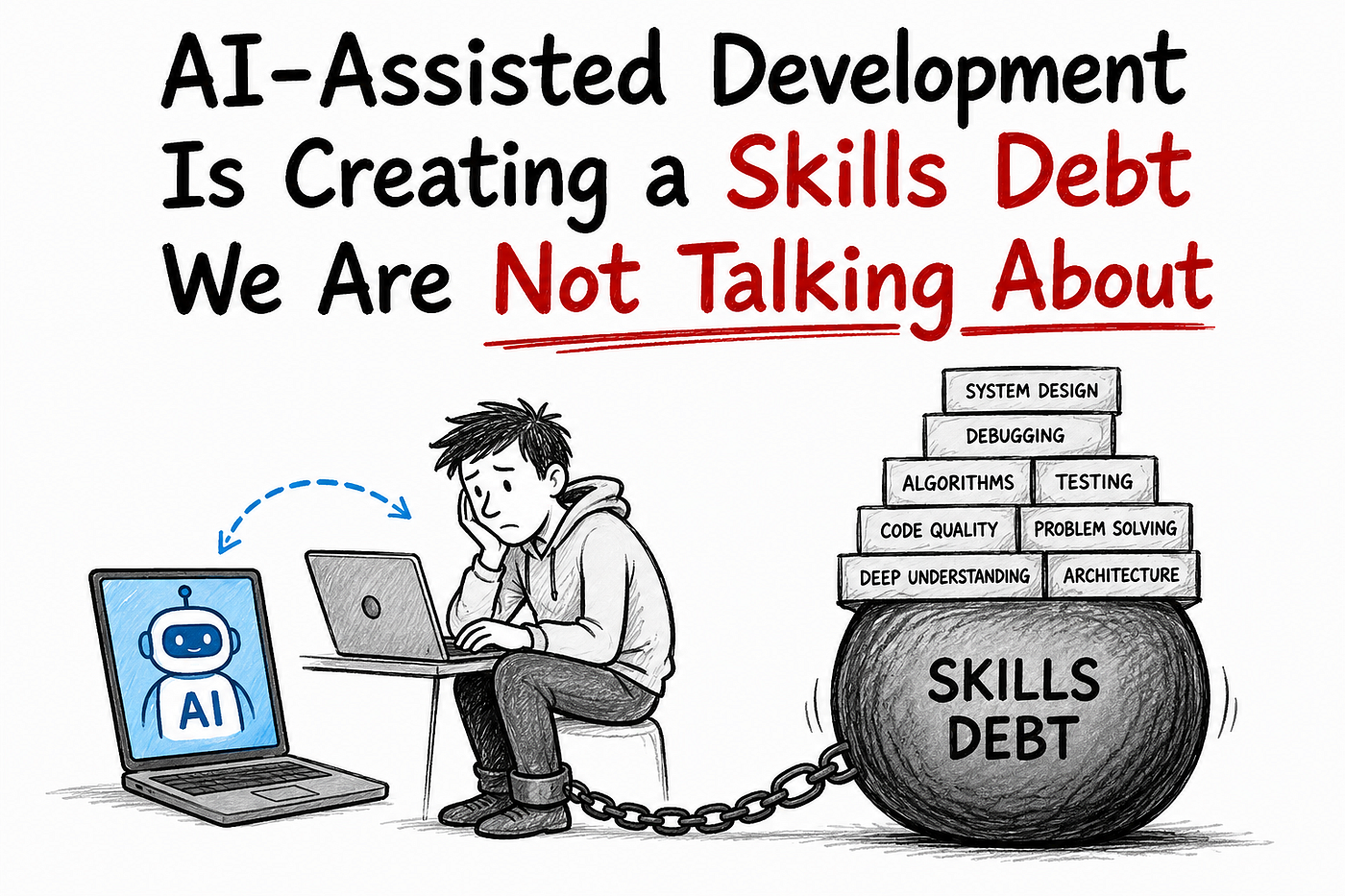
Let me be careful here because this is not a “AI bad” argument. AI coding tools are genuinely useful. I use them. Most experienced engineers I know use them. The problem is what happens when developers who have not yet built a mental model of how systems work start using them as a substitute for that model.
When you ask an AI assistant to generate an authentication flow and accept the output without understanding the session management, the token lifecycle, and the failure modes, you have not built an authentication system. You have borrowed one. And borrowed code comes with debt. When something breaks at 2am, you need to understand what you are looking at, and “the AI wrote it” is not a debugging strategy.
I have interviewed junior developers recently who can generate working code faster than I can type, but who struggle to explain what happens to their database connection pool under load. They know how to prompt an AI to write a caching layer, but they have not yet developed the intuition to know when caching will make things worse. These are not lazy developers. They are developers who had access to a very powerful shortcut before they understood what the shortcut was skipping.
The other side of this is subtler. Senior engineers using AI tools are offloading the low-level work, which is fine, but the muscle that comes from grinding through that work is not being built in the next generation. The engineer who spent three years writing raw SQL queries has a fundamentally different understanding of database performance than the engineer who has always used an ORM with AI-generated query optimization. Neither approach is wrong in isolation. But one builds intuition and the other builds dependency.
What responsible teams are doing is treating AI-generated code the same way they treat code from an extern: it goes through review, it gets tested, and the author is expected to defend every line. That standard is harder to enforce than it sounds, and most teams are not enforcing it.
The Complexity Creep Nobody Audits
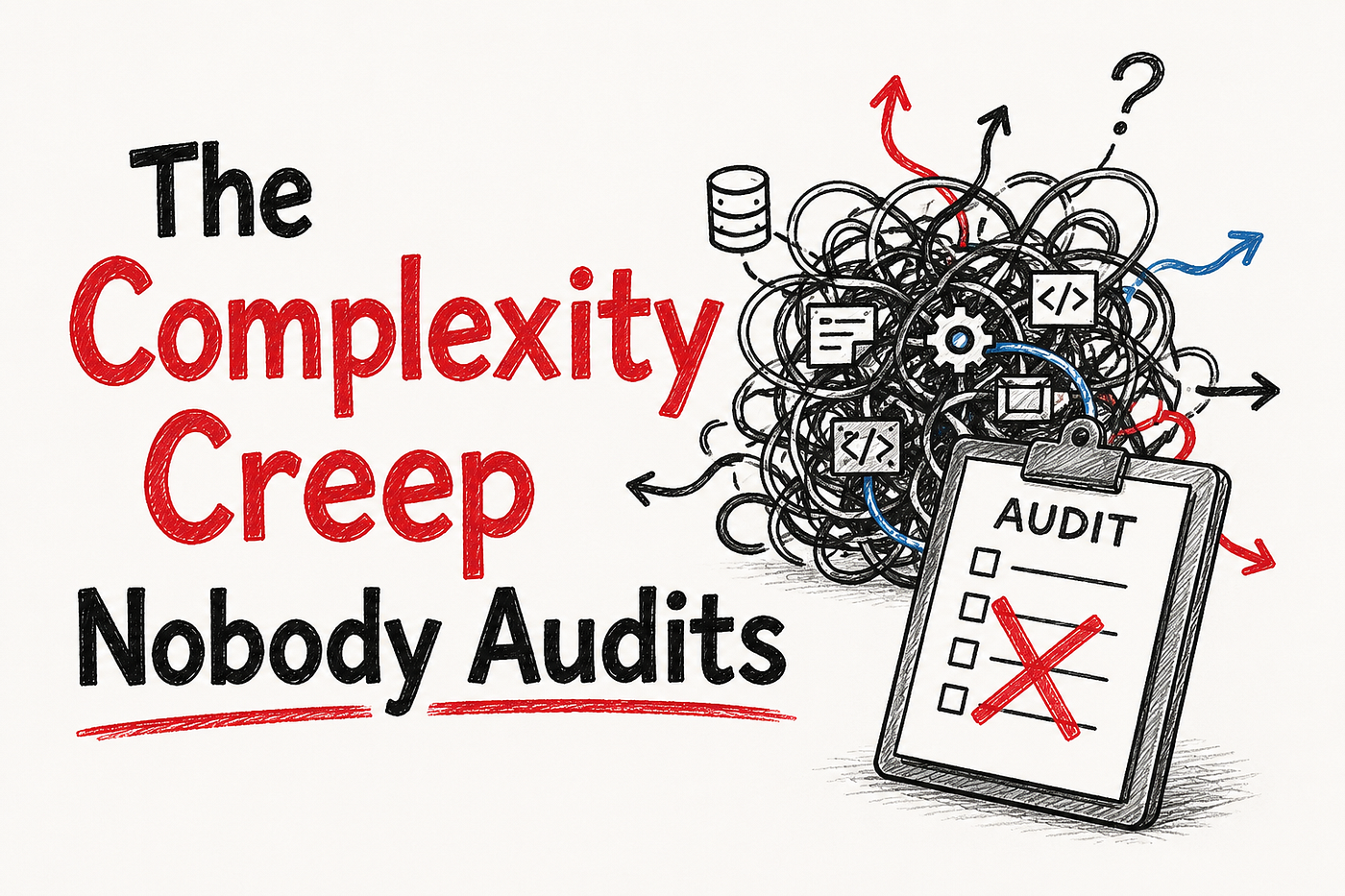
Six months after launch, most systems have accumulated complexity that nobody consciously decided to add. A third-party integration that was supposed to be temporary. A caching layer that was added during a performance spike and never removed. An abstraction that made sense for a use case that no longer exists. This is normal. What is not normal is the absence of any process to audit it.
Technical debt is not just bad code. It is the accumulated weight of decisions that were reasonable at the time but have since become obstacles. The team that built on top of a REST API before the vendor offered a proper SDK. The database schema designed for a product that pivoted. The auth library pinned to an old version because nobody wants to own the upgrade. None of these were mistakes when they were made. All of them are problems now.
The engineering teams that handle this best treat complexity audits the same way they treat security reviews: as a recurring practice, not an emergency response. Every quarter, someone is responsible for pulling up the dependency graph, the service topology, and the list of “temporary” solutions that have been in production for longer than a year. Not to fix everything immediately, but to make the invisible visible. Debt you cannot name is debt you cannot manage.
What makes this hard is organizational. Nobody gets credit for removing the caching layer that turned out to be unnecessary. Nobody writes a blog post about the service they deprecated. The incentive structure in most engineering teams rewards building, not removing, and the result is systems that grow in one direction indefinitely.
The senior engineers I respect most have a strong instinct for deletion. They are suspicious of the new abstraction. They ask whether the new service could just be a library. They push back on the proposal to add another layer before the existing layers are well understood. This is not laziness or risk aversion. It is the recognition that every line of code, every service, and every dependency is a future maintenance burden, and the budget for that burden is not unlimited.
Your Observability Is Probably Theater
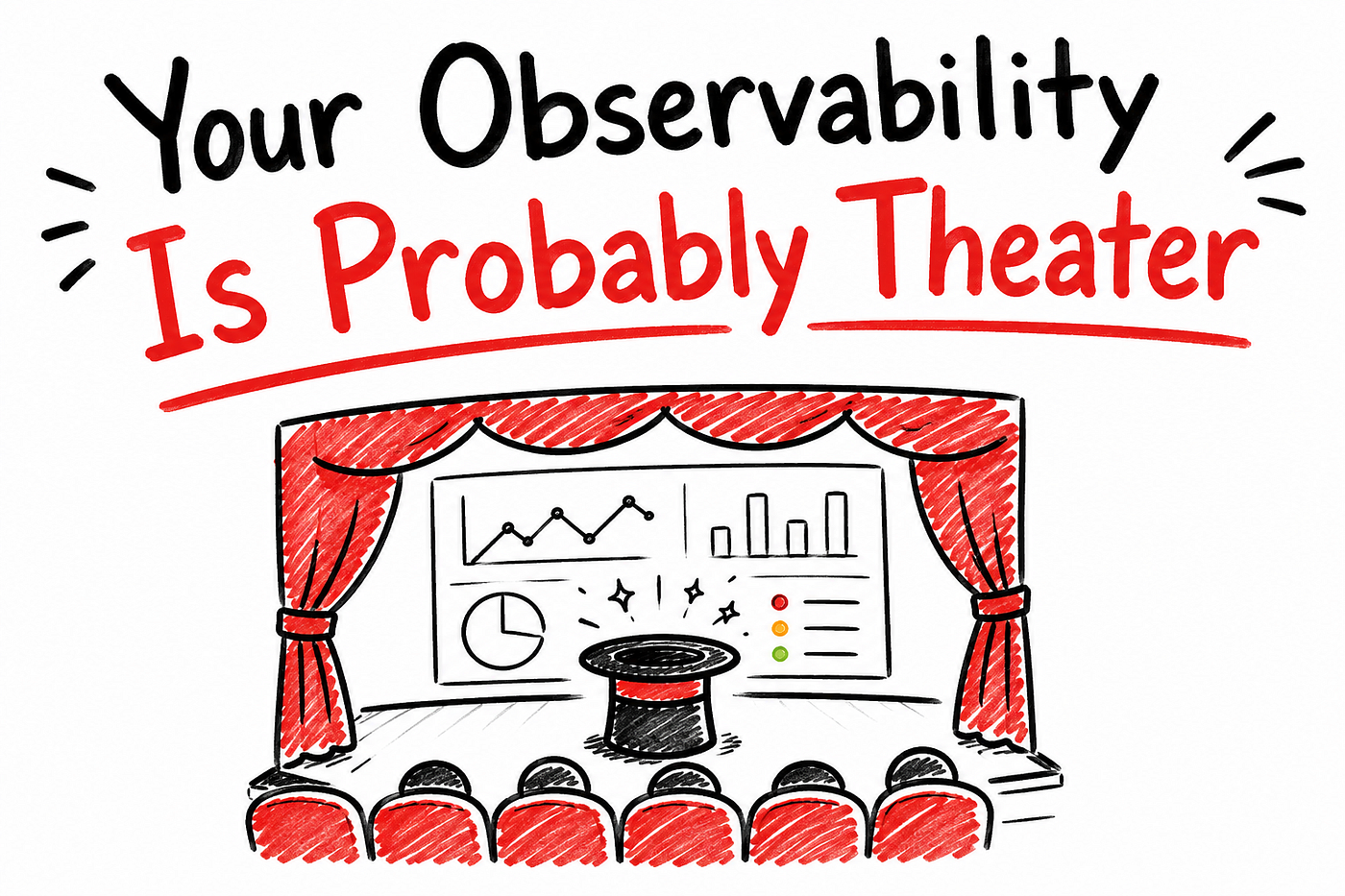
Most teams have logs. Many teams have metrics. Fewer teams have tracing. Almost no teams have the discipline to actually look at this data before something breaks. Observability theater is the practice of instrumenting your system extensively, patting yourself on the back, and then discovering during an incident that none of it tells you what you need to know.
I have been in post-mortems where the team had Datadog, had dashboards, had alerts, and still spent four hours during an outage trying to figure out which service was causing elevated error rates because the spans were not properly propagated across service boundaries. The tooling was there. The discipline to configure it correctly and maintain it was not.
Real observability means knowing, within two minutes of an incident starting, which component is failing, why it is failing, and what the blast radius is. It means your dashboards tell a story, not a data dump. It means your alerts fire on symptoms that matter to users, not on implementation details that only matter to the service author. Getting there requires treating observability as a product, not a side project.
The practical version of this for most teams is simpler than the full distributed tracing setup. Log at the right level. Make your logs structured so they are queryable. Add a correlation ID at the edge and propagate it everywhere. Define your SLIs before you define your alerts. None of this requires a six-figure observability platform. What it requires is treating “can we understand what this system is doing in production” as a first-class requirement.
The Local Development Environment Is Lying to You

Here is a production incident template I have seen play out too many times: everything works in development, staging looks fine, and then production behaves differently because the environment assumptions were wrong. The database has different indexes. The cache has different eviction policies. The network latency between services is orders of magnitude higher. The instance has a fraction of the memory. None of this was visible locally.
The distance between local development and production is not just a technical problem. It is a risk model problem. Teams that run everything in Docker Compose locally are often testing against a very different system than the one that serves their users. The abstractions that make local development convenient are the same ones that hide the failure modes you actually need to understand.
The response to this is not to make local development more painful. It is to have a clear mental model of what local development can and cannot validate. Unit tests catch logic errors. Integration tests catch contract violations. Local end-to-end tests catch flow problems. None of them reliably catch the distributed systems failures that only appear under production load with production data. You need load tests. You need chaos experiments. You need the discipline to ship incrementally so that production itself becomes your test environment.
Feature flags are underused for exactly this reason. The teams that have real confidence in their deployments are the ones that can turn a feature on for one percent of traffic, watch the metrics, and roll it back in thirty seconds if something looks wrong. That capability is not expensive to build, but it requires committing to it before you need it.
Architecture Reviews That Happen Too Late Are Useless
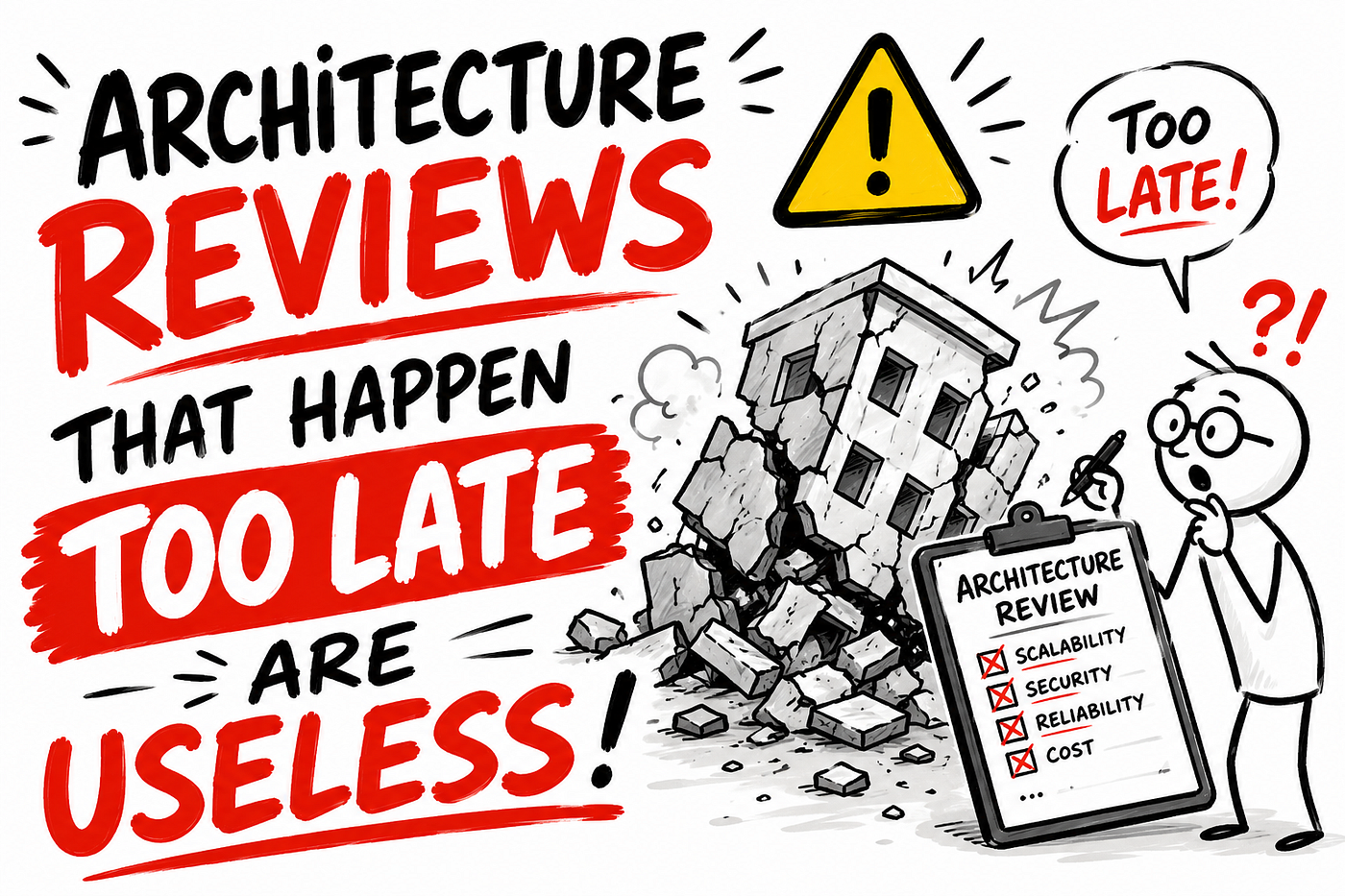
The architecture review that happens after the code is written is a rubber stamp. The developer has already made a hundred small decisions that constrain the big ones. The database schema is set. The service boundaries are drawn. The third-party integrations are chosen. By the time the review happens, the cost of changing anything significant is so high that the review almost always approves what is already there.
Real architecture review happens early and continuously. It is the conversation that happens when someone starts a new service and has to explain to the team why a separate service is the right unit of isolation. It is the pull request comment that asks why this module has a dependency on that one. It is the RFC process that forces engineers to write down the alternatives they considered and explain why they rejected them. The artifact is not the architecture diagram. The artifact is the reasoning.
The teams that do this well have a culture where questioning architectural decisions is expected and safe. Where a senior engineer can push back on a proposal without it being read as a personal criticism. Where “we considered this and rejected it for these reasons” is a valued output, not a sign that the team was indecisive. That culture is rare and worth protecting.
The other thing good teams do is distinguish between decisions that are easy to reverse and decisions that are hard to reverse. The choice of logging library is easy to reverse. The choice of database engine is hard. The choice of event-driven versus request-driven communication between services is very hard. Spending equal review time on all of these is a mistake. Spend more time on the hard ones.
The Senior Engineer Problem Nobody Talks About

The best engineers I have worked with share a quality that is hard to name but easy to recognize: they are comfortable with incomplete information. They can make a reasonable decision with sixty percent of the data, ship it, and then adjust based on what production tells them. They are not paralyzed by the unknown. They are not reckless either. They have calibrated their judgment against enough outcomes to know when more information matters and when it does not.
What junior engineers often do instead is one of two things. They ask for all the requirements before writing any code, because they are not sure what the requirements actually constrain. Or they pick an architecture that looks like it handles all possible futures, which is almost always more complex than what the present requires. Both patterns come from the same place: discomfort with uncertainty and the risk of being wrong.
The uncomfortable truth is that senior engineers are often wrong too. They just recover faster, because they have learned to keep the blast radius small. They ship in small increments. They keep things simple until they cannot. They document their assumptions so they can find them later when reality proves them incorrect. The superpower is not being right. It is being wrong in a way that is survivable.
Teams with a wide gap between senior and junior engineers produce junior engineers who cannot grow, because the seniors are too fast to jump in and solve the problem rather than letting the junior work through it. The knowledge transfer that happens through struggle and failure is not replaceable by code review comments. Someone has to let the junior engineer own something that matters enough to teach them something real.
Shipping Fast Does Not Mean What Teams Think It Means

“Move fast” has been misread in most engineering cultures as “skip the things that slow you down.” The things that get skipped are usually tests, documentation, and the second pass on the design. This is fine occasionally. Made into a habit, it is a debt accumulation strategy that eventually forces the team to stop moving entirely.
The teams that actually ship fast sustainably have a different model. They invest heavily in the things that reduce friction on future work. Fast CI pipelines. Good test coverage at the right level of the pyramid. Internal tools that make common tasks easier. Documentation that is just good enough to not require a synchronous conversation. These investments look like they slow you down in the short term. They are the reason you are still moving quickly eighteen months later when other teams are neck-deep in a rewrite.
The other thing fast teams do is make peace with not building things. The feature that is not built does not have bugs, does not require maintenance, and does not confuse users. The engineering teams I have watched that consistently outship their competition are the ones that are ruthless about scope. Not because they are lazy, but because they understand that the surface area of a system is a cost, not an achievement.
What Actually Matters When You Look Back at a System Two Years Later
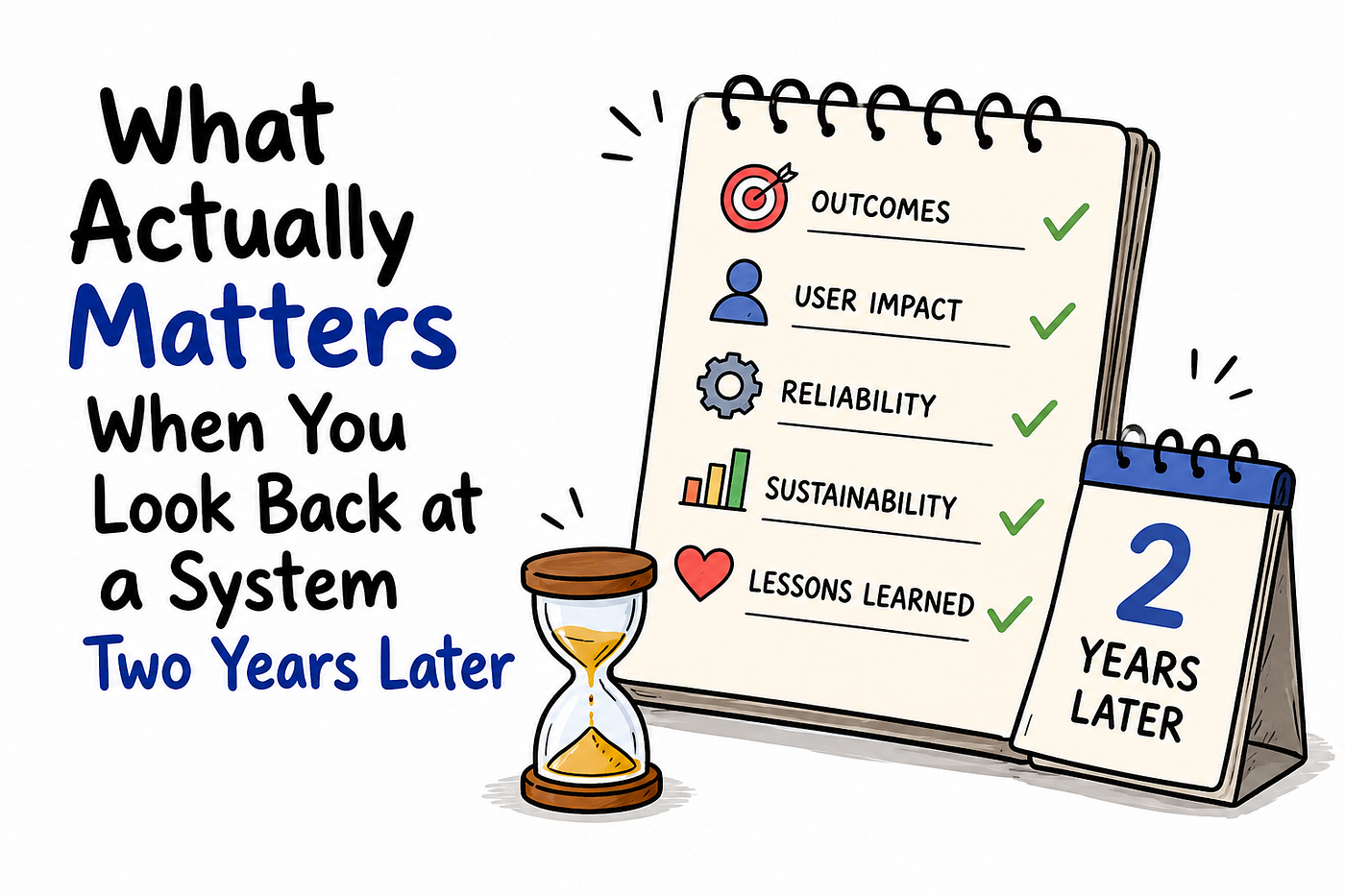
I have been asked to evaluate systems that teams built, maintained for two years, and then handed off or rewrote. The patterns of what ages well and what does not are consistent enough to be instructive.
What ages well: simple things. A single database with a well-designed schema. Clear module boundaries with explicit interfaces. A deployment process that is boring and repeatable. Tests that test behavior, not implementation. Logging that tells you what the user was trying to do when something went wrong. These things are not exciting to build. They are very exciting to inherit.
What ages poorly: novelty for its own sake. The custom framework that seemed like a good idea and is now a maintenance island. The clever abstraction that requires reading three files to understand what a function call does. The microservice that was split off before the bounded context was actually understood, and now has to be kept in sync with its parent through fragile async events. These are decisions that made sense in context and created problems that outlasted that context.
The clearest signal of a well-run engineering team is how new engineers onboard. If a new hire can make a meaningful contribution in their first week, the system is understandable. If they need three months of context before touching anything in production, something is wrong, and it is probably not the new engineer.
Conclusion: The Unsexy Truth About Building Software Well
Building software well in 2026 does not require the best tools, the most advanced AI assistant, or the most sophisticated architecture. It requires judgment, and judgment only comes from paying attention to what you have shipped, what broke, and why.
The teams consistently delivering real value to real users are not the ones with the most impressive tech stacks. They are the ones where engineers understand the system they are operating, where complexity is treated as a cost rather than a feature, and where the feedback loop between what was built and what users actually needed is short enough to course-correct before things go badly wrong.
The industry will keep producing new frameworks, new paradigms, and new ways to feel like you are doing modern engineering while avoiding the hard questions. The hard questions are the same as they have always been: What does this system need to do? What are the ways it can fail? What is the simplest version that works? How will we know when it is not working?
Answer those honestly, and the tooling will serve you. Skip them in favor of the shiny thing, and the tooling becomes part of the problem.
Before You Go
If this article challenged how you think about modern software engineering, consider following for more experience-driven articles on:
- Backend architecture that survives production
- System design without unnecessary complexity
- React, React Native, and Node.js engineering
- Performance optimization that actually matters
- Debugging stories from real client projects
- Scaling lessons learned the hard way
- Software engineering career growth without the usual clichés
I publish practical engineering articles every week — focused on real production experience, not theoretical advice.
What part of modern software development do you think teams are getting most wrong today?
Share your experience in the comments. I’m interested in hearing what you’ve seen in production.
If you found this useful, tap 👏 to help more developers discover it, and save the article for future reference when you’re making architecture decisions.
메타데이터
- post_id
- ab0908ace6ea
- slug
- the-truth-about-building-apps-in-2026-nobody-wants-to-admit-ab0908ace6ea
- url
- https://medium.com/@techbyrahmat/the-truth-about-building-apps-in-2026-nobody-wants-to-admit-ab0908ace6ea
- canonical_url
- https://medium.com/@techbyrahmat/the-truth-about-building-apps-in-2026-nobody-wants-to-admit-ab0908ace6ea
- author_url
- https://medium.com/@techbyrahmat
- status
- ok
- fetched_at
- 2026-07-27 12:41:27