AI and the Service Industry overview
If you thought that the current situation with its AI-related questions and concerns is unique, think again. For some fascinating thematic…
AI and the Service Industry overview
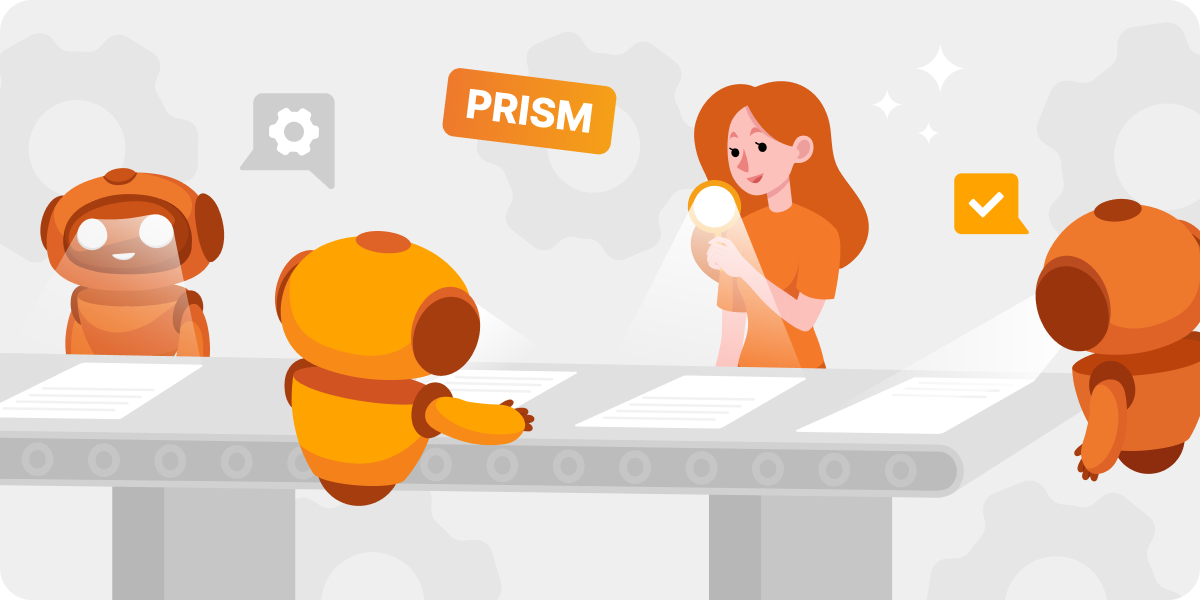
If you thought that the current situation with its AI-related questions and concerns is unique, think again. For some fascinating thematic parallels, we highly recommend reading or listening to the classic sci-fi short story Watchbird by Robert Sheckley (dating back to the early 1950s).
Artificial intelligence is an undeniably overheated topic in today’s business landscape. In fact, the sheer volume of eerily similar success stories can almost make you wonder if AI is writing its own self-promotion campaigns. Especially given that many suggested AI use cases raise big questions. Here are just some examples:
- Writing emails. Business emails should be short, structured, and include the ideas or requests YOU want to get across to the recipients. AI will not generate these ideas or requests for you. And if you are writing a generic text that contains no ideas or requests, maybe “Something is rotten in the state of Denmark”…
- Getting a book, article, or white paper summary. If you are a student, or the content deals with your primary business area, the summary is not sufficient! You also need to understand the underlying logic, the proof of concept, get the grasp of nuances, limitations, and exceptions, etc. to be able to move forward. Otherwise, you will not learn much or will not be able to develop or criticize the content competently.
- Other popular ideas include creating show ideas or scripts or producing illustrations. We get the fun part of it, but it only works as far as you amuse yourself or your friends. What about uniqueness, copyright violations, and other “boring” things?
While many users marvel at trivial applications-like translating an email in a foreign language or generating a closed captions file-the reality of deploying AI in a rigorous business environment demands much deeper scrutiny. We must ask the hard questions: Where does this technology genuinely work, what are its implications, and where must we be entirely transparent and straightforward with our clients?
To add some real-world perspective to the story, we have collected feedback from multiple business units at Logrus IT that use AI extensively and asked our gurus for real-life use cases and a balanced presentation of facts:
- What works well?
- What doesn’t?
- What things do we need to be aware (or wary) of?
- What do we need to discuss in detail with our customers?
Providing comprehensive AI-backed solutions at Logrus IT
In a professional setting, AI is not about executing a single, isolated task; it is about integrating the technology into comprehensive processes where it handles a variety of chores at different stages. At Logrus IT, we utilize approximately two dozen different AI applications and engines, recognizing that no single tool excels at everything.
Our current AI ecosystem encompasses:
- Creating or processing graphics.
- Preparing concept-level business prototypes.
- Developing animations.
- Generating neural voiceovers into several dozen languages.
- Aiding in text creation, including narrative skeleton generation, compiling lists of trustworthy sources and references, etc.
- Running extensive quality checks, spanning original or translated content intelligibility, relevance to the subject matter area, translation adequacy within the given context, terminology, tone of voice, etc.
- Adding relatively simple pieces of code to applications.
- And more…
Why are we not scared yet?
Despite this impressive roster of capabilities actively in use, why aren’t we terrified? Why aren’t we laying off our esteemed designers, programmers, and desktop publishing experts [at least for the time being] despite the hype?
Here are the five foundational reasons why.
1. The Illusion of the Final Product
The most important postulate in the current technological landscape is that no single AI tool on the market produces a final, client-ready product. Every AI-generated output requires the digital equivalent of a jack plane or file-or another specialized tool-to polish, edit, and improve it. Significant human input is still an absolute necessity to push these deliverables across the finish line.
2. The Danger of Smooth Hallucinations
AI is notoriously fickle. Its glitches, hallucinations, and errors are unpredictable, illogical, and often very well camouflaged. Unlike human errors-which are usually pronounced and easier to catch-AI mistakes are incredibly easy to overlook because the generated text or image feels so convincingly smooth.
Consider the recent reality of an Australian lawyer who relied on AI to summarize case materials, only to discover that the docket references were completely bogus. He was forced to apologize to a judge for citing fake people and fabricated references.
On a more personal note, while generating closed captions for a podcast by the Logrus IT CEO, Leonid Glazychev, the AI substituted the word “fallacy” with a phonetically close “phalluses”. While laughable in a personal podcast (Leonid noticed and fixed this AI mishap during the subtitle file review), such an error delivered to an important client would carry serious consequences.
There are so many praises related to AI creating pieces of code. BUT what about the repository where it gets code components? Do we know whether it uses the latest updates, are there any known vulnerabilities in the code that it assembled?
We had an eerie experience at Logrus IT with pieces of code written by AI. It often inexplicably excluded essential pieces from the previously written code or left unresolved references during the development process. When caught red-handed, the AI “acknowledged” the mistakes and “apologized” profusely. But still, we needed to catch these errors first during an in-depth human review…
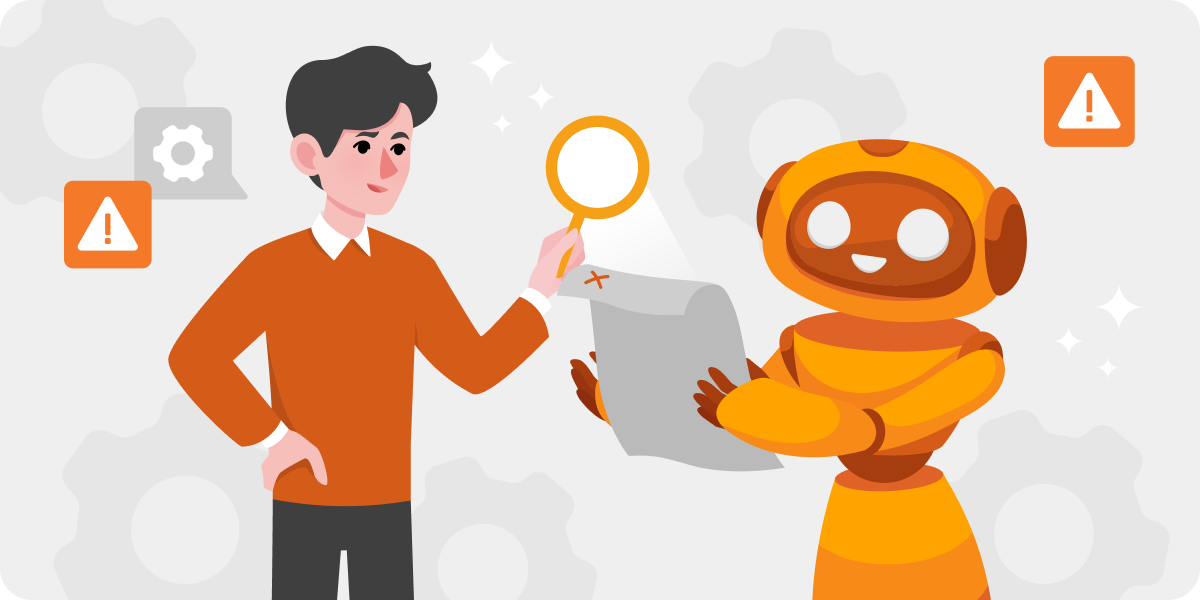
What it means is that we need to double-check everything under the microscope!
Ultimately, AI developers often exaggerate the productivity gains of their tools. If you want to achieve human-level final quality, a significant share of that supposed time saved is immediately spent on the intensive human effort required to double-check and fix the materials.
3. Evolutionary Setbacks and Consistency Issues
Technology does not always progress in a straight line; evolution includes serious setbacks. Model and application updates can suddenly cause previously reliable requests to produce much worse results or stop working entirely.
In the old times it used to be API changes on the developer end, when all connections to a server application suddenly stopped working. Now it is much more widespread, any new LLM release can create a lot of unpleasant surprises. It’s somewhat like humans: our own learning process includes inevitable steps back, lapses, and periods of decline. It is also akin to a smart home device acting up and deciding to play a song by ELO (“The Lights Go Down”) instead of simply turning off the lights (it really happened).
One way or the other, you’ll have to carefully select the most stable engine as well as fine-tune the prompts and the process around using AI more often than you probably imagine simply to obtain consistently palatable and usable results.
Another prominent issue deals with consistency of results returned by AI engines. With traditional tools one and the same input always produces the same output, no matter how many times one tries.
This is not true for AI-based tools. We staged these experiments at Logrus IT. Running one and the same prompt (AI-based automated QA) multiple times during the day produced reports with noticeable variations in both the number and severity of issues that the tool discovered. This is another convincing argument in favor of close human oversight over the final results.
4. The Originality Deficit
AI often works quite well in the assisting role, but suffers from limited usability in the creative realm, because it does not generate anything genuinely original. It merely reuses and builds upon the ideas and content it was fed during training or obtained via searches.
All of us have seen these stale, clichéd texts or pictures that many of us unmistakably recognize as AI-generated. Logrus IT editors have their own lists of typical AI overuses or abuses, including:
- “In an era where…”
- “… everything from ХХХ to ХХХ”
- “the ХХХ isn’t merely about ХХХ. It’s about…”
- Overabundant rhetorical questions, etc.
The issue of AI and copyright is like an old piece of news: “An animal that is an embarrassment to look at has escaped from the Philadelphia zoo. If you unexpectedly encounter the runaway, please do NOT look at it!” Many people intentionally try to avoid this dangerous topic.
If you use a free AI version, everything you generate belongs to the world. If you pay for a subscription, the output theoretically belongs to you. However, you can never be certain that the content or art you generated is truly unique. Someone else, anywhere in the world, could enter a similar query and get a nearly identical result. Worse, the system will not notify you if this happens.
Say, we have developed a unique art piece at Logrus IT, and suddenly its identical likeness starts showing on social networks or elsewhere… (Few precedents so far).
Here are a couple of obvious and rather pressing questions:
- Can AI guarantee that this art piece is unique given that it can use the same “parts” to generate a very similar art piece for some other subscriber?
- Will you even learn about the fact that identical or very similar pieces have been generated for somebody else?
AND THE ANSWER IS NO!
You will never know if someone else unknowingly recreates a piece of content that you previously delivered to a client, creating a massive risk for involuntary infringement. Currently, there is no worldwide copyright regulation that explicitly dictates how to handle this fluid situation.
On the other hand, the chances of somebody getting back to us and complaining that we have used their art piece or other content illegally is infinitesimally small. For a simple reason: there are millions of requests per day… There have been no front-page scandals, at least the ones involving big corporate names. And it is not easy to find a legal counsel who would seriously get involved in such litigation given lack of regulation. Currently most clients are ready to accept these AI application-level licensing agreements/assurances.
The Path Forward: Transparency and Human Effort
Given these undeniable risks-especially the “white spots” on the copyright map-can we use AI for high-profile clients? The answer is as follows: “Yes, as far as we do it ethically and responsibly”.
Clients are driven by the promise of faster turnaround times and lower prices, and every major company in the world is currently playing with this technology. If you are not utilizing it, you are falling behind the competition.
However, the key to responsible, ethical, and safe implementation is complete transparency. We must explicitly discuss these processes with our clients and secure their approval beforehand.
To mitigate the risks of infringement and guarantee quality, we must inject a very significant amount of human creative work at every stage where AI is used. This human input is the only way to ensure that the final product is of high quality as well as unique, copyright-proof, and fit for the purpose. That is exactly what we try to accomplish at Logrus IT, be it AI-backed content creation, translation, art, animations, voiceovers, subtitles, or anything else. Both transparency and a healthy dose of added human effort are key here. You can find more details related to the processes we apply as well as checks and balances involved in the sections dedicated to each of the services.
Originally published at https://www.logrusit.com.
메타데이터
- post_id
- ab0934aeca07
- slug
- ai-and-the-service-industry-overview-ab0934aeca07
- url
- https://medium.com/@logrusit_40171/ai-and-the-service-industry-overview-ab0934aeca07
- canonical_url
- https://medium.com/@logrusit_40171/ai-and-the-service-industry-overview-ab0934aeca07
- author_url
- https://medium.com/@logrusit_40171
- status
- ok
- fetched_at
- 2026-07-22 16:32:05