Ecommerce Product Pages Don’t Sell Products. They Reduce Doubt.
Most brands treat the product page like a pitch. One more push, one more line of persuasive copy, one more “Buy Now” button in a brighter…
Ecommerce Product Pages Don’t Sell Products. They Reduce Doubt.
Most brands treat the product page like a pitch. One more push, one more line of persuasive copy, one more “Buy Now” button in a brighter shade of green as if the shopper just needs a nudge to convert.
But by the time someone lands on a product page, they’ve usually already decided they want the product. What’s standing between them and checkout isn’t desire. It’s doubt.
The Real Job of a Product Page
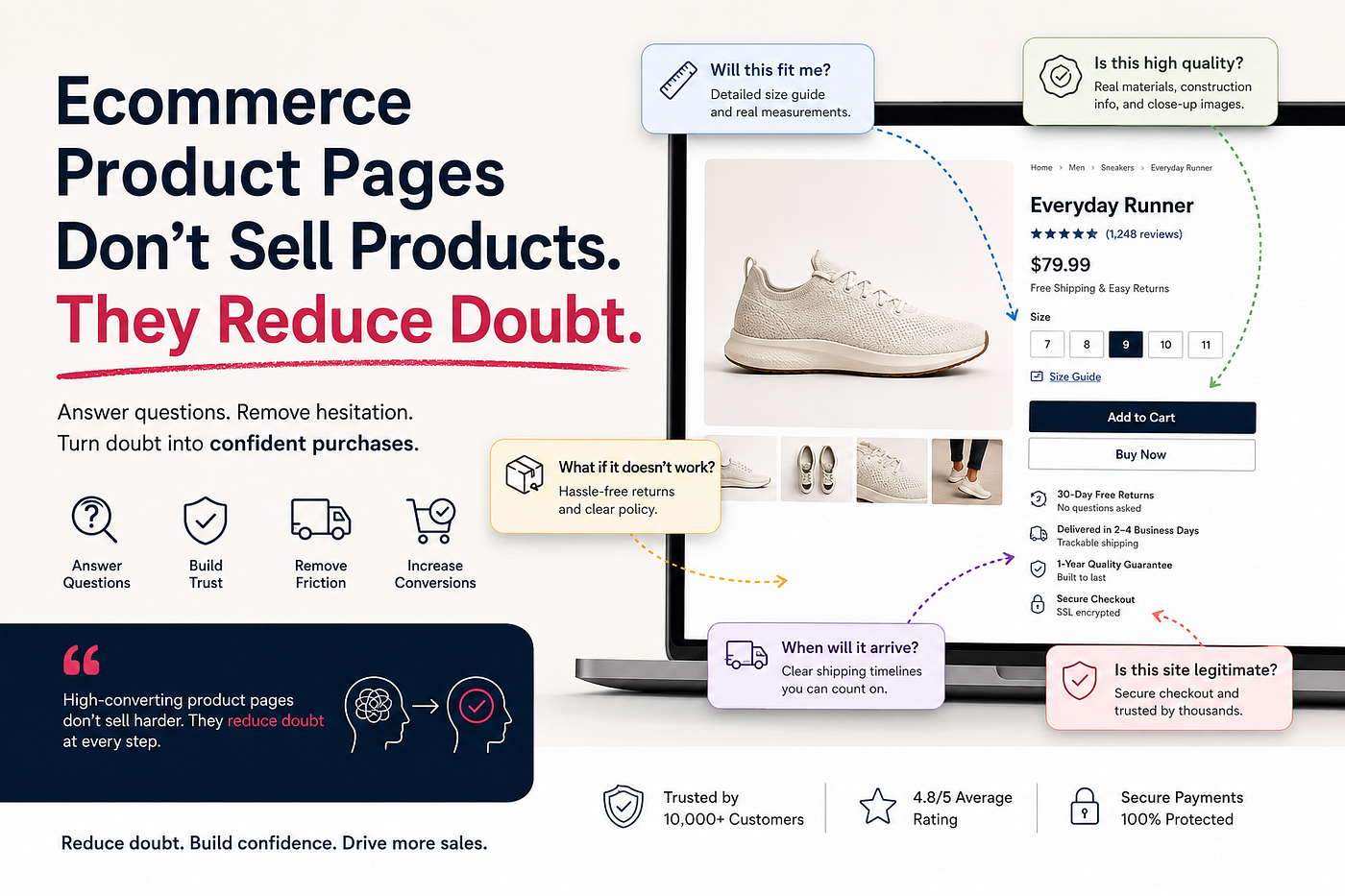
A product page isn’t a billboard. It’s a courtroom. The shopper has already built a case for buying; they clicked the ad, they searched the term, they compared a few options. Now they’re looking for reasons not to walk away.
Every unanswered question is a reason to bounce:
- Will this actually fit / work / last?
- What happens if it doesn’t?
- Is this site legitimate?
- Am I paying more than I should?
- Will it arrive when I need it?
A page that only sells bigger fonts, bolder claims, more exclamation points doesn’t answer any of that. It just adds noise on top of hesitation.
What Reducing Doubt Looks Like
The highest-converting product pages tend to share a handful of traits, and none of them are about “selling harder”:
- Specificity over adjectives. “Premium quality” reduces nothing. Exact dimensions, real materials, and precise use cases do.
- Evidence, placed where the question arises. A sizing chart next to the size selector. A durability claim next to a photo of the stitching. Reviews that mention the exact concern a shopper is likely to have at that moment.
- Friction removed from the answer, not just the checkout. Free returns matter less as a banner and more as a sentence answering “what if it doesn’t fit” right where that doubt would naturally surface.
- Visual proof, not just visual polish. Photos that show scale, texture, and real-world context do more work than a glossy hero shot on a white background.
- Trust signals that are actually relevant. A shipping guarantee matters more on a gift page. A material breakdown matters more on a $200 item than a $20 one. Generic trust badges copied across every product rarely address the specific doubt a specific shopper has.
Copy That Answers, Not the One That Convinces
This is where a lot of product pages fall short, not because the writing is bad, but because it’s aimed at the wrong job. Persuasive copy tries to convince. Doubt-reducing copy tries to inform, at the precise moment a question would otherwise stall the decision.
That distinction is subtle, but it changes everything about how a page gets written: what order the information appears in, what gets a headline versus a footnote, and which objections get addressed before the shopper even has to ask.
It’s also why this work is hard to do well at scale: matching copy, imagery, and structure to the actual doubts of an actual audience, across hundreds or thousands of SKUs, isn’t a one-person job.
It’s the kind of systematic, research-backed process an ecommerce content agency is built around: understanding where shoppers hesitate, then building pages that close that gap product by product.
Conclusion
If conversion rate is the goal, the instinct to write “better sales copy” is usually the wrong lever. The better question for every section of a product page is simpler: what doubt does this remove?
Pages that answer that question consistently don’t need to sell as hard because they’ve already cleared the way for the shopper to say yes.
FAQs
Q1. Why do shoppers abandon product pages even when they’re interested in the item?
Interest isn’t the same as certainty. Most shoppers arrive with intent to buy but leave when a specific question about fit, quality, shipping, or returns goes unanswered. The page loses them to hesitation, not disinterest.
Q2. What’s the difference between persuasive copy and doubt-reducing copy?
Persuasive copy tries to convince someone to want the product. Doubt-reducing copy assumes they already want it and instead answers the practical questions standing between them and checkout placed exactly where those questions arise.
Q3. Which trust signals actually move the needle on a product page?
The ones relevant to that specific product and price point. A detailed material breakdown matters more on a higher-priced item; a clear returns policy matters more on sizing-dependent products like apparel. Generic badges reused across every SKU tend to add little.
Q4. Do product reviews really reduce doubt, or are they just social proof?
Both, but their real power is specificity. A review that directly answers a common concern, “runs a half size small” or “held up after a year of daily use,” does more to remove doubt than a high star rating alone.
Q5. How do you fix doubt at scale across a large product catalog?
It takes a repeatable process: identifying the recurring objections for each product category, then structuring copy, imagery, and page layout around them consistently. This is typically where working with an ecommerce content agency pays off, since it turns doubt-reduction into a system rather than a one-off rewrite.
메타데이터
- post_id
- ab0e1469e912
- slug
- ecommerce-product-pages-dont-sell-products-they-reduce-doubt-ab0e1469e912
- url
- https://medium.com/@odnmarketing2000/ecommerce-product-pages-dont-sell-products-they-reduce-doubt-ab0e1469e912
- canonical_url
- https://medium.com/@odnmarketing2000/ecommerce-product-pages-dont-sell-products-they-reduce-doubt-ab0e1469e912
- author_url
- https://medium.com/@odnmarketing2000
- status
- ok
- fetched_at
- 2026-07-29 21:44:46