The “Frozen” Conflict and Security Dynamics in Syria 2026: Institutional Transition, Geopolitical…
The Post-Assad Transitional State and the Illusion of a Frozen Stalemate
The “Frozen” Conflict and Security Dynamics in Syria 2026: Institutional Transition, Geopolitical Realignment, and Localized Volatility
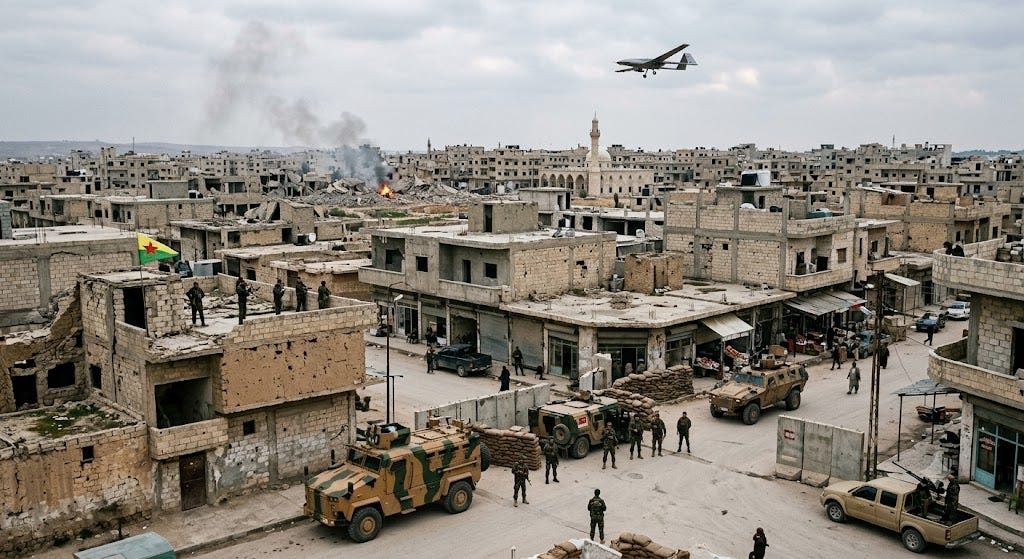
This image captures the 2026 Syrian stalemate, where armored ground patrols and persistent drone surveillance define a landscape of localized, ongoing conflict.
The Post-Assad Transitional State and the Illusion of a Frozen Stalemate
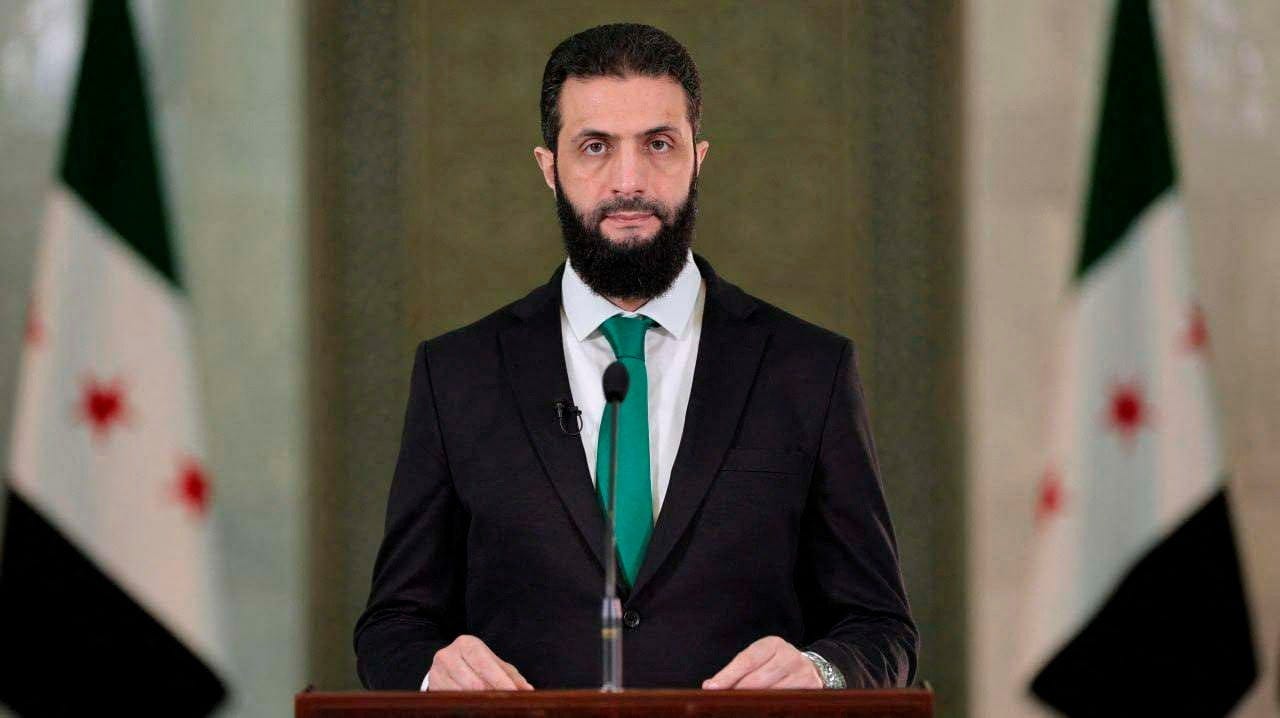
The collapse of the Bashar al-Assad regime on December 8, 2024, signaled a historic transformation in the modern history of the Middle East, ending more than half a century of Ba’athist rule and initiating a highly volatile transitional era. The rapid military campaign led by Hay’at Tahrir al-Sham (HTS) culminated in the appointment of former HTS leader Ahmed al-Sharaa as the transitional President of Syria in January 2025. Under al-Sharaa — who previously operated under a ten-million-dollar United States counterterrorism bounty — the transitional government has pursued a pragmatic, state-centric consolidation strategy aimed at establishing domestic order, securing international legitimacy, and navigating a profoundly altered regional security landscape.
While the large-scale frontlines that characterized the decade-long civil war have dissolved, the security environment in 2026 remains highly volatile. The current state of “frozen” conflict is a deceptive veneer concealing an active, multi-front security transition defined by localized border skirmishes, complex military integration initiatives, clandestine counter-insurgency operations, and persistent sectarian friction. The central dilemma facing the al-Sharaa administration is the “freezing of revolutionary legitimacy,” a condition in which the authority derived from overthrowing the previous dictatorship is used as a permanent justification for executive rule, thereby displacing the slower, more arduous task of building inclusive state institutions.
Syria’s current governance model operates under a profound institutional deficit. The essential state structures that normally mediate between a governing authority and the civilian population — including an independent judiciary, a professionalized civil service, and a non-sectarian security apparatus — were either systematically destroyed or deeply corrupted under the previous regime. In March 2025, the transitional authorities approved a constitutional declaration designed to govern this transitional phase. This document heavily concentrates power within the executive branch, granting the president sweeping authority over legislative and judicial appointments without formal checks or independent oversight. The administration defends these extraordinary executive powers as a structural necessity to prevent state fragmentation, execute sweeping security sector reform, and navigate the severe economic and geopolitical pressures of 2026.
Localized Skirmishes and Volatility in the Northern Borderlands
The northern regions of Syria remain highly active combat zones, characterized by localized skirmishes, targeted assassinations, and persistent aerial drone strikes involving Turkish forces, various Syrian opposition groups, and Kurdish-led forces. Since 2016, the Republic of Turkey has maintained a permanent military footprint in northern Syria, executing unilateral air and ground campaigns to establish a secure border zone and neutralize Kurdish security structures. Ankara perceives the Kurdish-led Syrian Democratic Forces (SDF) and its administrative wing, the Democratic Autonomous Administration of North and East Syria (DAANES), as direct extensions of the Kurdistan Workers’ Party (PKK), which Turkey designates as a terrorist organization.
DateGeopolitical / Military EventCore Strategic and Security SignificanceSourcesJanuary 2025Victory Conference in Damascus
Formal dissolution of independent rebel militias; Ahmed al-Sharaa assumes the transitional presidency.
March 10, 2025Initial SDF-Government Agreement
First country-wide integration framework; implementation systematically delayed by SDF demands for federalism.
March 16, 2025Kobane Drone Strike
Severe Turkish aerial attack killing nine civilians; highlights persistent northern border volatility.
May 17, 2025Presidential Justice Decrees
Creation of the Transitional Justice Commission; heavily criticized for limiting mandates to former government crimes.
July 15, 2025Sweida Sectarian Escalation
Intense clashes between Bedouin and Druze fighters; causes over 100 deaths and displaces 160,000 civilians.
Oct 5, 2025 — Jan 10, 2026Aleppo Urban Clashes
Intense government assault on Kurdish neighborhoods of Sheikh Maqsood and Ashrafiyah; ends in complete SDF evacuation.
December 19, 2025Launch of Operation Hawkeye Strike
Major US-led counter-ISIS aerial campaign across central Syria following Palmyra lethal attacks.
January 5–6, 2026Paris Diplomatic Talks
Indirect Israel-Syria talks under US mediation; establishes the tri-lateral Joint Fusion Mechanism.
Jan 13–30, 2026Northeastern Syria Offensive
Sweeping government-led military campaign; results in complete capitulation of DAANES and SDF military integration.
January 25, 2026SDF Counter-Drone Strikes
Explosive drone and rocket attacks targeting Sarrin and surrounding northern villages; brief collapse of local truces.
April 1, 2026Chatham House Event
President al-Sharaa officially announces plans to repurpose Russian bases into national military training hubs.
Turkish military operations in northern Syria are executed in close coordination with the Syrian National Army (SNA), a coalition of Turkish-backed Syrian opposition factions. Throughout the post-Assad transitional phase, these SNA factions have continued to occupy major border zones, where international monitors have documented systemic security abuses, including the arbitrary detention, mistreatment, and extortion of civilian populations. This northern border regime is characterized by high levels of local friction and lethal attrition. For example, a Turkish drone strike on a farm near SDF-controlled villages south of Kobane killed seven Kurdish children, their teenage sister, and their parents, emphasizing the high civilian toll of unilateral aerial containment operations.
Despite state-level integration talks, the YPG and SDF have consistently launched retaliatory drone and rocket strikes against Turkish positions and government-held areas in northern Syria. In late January 2026, SDF units launched more than 15 explosive drones at the town of Sarrin and surrounding villages in the Aleppo countryside, causing extensive damage to civilian homes and vehicles. Concurrently, SDF forces directed mortar and rocket fire from Kobani and Jarabulus at villages west of the Euphrates, demonstrating that despite the broader geopolitical transitions, localized cross-border violence remains a primary feature of the northern security theater. The airspace in northern Syria remains heavily contested, with Turkish unmanned aerial vehicles (UAVs) maintaining continuous surveillance and strike patrols over government-held towns like Ma’adan, which serves to maintain persistent security alerts and limit the transitional government’s ability to project unhindered sovereign authority over its northern borderlands.
The Dismantling of DAANES and the January 2026 Northeastern Offensive
The geopolitical and military balance of power shifted decisively in favor of the transitional government in Damascus following a rapid, coordinated offensive in January 2026, which effectively dismantled the administrative and territorial autonomy of the Kurdish-led DAANES in northeast Syria. Following the fall of the Assad regime, the Kurdish-led SDF — which controlled the oil-rich northeast and key urban neighborhoods in Aleppo — sought to maintain its independent military status, territorial administration, and control over energy revenues. While an initial integration agreement had been signed on March 10, 2025, its implementation was systematically stalled. The SDF continued to advocate for a highly decentralized, federalized model for Syria and went so far as to preside over a unilateral gathering of Syria’s minorities in Al-Hasakah in August 2025, which called for amending the transitional constitution — an action that drew sharp condemnation from Damascus.
The Aleppo Sheikh Maqsood Campaign
Urban tensions erupted into active warfare within the Kurdish-majority districts of Sheikh Maqsood and Ashrafiyah in Aleppo, which had been administered by the DAANES-affiliated Asayish security forces since the early years of the civil war. Following localized skirmishes in Dayr Hafir in October 2025, government forces established a tight blockade around the Aleppo neighborhoods, blocking the flow of critical fuel and supplies.
A temporary, US-backed ceasefire negotiated on October 7, 2025, collapsed entirely on December 22, 2025, amid intense checkpoint skirmishes. Government forces deployed heavy armor, artillery, and snipers, blockading all access roads and forcing local authorities to suspend operations in schools and universities.
The urban campaign reached a violent climax on January 6, 2026, when Asayish forces targeted a government patrol on the Castello Road, prompting the Ministry of Defense to declare all Asayish positions legitimate targets. A combined-arms assault, supported by Turkish surveillance drones and the defection of local Arab tribal elements from the al-Baggara tribe, allowed the Syrian Army to breach the district lines. An artillery strike near the Othman Hospital killed eight civilians and wounded nearly sixty. Facing imminent destruction, the remaining SDF garrison surrendered on January 10, 2026, and was evacuated on coordinated buses to northeastern Syria, leaving Aleppo entirely under central government control.
The January Offensive and the Capitulation of the SDF
Capitalizing on the collapse of the SDF’s urban footprint, the transitional government launched a sweeping offensive on January 13, 2026, targeting DAANES-held territories across Raqqa, Deir ez-Zor, and Al-Hasakah Governorates. Supported by Turkey and allied Arab Tribal and Clan Forces — including the al-Buhamad clan, the Al-Uqaydat tribe, the Al-Baggara tribe, and the Shammar-led Al-Sanadid Forces — government troops rapidly advanced east of the Euphrates. Tribal fighters entered the town of al-Shaddadi on January 18, forcing a rapid retreat of Kurdish forces.
On January 20, 2026, the central government announced a ceasefire and presented a four-day integration ultimatum to SDF Commander Mazloum Abdi, who had previously traveled to Damascus on January 4 for negotiations accompanied by US military representatives. The SDF’s capacity to resist was critically undermined by a fundamental shift in United States foreign policy under the second Trump administration.
US Special Envoy for Syria Tom Barrack actively pursued a regional stabilization agenda anchored by Turkey and Saudi Arabia, which favored centralized governance in Damascus. Barrack publicly assessed that the SDF’s counter-terrorism utility had “largely expired,” signaling to Damascus that the US would not oppose a central government takeover. On January 27, 2026, President Trump called President al-Sharaa to congratulate him on his territorial consolidation.
Left without a geopolitical protector, the SDF signed a comprehensive integration agreement on January 30, 2026, effectively ending autonomous Kurdish control in northeastern Syria. Under the terms of this deal, the Raqqa and Deir ez-Zor Governorates were formally ceded to the transitional government, and the Syrian state assumed immediate control over all international border crossings, oil and gas fields, and prisoner-of-war camps.
The majority of SDF combatants are to be systematically integrated into the 60th Division of the Syrian Army, structured into three distinct brigades, while a military brigade from Kobani is to be incorporated into the Aleppo Governorate command. On February 2, 2026, the central General Security Service (GSS) entered Al-Hasakah to assume security control, followed by the formal takeover of the Internal Security Directorate in Kobani on February 27, completing the rapid re-integration of the northeast into the Syrian state.
Counter-Insurgency Dynamics: Operation Hawkeye Strike and ISIS Clandestine Operations
The threat of a highly resilient Salafi-jihadist insurgency remains a critical security concern for the transitional government and international actors in Syria. The Islamic State (ISIS) maintains an active network in the region, with its global core of approximately 8,800 to 13,100 fighters including an estimated 1,500 to 3,000 active operatives in the Iraq-Syria theater.
The rapid offensive and subsequent collapse of SDF control in northeastern Syria in January 2026 created highly chaotic conditions on the ground. The lack of an orderly, systematic handover of military positions from Kurdish forces to central government authorities created immediate local vacuums that ISIS networks actively exploited to recruit displaced individuals, secure weapons caches, and expand their intelligence infrastructure.
ISIS has targeted the transitional government, particularly after President al-Sharaa formally committed Syria to the US-led Global Coalition to Defeat ISIS in November 2025. In 2025, ISIS operatives executed at least three failed assassination attempts against President al-Sharaa and other senior transitional officials. The group also launched its first major urban attack under the new regime on June 22, 2025, executing a devastating suicide bombing against a church in Damascus that killed at least 25 people.
Following the implementation of the January 30, 2026 government-SDF integration agreement, security coordination improved, resulting in an 85% decline in recorded ISIS attacks. However, ISIS has increasingly adapted by transitioning from desert-based guerrilla operations to highly targeted, urban insurgent warfare.
In response to the persistent threat, the United States military has expanded its independent counterterrorism operations in Syria. On December 19, 2025, US Central Command (CENTCOM) launched Operation Hawkeye Strike. The operation was a direct response to a lethal ISIS attack on December 13 in Palmyra, which killed two US soldiers and a civilian interpreter, while wounding members of both the US military and the transitional Syrian security forces. Operation Hawkeye Strike initially involved coordinated strikes against more than seventy ISIS weapons depots, command cells, and logistics hubs across central Syria.
This campaign was significantly expanded on January 10, 2026, when US forces struck thirty-five additional targets to disrupt insurgent supply routes. These operations build on a baseline of intense counterterrorism activity; in the six months prior to Operation Hawkeye Strike, US forces had executed nearly eighty targeted operations in Syria, neutralizing key ISIS regional leaders.
A highly critical dimension of the current counter-insurgency landscape is the security of ISIS detentions. To prevent mass jailbreaks during the security transition in northeast Syria, the US military launched a major logistics mission on January 20, 2026, to transfer up to 7,000 high-risk ISIS fighters from fragile, SDF-run camps in Al-Hasakah — such as al-Hol and Roj — to secure, Iraqi-controlled detention facilities. The mission began with the transport of 150 fighters to Iraq under heavy US military guard.
To facilitate this highly sensitive security operation, the Syrian Ministry of Defense agreed to a fifteen-day extension of the local ceasefire, ensuring a stable security environment along the transport corridors. This coordination highlights a high level of pragmatism, with the transitional government actively facilitating US security objectives to gain diplomatic leverage and accelerate the lifting of remaining international sanctions.
Geopolitical Realignment: Active Neutrality and the Paris Talks with Israel
A central pillar of President al-Sharaa’s foreign policy is the systematic dismantling of the “Axis of Resistance” corridor that had historically bound Damascus to the Islamic Republic of Iran and Hezbollah. Under the previous regime, Syria functioned as a vital logistical and territorial bridge, enabling Iran to deploy forces, establish military bases, and funnel advanced weaponry to Hezbollah in Lebanon.
The transitional government has adopted a policy of “active neutrality,” avoiding direct involvement in regional conflicts while actively dismantling Iranian influence inside Syria to position Damascus as a responsible regional partner. The transitional government has closed major Iranian cultural and religious institutions, including branches of al-Mustafa University in Sayyida Zaynab and Nubl. To avoid confrontation with the new authorities, Shia religious leaders in Nubl and al-Zahra’ have removed public displays of Khamenei and Qasem Soleimani, and local Sunni tribal militias formerly trained by the IRGC, such as the Baqir Brigade and the Martyr Ali Zayn al-Abidin Berri Brigade, have defected to align with the transitional government.
This strategic pivot was tested on February 28, 2026, when a direct US-Israeli military escalation against Iran began. Despite explosions in Damascus caused by the interception of an Iranian missile aimed at Israel, the transitional government maintained strict non-involvement, resulting in the lowest level of domestic violence in Syria since the fall of Assad.
Syria has actively cooperated with US and Israeli forces, allowing the use of its airspace to intercept Iranian drone and missile threats, a coordination that built on the precedent set during the twelve-day regional war (Operation Rising Lion) in the summer of 2025. In response to reports of Hezbollah attempts to establish border positions, the Syrian Army deployed reinforcements along the Lebanese border, establishing a strict buffer zone and executing targeted operations to dismantle weapons-smuggling cells linked to Hezbollah. This security clampdown has involved high-profile arrests, including Maher Hussein Ali, the leader of a covert Alawite insurgent cell receiving logistical support from Hezbollah, and al-Wadah Suhayl Isma’il, leader of the Alawite insurgent group Fawj al-Makzun.
DimensionActive Foreign Military Posture and Objectives (2026)SourcesUnited States
Cautious diplomatic engagement; Counter-ISIS Operations (Operation Hawkeye Strike); US Special Envoy Tom Barrack coordinating regional integration; secure ISIS detainee transfers to Iraq.
Turkey
Permanent northern security zone; direct combat coordination with the Syrian National Army (SNA) against Kurdish forces; active drone strike and aerial surveillance regime.
Russia
Significant drawdown of forces; concentration at Khmeimim Air Base and Tartus Naval Base; transitioning to joint training centers; provision of wheat and energy aid.
Iran
Hard power systematically degraded; expulsion of IRGC personnel; closure of cultural and educational centers; reliance on low-level covert proxy cells and sectarian agitation.
Israel
Extensive containment strikes (277 strikes between Dec 2024 and Sept 2025); direct bilateral negotiations in Paris; creation of Tri-lateral Joint Fusion Mechanism with the US and Syria.
This active neutrality facilitated historic, US-mediated bilateral security talks between Syria and Israel in Paris on January 5–6, 2026. The Syrian delegation was led by Foreign Minister Asaad al-Shaibani and intelligence chief Hussein Salamah, while Israel was represented by Ambassador to the United States Yechiel Leiter. The talks focused on reviving the 1974 Disengagement Agreement to establish a sustainable, UN-monitored border regime, which would include the withdrawal of Israeli troops from forward zones they occupied in southern Syria following the collapse of the Assad regime.
The second day of talks yielded a major diplomatic breakthrough: the establishment of a Joint Fusion Mechanism. Operating under direct United States supervision, this dedicated communication cell is designed to facilitate real-time intelligence sharing, manage military de-escalation along the border, and explore future commercial and economic opportunities between the two historic adversaries.
While Israel has raised concerns regarding the security of the Druze minority in southern Syria and demanded a humanitarian corridor to the region, Damascus maintained that Sweida remains an internal Syrian matter. The al-Sharaa administration has committed to resolving southern tensions through peaceful, local administrative means, a position Israel has agreed to in principle.
This diplomatic track is critical for al-Sharaa, as American pressure has created fertile ground for a comprehensive security agreement that would secure Syria’s southern borders and facilitate the return of French and other European businesses to aid in reconstruction. This realignment has occurred despite persistent Alawite insurgent groups opposed to the central government, such as Coastal Shield and Fawj Azra’il al-Jabal, whose leader, Abu Ali Sumer, criticized Tehran for failing to protect Alawites before he was killed in Lebanon in March 2026.
The Repurposing of Russian Military Infrastructure and Sovereign Consolidation
The geopolitical transition in Damascus has altered the status of the Russian Federation’s military footprint in Syria. Following its direct intervention in 2015, Russia established a permanent, influential military posture anchored by the Khmeimim Air Base and the Tartus Naval Base, which served as Moscow’s only fully-fledged naval facility in the Mediterranean. At its peak, Russia’s presence included approximately 21 bases and 93 military outposts across the country. Following the fall of the Assad regime in late December 2024, Russia began a large-scale, systematic drawdown of its forces, quickly vacating forward positions in northern, eastern, and mountainous regions to concentrate its remaining personnel strictly within Khmeimim and Tartus.
A major milestone in this military contraction occurred in late January 2026, when Russian forces completely evacuated their logistics base at the Qamishli International Airport. Personnel and military equipment were loaded onto Il-76 transport planes and either relocated to Khmeimim or flown back to Russia, leaving the strategically vital northeastern airfield under the direct control of the Syrian General Security Service.
Currently, Russia’s military presence in Syria is limited to a small technical and security contingent of several hundred to a thousand personnel, representing a substantial downsizing compared to the peak deployments of the Assad era. Throughout 2025, the new Syrian authorities systematically restricted Russian movements beyond their designated coastal bases and imposed periodic blockades on Russian naval access to the port of Tartus.
To assert national military sovereignty while preserving a pragmatic relationship with Moscow, President al-Sharaa has implemented a plan to repurpose the remaining Russian bases. During a Chatham House event in London on April 1, 2026, al-Sharaa officially announced that the remaining Russian facilities would be converted into modern training centers for the national Syrian armed forces. Under this joint management framework, the bases will serve non-military and humanitarian purposes.
Because the newly integrated national forces — which include thousands of former rebel combatants — lack conventional, professional military training, Damascus plans to utilize Russian military instructors to run specialized training programs. This arrangement allows the al-Sharaa government to satisfy domestic demands to reclaim national territory, while retaining Russia as a valuable diplomatic and security partner to balance the influence of other regional players and protect Syria’s interests in the UN Security Council.
The Humanitarian-Recovery Nexus: Economic Shockwaves, Drought, and Funding Deficits
While the al-Sharaa administration has made rapid progress in political and military consolidation, Syria’s long-term stabilization remains severely threatened by an acute socio-economic and humanitarian crisis. Fourteen years of war have left the country’s physical and economic infrastructure in ruins. Between 2010 and 2022, Syria’s GDP contracted by approximately 53%, leaving more than 90% of the population living below the poverty line. Nearly half of the country’s capital losses, estimated at $52 billion, are concentrated in destroyed infrastructure, including approximately 40% of the nation’s schools and more than 40% of primary healthcare centers.
Key Macroeconomic and Humanitarian Parameters2026 Value / StatusPrimary SourcesTotal Population requiring Humanitarian Assistance15.6 million people (6.59% decline from 2025)Poverty RateOver 90% of the populationHNRP Target Population (2026)10.3 million peopleHNRP Funding Requirement$3.19 billionHNRP Funding Secured (Mid-2026)Approximately 16% to 18%WFP Emergency Food Assistance LevelCut by 50% due to funding cutsAcute Malnutrition (Wasting) Rate5.5% (up from 1.7% in 2019)Chronic Malnutrition (Stunting) Rate17.1%Explosive Ordnance (EO) Incidents (2025)909 incidents (606 killed, 1,061 injured)Rainfed Crop Destruction (Due to 36-year Drought)95% of rainfed crops devastatedLebanon Refugee Influx (Since March 2026)Over 390,000 crossings
This fragile transitional landscape must absorb an immense influx of returning populations. Since December 2024, more than 2.5 million Syrians have returned to their areas of origin, including 1.79 million internally displaced persons (IDPs) and over 780,000 refugee arrivals from neighboring countries. This influx has placed unsustainable pressure on highly degraded municipal water and electrical systems, particularly in major return centers like Aleppo, Homs, Hama, and Rural Damascus.
Furthermore, the regional escalation has triggered a secondary crisis; since March 2026, intense shelling in Lebanon has forced more than 390,000 people to flee across the border into Syria, further straining depleted state resources. Returning populations face a lethal environment, as Syria remains the second most heavily contaminated country in the world regarding Explosive Ordnance (EO). Between December 2024 and December 2025, authorities recorded 909 EO incidents, which killed 606 civilians and injured 1,061 others, presenting a major barrier to agricultural recovery and safe reintegration.
This crisis is compounded by severe environmental and macroeconomic shocks. In 2025, Syria experienced its worst drought in 36 years, which devastated 95% of rainfed crops, killed livestock, and forced a reliance on expensive food imports. A Standardized Monitoring and Assessment of Relief and Transitions (SMART) survey conducted in 2025 revealed that acute malnutrition (wasting) among children had surged to 5.5%, up from 1.7% in 2019, while stunting reached 17.1%, leaving approximately 587,000 children requiring life-saving nutritional treatment.
The closure of the Strait of Hormuz has further driven up the cost of importing food and fuel. To prevent a complete socioeconomic collapse, the transitional government has relied on immediate wheat and oil shipments provided by Russia in exchange for defense concessions, alongside a modest economic recovery that saw the Syrian pound appreciate by 20% and GDP grow by 5% in 2025 following the easing of international sanctions.
Despite these critical needs, the international humanitarian response is facing an unprecedented funding crisis. The 2026 HNRP requires $3.19 billion to assist 10.3 million targeted individuals, but as of mid-2026, the appeal is barely 16% to 18% funded. This severe deficit, driven by a reduction in US and international donor funding, has forced the World Food Programme (WFP) to cut its emergency food assistance by half.
Additionally, approximately 452 critical healthcare facilities have faced closure due to funding cuts, leaving over 5 million Syrians without basic medical services. The funding deficit has also led to the collapse of numerous local non-governmental organizations, particularly grassroots and women-led initiatives, which had functioned as the primary delivery mechanisms for localized aid.
To bridge the gap between emergency aid and long-term stabilization, the World Bank has re-engaged in Syria, allocating $225 million through the International Development Association (IDA) to rebuild water and healthcare infrastructure. This allocation represents a critical milestone in the transition from a humanitarian-assistance model to a sustainable economic development paradigm, though its long-term success remains highly dependent on the central government’s ability to maintain a stable security environment and pursue an inclusive, non-sectarian political transition.
Strategic Conclusions and Recommendations
The transitional landscape of Syria in 2026 is defined by a highly ambitious and pragmatic effort to consolidate central state authority, execute deep security sector reforms, and realign the country’s geopolitical posture. Under President Ahmed al-Sharaa, the transitional government has successfully projected authority over the Kurdish-led northeast, dismantled key Iranian intelligence and logistical corridors, and established a direct communication cell with Israel under US supervision to secure its borders and encourage foreign investment. These strategic shifts have facilitated a modest economic recovery and marked the beginning of a transition toward international re-engagement and infrastructure reconstruction.
However, the structural foundations of Syria’s transition remain exceptionally fragile. The state is currently navigating a deep legitimacy deficit, characterized by a highly centralized transitional executive that lacks independent judicial or legislative oversight. The rapid integration of former opposition fighters and Kurdish forces has been largely limited to “reflagging” existing command structures, leaving the national army vulnerable to internal fragmentation and sectarian friction.
This security vulnerability is highlighted by persistent, localized skirmishes in the north, where Turkish drone strikes and SDF retaliatory attacks continue to inflict civilian casualties, alongside a resilient ISIS network that actively seeks to exploit the administrative transition in the northeast to recruit new fighters and execute urban terror operations. This volatile security architecture must absorb millions of returning IDPs and refugees, even as the country faces a devastating drought, severe fuel shocks, and an acute international funding shortfall that has forced the WFP to cut food aid in half.
To preserve the stabilization gains of 2025 and prevent a relapse into active, multi-front civil conflict, the following strategic actions are recommended for transitional authorities and international stakeholders:
- Institutionalize Governance and Accountability: The transitional government must transition from an executive-led emergency model to an inclusive, institutionalized governance framework. This requires establishing independent judicial oversight, strengthening civil service frameworks, and expanding the mandate of the Transitional Justice Commission to investigate human rights abuses committed by all actors during the transition, rather than limiting its scope to the crimes of the previous regime.
- Implement Comprehensive Security Sector Reform (SSR): The Ministry of Defense must move beyond the nominal “reflagging” of armed factions toward a professionalized, non-sectarian disarmament, demobilization, and reintegration (DDR) process. The integration of foreign fighters and the SDF must be executed under strict, professional oversight to prevent the emergence of parallel command structures.
- Maintain Active Neutrality and Border De-escalation: Damascus should continue to strengthen its “active neutrality” posture, systematically dismantling hostile proxy cells along the Lebanese border while leveraging the Joint Fusion Mechanism to codify a permanent security arrangement with Israel based on the 1974 Disengagement Agreement.
- Bridge the Humanitarian-Recovery Funding Gap: International donors must urgently scale up immediate funding for the 2026 HNRP to prevent a humanitarian catastrophe. This funding must be coupled with targeted investments in early recovery, including the rehabilitation of water, healthcare, and educational infrastructure under the guidance of the World Bank, alongside expanded support for localized demining operations to facilitate safe returns.
메타데이터
- post_id
- ab186d2ae960
- slug
- the-frozen-conflict-and-security-dynamics-in-syria-2026-institutional-transition-geopolitical-ab186d2ae960
- url
- https://medium.com/@m.imad.albahri/the-frozen-conflict-and-security-dynamics-in-syria-2026-institutional-transition-geopolitical-ab186d2ae960
- canonical_url
- https://medium.com/@m.imad.albahri/the-frozen-conflict-and-security-dynamics-in-syria-2026-institutional-transition-geopolitical-ab186d2ae960
- author_url
- https://medium.com/@m.imad.albahri
- status
- ok
- fetched_at
- 2026-06-20 20:29:01