The English Language Has a Weird Crush on Disaster
Why are so many of our coolest words describing everything falling apart?
Pitfall Language
The English Language Has a Weird Crush on Disaster
Why are so many of our coolest words describing everything falling apart?
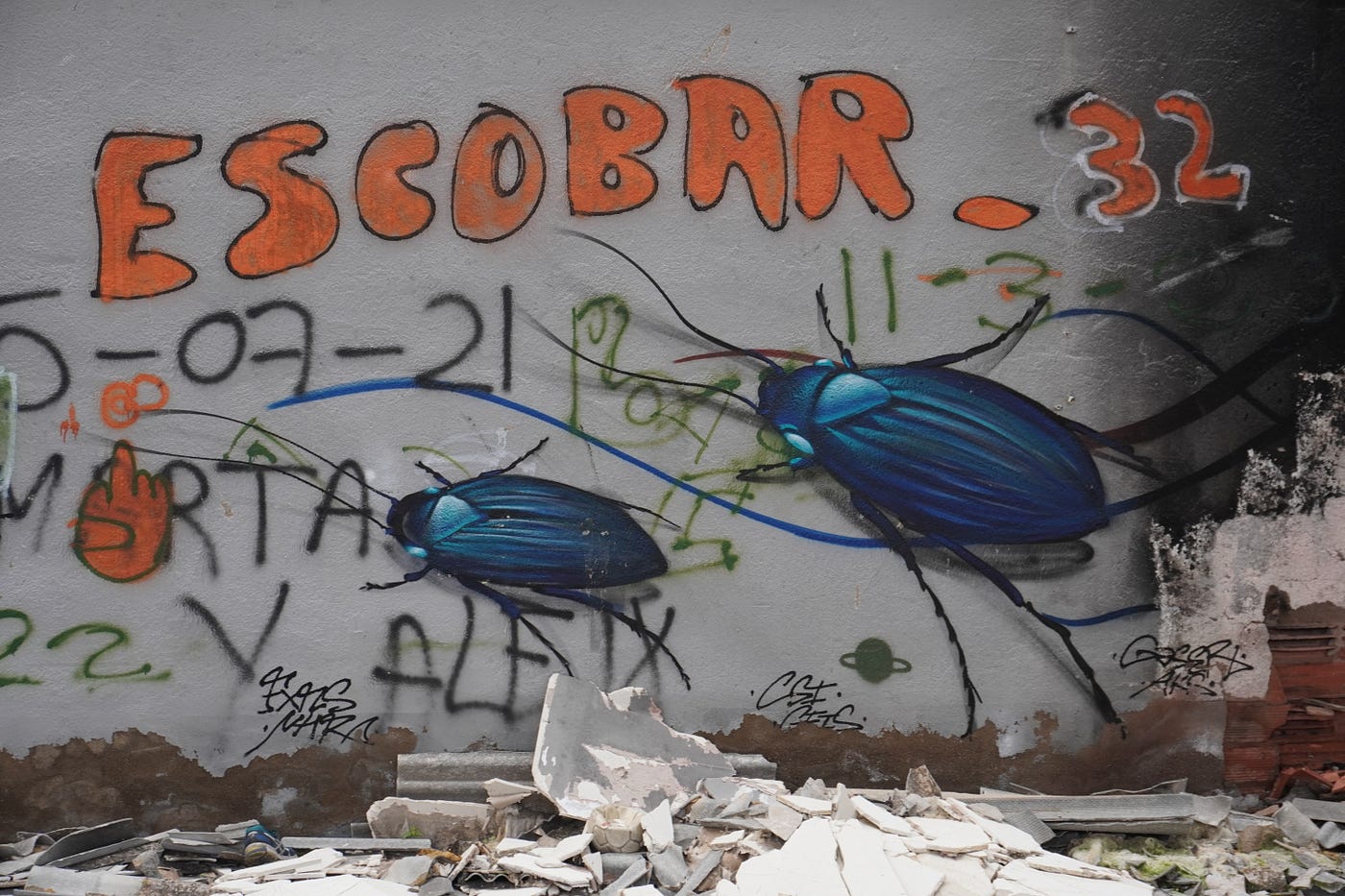
This bando had a lot going on | Image © Paradis Media llc
I’ve been thinking about something that feels like linguistic mischief, and no, not like Eminem’s version.
It’s just why do so many of our coolest-sounding words describe things that are, objectively… not cool?
I’m not talking “mildly inconvenient” not cool. I mean dignity-removing, paperwork-involving disaster territory.
It’s almost suspicious.
And yes — let’s start with suspicious.
The very word sounds like it’s already accusing me of something I definitely didn’t do, yet don’t entirely have the evidence to support my innocence. Think of it like a social worker slowly narrowing their eyes as they walk past you in the office lobby, while mentally filing you under “problem” based on a malicious and erroneous report filed by your vindictive landlord.
But here’s the thing that really gets me… when you start tracing these words back, giving a good carrot-topped tug on them to expose their etymological roots, their origin stories aren’t always designed for so much drama.
Take chaos.
From the Greek khaos, meaning something like “vast emptiness” or “gaping void.” Not clutter or mess. Not “the current state of my kitchen (or life)” but a galactic opening.
So already, chaos isn’t just disorder. It’s primordial. Theatrical. Like the final scene of Fight Club, standing at the edge of something you probably shouldn’t get any closer to.
Then there’s catastrophe.
Arguably one of the most elegant words we have for things going horribly wrong. From Greek katastrophē, meaning “overturning” or “sudden end.” Literally something flipping over, yet more often associated with people flipping out.
It’s quite poetic until you remember that in real life it includes things like economic collapse, political failure, and your partner texting “we need to talk.”
When it comes to cool words, we have the Greeks to thank for so much.
Another strong contender is the word debacle.
From French débâcler, meaning to unfasten or break up ice — like a river suddenly releasing itself after being frozen. Having grown up along the Hudson, I know that this is both a beautiful, and very loud, undertaking.
It’s more apropos than I’d originally understood. But paradoxically, so many debacles end up with people sitting around staring at each other in silence. Many have that “meeting that should have been an email vibe,” but worse.
Fiasco serves up a bit of a twist.
It comes from Italian theatrical slang — possibly from far fiasco, “to make a bottle,” which evolved into meaning a performance that went so badly it became a joke.
I feel like Italians are particularly gifted at saying one thing and meaning something entirely different. One of the idioms I learned on my trip there was “avere le palle che strisciano per terra,” which literally translates to “having your balls dragging on the floor,” but really just means you’re overwhelmed, exhausted, or burnt out.
Fiasco carries a strange festive energy, like failure with confetti. Like lots of things going wrong but at least everyone agrees it was interesting.
These are all words that sound more important than the human experience they describe.
While not quite the same thing, I find that many of our power structures also sound a lot cooler than they are. Let’s take the entire -archy family. From Greek arkhein, meaning “to rule.”
Monarchy — rule by one. Oligarchy — rule by a few. Anarchy — no ruler at all.
Hierarchy sort of bucks the trend, but not really. This one starts with the Greek words hieros, for holy. In a previous era, it referred to the ranked order of angels or church officials, while today… any standard pecking order.
They all kind of sound like a very serious fantasy game expansion pack.
And weirdly, anarchy wins on sound alone. I don’t hear absence of order, so much as stylish refusal of order. Maybe that’s just me thinking that it’s the linguistic equivalent of blowing up the credit card companies in slow-mo. Unfortunately, it has seen catastrophic pop culture over-branding.
Yes, there’s something to this. Some of the most socially unstable concepts are sonically satisfying. My apologies in advance, but this topic almost begs to be a listicle.
Pandemonium — sounds like an epic boss battle, but means wild uproar.
Cataclysm — originally Greek kataklysmos for flood, now describes any violent upheaval or disaster.
Calamity — could pass for an elegant Victorian dame, but means serious disaster.
Pandemic — quite fittingly, it means “all the people.” But, I’m going to go out on a limb and say it’s sort of lost its ring, hasn’t it?
Apocalypse — literally means “unveiling” or “revelation.” Yeah, this one’s really cool, yet now totally synonymous with the end of civilization.
Melancholy — sounds warm and poetic, but it’s Greek for “black bile.” Now means prolonged sadness, and is so mentally fused for me that I can’t even think the word without hearing this song:
[embed]
(Arguably the best $15 I spent in 1995.)
Hysteria — I know, I know. Terrible historical baggage. Still… cool word.
Delirium — means complete mental confusion, but sounds like a perfume. Is it one?… In fact, yes. Flor de Mayo knew what’s up.
Kleptocracy, Plutocracy, Autocracy — rule by thieves, rule by the wealthy, absolute rule. Is it me, or are these becoming almost interchangeable?
Bureaucracy — still somehow majestic despite meaning… forms. An endless stack of forms.
Sabotage — originally linked to wooden shoes. Hmm, yeah those suckers will sabotage any walk. True.
Massacre — a very pretty sounding horrific word.
Oblivion — hands down one of the coolest, while meaning a complete forgetting or total destruction.
Maelstrom — Dutch for gigantic whirlpool. I guess that one’s got a straightforward link to chaos.
Tempest — I mean Shakespeare certainly helped this one, but it’s still way cooler than storm.
My dark horses (a listicle in a listicle): Schism Nemesis Harbinger Leviathan
Paranoia’s another.
From Greek para (beside or beyond) and noos (mind). So literally: “beside the mind.” Not a broken mind, but a mind slightly offset. Reality nudged a few degrees to the left.
And, circling back to suspicious, from Latin suspicio — “to look up at” or “to mistrust” — it’s one that carries a strange duality. A little bit observation; a little bit doubt. You’re watching too closely and probably shouldn’t be.
Perhaps as I’m doing right now with words.
But my suspicions have a working theory — these words survived precisely because they sound better than the reality they describe. Language as aesthetic compensation. If humans are going to endure collapse, confusion, and power struggles, at least the words can sound flashy, so English picked them up and put them in its pocket.
I may have fried my brain thinking on this subject, but I’m certain there are more. If you’ve got one on the tip of your tongue, add it to the mix in the comments.
메타데이터
- post_id
- ab1aedbc1bcb
- slug
- the-english-language-has-a-weird-crush-on-disaster-ab1aedbc1bcb
- url
- https://medium.com/pitfall/the-english-language-has-a-weird-crush-on-disaster-ab1aedbc1bcb
- canonical_url
- https://medium.com/pitfall/the-english-language-has-a-weird-crush-on-disaster-ab1aedbc1bcb
- author_url
- https://medium.com/@abby.paradis
- status
- ok
- fetched_at
- 2026-07-09 08:02:55