AI Slop Isn’t the Crisis — It’s the Cost Shift People Don’t Like
AI Slop Isn’t the Crisis — It’s the Cost Shift People Don’t Like
AI Slop Isn’t the Crisis — It’s the Cost Shift People Don’t Like
AI Slop Isn’t the Crisis — It’s the Cost Shift People Don’t Like
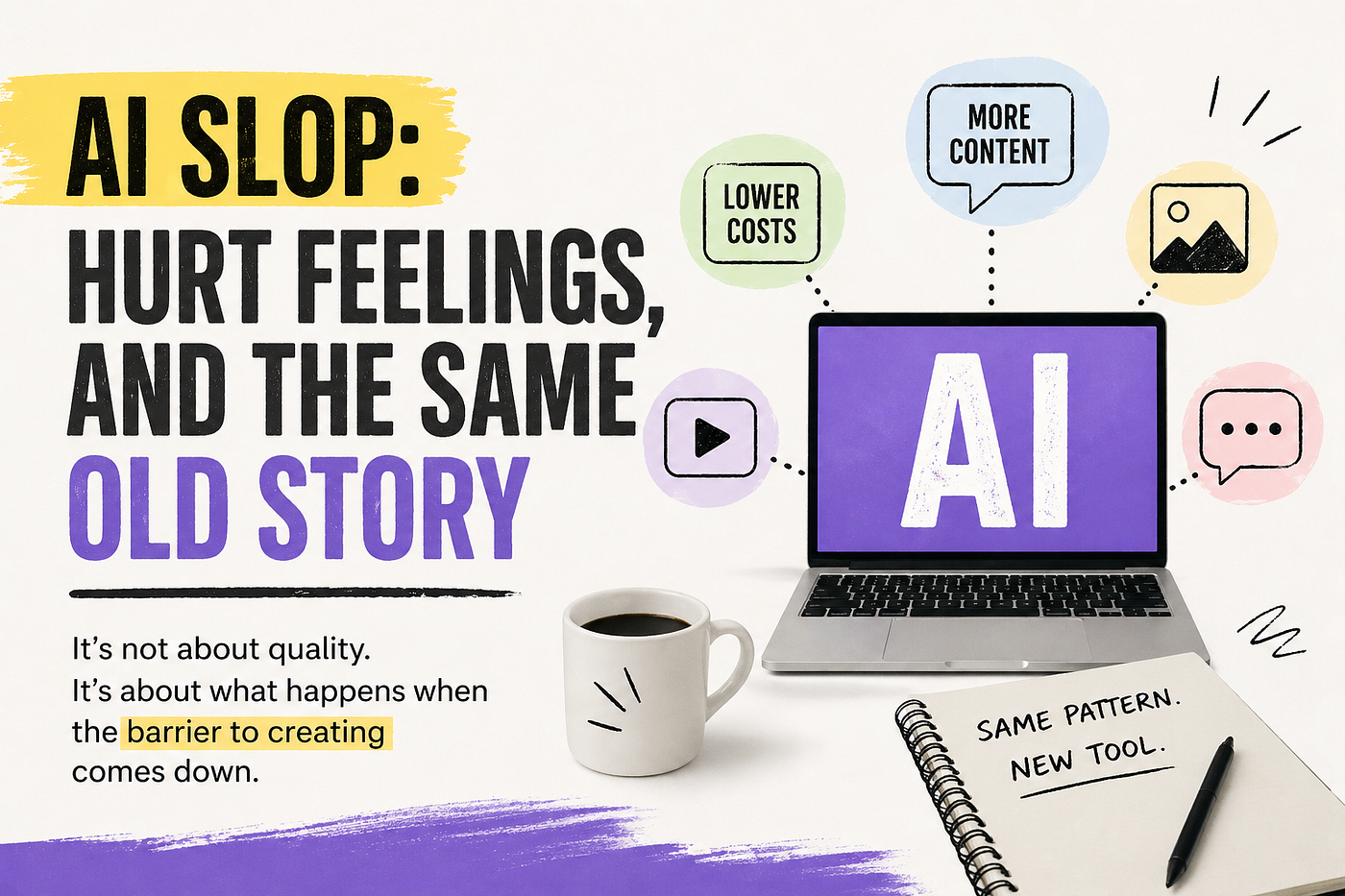
Let’s talk about AI Slop — not the phrase, but what people are actually reacting to when they use it. You’ve heard the complaints: too much content, too fast, too generic, too easy. And sure, some of that holds up. There is more content than ever, and not all of it is great.
But that’s not the real story.
The real shift is cost.
For the first time, a lot of the work that used to require a specialist — writing, design, basic video, even SEO content — can now be done by someone with a prompt and a few minutes. That changes things. Not just how content is made, but who gets to make it.
And that’s where most of the friction is coming from.
We’ve Seen This Before
This isn’t the first time a tool has lowered the barrier and made people uncomfortable.
There was a stretch where building a website meant hiring a developer, waiting weeks, and paying real money for every change. Then tools like Dreamweaver and FrontPage showed up and blew that open. Suddenly, non-developers could build websites themselves.
The reaction was predictable. Developers pushed back. They complained about messy code and poor structure. Some of those complaints were valid. Most of them didn’t matter.
Businesses didn’t care about perfect code. They cared about getting something live. Faster. Cheaper. Easier to update. Once internet speeds improved, most of the performance complaints faded, and the tools stuck around.
What changed wasn’t the need for good developers. What changed was who could participate in building something.
That pattern keeps repeating.
When the Barrier Drops, the Crowd Shows Up
Every time a tool makes something easier, more people jump in.
Blogging platforms did it for writing. YouTube did it for video. Canva did it for design. Each time, the same concerns showed up — quality would drop, the space would get crowded, professionals would be replaced.
Some of that happened. Most of it didn’t.
What actually changed was volume. More people created things. Some of it was rough. Some of it was surprisingly good. Over time, the better work still found its way to the top.
AI is doing the same thing, just faster and at a larger scale.
The Real Tension Isn’t About Quality
When people complain about AI slop, they usually frame it as a quality issue. And yes, there is plenty of low-effort content out there.
But low-effort content has always existed.
The real tension is economic. If your work depended on the fact that not many people could do what you do, then a tool that removes that barrier changes your position overnight. It compresses pricing. It speeds up delivery. It shifts expectations.
That’s a hard adjustment.
And it explains why the loudest objections often come from people who feel that shift directly. That doesn’t make them wrong. But it does explain the intensity.
SEO Writing Was Headed Here Anyway
SEO content is a perfect example.
For years, the expectation was simple: produce more content. More pages, more keywords, more coverage. The rules changed constantly, but the pressure to scale never went away. Businesses hired writers, built teams, and outsourced just to keep up.
Now AI can produce structured, search-friendly content in minutes, and the reaction has flipped.
The same system that demanded volume is now uncomfortable with how that volume gets created.
That’s not really about quality. It’s about losing control over the process.
AI Didn’t Show Up Overnight
AI didn’t suddenly appear out of nowhere. It’s been part of everyday tools for years. It just wasn’t good enough to matter.
Now it is.
That’s the difference. Not existence — capability.
Once a tool crosses that line, adoption speeds up. People stop treating it like a novelty and start using it to get real work done.
That’s exactly where we are now.
What AI Actually Does
AI doesn’t turn someone into a great writer or designer. It doesn’t replace taste, judgment, or experience.
What it does is remove friction.
It lets someone go from idea to output without waiting on someone else. It shortens the gap between “I need this” and “this exists.” For a lot of use cases, that’s enough.
The ceiling for quality hasn’t changed. The floor has moved up.
And for most of the market, the floor is where decisions get made.
You Still Control What You Consume
If you don’t like AI-generated content, you’re not stuck with it.
You can skip it. Ignore it. Set your own standards. Choose what you read, what you publish, and what you trust. That hasn’t changed.
What has changed is how much content is out there and how quickly it can be produced. Filtering matters more now, not less.
Complaining about volume won’t reduce it. Behavior will.
Adaptation Isn’t Optional
When something becomes faster and cheaper, expectations follow. That’s how markets work.
If your work can be replicated — or even approximated — by AI, your role doesn’t disappear, but it does change. Ignoring that shift doesn’t protect you from it.
Every major tool change has followed the same pattern. Some people adapt and find new ways to add value. Others hold the line and hope things go back.
They usually don’t.
What This Really Comes Down To
The argument around AI Slop sounds like it’s about content quality, but that’s only part of it. Underneath that is a bigger shift — who gets to create, who gets paid, and how work gets valued.
That’s why the conversation feels tense. It’s not just about content. It’s about position.
We’ve seen this kind of shift before. The tools change. The reaction doesn’t.
And once again, more people are being let into the room
메타데이터
- post_id
- ab2233f7fd5e
- slug
- ai-slop-isnt-the-crisis-it-s-the-cost-shift-people-don-t-like-ab2233f7fd5e
- url
- https://medium.com/techknows/ai-slop-isnt-the-crisis-it-s-the-cost-shift-people-don-t-like-ab2233f7fd5e
- canonical_url
- https://medium.com/techknows/ai-slop-isnt-the-crisis-it-s-the-cost-shift-people-don-t-like-ab2233f7fd5e
- author_url
- https://medium.com/@OneTooTall
- status
- ok
- fetched_at
- 2026-07-22 13:16:18






