Why I Built an AI “Executive Function” to Outsmart My Own Brain
I have a confession: I spent forty-five minutes this morning deep-diving into the bioavailability of iron in different brands of organic…
Why I Built an AI “Executive Function” to Outsmart My Own Brain
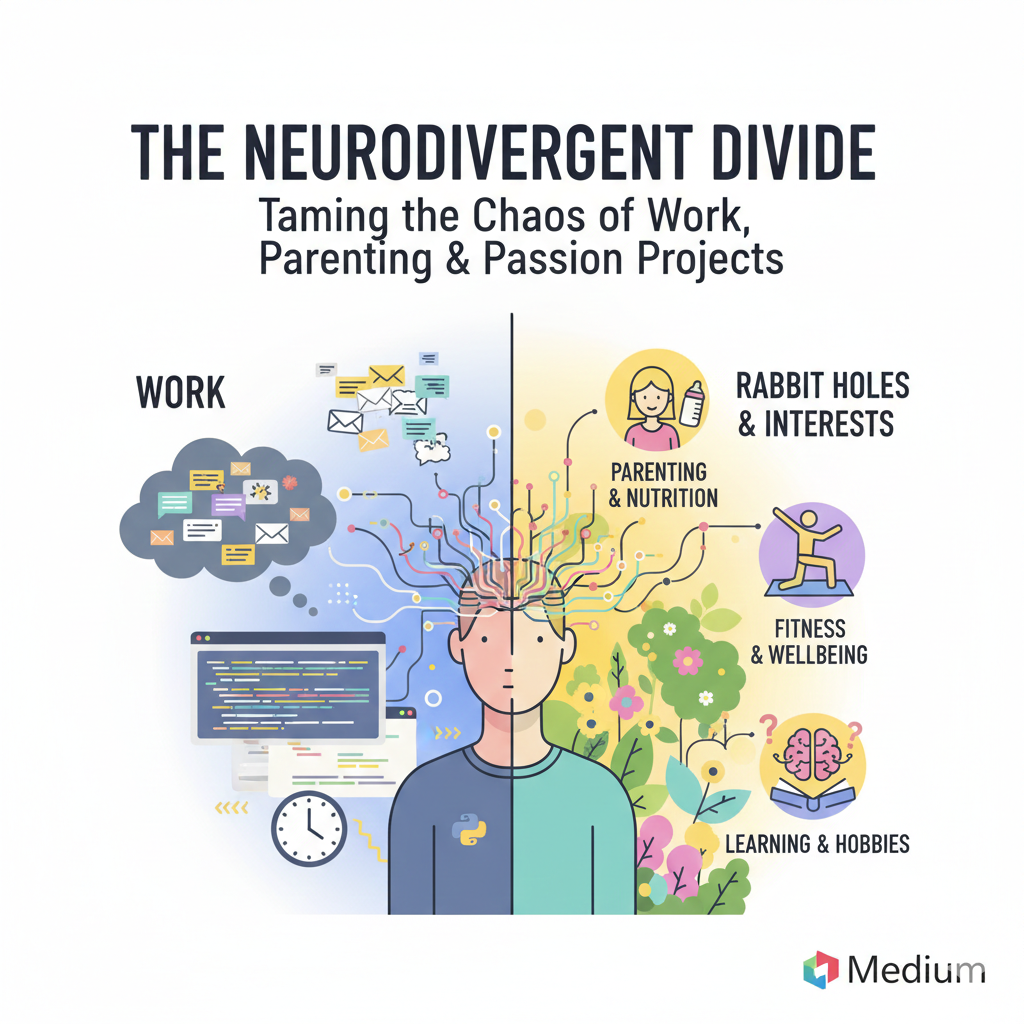
I have a confession: I spent forty-five minutes this morning deep-diving into the bioavailability of iron in different brands of organic baby oatmeal. I was supposed to be refactoring a message-sending function for a software project.
If you’re a parent — or if you’re rocking an ADHD brain — you probably didn’t even blink at that sentence. You just thought, “Only forty-five minutes? Rookie numbers.”
Parenting often feels like a high-stakes form of ADHD. Every decision — the best formula, the safest car seat — feels like an emergency. When you’re in the middle of a workday and a “did I buy the right transition cups?” thought pops up, it doesn’t feel like a distraction. It feels like a survival mission. But three hours later, your code hasn’t moved, and your brain is fried.
I decided to stop fighting my wiring and build a team of AI agents to handle the “management” side of my brain. Here is how they solve the three biggest hurdles of my day.
1. The “Getting Started” Struggle
The Hurdle: When I see a large project, my brain sees a thousand tiny, overwhelming steps. I stall. I “prep.” I organize. I do everything except the work. The AI Fix: I created an agent that ignores the big project and identifies a 2-minute entry point. It doesn’t tell me to “Build the App”; it tells me to “Open the file and write the first comment.” It lowers the bar so much that my brain doesn’t feel the need to run away.
2. The “Rabbit Hole” Trap
The Hurdle: Researching baby food or new software libraries provides a hit of dopamine because it feels productive. But in the middle of a workday, it’s actually “Productive Procrastination.” The AI Fix: One agent acts as a Signal Filter. If I tell it I’m “researching,” it starts a timer. If I stay in that loop for more than 30 minutes, it realizes I’m drifting. It then sends a firm, physical nudge to my phone via WhatsApp to pull me back to the actual task.
3. The “Focus Fog”
The Hurdle: The moment a task gets hard, my brain looks for an exit ramp. I lose track of what I was even trying to achieve. The AI Fix: Whenever I find a “parenting emergency” (like that baby oatmeal search), I tell the agent. Instead of letting me go down the hole, the agent says: “I’ve saved that link in your ‘Inspiration Archive’ for you to look at during your 6 PM break. Now, go back to line 42.” It validates the thought without letting it hijack the hour.
4. The “Brain Fuel” Reward System
The Hurdle: Our brains — especially neurodivergent ones — run on dopamine. Sometimes, “finishing the project” is too far away to feel rewarding now. We need a reason to stay on track when the work gets boring. The AI Fix: I added a simple Reward Point system. Every time I finish one of those 30-minute construction blocks or successfully pull myself out of a rabbit hole, the agent awards me points. These aren’t just digital numbers; they represent real-world treats I’ve pre-approved.

Once I hit a certain score, the agent pings me: “You’ve earned enough points for that fancy almond milk latte,” or “Time for that 15-minute yoga flow you love.” It turns the grind into a game where the prizes actually help me recharge.
A Note to the Mothers and the “Distractable”
To the mothers out there: “Mom Brain” isn’t a myth. It is the result of holding a staggering amount of cognitive load. You are expected to be a high-level project manager at home and a focused professional at work, often at the same time. It is exhausting to be your own secretary, your own boss, and your own taskmaster.
To the ADHD community: We’ve spent our lives being told to “just use a planner.” But we know that our struggle isn’t a lack of will — it’s a lack of Executive Function.
I built this because I realized that if I could outsource the “managing” part of my brain to an AI, I could free up my “creative” brain to actually build things. I’m no longer fighting myself; I’m collaborating with a system designed to support me. We’re replacing the internal guilt with external structure — and a few reward points for an ice cream along the way.
[Image: A simple visual of a ‘Points Meter’ next to a laptop, with icons for a yoga mat, a coffee cup, and an ice cream cone.]
What’s Next?
This is just the beginning. I am working to move this from a “chat window” to a real-world engine.
- The Agents have “Hands”: They actually write to my Google Calendar to block out my time.
- The Agents have a “Voice”: They ping my WhatsApp to break my “screen trance.”
In my upcoming articles, I’m going to share the scripts, and the step-by-step build so you can set up your own support system. We’ll look at how to connect the AI “brain” to the WhatsApp “voice” and the Calendar “hands.” Would love to hera thoughts/interest on the same.
You don’t have to change your brain to be productive. You just have to build a system that understands it.
메타데이터
- post_id
- ab3b8aee2d74
- slug
- why-i-built-an-ai-executive-function-to-outsmart-my-own-brain-ab3b8aee2d74
- url
- https://medium.com/@sakshigupta_54699/why-i-built-an-ai-executive-function-to-outsmart-my-own-brain-ab3b8aee2d74
- canonical_url
- https://medium.com/@sakshigupta_54699/why-i-built-an-ai-executive-function-to-outsmart-my-own-brain-ab3b8aee2d74
- author_url
- https://medium.com/@sakshigupta_54699
- status
- ok
- fetched_at
- 2026-07-09 03:40:04



