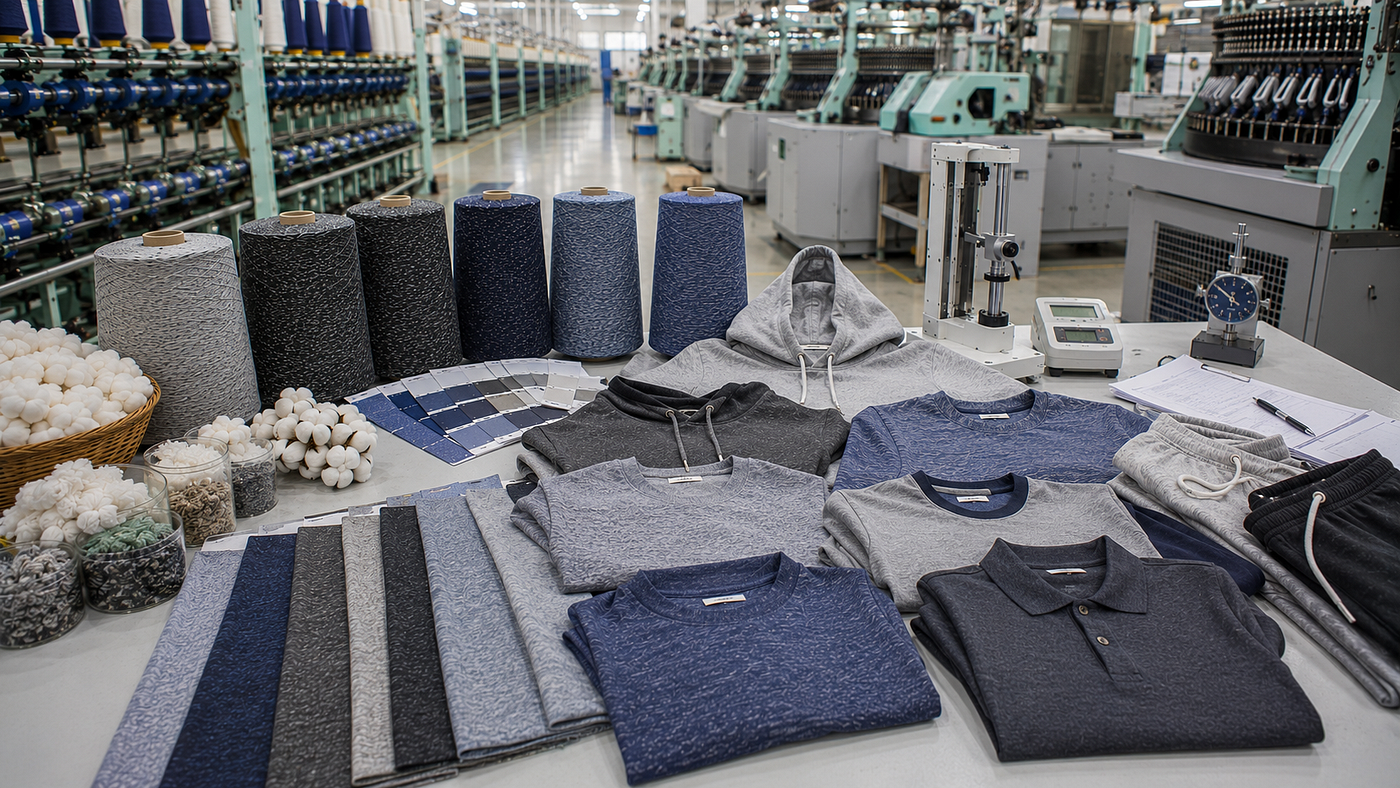
Melange Yarn Manufacturing Process: From Fiber Blending to Finished Yarn
Melange yarn has become one of the most widely used specialty yarns in the textile industry. From heather T-shirts and hoodies to premium…
Melange Yarn Manufacturing Process: From Fiber Blending to Finished Yarn

Melange yarn has become one of the most widely used specialty yarns in the textile industry. From heather T-shirts and hoodies to premium knitwear and athleisure apparel, melange fabrics are everywhere.
What makes these fabrics unique is their distinctive appearance. Unlike solid-colored yarns, melange yarn is created by blending fibers of different colors before spinning. This process produces the subtle heather, marl, or mélange effect that consumers often associate with premium casualwear.
While the finished fabric may look simple, producing high-quality melange yarn requires careful planning, technical expertise, and strict process control.
Let’s take a closer look at how melange yarn is manufactured.
What Is Melange Yarn?
Melange yarn is a yarn made from a blend of differently colored fibers.
Instead of dyeing the yarn after spinning, selected fibers are dyed first and then mixed in specific proportions before entering the spinning process.
For example:
- 90% white cotton + 10% black dyed fiber
- 80% white cotton + 20% grey dyed fiber
- Multiple colored fibers blended together
The final appearance depends on the blend ratio, fiber quality, and spinning consistency.
This pre-spinning blending process is what gives melange yarn its unique visual texture.
Why the Manufacturing Process Matters
Many buyers focus on color and price when sourcing melange yarn.
However, the quality of a melange fabric is largely determined by how the yarn is manufactured.
Poor blending can create:
- Shade inconsistency
- Uneven appearance
- Color streaks
- Fabric barriness
- Knitting problems
A well-controlled manufacturing process helps ensure that every production lot maintains the desired color effect and performance characteristics.
Step 1: Fiber Selection
The manufacturing process begins with selecting the right raw materials.
Cotton remains the most common fiber used for melange yarn, although other fibers may also be incorporated depending on product requirements.
Important considerations include:
- Fiber length
- Fiber strength
- Micronaire
- Cleanliness
- Uniformity
Higher-quality fibers generally contribute to stronger and more consistent yarn.
For premium apparel applications, manufacturers often pay close attention to staple length and contamination levels.
Step 2: Dyeing the Fibers
Unlike conventional yarn production, melange yarn requires colored fibers before spinning begins.
A portion of the fibers is dyed according to the required shade.
The quality of fiber dyeing significantly affects the final yarn appearance.
Manufacturers monitor factors such as:
- Shade accuracy
- Dye penetration
- Color fastness
- Batch consistency
Even small shade variations can become visible in the finished fabric.
For global brands producing repeat orders, maintaining color consistency between batches is especially important.
Step 3: Fiber Blending
Fiber blending is one of the most critical stages of melange yarn manufacturing.
At this stage, dyed and undyed fibers are mixed according to predetermined ratios.
Examples include:
Blend RatioTypical Appearance95/5Very subtle melange effect90/10Light heather appearance80/20More visible melange texture70/30Strong heather effect
The objective is to distribute colored fibers evenly throughout the blend.
Poor blending can result in:
- Shade variation
- Uneven fabric appearance
- Visible streaks
- Customer complaints
This is why experienced melange yarn manufacturers invest heavily in blending technology and process control.
Step 4: Blow Room Processing
After blending, the fibers move through the blow room.
The blow room performs several important functions:
- Opening compressed fiber bales
- Removing contaminants
- Mixing fibers further
- Preparing material for carding
For melange yarn, additional blending during this stage helps improve color distribution throughout the fiber mass.
Proper blow room management plays an important role in achieving a uniform melange effect.
Step 5: Carding
Carding is often called the heart of spinning.
During this process, fibers are:
- Opened
- Straightened
- Individualized
- Cleaned further
The output from carding is a continuous strand known as a sliver.
For melange yarn production, carding also helps improve fiber distribution and blend uniformity.
Any inconsistency introduced here can affect the appearance of the finished fabric.
Step 6: Drawing
Multiple card slivers are combined and drafted during the drawing process.
Drawing helps:
- Improve fiber alignment
- Increase blend uniformity
- Reduce mass variation
- Enhance yarn consistency
Most melange yarn manufacturers use several drawing passages to achieve better mixing and evenness.
This stage is particularly important because it contributes directly to shade consistency in the final yarn.
Step 7: Roving
The drawn sliver then moves to the roving frame.
Here, the material is:
- Attenuated further
- Given a small amount of twist
- Wound onto bobbins
Roving serves as the intermediate stage between drawing and final spinning.
Proper roving quality helps ensure stable spinning performance and consistent yarn properties.
Step 8: Ring Spinning
Ring spinning remains one of the most widely used methods for producing melange yarn.
At this stage, the roving is drafted and twisted into finished yarn.
The spinning process influences important yarn characteristics such as:
- Strength
- Evenness
- Hairiness
- Appearance
- Knitting performance
Because melange yarn contains fibers of different colors, maintaining consistent drafting and tension becomes particularly important.
Poor control during spinning can affect the final visual effect.
Step 9: Yarn Clearing and Winding
After spinning, the yarn moves to the winding section.
Modern winding machines often use electronic yarn clearers to detect and remove defects.
Common defects include:
- Thick places
- Thin places
- Neps
- Foreign contamination
The yarn is then wound onto cones suitable for knitting or weaving operations.
Quality winding helps improve downstream production efficiency.
Step 10: Quality Testing and Inspection
Before shipment, melange yarn typically undergoes various quality checks.
Testing may include:
Yarn Count
Verifies whether the yarn meets the required specification.
Strength Testing
Measures tensile properties and performance.
Evenness Testing
Evaluates yarn uniformity.
Hairiness Measurement
Assesses surface fiber characteristics.
Shade Evaluation
Checks color consistency throughout production lots.
Contamination Inspection
Ensures unwanted foreign matter is minimized.
Many international buyers also request laboratory reports before approving bulk production.
Understanding USTER Testing
Many spinning mills use USTER testing systems to evaluate yarn quality.
USTER reports may provide information on:
- Unevenness (U%)
- CV%
- Thin places
- Thick places
- Neps
- Hairiness
These measurements help buyers compare yarn quality against industry benchmarks.
For melange yarn, good evenness and consistency contribute to a more uniform fabric appearance.
Common Challenges in Melange Yarn Manufacturing
Producing melange yarn is more complex than manufacturing standard solid-colored yarn.
Some common challenges include:
Shade Variation
Inconsistent blending can create visible color differences.
Fiber Segregation
Different fibers may separate during processing if not properly controlled.
Contamination
Foreign fibers can affect fabric quality and appearance.
Repeatability
Maintaining the same melange effect across multiple production runs can be challenging.
Production Efficiency
Additional blending and color-control requirements increase manufacturing complexity.
Experienced spinning mills develop specialized procedures to address these challenges.
Why Consistency Is Critical
For apparel brands, consistency often matters more than achieving the lowest possible price.
A successful T-shirt, hoodie, or sweatshirt program may require the same fabric to be reproduced months later.
If the melange effect changes noticeably, the finished garments may no longer match previous production.
This is why buyers often evaluate suppliers based on:
- Process control
- Laboratory capabilities
- Production experience
- Shade consistency
- Quality systems
Reliable repeatability is one of the most valuable characteristics in melange yarn production.
Bangladesh’s Growing Expertise in Melange Yarn
Bangladesh has developed significant expertise in knitwear manufacturing, and that growth has increased demand for value-added yarns.
Today, many spinning mills are investing in:
- Advanced blending systems
- Modern spinning technology
- Laboratory testing facilities
- Product development capabilities
This allows manufacturers to produce melange yarns that meet the requirements of international apparel brands.
Karotoa Green and Melange Yarn Manufacturing
As demand for specialized yarn continues to grow, manufacturers such as **Karotoa Green** are focusing on cotton and melange yarn production for knitwear and apparel applications.
Producing quality melange yarn requires more than machinery alone. It depends on fiber selection, blend accuracy, process control, laboratory testing, and consistent production practices.
For buyers sourcing melange yarn, these factors often determine whether the final fabric delivers the appearance and performance expected by modern apparel brands.
Final Thoughts
The melange yarn manufacturing process involves much more than simply mixing different colors together.
From fiber selection and dyeing to blending, spinning, winding, and quality testing, every stage influences the final appearance of the yarn and fabric.
When done correctly, the result is a yarn that offers the visual depth, versatility, and premium aesthetic that today’s apparel market increasingly demands.
As fashion continues to favor heather fabrics, premium basics, athleisure, and casual knitwear, melange yarn will remain an important material — and the quality of its manufacturing process will continue to be a key differentiator for spinning mills worldwide.
메타데이터
- post_id
- ab59924ead25
- slug
- melange-yarn-manufacturing-process-from-fiber-blending-to-finished-yarn-ab59924ead25
- url
- https://medium.com/@karotoagreenspinningmillsltd/melange-yarn-manufacturing-process-from-fiber-blending-to-finished-yarn-ab59924ead25
- canonical_url
- https://medium.com/@karotoagreenspinningmillsltd/melange-yarn-manufacturing-process-from-fiber-blending-to-finished-yarn-ab59924ead25
- author_url
- https://medium.com/@karotoagreenspinningmillsltd
- status
- ok
- fetched_at
- 2026-08-26 13:23:22