Reimagining Strategizing
Last week the Strategic Management Society (SMS) held their 45th annual global conference in San Francisco. I was honored to be invited to…
Reimagining Strategizing
Last week the Strategic Management Society (SMS) held their 45th annual global conference in San Francisco. I was honored to be invited to participate in a panel discussion titled “Reimagining Strategizing.”

Photo by Alf Steinar Sætre
The SMS is the leading global member organization that fosters and supports rigorous and practice-engaged strategic management research. The society is focused on accelerating thought leadership in the field of strategic management, nurturing and disseminating cutting-edge research, advancing the practice of strategic management, addressing economic challenges, and positively impacting society around the world.
My panel was led by Dr. Laura Poppo and Dr. Dylan Boynton and featured presentations by Dr. Teppo Felin, Dr. Anne Parmigiani, and Dr. Libby Weber. Dr. Kristen Hege and I represented the “practitioner” perspectives — how businesses actually do strategy. After each presentation, the moderators asked Kristen and I questions related to the topic and opened it up to the audience to ask their questions. There was really good engagement and I enjoyed sharing my perspectives from developing and implementing strategy at different companies throughout my career.
Teppo’s presentation introduced his Theory Based View (TBV) of strategy. From his research he has found that effective strategies start from a contrarian theory of the world. He often uses AirBnB as an example — if you had asked anyone, prior to the launch of the platform, whether there was a market either for people willing to share their spare rooms or couches with others, or for people willing to rent those sleeping accommodations, you would’ve gotten a resounding “No!” And yet in 2024 (the most recent available data) the company did over $11 billion in revenue. The company held a theory that was counter to prevailing wisdom and that was the basis for their winning strategy.
Anne’s research has focused on the RV industry. Since the industry is concentrated in a small number of players, it is relatively easy to deeply study each company, their identity, their level of innovation and risk-taking, and their decision making approach. Although the industry is tightly coupled (even geographically), there are interesting distinctions between them that play out in very different approaches to strategy.
Libby’s talk focused on goal framing and collective action. One key question is whether goals are set top-down, or are they set within context. She talked about decision making within two different frame-sets: prevention or promotion. She also distinguished between three types of motivational goals:
- Hedonic goals (focused on feelings — this makes me feel good)
- Gain goals (focused on resources — e.g. this provides income)
- Normative goals (focused on the collective — this helps me fit in)
The audience seemed to greatly appreciate the real-world perspectives that Kristen and I provided.
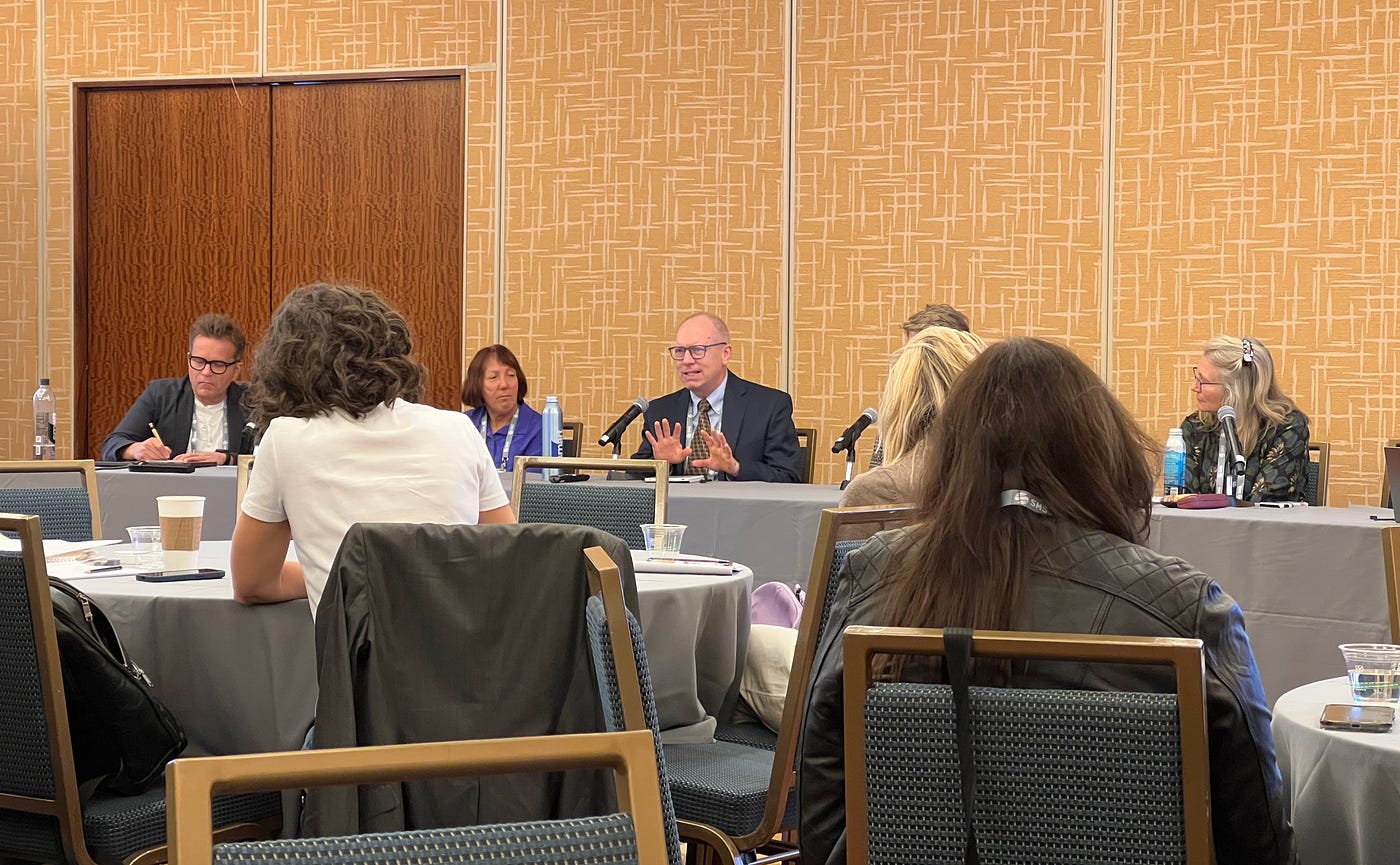
Photo by Alf Steinar Sætre
One of the benefits that I get from interacting with the academic community is connecting what I have experienced and learned with the theories behind it. It’s always rewarding to make good strategic decisions based on experience and knowledge, but sometimes it’s nice to have that “aha” moment of “oh, that’s why it works that way.”
Some of the concepts that I encountered at the conference that I hope to learn more about include Teppo’s TBV, Dynamic Capabilities, and Shaping vs. Adapting.
However, one of the challenges of academic research is that it is often backwards-looking. Researchers develop theories and approaches that can be used to develop strategies in the future based on what has worked in the past. One of my questions at the end of our panel was whether the strategic management logic of the past still holds in the face of absolute uncertainty. If we can no longer predict the future, does the traditional approach of Forecast → Plan → Execute still make sense? Too often, the forecasts are wrong and the plans are already obsolete before execution can even begin.
For next week’s article I’ll focus on what I think is the answer to that question. Stay tuned!
메타데이터
- post_id
- ab613703d1ea
- slug
- reimagining-strategizing-ab613703d1ea
- url
- https://clearpurpose.media/reimagining-strategizing-ab613703d1ea
- canonical_url
- https://clearpurpose.media/reimagining-strategizing-ab613703d1ea
- author_url
- https://medium.com/@russ_13760
- status
- ok
- fetched_at
- 2026-06-09 14:34:10