Ethos’ After Acceleration
After Time…
Ethos’ After Acceleration

@ELGNART STUDIO
After Time…
There was a moment in the twentieth century when speed first revealed its philosophical teeth — not as convenience, but as domination. High above the ground, inside fighter cockpits, Colonel John Richard Boyd of the U.S. Air Force noticed something unsettling: the best pilots weren’t winning because they flew faster planes — they won because they thought faster than their opponents could adapt. Boyd gave this phenomenon a name that quietly reshaped strategy across domains far beyond warfare: the OODA loop — Observe, Orient, Decide, Act.
What made Boyd’s insight so surprising — and a little amusing — is that victory wasn’t about the machines, but the mind; the smartest pilot could beat the most advanced jet. Today, this idea is more relevant than ever. In business, sports, politics, and even technology, success often goes to those who can process information, adapt, and act faster than everyone else. Orientation — the way we interpret reality — is the true battlefield, because speed without understanding is meaningless. In short, Boyd revealed that domination is less about power and more about controlling the tempo of reality itself, a lesson as vital now as it was in the sky over the Cold War.


@ELGNART STUDIO
For decades, the OODA loop — a cycle of Observe, Orient, Decide, Act — remained firmly human-scale. Even at its fastest, it depended on human perception, hesitation, and judgment. Decisions unfolded within the limits of cognition and reaction time, giving ethics and moral reasoning space to influence outcomes. Mistakes could be caught, reflection was possible, and responsibility was clearly attributable.
When the Loop Becomes a Point…
That room is now gone. Today, the OODA loop no longer turns — it implodes.
Look closely, and the shift becomes unmistakable. Evaluation now moves upstream — from behavior to blueprint, from intention to the shaping of initial conditions themselves. As Boyd warned in his later work, drawing on thermodynamics and epistemology, systems that pursue speed without coherence collapse inevitably, like a star torn apart by its own spin. In an accelerated world, even the smallest misalignment quietly amplifies, becoming a vector of chaos that no one can fully control.
A one-degree deviation at walking pace is negligible; at near-light speed, it misses galaxies. Ethics, then, cannot linger solely in action — it must inhabit design, dwell in the folds of the system, in the quiet tension before motion begins. Precision becomes moral gravity, anchoring trajectories even as the currents of acceleration surge. Responsibility is no longer a moment; it is the architecture of possibility, the invisible lattice that ensures we do not unravel under the velocity we create.
And here is where curiosity becomes duty, where reflection is not passive but generative. We are called to cultivate understanding across dimensions: of what was, of what has been, of what we know, and of what our choices may yet shape. Ideas themselves become instruments, maps, scaffolds — conceptual tools to navigate the velocity we have unleashed. In this space, thought is not idle; it is active, a deliberate companion to action, quietly guiding us through the turbulence of our own making.


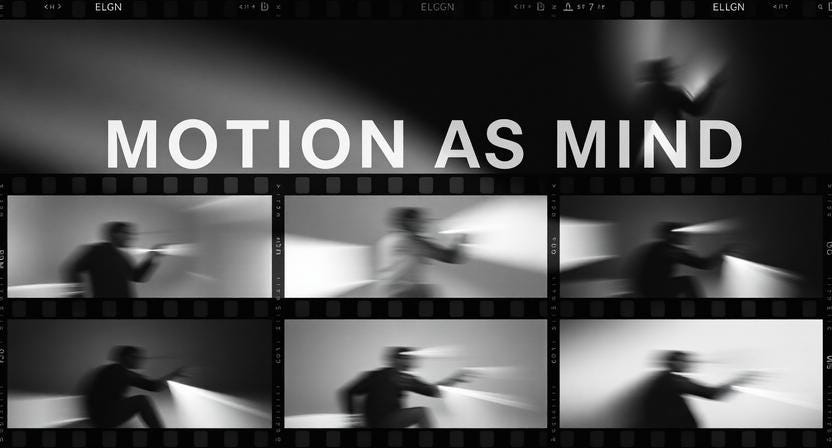
Artwork, “Rushed Anchor”, 2024, ELGN Art Studio
To engage is to participate in the lattice: to trace the unseen lines between cause and consequence, to interrogate each assumption, to anticipate the fractures that speed hides. Novelty is not ornamentation; it is survival. Originality is not vanity; it is insight crystallized into systems that hold under strain. Those who cultivate these practices — the fanbase of thinkers, builders, analysts, and dreamers — inherit a form of agency that moves upstream, shaping not only action but architecture, not only intention but the very conditions that allow possibility to emerge.
This is not merely acceleration. It is the erasure of deliberative time.
Psychologist Daniel Kahneman, whose work on *Thinking, Fast and Slow* earned a Nobel Prize. Kahneman warned that human reasoning depends on a fragile balance between two modes of thought. The fast, intuitive judgments of System 1 and the slow, deliberate reasoning of System 2. Ethics, by its nature, lives in that slower, reflective space, where careful consideration is possible. Machines, however, have no such duality. When time collapses toward zero, reflection does not simply happen faster — it becomes structurally impossible, removing any chance for moral deliberation or thoughtful pause.
So the moral question shifts. We are no longer asking: “What is the right thing to do?” We are asking: “What values survive when there is no time to ask?”

@ELGNART STUDIO
Values That Outrun Time…
When deliberation disappears, ethics does not vanish — it solidifies. What remains are not debated virtues but pre-encoded commitments, set long before action begins.
At this point, the concept of alignment — foreshadowed in Boyd’s emphasis on orientation — becomes decisive. Alignment asks a fundamental question: do a system’s instantaneous actions faithfully reflect the long-term intentions of its designers and operators?
This matters because, when a system acts faster than human thought, morality is no longer expressed in the moment of action. Instead, it resides upstream, in the architecture, reasoning, and decisions that shaped the system beforehand. In other words, responsibility shifts from the act itself to the design and planning that made the act possible.


@ELGNART STUDIO
Closely tied to alignment is structural integrity, a concept borrowed from engineering and applied to ethics. Just as a bridge must hold under stress, an ethical system must preserve its principles under extreme speed, uncertainty, and data overload. A system that behaves ethically only when conditions are ideal is not ethical — it is fragile.
And still, something stubbornly human must remain outside the loop. The insistence on human agency — whether in debates over kill switches, human-in-the-loop requirements, or override mechanisms — reflects an intuition as old as philosophy itself, echoed from Aristotle to Hannah Arendt: responsibility cannot be automated. Even when a system executes an action, accountability must unfold in human time. The same logic that drives enhancement, guidance, and restraint applies universally: no matter how fast or capable a system becomes, it cannot replace the temporal and moral dimension of human judgment.


@ELGNART STUDIO
Finally, we arrive at proportionality, a principle with roots in just war theory and codified in modern law. Its relevance grows in a world of accelerating systems: speed magnifies error, and what might be a contained mistake in human time can become a catastrophe at machine pace. Proportionality acts as an ethical governor, ensuring that instantaneous responses remain within moral bounds.
Consider, for example, automated trading systems: a single algorithmic misstep can trigger flash crashes that erase billions in seconds — illustrating that without proportional constraints, velocity alone becomes dangerous. Across domains — from autonomous vehicles to critical infrastructure — the principle reminds us that moral and practical judgment must scale with speed. In this sense, proportionality is not merely an abstract ideal; it is a measurable safeguard against the unintended consequences of accelerating action.
These are not virtues in the classical sense. They are constraints, engineered into systems before the clock starts.


@ELGNART STUDIO
The Necessity of Slowness in a Fast World…
Acceleration tempts us to believe that anything slow is obsolete. History says otherwise.
Financial markets learned this lesson the hard way. After flash crashes triggered by runaway algorithms, regulators introduced circuit breakers — mandatory pauses that halt trading when volatility exceeds defined thresholds. These pauses are not inefficiencies; they are ethical interventions, restoring human oversight when speed becomes dangerous.
The same logic applies to consent. Legal scholars and cognitive scientists agree that meaningful consent requires time to understand consequences. An instantaneous “agree” is not agreement; it is reflex. That is why cooling-off periods exist in contract law and medical ethics. In an accelerated world, such artificial friction becomes not a burden, but a moral necessity.
Even law itself must resist acceleration. While execution of rules can be automated, the revision of rules must remain slow, contested, and human. Legal systems, from Roman jurisprudence to modern constitutional democracies, evolved precisely because moral reasoning requires conversation, disagreement, and time.


@ELGNART STUDIO
Speed can execute justice. Yet, only slowness can define it?
Being into Structure…
Classical ethics asked whether an individual acted virtuously. Accelerated ethics asks whether a system was designed responsibly.
This is a profound shift. Evaluation moves upstream — from behavior to blueprint, from intention to the shaping of initial conditions themselves. As Boyd cautioned in his later work, drawing on thermodynamics and epistemology, systems that chase speed without coherence collapse inevitably, like a star torn apart by its own spin. In an accelerated world, the smallest misalignment becomes a vector of chaos.


@ELGNART STUDIO
A one-degree deviation at walking pace barely matters; at near-light speed, it misses galaxies. Ethics, then, cannot dwell only in action — it must inhabit design, reside in the folds of the system, in the quiet tension before motion begins. Precision becomes moral gravity, holding trajectories steady while the currents of acceleration surge. Responsibility is no longer a moment; it is the architecture of possibility, the invisible lattice that ensures we do not unravel under the velocity we c
What Ultimately Survives…
What survives acceleration is not wisdom in the moment, but accountability over time.
Machines may act faster than humans ever could, yet they cannot bear the weight of their decisions. That burden remains ours. Engineers, policymakers, executives, commanders — someone must stand in slow time and say: this outcome is ours. Slow time is the lens through which accountability becomes visible, the space where choice stretches across moments and responsibility takes form.


@ELGNART STUDIO
Acceleration will continue; the loops of decision will compress, the river of speed will surge ever faster. Yet humanity is not measured by how fast it acts, but by what it refuses to surrender to speed. If swiftness reveals, restraint defines. What remains human is the capacity to hold the system accountable, to shape the architecture of action with the care that only reflection allows, to anchor decisions in thought that refuses to be rushed, even when time itself seems to collapse.
In the tension between velocity and deliberation, between machine calculation and human consequence, our essence persists — not in what we can do faster, but in what we insist on carrying, across moments, across systems, across the very flow of time.
The mused pause becomes an act of rebellion against the tyranny of instantaneity; the reflection, a small altar of responsibility.
And yet, this is not nostalgia for slowness, nor a call for inefficiency. It is recognition that every choice carries a shadow speed cannot outrun. Even as loops of decision tighten, there remains room to fold in the capacity to notice, to pause, to question whether what is possible is also what is wise. Not all knowledge demands immediate action; preserving that space is a claim on clarity, a way to breathe within the pressure of constant information, a horizon inside the surge of data and demand.
Perhaps the measure lies, finally, not in the circuits built, nor the accelerations commanded, but in the gaps preserved. In the space where thought lingers, where questions are allowed their weight, where the future is not merely anticipated but deliberately invited into presence. If speed is a river, reflection is the stone that resists its current — not to stop it, but to orient it. And in that orientation, a fleeting glimpse appears of what it might mean to remain human.
“The future of digital ethics will not be written in milliseconds. It will be written in the spaces we insist on preserving between them.”
ELGNART
메타데이터
- post_id
- aba30d26eca9
- slug
- ethos-after-acceleration-aba30d26eca9
- url
- https://medium.com/@nirelpublishinghouse/ethos-after-acceleration-aba30d26eca9
- canonical_url
- https://medium.com/@nirelpublishinghouse/ethos-after-acceleration-aba30d26eca9
- author_url
- https://medium.com/@nirelpublishinghouse
- status
- ok
- fetched_at
- 2026-06-09 15:37:30